 Add to Chrome
 Add to Firefox
 Add to Edge
JuZhou 1.0 Technical Report: The First Edge-Native Text-to-Image Foundation Model Trained Entirely on China-Developed AI Accelerators
Jun 25, 2026
Text-to-image (T2I) diffusion models typically require substantial computational resources and cloud infrastructure, posing significant challenges for edge deployment in terms of latency, cost, and user privacy. We present JuZhou 1.0, an ultra-lightweight T2I foundation model designed for fully offline, on-device execution. JuZhou 1.0 achieves its efficiency through four key designs: (1) a compact image-generation backbone consisting of a 0.385B-parameter denoising U-Net and a 1.90M-parameter distilled decoder, totaling approximately 0.387B parameters; (2) Rectified Flow training combined with DMD2 distillation, reducing inference to 4 sampling steps; (3) Chinese semantic alignment trained on 9M curated image-text pairs, enabling direct Chinese prompting without external translation at inference time; and (4) a training and distillation pipeline completed on domestically developed Sugon K100 AI accelerators without relying on NVIDIA GPUs for training or distillation. Despite its compact scale, the 28-step base model of JuZhou 1.0 achieves an overall GenEval score of 0.69, outperforming published baselines including SDXL (2.6B, 0.55), SD3-Medium (2B, 0.62), and IF-XL (4.3B, 0.61). We further validate the full poetry-to-image pipeline on Android and the core CLIP-U-Net-VAE generation branch on iOS. On a smartphone powered by the Snapdragon 8 Elite Gen 5 Mobile Platform, the 4-step U-Net denoising branch runs in approximately 1.6 seconds, while the full Android poetry-to-image pipeline takes 4.5 seconds with on-device prompt refinement on Xiaomi 17 Pro Max. These results position JuZhou 1.0 as a practical approach to mobile text-to-image generation and provide a concrete reference for Chinese-native generation, domestic-compute training, and fully offline on-device deployment after one-time installation.

LightHarmony3D: Harmonizing Illumination and Shadows for Object Insertion in 3D Gaussian Splatting
Mar 31, 20263D Gaussian Splatting (3DGS) enables high-fidelity reconstruction of scene geometry and appearance. Building on this capability, inserting external mesh objects into reconstructed 3DGS scenes enables interactive editing and content augmentation for immersive applications such as AR/VR, virtual staging, and digital content creation. However, achieving physically consistent lighting and shadows for mesh insertion remains challenging, as it requires accurate scene illumination estimation and multi-view consistent rendering. To address this challenge, we present LightHarmony3D, a novel framework for illumination-consistent mesh insertion in 3DGS scenes. Central to our approach is our proposed generative module that predicts a full 360° HDR environment map at the insertion location via a single forward pass. By leveraging generative priors instead of iterative optimization, our method efficiently captures dominant scene illumination and enables physically grounded shading and shadows for inserted meshes while maintaining multi-view coherence. Furthermore, we introduce the first dedicated benchmark for mesh insertion in 3DGS, providing a standardized evaluation framework for assessing lighting consistency and photorealism. Extensive experiments across multiple real-world reconstruction datasets demonstrate that LightHarmony3D achieves state-of-the-art realism and multi-view consistency.
Mobile-VTON: High-Fidelity On-Device Virtual Try-On
Mar 03, 2026Virtual try-on (VTON) has recently achieved impressive visual fidelity, but most existing systems require uploading personal photos to cloud-based GPUs, raising privacy concerns and limiting on-device deployment. To address this, we present Mobile-VTON, a high-quality, privacy-preserving framework that enables fully offline virtual try-on on commodity mobile devices using only a single user image and a garment image. Mobile-VTON introduces a modular TeacherNet-GarmentNet-TryonNet (TGT) architecture that integrates knowledge distillation, garment-conditioned generation, and garment alignment into a unified pipeline optimized for on-device efficiency. Within this framework, we propose a Feature-Guided Adversarial (FGA) Distillation strategy that combines teacher supervision with adversarial learning to better match real-world image distributions. GarmentNet is trained with a trajectory-consistency loss to preserve garment semantics across diffusion steps, while TryonNet uses latent concatenation and lightweight cross-modal conditioning to enable robust garment-to-person alignment without large-scale pretraining. By combining these components, Mobile-VTON achieves high-fidelity generation with low computational overhead. Experiments on VITON-HD and DressCode at 1024 x 768 show that it matches or outperforms strong server-based baselines while running entirely offline. These results demonstrate that high-quality VTON is not only feasible but also practical on-device, offering a secure solution for real-world applications.
* The project page is available at: https://zhenchenwan.github.io/Mobile-VTON/
MF-VITON: High-Fidelity Mask-Free Virtual Try-On with Minimal Input
Mar 11, 2025Recent advancements in Virtual Try-On (VITON) have significantly improved image realism and garment detail preservation, driven by powerful text-to-image (T2I) diffusion models. However, existing methods often rely on user-provided masks, introducing complexity and performance degradation due to imperfect inputs, as shown in Fig.1(a). To address this, we propose a Mask-Free VITON (MF-VITON) framework that achieves realistic VITON using only a single person image and a target garment, eliminating the requirement for auxiliary masks. Our approach introduces a novel two-stage pipeline: (1) We leverage existing Mask-based VITON models to synthesize a high-quality dataset. This dataset contains diverse, realistic pairs of person images and corresponding garments, augmented with varied backgrounds to mimic real-world scenarios. (2) The pre-trained Mask-based model is fine-tuned on the generated dataset, enabling garment transfer without mask dependencies. This stage simplifies the input requirements while preserving garment texture and shape fidelity. Our framework achieves state-of-the-art (SOTA) performance regarding garment transfer accuracy and visual realism. Notably, the proposed Mask-Free model significantly outperforms existing Mask-based approaches, setting a new benchmark and demonstrating a substantial lead over previous approaches. For more details, visit our project page: https://zhenchenwan.github.io/MF-VITON/.
TED-VITON: Transformer-Empowered Diffusion Models for Virtual Try-On
Nov 26, 2024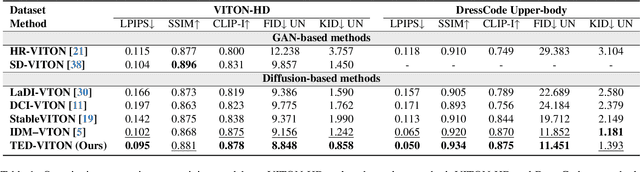
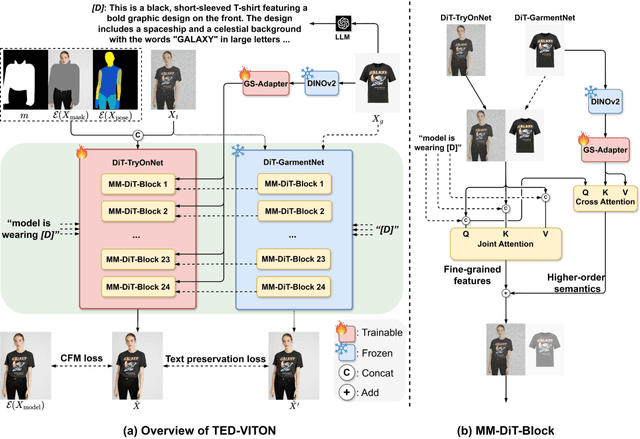
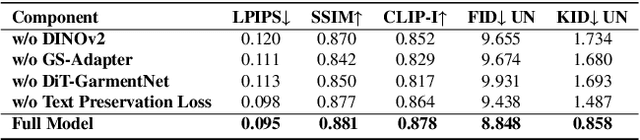
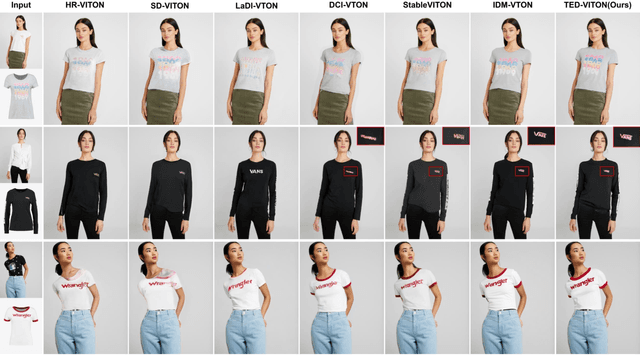
Recent advancements in Virtual Try-On (VTO) have demonstrated exceptional efficacy in generating realistic images and preserving garment details, largely attributed to the robust generative capabilities of text-to-image (T2I) diffusion backbones. However, the T2I models that underpin these methods have become outdated, thereby limiting the potential for further improvement in VTO. Additionally, current methods face notable challenges in accurately rendering text on garments without distortion and preserving fine-grained details, such as textures and material fidelity. The emergence of Diffusion Transformer (DiT) based T2I models has showcased impressive performance and offers a promising opportunity for advancing VTO. Directly applying existing VTO techniques to transformer-based T2I models is ineffective due to substantial architectural differences, which hinder their ability to fully leverage the models' advanced capabilities for improved text generation. To address these challenges and unlock the full potential of DiT-based T2I models for VTO, we propose TED-VITON, a novel framework that integrates a Garment Semantic (GS) Adapter for enhancing garment-specific features, a Text Preservation Loss to ensure accurate and distortion-free text rendering, and a constraint mechanism to generate prompts by optimizing Large Language Model (LLM). These innovations enable state-of-the-art (SOTA) performance in visual quality and text fidelity, establishing a new benchmark for VTO task.