 Add to Chrome
 Add to Firefox
 Add to Edge
Semi-supervised Latent Disentangled Diffusion Model for Textile Pattern Generation
Mar 17, 2026
Textile pattern generation (TPG) aims to synthesize fine-grained textile pattern images based on given clothing images. Although previous studies have not explicitly investigated TPG, existing image-to-image models appear to be natural candidates for this task. However, when applied directly, these methods often produce unfaithful results, failing to preserve fine-grained details due to feature confusion between complex textile patterns and the inherent non-rigid texture distortions in clothing images. In this paper, we propose a novel method, SLDDM-TPG, for faithful and high-fidelity TPG. Our method consists of two stages: (1) a latent disentangled network (LDN) that resolves feature confusion in clothing representations and constructs a multi-dimensional, independent clothing feature space; and (2) a semi-supervised latent diffusion model (S-LDM), which receives guidance signals from LDN and generates faithful results through semi-supervised diffusion training, combined with our designed fine-grained alignment strategy. Extensive evaluations show that SLDDM-TPG reduces FID by 4.1 and improves SSIM by up to 0.116 on our CTP-HD dataset, and also demonstrate good generalization on the VITON-HD dataset.

Diffusion Model Quantization: A Review
May 08, 2025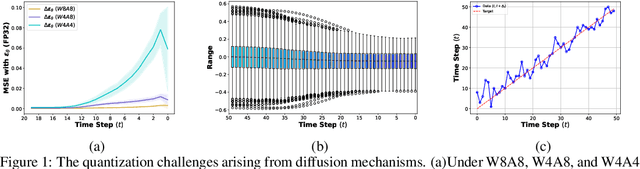
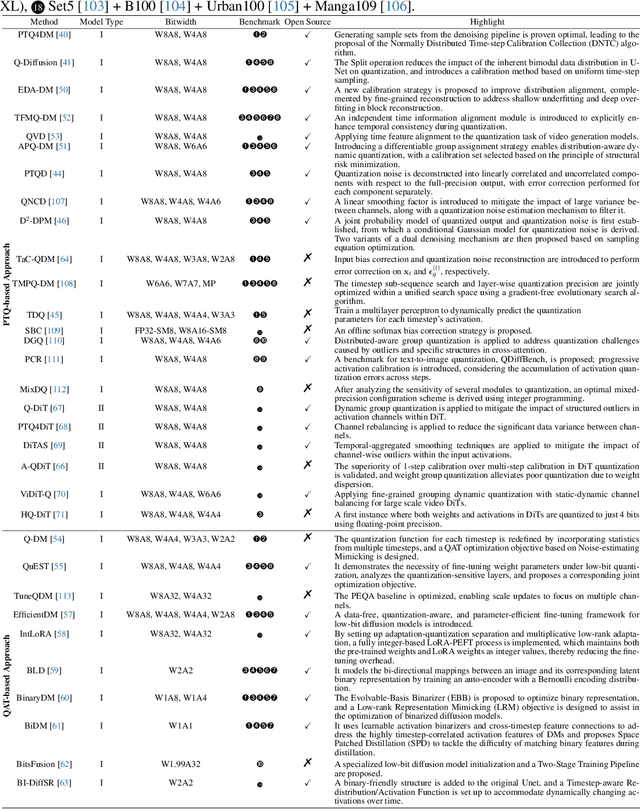
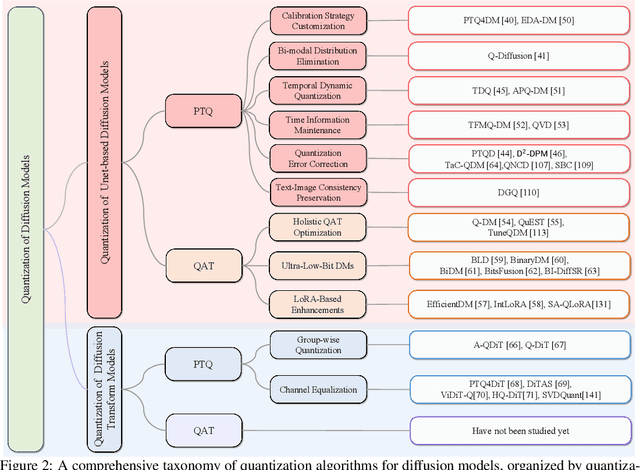
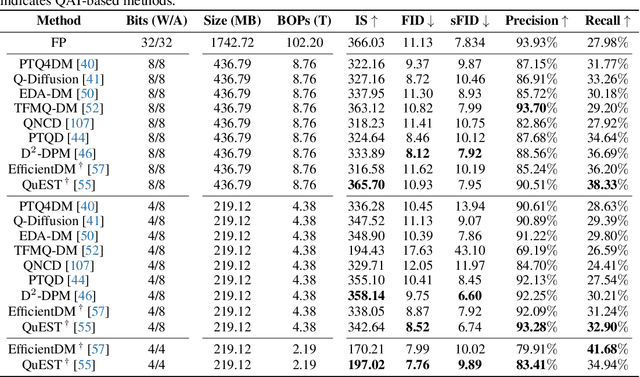
Recent success of large text-to-image models has empirically underscored the exceptional performance of diffusion models in generative tasks. To facilitate their efficient deployment on resource-constrained edge devices, model quantization has emerged as a pivotal technique for both compression and acceleration. This survey offers a thorough review of the latest advancements in diffusion model quantization, encapsulating and analyzing the current state of the art in this rapidly advancing domain. First, we provide an overview of the key challenges encountered in the quantization of diffusion models, including those based on U-Net architectures and Diffusion Transformers (DiT). We then present a comprehensive taxonomy of prevalent quantization techniques, engaging in an in-depth discussion of their underlying principles. Subsequently, we perform a meticulous analysis of representative diffusion model quantization schemes from both qualitative and quantitative perspectives. From a quantitative standpoint, we rigorously benchmark a variety of methods using widely recognized datasets, delivering an extensive evaluation of the most recent and impactful research in the field. From a qualitative standpoint, we categorize and synthesize the effects of quantization errors, elucidating these impacts through both visual analysis and trajectory examination. In conclusion, we outline prospective avenues for future research, proposing novel directions for the quantization of generative models in practical applications. The list of related papers, corresponding codes, pre-trained models and comparison results are publicly available at the survey project homepage https://github.com/TaylorJocelyn/Diffusion-Model-Quantization.