 Add to Chrome
 Add to Firefox
 Add to Edge
3D-PLOT-LLM: Part-Level Object Tokens for 3D Large Language Models
Jun 18, 2026
3D multimodal large language models (3D MLLMs) describe a 3D object as a whole but cannot address, name, or reason about its parts. Prior part-aware attempts add segmentation decoders, heavier 3D encoders, or bounding-box grammars at substantial parameter cost. We take a fundamentally different path: we reorganize the input token stream so that parts become directly addressable through the LLM's own vocabulary. Our model, 3D-PLOT-LLM, partitions the frozen point encoder's patches into K locally coherent regions and inserts, before each region's patch tokens, a learnable per-region marker and a reserved vocabulary token <part_k>; a Marker-Space Refinement (MSR) module then conditions each marker on its region's spatial statistics and adjacency neighbors. The model thus cites parts in its output and follows prompts that refer to parts by token, a capability absent from prior object-level 3D MLLMs. To probe this interface, we construct PartVerse-QA, a vocabulary-level part-QA benchmark adapted from PartVerse mesh annotations (77K training pairs and 588 held-out queries on disjoint object splits), on which 3D-PLOT-LLM reaches caption-to-slots Jaccard 0.459 and Exact-match 13.78%, with a slot-to-caption GPT-4o judge of 44.68. On the 3DCoMPaT-GrIn part-aware grounded description benchmark, 3D-PLOT-LLM outperforms PointLLM, Kestrel, PARIS3D, and SegPoint on every text-output metric, and ShapeLLM on 3 of 4, with up to +3.03 GPT-4o judge over PointLLM. On Objaverse whole-object captioning, adding PartVerse-QA at Stage 2 yields +0.65 SBERT and +1.85 GPT-4o over PointLLM, and tops PointLLM-PiSA on 4 of 5 traditional metrics (SBERT, SimCSE, BLEU-1, METEOR) despite targeting a different (part-grounded) objective. All with under 1M new trainable parameters on a frozen point encoder, an order of magnitude below prior part-aware 3D MLLMs, and no segmentation decoder or bounding-box head.

Rethinking Continual Experience Internalization for Self-Evolving LLM Agents
Jun 03, 2026Experience internalization converts contextual experience from past interactions into reusable parametric capability, offering a promising path toward continual learning in large language models (LLMs). While prior work has predominantly focused on single-iteration transfer, we discover that under multi-iteration experience learning, existing methods suffer from a progressive capability collapse rather than compounding improvement. We systematically examine this failure through three vital dimensions of experience internalization: (1) Experience Granularity: We find that principle-level experience is more durable than instance-level experience, as it effectively abstracts transferable strategies away from trajectory-specific details. (2) Experience Injection Pattern: Our analysis reveals that step-wise injection significantly outperforms global injection by aligning experience with intermediate decision states, a property that is critical for long-horizon tool use. (3) Internalization Regime: We demonstrate that off-policy context-distillation on high-quality teacher trajectories provides a substantially more stable training signal than on-policy context-distillation, which is inherently limited by local corrections on student-induced flawed states. Together, these insights yield a simple yet robust recipe for stable and sustainable experience internalization, providing concrete guidance for engineering self-evolving and continually learning LLMs.
AgentProcessBench: Diagnosing Step-Level Process Quality in Tool-Using Agents
Mar 15, 2026While Large Language Models (LLMs) have evolved into tool-using agents, they remain brittle in long-horizon interactions. Unlike mathematical reasoning where errors are often rectifiable via backtracking, tool-use failures frequently induce irreversible side effects, making accurate step-level verification critical. However, existing process-level benchmarks are predominantly confined to closed-world mathematical domains, failing to capture the dynamic and open-ended nature of tool execution. To bridge this gap, we introduce AgentProcessBench, the first benchmark dedicated to evaluating step-level effectiveness in realistic, tool-augmented trajectories. The benchmark comprises 1,000 diverse trajectories and 8,509 human-labeled step annotations with 89.1% inter-annotator agreement. It features a ternary labeling scheme to capture exploration and an error propagation rule to reduce labeling ambiguity. Extensive experiments reveal key insights: (1) weaker policy models exhibit inflated ratios of correct steps due to early termination; (2) distinguishing neutral and erroneous actions remains a significant challenge for current models; and (3) process-derived signals provide complementary value to outcome supervision, significantly enhancing test-time scaling. We hope AgentProcessBench can foster future research in reward models and pave the way toward general agents. The code and data are available at https://github.com/RUCBM/AgentProcessBench.
DreamVAR: Taming Reinforced Visual Autoregressive Model for High-Fidelity Subject-Driven Image Generation
Jan 30, 2026Recent advances in subject-driven image generation using diffusion models have attracted considerable attention for their remarkable capabilities in producing high-quality images. Nevertheless, the potential of Visual Autoregressive (VAR) models, despite their unified architecture and efficient inference, remains underexplored. In this work, we present DreamVAR, a novel framework for subject-driven image synthesis built upon a VAR model that employs next-scale prediction. Technically, multi-scale features of the reference subject are first extracted by a visual tokenizer. Instead of interleaving these conditional features with target image tokens across scales, our DreamVAR pre-fills the full subject feature sequence prior to predicting target image tokens. This design simplifies autoregressive dependencies and mitigates the train-test discrepancy in multi-scale conditioning scenario within the VAR paradigm. DreamVAR further incorporates reinforcement learning to jointly enhance semantic alignment and subject consistency. Extensive experiments demonstrate that DreamVAR achieves superior appearance preservation compared to leading diffusion-based methods.
HiDream-I1: A High-Efficient Image Generative Foundation Model with Sparse Diffusion Transformer
May 28, 2025Recent advancements in image generative foundation models have prioritized quality improvements but often at the cost of increased computational complexity and inference latency. To address this critical trade-off, we introduce HiDream-I1, a new open-source image generative foundation model with 17B parameters that achieves state-of-the-art image generation quality within seconds. HiDream-I1 is constructed with a new sparse Diffusion Transformer (DiT) structure. Specifically, it starts with a dual-stream decoupled design of sparse DiT with dynamic Mixture-of-Experts (MoE) architecture, in which two separate encoders are first involved to independently process image and text tokens. Then, a single-stream sparse DiT structure with dynamic MoE architecture is adopted to trigger multi-model interaction for image generation in a cost-efficient manner. To support flexiable accessibility with varied model capabilities, we provide HiDream-I1 in three variants: HiDream-I1-Full, HiDream-I1-Dev, and HiDream-I1-Fast. Furthermore, we go beyond the typical text-to-image generation and remould HiDream-I1 with additional image conditions to perform precise, instruction-based editing on given images, yielding a new instruction-based image editing model namely HiDream-E1. Ultimately, by integrating text-to-image generation and instruction-based image editing, HiDream-I1 evolves to form a comprehensive image agent (HiDream-A1) capable of fully interactive image creation and refinement. To accelerate multi-modal AIGC research, we have open-sourced all the codes and model weights of HiDream-I1-Full, HiDream-I1-Dev, HiDream-I1-Fast, HiDream-E1 through our project websites: https://github.com/HiDream-ai/HiDream-I1 and https://github.com/HiDream-ai/HiDream-E1. All features can be directly experienced via https://vivago.ai/studio.
Incorporating Visual Correspondence into Diffusion Model for Virtual Try-On
May 22, 2025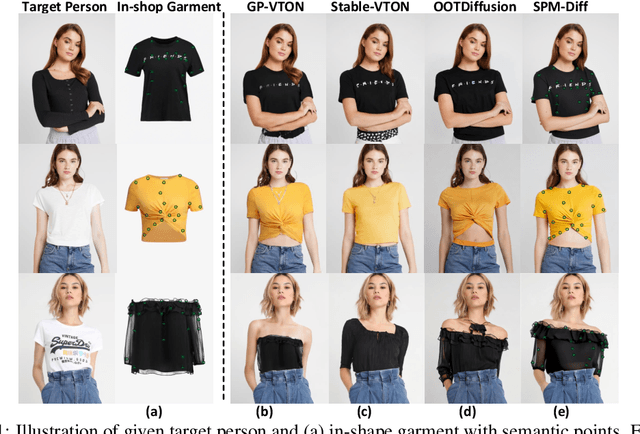
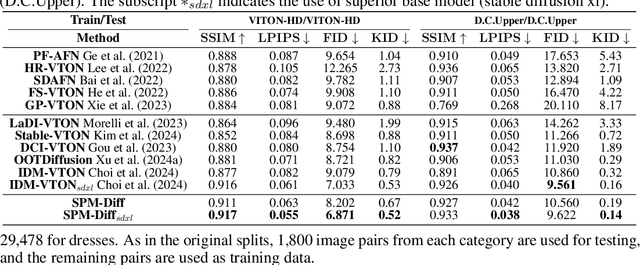
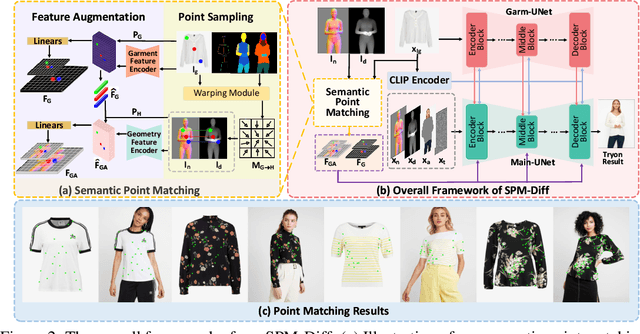
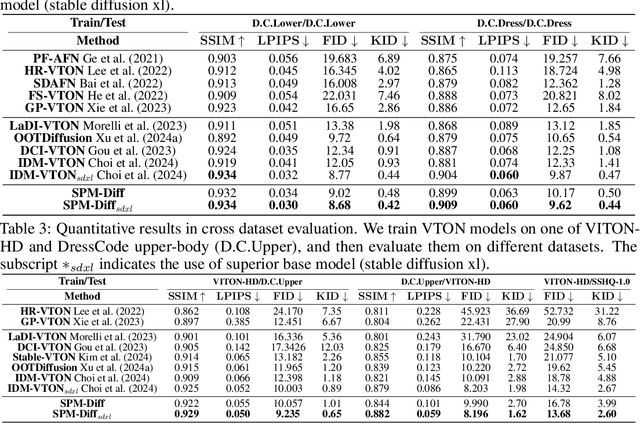
Diffusion models have shown preliminary success in virtual try-on (VTON) task. The typical dual-branch architecture comprises two UNets for implicit garment deformation and synthesized image generation respectively, and has emerged as the recipe for VTON task. Nevertheless, the problem remains challenging to preserve the shape and every detail of the given garment due to the intrinsic stochasticity of diffusion model. To alleviate this issue, we novelly propose to explicitly capitalize on visual correspondence as the prior to tame diffusion process instead of simply feeding the whole garment into UNet as the appearance reference. Specifically, we interpret the fine-grained appearance and texture details as a set of structured semantic points, and match the semantic points rooted in garment to the ones over target person through local flow warping. Such 2D points are then augmented into 3D-aware cues with depth/normal map of target person. The correspondence mimics the way of putting clothing on human body and the 3D-aware cues act as semantic point matching to supervise diffusion model training. A point-focused diffusion loss is further devised to fully take the advantage of semantic point matching. Extensive experiments demonstrate strong garment detail preservation of our approach, evidenced by state-of-the-art VTON performances on both VITON-HD and DressCode datasets. Code is publicly available at: https://github.com/HiDream-ai/SPM-Diff.
DeepCritic: Deliberate Critique with Large Language Models
May 01, 2025As Large Language Models (LLMs) are rapidly evolving, providing accurate feedback and scalable oversight on their outputs becomes an urgent and critical problem. Leveraging LLMs as critique models to achieve automated supervision is a promising solution. In this work, we focus on studying and enhancing the math critique ability of LLMs. Current LLM critics provide critiques that are too shallow and superficial on each step, leading to low judgment accuracy and struggling to offer sufficient feedback for the LLM generator to correct mistakes. To tackle this issue, we propose a novel and effective two-stage framework to develop LLM critics that are capable of deliberately critiquing on each reasoning step of math solutions. In the first stage, we utilize Qwen2.5-72B-Instruct to generate 4.5K long-form critiques as seed data for supervised fine-tuning. Each seed critique consists of deliberate step-wise critiques that includes multi-perspective verifications as well as in-depth critiques of initial critiques for each reasoning step. Then, we perform reinforcement learning on the fine-tuned model with either existing human-labeled data from PRM800K or our automatically annotated data obtained via Monte Carlo sampling-based correctness estimation, to further incentivize its critique ability. Our developed critique model built on Qwen2.5-7B-Instruct not only significantly outperforms existing LLM critics (including the same-sized DeepSeek-R1-distill models and GPT-4o) on various error identification benchmarks, but also more effectively helps the LLM generator refine erroneous steps through more detailed feedback.
Beyond Wide-Angle Images: Unsupervised Video Portrait Correction via Spatiotemporal Diffusion Adaptation
Apr 01, 2025Wide-angle cameras, despite their popularity for content creation, suffer from distortion-induced facial stretching-especially at the edge of the lens-which degrades visual appeal. To address this issue, we propose an image portrait correction framework using diffusion models named ImagePD. It integrates the long-range awareness of transformer and multi-step denoising of diffusion models into a unified framework, achieving global structural robustness and local detail refinement. Besides, considering the high cost of obtaining video labels, we then repurpose ImagePD for unlabeled wide-angle videos (termed VideoPD), by spatiotemporal diffusion adaption with spatial consistency and temporal smoothness constraints. For the former, we encourage the denoised image to approximate pseudo labels following the wide-angle distortion distribution pattern, while for the latter, we derive rectification trajectories with backward optical flows and smooth them. Compared with ImagePD, VideoPD maintains high-quality facial corrections in space and mitigates the potential temporal shakes sequentially. Finally, to establish an evaluation benchmark and train the framework, we establish a video portrait dataset with a large diversity in people number, lighting conditions, and background. Experiments demonstrate that the proposed methods outperform existing solutions quantitatively and qualitatively, contributing to high-fidelity wide-angle videos with stable and natural portraits. The codes and dataset will be available.
Unleashing Text-to-Image Diffusion Prior for Zero-Shot Image Captioning
Dec 31, 2024Recently, zero-shot image captioning has gained increasing attention, where only text data is available for training. The remarkable progress in text-to-image diffusion model presents the potential to resolve this task by employing synthetic image-caption pairs generated by this pre-trained prior. Nonetheless, the defective details in the salient regions of the synthetic images introduce semantic misalignment between the synthetic image and text, leading to compromised results. To address this challenge, we propose a novel Patch-wise Cross-modal feature Mix-up (PCM) mechanism to adaptively mitigate the unfaithful contents in a fine-grained manner during training, which can be integrated into most of encoder-decoder frameworks, introducing our PCM-Net. Specifically, for each input image, salient visual concepts in the image are first detected considering the image-text similarity in CLIP space. Next, the patch-wise visual features of the input image are selectively fused with the textual features of the salient visual concepts, leading to a mixed-up feature map with less defective content. Finally, a visual-semantic encoder is exploited to refine the derived feature map, which is further incorporated into the sentence decoder for caption generation. Additionally, to facilitate the model training with synthetic data, a novel CLIP-weighted cross-entropy loss is devised to prioritize the high-quality image-text pairs over the low-quality counterparts. Extensive experiments on MSCOCO and Flickr30k datasets demonstrate the superiority of our PCM-Net compared with state-of-the-art VLMs-based approaches. It is noteworthy that our PCM-Net ranks first in both in-domain and cross-domain zero-shot image captioning. The synthetic dataset SynthImgCap and code are available at https://jianjieluo.github.io/SynthImgCap.
Improving Text-guided Object Inpainting with Semantic Pre-inpainting
Sep 12, 2024Recent years have witnessed the success of large text-to-image diffusion models and their remarkable potential to generate high-quality images. The further pursuit of enhancing the editability of images has sparked significant interest in the downstream task of inpainting a novel object described by a text prompt within a designated region in the image. Nevertheless, the problem is not trivial from two aspects: 1) Solely relying on one single U-Net to align text prompt and visual object across all the denoising timesteps is insufficient to generate desired objects; 2) The controllability of object generation is not guaranteed in the intricate sampling space of diffusion model. In this paper, we propose to decompose the typical single-stage object inpainting into two cascaded processes: 1) semantic pre-inpainting that infers the semantic features of desired objects in a multi-modal feature space; 2) high-fieldity object generation in diffusion latent space that pivots on such inpainted semantic features. To achieve this, we cascade a Transformer-based semantic inpainter and an object inpainting diffusion model, leading to a novel CAscaded Transformer-Diffusion (CAT-Diffusion) framework for text-guided object inpainting. Technically, the semantic inpainter is trained to predict the semantic features of the target object conditioning on unmasked context and text prompt. The outputs of the semantic inpainter then act as the informative visual prompts to guide high-fieldity object generation through a reference adapter layer, leading to controllable object inpainting. Extensive evaluations on OpenImages-V6 and MSCOCO validate the superiority of CAT-Diffusion against the state-of-the-art methods. Code is available at \url{https://github.com/Nnn-s/CATdiffusion}.