 Add to Chrome
 Add to Firefox
 Add to Edge
Typography
Papers and Code
Lingua-SafetyBench: A Benchmark for Safety Evaluation of Multilingual Vision-Language Models
Jan 30, 2026
Robust safety of vision-language large models (VLLMs) under joint multilingual and multimodal inputs remains underexplored. Existing benchmarks are typically multilingual but text-only, or multimodal but monolingual. Recent multilingual multimodal red-teaming efforts render harmful prompts into images, yet rely heavily on typography-style visuals and lack semantically grounded image-text pairs, limiting coverage of realistic cross-modal interactions. We introduce Lingua-SafetyBench, a benchmark of 100,440 harmful image-text pairs across 10 languages, explicitly partitioned into image-dominant and text-dominant subsets to disentangle risk sources. Evaluating 11 open-source VLLMs reveals a consistent asymmetry: image-dominant risks yield higher ASR in high-resource languages, while text-dominant risks are more severe in non-high-resource languages. A controlled study on the Qwen series shows that scaling and version upgrades reduce Attack Success Rate (ASR) overall but disproportionately benefit HRLs, widening the gap between HRLs and Non-HRLs under text-dominant risks. This underscores the necessity of language- and modality-aware safety alignment beyond mere scaling.To facilitate reproducibility and future research, we will publicly release our benchmark, model checkpoints, and source code.The code and dataset will be available at https://github.com/zsxr15/Lingua-SafetyBench.Warning: this paper contains examples with unsafe content.

SymbolSight: Minimizing Inter-Symbol Interference for Reading with Prosthetic Vision
Jan 24, 2026Retinal prostheses restore limited visual perception, but low spatial resolution and temporal persistence make reading difficult. In sequential letter presentation, the afterimage of one symbol can interfere with perception of the next, leading to systematic recognition errors. Rather than relying on future hardware improvements, we investigate whether optimizing the visual symbols themselves can mitigate this temporal interference. We present SymbolSight, a computational framework that selects symbol-to-letter mappings to minimize confusion among frequently adjacent letters. Using simulated prosthetic vision (SPV) and a neural proxy observer, we estimate pairwise symbol confusability and optimize assignments using language-specific bigram statistics. Across simulations in Arabic, Bulgarian, and English, the resulting heterogeneous symbol sets reduced predicted confusion by a median factor of 22 relative to native alphabets. These results suggest that standard typography is poorly matched to serial, low-bandwidth prosthetic vision and demonstrate how computational modeling can efficiently narrow the design space of visual encodings to generate high-potential candidates for future psychophysical and clinical evaluation.
PosterVerse: A Full-Workflow Framework for Commercial-Grade Poster Generation with HTML-Based Scalable Typography
Jan 07, 2026Commercial-grade poster design demands the seamless integration of aesthetic appeal with precise, informative content delivery. Current automated poster generation systems face significant limitations, including incomplete design workflows, poor text rendering accuracy, and insufficient flexibility for commercial applications. To address these challenges, we propose PosterVerse, a full-workflow, commercial-grade poster generation method that seamlessly automates the entire design process while delivering high-density and scalable text rendering. PosterVerse replicates professional design through three key stages: (1) blueprint creation using fine-tuned LLMs to extract key design elements from user requirements, (2) graphical background generation via customized diffusion models to create visually appealing imagery, and (3) unified layout-text rendering with an MLLM-powered HTML engine to guarantee high text accuracy and flexible customization. In addition, we introduce PosterDNA, a commercial-grade, HTML-based dataset tailored for training and validating poster design models. To the best of our knowledge, PosterDNA is the first Chinese poster generation dataset to introduce HTML typography files, enabling scalable text rendering and fundamentally solving the challenges of rendering small and high-density text. Experimental results demonstrate that PosterVerse consistently produces commercial-grade posters with appealing visuals, accurate text alignment, and customizable layouts, making it a promising solution for automating commercial poster design. The code and model are available at https://github.com/wuhaer/PosterVerse.
FreeText: Training-Free Text Rendering in Diffusion Transformers via Attention Localization and Spectral Glyph Injection
Jan 02, 2026Large-scale text-to-image (T2I) diffusion models excel at open-domain synthesis but still struggle with precise text rendering, especially for multi-line layouts, dense typography, and long-tailed scripts such as Chinese. Prior solutions typically require costly retraining or rigid external layout constraints, which can degrade aesthetics and limit flexibility. We propose \textbf{FreeText}, a training-free, plug-and-play framework that improves text rendering by exploiting intrinsic mechanisms of \emph{Diffusion Transformer (DiT)} models. \textbf{FreeText} decomposes the problem into \emph{where to write} and \emph{what to write}. For \emph{where to write}, we localize writing regions by reading token-wise spatial attribution from endogenous image-to-text attention, using sink-like tokens as stable spatial anchors and topology-aware refinement to produce high-confidence masks. For \emph{what to write}, we introduce Spectral-Modulated Glyph Injection (SGMI), which injects a noise-aligned glyph prior with frequency-domain band-pass modulation to strengthen glyph structure and suppress semantic leakage (rendering the concept instead of the word). Extensive experiments on Qwen-Image, FLUX.1-dev, and SD3 variants across longText-Benchmark, CVTG, and our CLT-Bench show consistent gains in text readability while largely preserving semantic alignment and aesthetic quality, with modest inference overhead.
UTDesign: A Unified Framework for Stylized Text Editing and Generation in Graphic Design Images
Dec 23, 2025AI-assisted graphic design has emerged as a powerful tool for automating the creation and editing of design elements such as posters, banners, and advertisements. While diffusion-based text-to-image models have demonstrated strong capabilities in visual content generation, their text rendering performance, particularly for small-scale typography and non-Latin scripts, remains limited. In this paper, we propose UTDesign, a unified framework for high-precision stylized text editing and conditional text generation in design images, supporting both English and Chinese scripts. Our framework introduces a novel DiT-based text style transfer model trained from scratch on a synthetic dataset, capable of generating transparent RGBA text foregrounds that preserve the style of reference glyphs. We further extend this model into a conditional text generation framework by training a multi-modal condition encoder on a curated dataset with detailed text annotations, enabling accurate, style-consistent text synthesis conditioned on background images, prompts, and layout specifications. Finally, we integrate our approach into a fully automated text-to-design (T2D) pipeline by incorporating pre-trained text-to-image (T2I) models and an MLLM-based layout planner. Extensive experiments demonstrate that UTDesign achieves state-of-the-art performance among open-source methods in terms of stylistic consistency and text accuracy, and also exhibits unique advantages compared to proprietary commercial approaches. Code and data for this paper are available at https://github.com/ZYM-PKU/UTDesign.
VisionDirector: Vision-Language Guided Closed-Loop Refinement for Generative Image Synthesis
Dec 22, 2025Generative models can now produce photorealistic imagery, yet they still struggle with the long, multi-goal prompts that professional designers issue. To expose this gap and better evaluate models' performance in real-world settings, we introduce Long Goal Bench (LGBench), a 2,000-task suite (1,000 T2I and 1,000 I2I) whose average instruction contains 18 to 22 tightly coupled goals spanning global layout, local object placement, typography, and logo fidelity. We find that even state-of-the-art models satisfy fewer than 72 percent of the goals and routinely miss localized edits, confirming the brittleness of current pipelines. To address this, we present VisionDirector, a training-free vision-language supervisor that (i) extracts structured goals from long instructions, (ii) dynamically decides between one-shot generation and staged edits, (iii) runs micro-grid sampling with semantic verification and rollback after every edit, and (iv) logs goal-level rewards. We further fine-tune the planner with Group Relative Policy Optimization, yielding shorter edit trajectories (3.1 versus 4.2 steps) and stronger alignment. VisionDirector achieves new state of the art on GenEval (plus 7 percent overall) and ImgEdit (plus 0.07 absolute) while producing consistent qualitative improvements on typography, multi-object scenes, and pose editing.
Jailbreaking Large Vision Language Models in Intelligent Transportation Systems
Nov 17, 2025Large Vision Language Models (LVLMs) demonstrate strong capabilities in multimodal reasoning and many real-world applications, such as visual question answering. However, LVLMs are highly vulnerable to jailbreaking attacks. This paper systematically analyzes the vulnerabilities of LVLMs integrated in Intelligent Transportation Systems (ITS) under carefully crafted jailbreaking attacks. First, we carefully construct a dataset with harmful queries relevant to transportation, following OpenAI's prohibited categories to which the LVLMs should not respond. Second, we introduce a novel jailbreaking attack that exploits the vulnerabilities of LVLMs through image typography manipulation and multi-turn prompting. Third, we propose a multi-layered response filtering defense technique to prevent the model from generating inappropriate responses. We perform extensive experiments with the proposed attack and defense on the state-of-the-art LVLMs (both open-source and closed-source). To evaluate the attack method and defense technique, we use GPT-4's judgment to determine the toxicity score of the generated responses, as well as manual verification. Further, we compare our proposed jailbreaking method with existing jailbreaking techniques and highlight severe security risks involved with jailbreaking attacks with image typography manipulation and multi-turn prompting in the LVLMs integrated in ITS.
SkyReels-Text: Fine-grained Font-Controllable Text Editing for Poster Design
Nov 17, 2025Artistic design such as poster design often demands rapid yet precise modification of textual content while preserving visual harmony and typographic intent, especially across diverse font styles. Although modern image editing models have grown increasingly powerful, they still fall short in fine-grained, font-aware text manipulation, limiting their utility in professional design workflows such as poster editing. To address this issue, we present SkyReels-Text, a novel font-controllable framework for precise poster text editing. Our method enables simultaneous editing of multiple text regions, each rendered in distinct typographic styles, while preserving the visual appearance of non-edited regions. Notably, our model requires neither font labels nor fine-tuning during inference: users can simply provide cropped glyph patches corresponding to their desired typography, even if the font is not included in any standard library. Extensive experiments on multiple datasets, including handwrittent text benchmarks, SkyReels-Text achieves state-of-the-art performance in both text fidelity and visual realism, offering unprecedented control over font families, and stylistic nuances. This work bridges the gap between general-purpose image editing and professional-grade typographic design.
Stroke Modeling Enables Vectorized Character Generation with Large Vectorized Glyph Model
Nov 14, 2025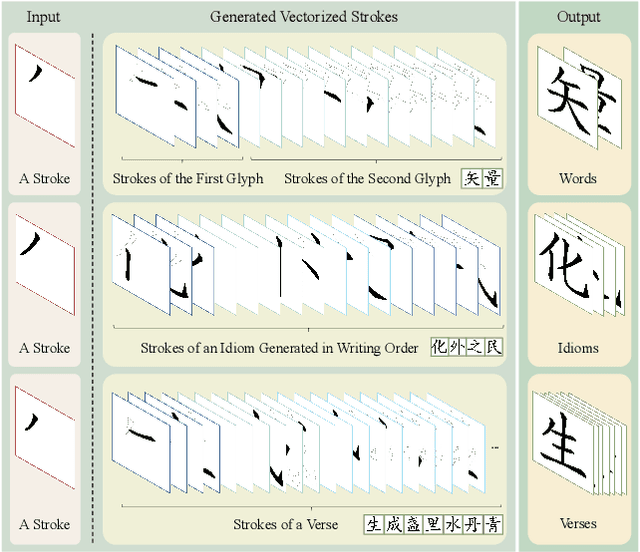
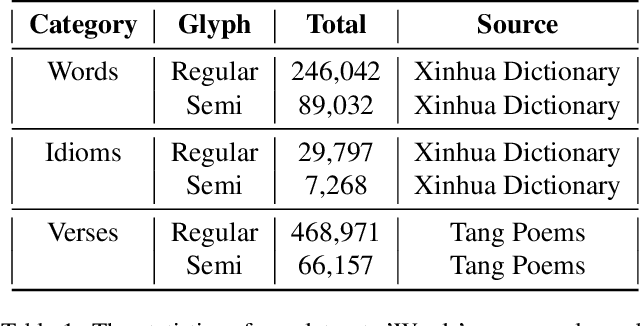

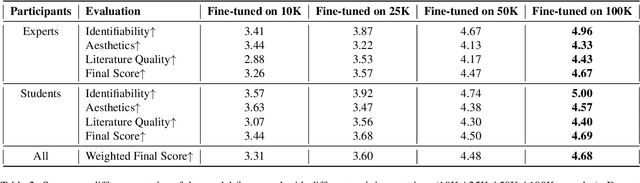
Vectorized glyphs are widely used in poster design, network animation, art display, and various other fields due to their scalability and flexibility. In typography, they are often seen as special sequences composed of ordered strokes. This concept extends to the token sequence prediction abilities of large language models (LLMs), enabling vectorized character generation through stroke modeling. In this paper, we propose a novel Large Vectorized Glyph Model (LVGM) designed to generate vectorized Chinese glyphs by predicting the next stroke. Initially, we encode strokes into discrete latent variables called stroke embeddings. Subsequently, we train our LVGM via fine-tuning DeepSeek LLM by predicting the next stroke embedding. With limited strokes given, it can generate complete characters, semantically elegant words, and even unseen verses in vectorized form. Moreover, we release a new large-scale Chinese SVG dataset containing 907,267 samples based on strokes for dynamically vectorized glyph generation. Experimental results show that our model has scaling behaviors on data scales. Our generated vectorized glyphs have been validated by experts and relevant individuals.
Layout-Aware OCR for Black Digital Archives with Unsupervised Evaluation
Sep 16, 2025Despite their cultural and historical significance, Black digital archives continue to be a structurally underrepresented area in AI research and infrastructure. This is especially evident in efforts to digitize historical Black newspapers, where inconsistent typography, visual degradation, and limited annotated layout data hinder accurate transcription, despite the availability of various systems that claim to handle optical character recognition (OCR) well. In this short paper, we present a layout-aware OCR pipeline tailored for Black newspaper archives and introduce an unsupervised evaluation framework suited to low-resource archival contexts. Our approach integrates synthetic layout generation, model pretraining on augmented data, and a fusion of state-of-the-art You Only Look Once (YOLO) detectors. We used three annotation-free evaluation metrics, the Semantic Coherence Score (SCS), Region Entropy (RE), and Textual Redundancy Score (TRS), which quantify linguistic fluency, informational diversity, and redundancy across OCR regions. Our evaluation on a 400-page dataset from ten Black newspaper titles demonstrates that layout-aware OCR improves structural diversity and reduces redundancy compared to full-page baselines, with modest trade-offs in coherence. Our results highlight the importance of respecting cultural layout logic in AI-driven document understanding and lay the foundation for future community-driven and ethically grounded archival AI systems.