 Add to Chrome
 Add to Firefox
 Add to Edge
UTDesign: A Unified Framework for Stylized Text Editing and Generation in Graphic Design Images
Dec 23, 2025
AI-assisted graphic design has emerged as a powerful tool for automating the creation and editing of design elements such as posters, banners, and advertisements. While diffusion-based text-to-image models have demonstrated strong capabilities in visual content generation, their text rendering performance, particularly for small-scale typography and non-Latin scripts, remains limited. In this paper, we propose UTDesign, a unified framework for high-precision stylized text editing and conditional text generation in design images, supporting both English and Chinese scripts. Our framework introduces a novel DiT-based text style transfer model trained from scratch on a synthetic dataset, capable of generating transparent RGBA text foregrounds that preserve the style of reference glyphs. We further extend this model into a conditional text generation framework by training a multi-modal condition encoder on a curated dataset with detailed text annotations, enabling accurate, style-consistent text synthesis conditioned on background images, prompts, and layout specifications. Finally, we integrate our approach into a fully automated text-to-design (T2D) pipeline by incorporating pre-trained text-to-image (T2I) models and an MLLM-based layout planner. Extensive experiments demonstrate that UTDesign achieves state-of-the-art performance among open-source methods in terms of stylistic consistency and text accuracy, and also exhibits unique advantages compared to proprietary commercial approaches. Code and data for this paper are available at https://github.com/ZYM-PKU/UTDesign.

PEneo: Unifying Line Extraction, Line Grouping, and Entity Linking for End-to-end Document Pair Extraction
Jan 07, 2024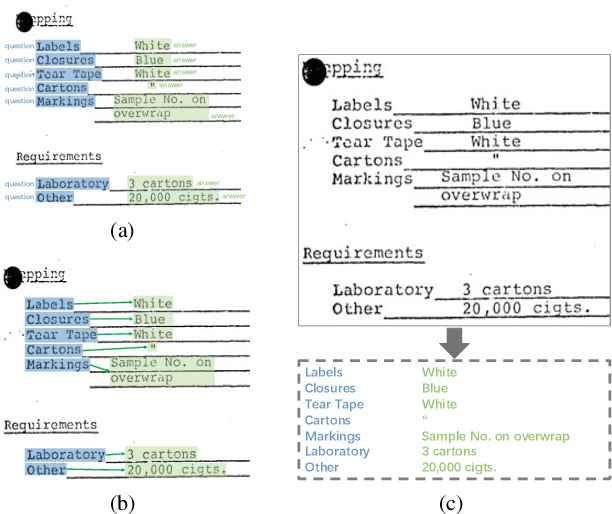
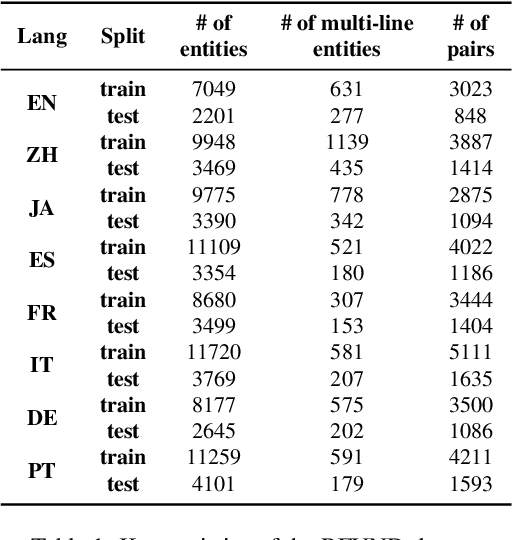
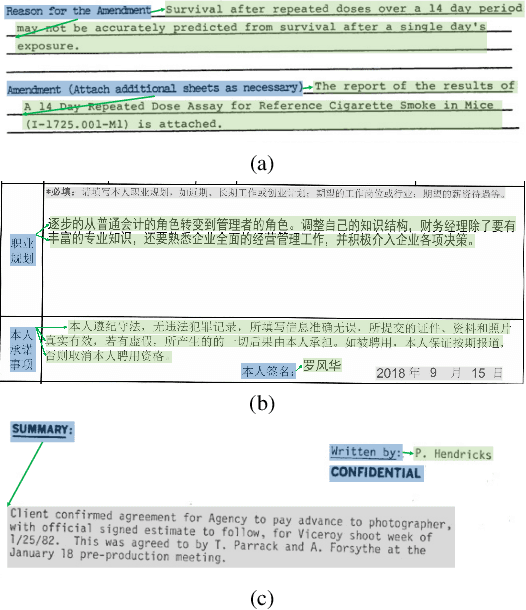
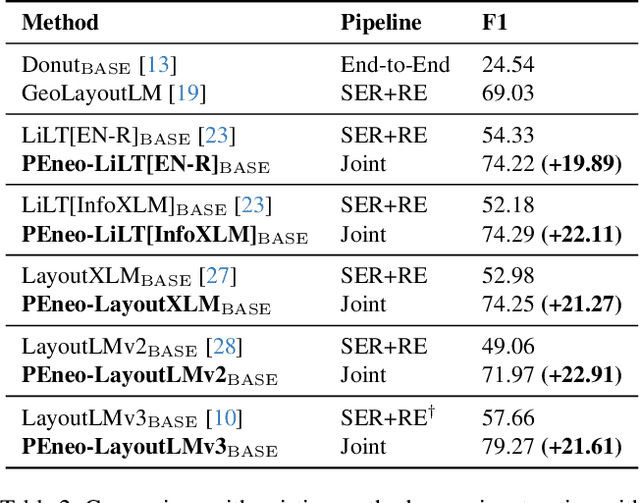
Document pair extraction aims to identify key and value entities as well as their relationships from visually-rich documents. Most existing methods divide it into two separate tasks: semantic entity recognition (SER) and relation extraction (RE). However, simply concatenating SER and RE serially can lead to severe error propagation, and it fails to handle cases like multi-line entities in real scenarios. To address these issues, this paper introduces a novel framework, PEneo (Pair Extraction new decoder option), which performs document pair extraction in a unified pipeline, incorporating three concurrent sub-tasks: line extraction, line grouping, and entity linking. This approach alleviates the error accumulation problem and can handle the case of multi-line entities. Furthermore, to better evaluate the model's performance and to facilitate future research on pair extraction, we introduce RFUND, a re-annotated version of the commonly used FUNSD and XFUND datasets, to make them more accurate and cover realistic situations. Experiments on various benchmarks demonstrate PEneo's superiority over previous pipelines, boosting the performance by a large margin (e.g., 19.89%-22.91% F1 score on RFUND-EN) when combined with various backbones like LiLT and LayoutLMv3, showing its effectiveness and generality. Codes and the new annotations will be open to the public.