 Add to Chrome
 Add to Firefox
 Add to Edge
JieZi: A Large-Scale Expert-Audited Dataset and Benchmark for Ancient Chinese Character Exegesis
Aug 12, 2026
The scholarly exegesis of ancient Chinese characters demands integrating visual observation, linguistic analysis, and historical context. However, existing computational approaches focus narrowly on subtasks such as character recognition and retrieval, lacking the structured datasets and benchmarks required for comprehensive scholarly analysis. To address this limitation, we introduce Ancient Chinese Character Exegesis (ACCE), a vision-language question answering (VQA) task that models the scholarly exegesis process. ACCE is organized into four progressive levels: basic character identification, glyph-form analysis, meaning exegesis, and diachronic evolution analysis. To support this task, we construct two complementary resources. JieZi-Dataset is the first large-scale, expert-audited VQA training dataset for ACCE, comprising over 500K QA pairs. It is constructed via a pipeline that reduces factual errors by constraining generation with expert-designed templates and source-text references. Human verification is further applied at each key stage to ensure scholarly accuracy. JieZi-Bench is an evaluation benchmark aligned with the exegesis process, constructed and verified by human experts to ensure evaluation reliability. It consists of four levels with reference answers curated from authoritative lexicographic works held separate from the training data. Experiments on multimodal large language models show that current models perform well on basic identification but struggle with glyph analysis, semantic reasoning, and diachronic understanding. Fine-tuning on JieZi-Dataset substantially improves performance across all four levels. Code and dataset are available at https://github.com/Ran00w/JieZi.

Deep Multimodal Fusion Detection through Spatial Mask and Channel Fusion
Aug 03, 2026Deep multimodal fusion for object detection has demonstrated good performance through mining modal characteristics. However, existing feature-level fusion methods mainly weigh between two modalities and unify them in a unified representation space. This can lead to overfitting or over-specialization of the statistical properties of a single modality within a dual-backbone architecture. This paper proposes an Attention-Driven Complementarity Resampling framework for robust improvement of cross-modality object detection. Based on a shared channel spatial attention mechanism, we first introduce the semantic mask exchange to actively mix the boundaries of the modalities during the training phase, forcing the backbone network to learn generalized features without relying on fixed modal labels. Then we propose a learnable channel competition to sample and aggregate features in a channel-wise and learnable way. Our experiments on multiple datasets demonstrate that the proposed method is effective and yields competitive results among existing state-of-the-art approaches. The source code is provided in the supplementary material.
CI-ICM: Channel Importance-driven Learned Image Coding for Machines
Apr 07, 2026Traditional human vision-centric image compression methods are suboptimal for machine vision centric compression due to different visual properties and feature characteristics. To address this problem, we propose a Channel Importance-driven learned Image Coding for Machines (CI-ICM), aiming to maximize the performance of machine vision tasks at a given bitrate constraint. First, we propose a Channel Importance Generation (CIG) module to quantify channel importance in machine vision and develop a channel order loss to rank channels in descending order. Second, to properly allocate bitrate among feature channels, we propose a Feature Channel Grouping and Scaling (FCGS) module that non-uniformly groups the feature channels based on their importance and adjusts the dynamic range of each group. Based on FCGS, we further propose a Channel Importance-based Context (CI-CTX) module to allocate bits among feature groups and to preserve higher fidelity in critical channels. Third, to adapt to multiple machine tasks, we propose a Task-Specific Channel Adaptation (TSCA) module to adaptively enhance features for multiple downstream machine tasks. Experimental results on the COCO2017 dataset show that the proposed CI-ICM achieves BD-mAP@50:95 gains of 16.25$\%$ in object detection and 13.72$\%$ in instance segmentation over the established baseline codec. Ablation studies validate the effectiveness of each contribution, and computation complexity analysis reveals the practicability of the CI-ICM. This work establishes feature channel optimization for machine vision-centric compression, bridging the gap between image coding and machine perception.
PosterVerse: A Full-Workflow Framework for Commercial-Grade Poster Generation with HTML-Based Scalable Typography
Jan 07, 2026Commercial-grade poster design demands the seamless integration of aesthetic appeal with precise, informative content delivery. Current automated poster generation systems face significant limitations, including incomplete design workflows, poor text rendering accuracy, and insufficient flexibility for commercial applications. To address these challenges, we propose PosterVerse, a full-workflow, commercial-grade poster generation method that seamlessly automates the entire design process while delivering high-density and scalable text rendering. PosterVerse replicates professional design through three key stages: (1) blueprint creation using fine-tuned LLMs to extract key design elements from user requirements, (2) graphical background generation via customized diffusion models to create visually appealing imagery, and (3) unified layout-text rendering with an MLLM-powered HTML engine to guarantee high text accuracy and flexible customization. In addition, we introduce PosterDNA, a commercial-grade, HTML-based dataset tailored for training and validating poster design models. To the best of our knowledge, PosterDNA is the first Chinese poster generation dataset to introduce HTML typography files, enabling scalable text rendering and fundamentally solving the challenges of rendering small and high-density text. Experimental results demonstrate that PosterVerse consistently produces commercial-grade posters with appealing visuals, accurate text alignment, and customizable layouts, making it a promising solution for automating commercial poster design. The code and model are available at https://github.com/wuhaer/PosterVerse.
Multiscale Feature Importance-based Bit Allocation for End-to-End Feature Coding for Machines
Mar 25, 2025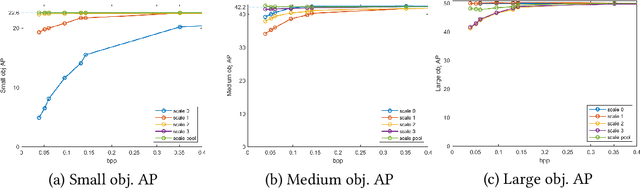
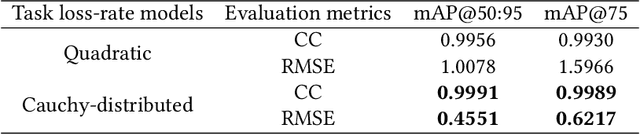
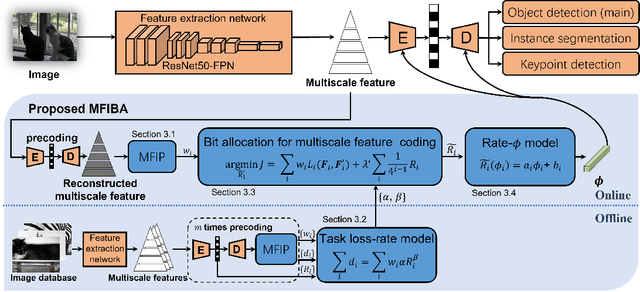

Feature Coding for Machines (FCM) aims to compress intermediate features effectively for remote intelligent analytics, which is crucial for future intelligent visual applications. In this paper, we propose a Multiscale Feature Importance-based Bit Allocation (MFIBA) for end-to-end FCM. First, we find that the importance of features for machine vision tasks varies with the scales, object size, and image instances. Based on this finding, we propose a Multiscale Feature Importance Prediction (MFIP) module to predict the importance weight for each scale of features. Secondly, we propose a task loss-rate model to establish the relationship between the task accuracy losses of using compressed features and the bitrate of encoding these features. Finally, we develop a MFIBA for end-to-end FCM, which is able to assign coding bits of multiscale features more reasonably based on their importance. Experimental results demonstrate that when combined with a retained Efficient Learned Image Compression (ELIC), the proposed MFIBA achieves an average of 38.202% bitrate savings in object detection compared to the anchor ELIC. Moreover, the proposed MFIBA achieves an average of 17.212% and 36.492% feature bitrate savings for instance segmentation and keypoint detection, respectively. When the proposed MFIBA is applied to the LIC-TCM, it achieves an average of 18.103%, 19.866% and 19.597% bit rate savings on three machine vision tasks, respectively, which validates the proposed MFIBA has good generalizability and adaptability to different machine vision tasks and FCM base codecs.