 Add to Chrome
 Add to Firefox
 Add to Edge
TongGuOCR: A Layout-Aware and Token-Augmented OCR MLLM for Chinese Historical Documents
Aug 11, 2026
Chinese historical documents preserve valuable cultural heritage, but many collections remain accessible only as scanned page images, preventing full-text retrieval, collation, and computational analysis. Optical character recognition (OCR) can bridge this gap, but accurate transcription remains challenging because historical documents often contain complex layouts, rare characters, and nontrivial reading orders. We propose TongGuOCR, a layout-aware and token-augmented multimodal large language model (MLLM) for OCR of Chinese historical documents. First, a Layout-Aware Preprocessing module constructs and refines locally coherent recognition blocks to preserve local context while reducing interference across regions. Second, a Token-Augmented Recognition module augments the transcription target at two complementary levels: character-level vocabulary expansion gives each rare glyph a direct one-token representation and shortens its decoding path, while line-to-line transition modeling injects discrete spatial displacement tokens that guide the decoder along complex reading paths without requiring precise coordinates. Experiments on two Chinese historical document OCR benchmarks show that TongGuOCR outperforms representative traditional task-specific OCR models, general-purpose MLLMs, and OCR-oriented MLLMs. On the more challenging M5HisDoc benchmark, TongGuOCR achieves 93.76 AR and reduces NED from 10.43 to 6.15 and RO-ED from 7.53 to 3.49 relative to the best competing score for each metric. An online demo is available at https://jzzh2004.github.io/TongGuOCR.

GRASP: Granularity-Aware Region Alignment and Semantic Prototype Learning for Fine-Grained Cross-Modal Understanding in Drone Views
Aug 10, 2026Fine-grained cross-modal understanding in drone views is essential for aerial vision-language navigation. However, the inherent wide field of view and overhead perspective of drone scenarios impose dual challenges on vision-language understanding. At the macro level, overwhelming background clutter in visual representations leads to Cross-Modal Focus Misalignment, where the model prioritizes global environmental similarities over specific object details. At the micro level, Visual Isomorphism creates ambiguity, where candidates share similar geometric structures yet differ only in subtle attributes. To address these challenges, we propose the Granularity-Aware Region Alignment and Semantic Prototype (GRASP) learning framework, enhancing discriminative capability through two synergistic strategies. Specifically, we introduce Region-Focused Alignment (RFA) to promote object-centric cross-modal alignment while suppressing background interference. Concurrently, to tackle visual isomorphism, we propose Semantic Perturbation Enhanced Matching (SPEM), which leverages a foreground-purified Semantic Prototype Codebook (SPC) to construct semantically perturbed negatives for fine-grained semantic discrimination. Extensive experiments on the GeoText-1652 benchmark and the unseen ERA dataset demonstrate that GRASP achieves competitive performance in drone-view fine-grained image-text retrieval, validating its effectiveness for cross-modal understanding in aerial scenarios. Our code implementation is available at https://github.com/UCAS-JC/GRASP.
One Patch Is Enough: Reinforcement-Optimized Visual Token Grounding for MLLM-Based Scene Text Spotting
Jul 30, 2026Scene text spotting requires high-precision alignment between textual recognition and spatial localization. While visual-token grounding has emerged as a promising formulation for Multimodal Large Language Models (MLLMs), the previous multi-patch paradigm often introduces redundant noise and localization ambiguity, particularly for dense or small text instances. To address this, we propose Single-Patch Text Spotting (SPaTS), a vision-centric framework that routes each text instance through a single anchor visual token and then recovers geometry via full-image refinement. To accurately identify this anchor without oracle labels, we introduce Single-Patch Selective Optimization (SPaSO), a reinforcement learning framework that optimizes discrete visual-token selection using patch-level rewards. To further improve representation robustness and localization precision, we introduce Directional Embedding Alignment (DEA) to suppress unstable norm bias by decoupling feature magnitude and direction, and Patch-Enhanced Decoding (PED) to fuse the routed anchor with language semantics and cross-attend over the full-image feature map for geometry-aware boundary regression beyond coordinate-space surrogates. Extensive experiments demonstrate that SPaTS consistently and significantly outperforms both frontier closed-source MLLMs and OCR MLLMs. Code will be released soon.
* 15 pages, 11 figures. Accepted to ACM Multimedia 2026
GeoSearcher: Anchor-Guided Progressive Reasoning for Remote Sensing Visual Grounding with Process Supervision
Jul 01, 2026Recent multimodal large language models (MLLMs) have shown strong cross-modal understanding and coordinate generation abilities in visual grounding. However, transferring these abilities to remote sensing visual grounding (RSVG) remains challenging. High-resolution remote sensing images usually cover large-scale scenes, where targets are often extremely small and surrounded by numerous visually similar distractors. Meanwhile, queries often contain multiple clues, such as reference objects, spatial relations, and target attributes. Existing MLLM-based methods usually formulate RSVG as one-step coordinate generation, which may lead to unstable predictions for small-object localization and complex queries. To address these challenges, we propose GeoSearcher, which reformulates RSVG as an anchor-guided progressive reasoning process and realizes it through two coupled stages: Anchor-Centric Reasoning Supervised Fine-Tuning (ACR-SFT) and Process-Faithful Group Relative Policy Optimization (PF-GRPO). In ACR-SFT, anchor-centric reasoning data are used to teach the model to represent key visual clues as anchors and progressively integrate location, relational, and attribute clues around them. In PF-GRPO, Process-Aware Reward (PAR) and Reasoning-Informative Sample Selector (RISS) further optimize this reasoning behavior by jointly evaluating key reasoning steps and target localization, while focusing training on samples that are more beneficial for improving progressive reasoning. Through this design, GeoSearcher transforms large-scale visual search into a more constrained local reasoning process. Extensive experiments on DIOR-RSVG, OPT-RSVG, and VRS-Bench show that GeoSearcher outperforms existing state-of-the-art methods. The project will be released at https://github.com/wangdianyu954-xixi/GeoSearcher.
PosterVerse: A Full-Workflow Framework for Commercial-Grade Poster Generation with HTML-Based Scalable Typography
Jan 07, 2026Commercial-grade poster design demands the seamless integration of aesthetic appeal with precise, informative content delivery. Current automated poster generation systems face significant limitations, including incomplete design workflows, poor text rendering accuracy, and insufficient flexibility for commercial applications. To address these challenges, we propose PosterVerse, a full-workflow, commercial-grade poster generation method that seamlessly automates the entire design process while delivering high-density and scalable text rendering. PosterVerse replicates professional design through three key stages: (1) blueprint creation using fine-tuned LLMs to extract key design elements from user requirements, (2) graphical background generation via customized diffusion models to create visually appealing imagery, and (3) unified layout-text rendering with an MLLM-powered HTML engine to guarantee high text accuracy and flexible customization. In addition, we introduce PosterDNA, a commercial-grade, HTML-based dataset tailored for training and validating poster design models. To the best of our knowledge, PosterDNA is the first Chinese poster generation dataset to introduce HTML typography files, enabling scalable text rendering and fundamentally solving the challenges of rendering small and high-density text. Experimental results demonstrate that PosterVerse consistently produces commercial-grade posters with appealing visuals, accurate text alignment, and customizable layouts, making it a promising solution for automating commercial poster design. The code and model are available at https://github.com/wuhaer/PosterVerse.
RAPTOR: Real-Time High-Resolution UAV Video Prediction with Efficient Video Attention
Dec 25, 2025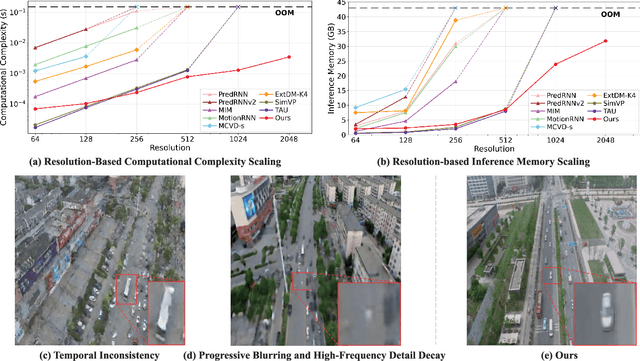
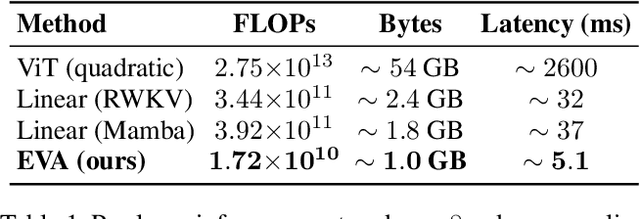
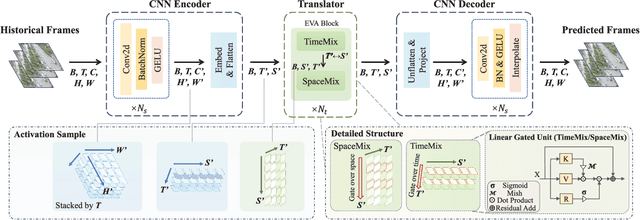
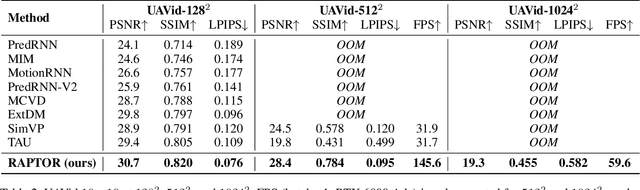
Video prediction is plagued by a fundamental trilemma: achieving high-resolution and perceptual quality typically comes at the cost of real-time speed, hindering its use in latency-critical applications. This challenge is most acute for autonomous UAVs in dense urban environments, where foreseeing events from high-resolution imagery is non-negotiable for safety. Existing methods, reliant on iterative generation (diffusion, autoregressive models) or quadratic-complexity attention, fail to meet these stringent demands on edge hardware. To break this long-standing trade-off, we introduce RAPTOR, a video prediction architecture that achieves real-time, high-resolution performance. RAPTOR's single-pass design avoids the error accumulation and latency of iterative approaches. Its core innovation is Efficient Video Attention (EVA), a novel translator module that factorizes spatiotemporal modeling. Instead of processing flattened spacetime tokens with $O((ST)^2)$ or $O(ST)$ complexity, EVA alternates operations along the spatial (S) and temporal (T) axes. This factorization reduces the time complexity to $O(S + T)$ and memory complexity to $O(max(S, T))$, enabling global context modeling at $512^2$ resolution and beyond, operating directly on dense feature maps with a patch-free design. Complementing this architecture is a 3-stage training curriculum that progressively refines predictions from coarse structure to sharp, temporally coherent details. Experiments show RAPTOR is the first predictor to exceed 30 FPS on a Jetson AGX Orin for $512^2$ video, setting a new state-of-the-art on UAVid, KTH, and a custom high-resolution dataset in PSNR, SSIM, and LPIPS. Critically, RAPTOR boosts the mission success rate in a real-world UAV navigation task by 18/%, paving the way for safer and more anticipatory embodied agents.
MegaHan97K: A Large-Scale Dataset for Mega-Category Chinese Character Recognition with over 97K Categories
Jun 05, 2025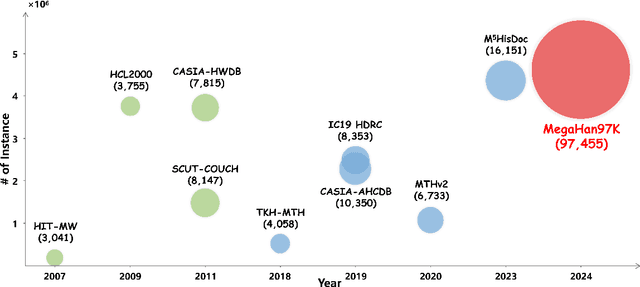

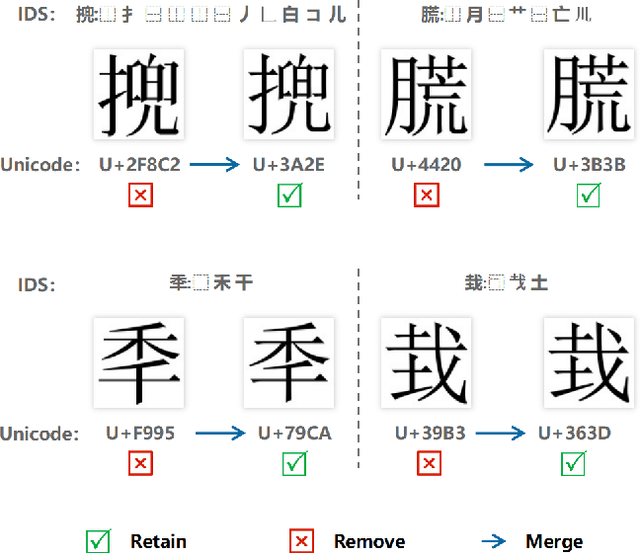
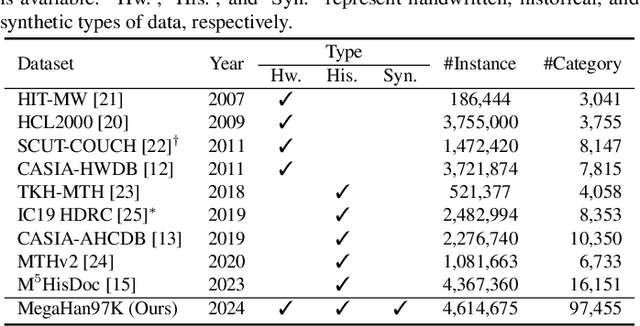
Foundational to the Chinese language and culture, Chinese characters encompass extraordinarily extensive and ever-expanding categories, with the latest Chinese GB18030-2022 standard containing 87,887 categories. The accurate recognition of this vast number of characters, termed mega-category recognition, presents a formidable yet crucial challenge for cultural heritage preservation and digital applications. Despite significant advances in Optical Character Recognition (OCR), mega-category recognition remains unexplored due to the absence of comprehensive datasets, with the largest existing dataset containing merely 16,151 categories. To bridge this critical gap, we introduce MegaHan97K, a mega-category, large-scale dataset covering an unprecedented 97,455 categories of Chinese characters. Our work offers three major contributions: (1) MegaHan97K is the first dataset to fully support the latest GB18030-2022 standard, providing at least six times more categories than existing datasets; (2) It effectively addresses the long-tail distribution problem by providing balanced samples across all categories through its three distinct subsets: handwritten, historical and synthetic subsets; (3) Comprehensive benchmarking experiments reveal new challenges in mega-category scenarios, including increased storage demands, morphologically similar character recognition, and zero-shot learning difficulties, while also unlocking substantial opportunities for future research. To the best of our knowledge, the MetaHan97K is likely the dataset with the largest classes not only in the field of OCR but may also in the broader domain of pattern recognition. The dataset is available at https://github.com/SCUT-DLVCLab/MegaHan97K.
Privacy-Preserving Biometric Verification with Handwritten Random Digit String
Mar 17, 2025Handwriting verification has stood as a steadfast identity authentication method for decades. However, this technique risks potential privacy breaches due to the inclusion of personal information in handwritten biometrics such as signatures. To address this concern, we propose using the Random Digit String (RDS) for privacy-preserving handwriting verification. This approach allows users to authenticate themselves by writing an arbitrary digit sequence, effectively ensuring privacy protection. To evaluate the effectiveness of RDS, we construct a new HRDS4BV dataset composed of online naturally handwritten RDS. Unlike conventional handwriting, RDS encompasses unconstrained and variable content, posing significant challenges for modeling consistent personal writing style. To surmount this, we propose the Pattern Attentive VErification Network (PAVENet), along with a Discriminative Pattern Mining (DPM) module. DPM adaptively enhances the recognition of consistent and discriminative writing patterns, thus refining handwriting style representation. Through comprehensive evaluations, we scrutinize the applicability of online RDS verification and showcase a pronounced outperformance of our model over existing methods. Furthermore, we discover a noteworthy forgery phenomenon that deviates from prior findings and discuss its positive impact in countering malicious impostor attacks. Substantially, our work underscores the feasibility of privacy-preserving biometric verification and propels the prospects of its broader acceptance and application.
Online Signature Verification based on the Lagrange formulation with 2D and 3D robotic models
Mar 17, 2025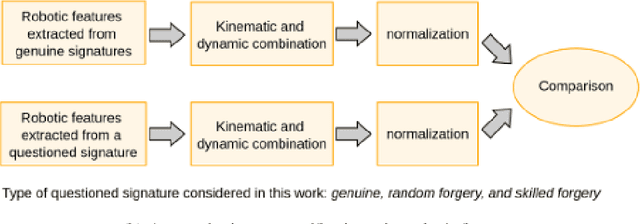
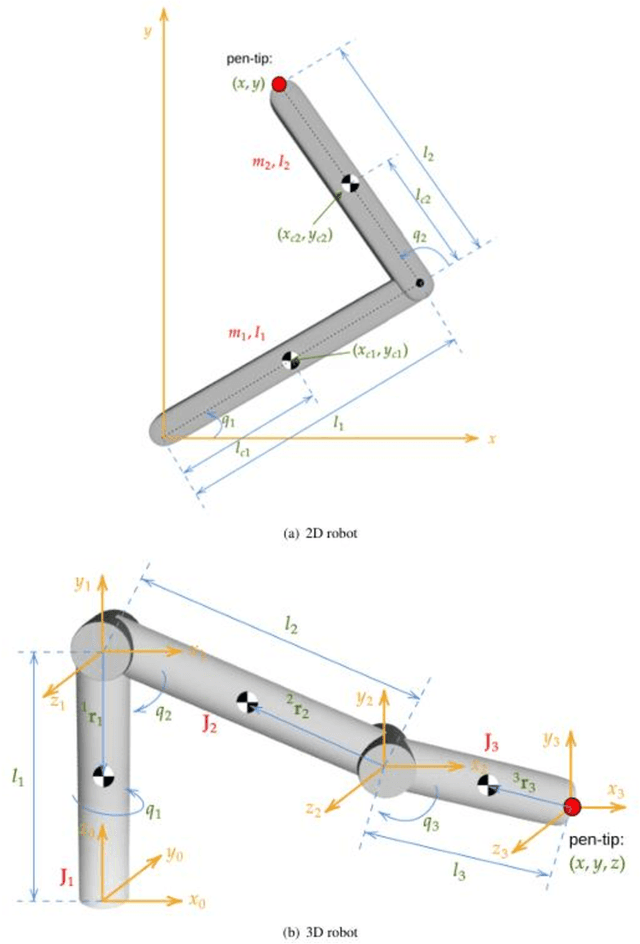
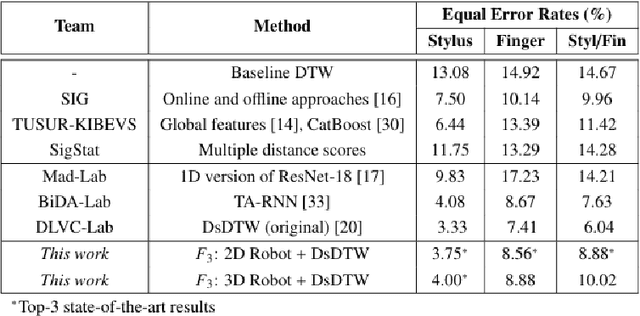
Online Signature Verification commonly relies on function-based features, such as time-sampled horizontal and vertical coordinates, as well as the pressure exerted by the writer, obtained through a digitizer. Although inferring additional information about the writers arm pose, kinematics, and dynamics based on digitizer data can be useful, it constitutes a challenge. In this paper, we tackle this challenge by proposing a new set of features based on the dynamics of online signatures. These new features are inferred through a Lagrangian formulation, obtaining the sequences of generalized coordinates and torques for 2D and 3D robotic arm models. By combining kinematic and dynamic robotic features, our results demonstrate their significant effectiveness for online automatic signature verification and achieving state-of-the-art results when integrated into deep learning models.
Smaller But Better: Unifying Layout Generation with Smaller Large Language Models
Feb 19, 2025We propose LGGPT, an LLM-based model tailored for unified layout generation. First, we propose Arbitrary Layout Instruction (ALI) and Universal Layout Response (ULR) as the uniform I/O template. ALI accommodates arbitrary layout generation task inputs across multiple layout domains, enabling LGGPT to unify both task-generic and domain-generic layout generation hitherto unexplored. Collectively, ALI and ULR boast a succinct structure that forgoes superfluous tokens typically found in existing HTML-based formats, facilitating efficient instruction tuning and boosting unified generation performance. In addition, we propose an Interval Quantization Encoding (IQE) strategy that compresses ALI into a more condensed structure. IQE precisely preserves valid layout clues while eliminating the less informative placeholders, facilitating LGGPT to capture complex and variable layout generation conditions during the unified training process. Experimental results demonstrate that LGGPT achieves superior or on par performance compared to existing methods. Notably, LGGPT strikes a prominent balance between proficiency and efficiency with a compact 1.5B parameter LLM, which beats prior 7B or 175B models even in the most extensive and challenging unified scenario. Furthermore, we underscore the necessity of employing LLMs for unified layout generation and suggest that 1.5B could be an optimal parameter size by comparing LLMs of varying scales. Code is available at https://github.com/NiceRingNode/LGGPT.