 Add to Chrome
 Add to Firefox
 Add to Edge
SkyReels-V4: Multi-modal Video-Audio Generation, Inpainting and Editing model
Feb 26, 2026
SkyReels V4 is a unified multi modal video foundation model for joint video audio generation, inpainting, and editing. The model adopts a dual stream Multimodal Diffusion Transformer (MMDiT) architecture, where one branch synthesizes video and the other generates temporally aligned audio, while sharing a powerful text encoder based on the Multimodal Large Language Models (MMLM). SkyReels V4 accepts rich multi modal instructions, including text, images, video clips, masks, and audio references. By combining the MMLMs multi modal instruction following capability with in context learning in the video branch MMDiT, the model can inject fine grained visual guidance under complex conditioning, while the audio branch MMDiT simultaneously leverages audio references to guide sound generation. On the video side, we adopt a channel concatenation formulation that unifies a wide range of inpainting style tasks, such as image to video, video extension, and video editing under a single interface, and naturally extends to vision referenced inpainting and editing via multi modal prompts. SkyReels V4 supports up to 1080p resolution, 32 FPS, and 15 second duration, enabling high fidelity, multi shot, cinema level video generation with synchronized audio. To make such high resolution, long-duration generation computationally feasible, we introduce an efficiency strategy: Joint generation of low resolution full sequences and high-resolution keyframes, followed by dedicated super-resolution and frame interpolation models. To our knowledge, SkyReels V4 is the first video foundation model that simultaneously supports multi-modal input, joint video audio generation, and a unified treatment of generation, inpainting, and editing, while maintaining strong efficiency and quality at cinematic resolutions and durations.

SkyReels-Text: Fine-grained Font-Controllable Text Editing for Poster Design
Nov 17, 2025Artistic design such as poster design often demands rapid yet precise modification of textual content while preserving visual harmony and typographic intent, especially across diverse font styles. Although modern image editing models have grown increasingly powerful, they still fall short in fine-grained, font-aware text manipulation, limiting their utility in professional design workflows such as poster editing. To address this issue, we present SkyReels-Text, a novel font-controllable framework for precise poster text editing. Our method enables simultaneous editing of multiple text regions, each rendered in distinct typographic styles, while preserving the visual appearance of non-edited regions. Notably, our model requires neither font labels nor fine-tuning during inference: users can simply provide cropped glyph patches corresponding to their desired typography, even if the font is not included in any standard library. Extensive experiments on multiple datasets, including handwrittent text benchmarks, SkyReels-Text achieves state-of-the-art performance in both text fidelity and visual realism, offering unprecedented control over font families, and stylistic nuances. This work bridges the gap between general-purpose image editing and professional-grade typographic design.
BARET : Balanced Attention based Real image Editing driven by Target-text Inversion
Dec 09, 2023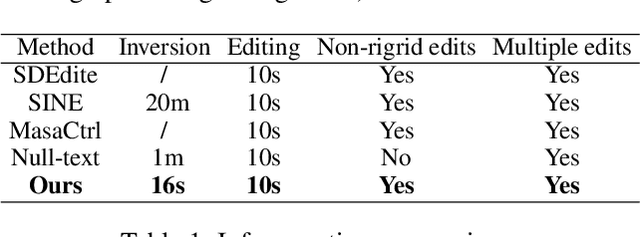
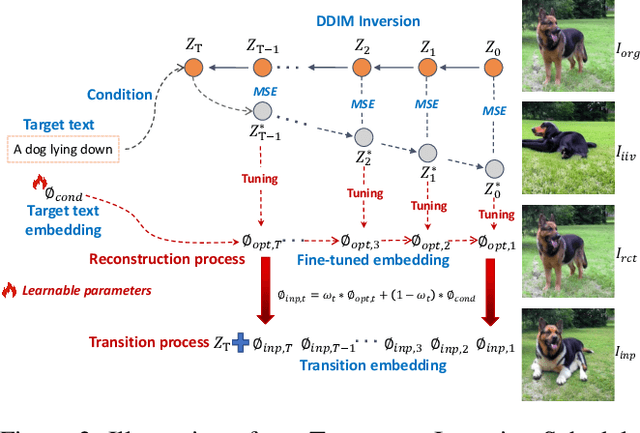
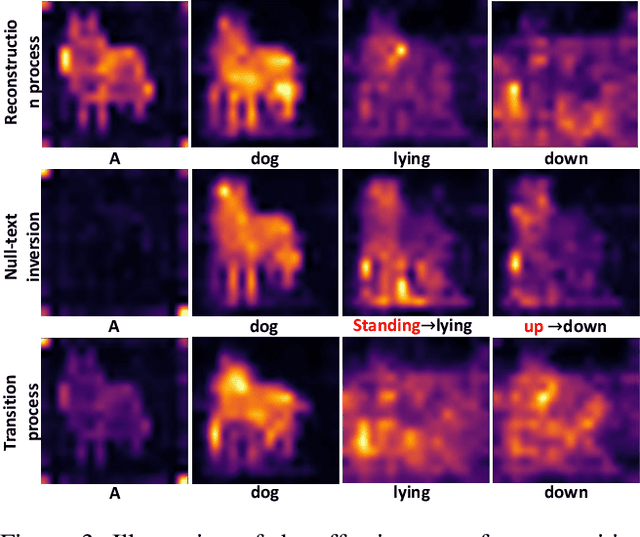
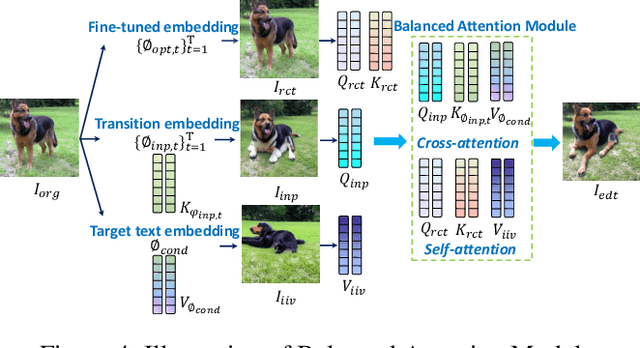
Image editing approaches with diffusion models have been rapidly developed, yet their applicability are subject to requirements such as specific editing types (e.g., foreground or background object editing, style transfer), multiple conditions (e.g., mask, sketch, caption), and time consuming fine-tuning of diffusion models. For alleviating these limitations and realizing efficient real image editing, we propose a novel editing technique that only requires an input image and target text for various editing types including non-rigid edits without fine-tuning diffusion model. Our method contains three novelties:(I) Target-text Inversion Schedule (TTIS) is designed to fine-tune the input target text embedding to achieve fast image reconstruction without image caption and acceleration of convergence.(II) Progressive Transition Scheme applies progressive linear interpolation between target text embedding and its fine-tuned version to generate transition embedding for maintaining non-rigid editing capability.(III) Balanced Attention Module (BAM) balances the tradeoff between textual description and image semantics.By the means of combining self-attention map from reconstruction process and cross-attention map from transition process, the guidance of target text embeddings in diffusion process is optimized.In order to demonstrate editing capability, effectiveness and efficiency of the proposed BARET, we have conducted extensive qualitative and quantitative experiments. Moreover, results derived from user study and ablation study further prove the superiority over other methods.