 Add to Chrome
 Add to Firefox
 Add to Edge
Ring-Zero: Scaling Zero RL to a Trillion Parameters for Emergent Reasoning
Jul 14, 2026
Reinforcement learning with verifiable rewards without human-annotated data, often referred to as zero RL, has emerged as a powerful paradigm for eliciting chain-of-thought reasoning. However, due to computational constraints, existing studies are largely restricted to small models, leaving the training dynamics and emergent capabilities at a large scale unexplored. To meaningfully explore this frontier, we aim to elicit high-quality reasoning behaviors from the model. However, we find that naive scaling often suffers from poor readability, token redundancy, and a lack of adaptive reasoning depth. To address these challenges, we present a stable and efficient training pipeline, incorporating algorithmic and system optimizations such as clipped importance sampling, training-inference ratio correction, and mixed-precision control. Our experiments offer three key findings that validate the "bitter lesson" of scaling: (1) scaling to 1T parameters significantly enhances sample efficiency and performance ceilings; (2) the training process progresses sequentially through an initial discovery phase followed by a sharpening phase; and (3) the model spontaneously develops advanced cognitive behaviors, including anthropomorphism, structured formatting, self-verification, parallel reasoning, and context anxiety, rendering hand-crafted heuristics redundant. Evaluated on seven mathematical benchmarks, Ring-2.5-1T-Zero achieves competitive performance. Additionally, to assess CoT quality beyond final-answer correctness, we propose a structured evaluation framework across three dimensions: comprehensibility, reproducibility, and efficiency, where our model demonstrates clear advantages in producing structured and concise reasoning traces. By sharing our observed emergent phenomena, we hope to provide the community with deeper insights into scaling behaviors, particularly at the 1-trillion scale.

Ling and Ring 2.6 Technical Report: Efficient and Instant Agentic Intelligence at Trillion-Parameter Scale
Jun 13, 2026Efficient and scalable agentic intelligence requires models that can deliver both low-latency responses and strong reasoning capabilities while remaining practical to train, serve, and deploy. In this report, we present Ling-2.6 and Ring-2.6, a family of models designed to address this challenge at scale. Ling-2.6 is optimized for instant response generation and high capability per output token, whereas Ring-2.6 is tailored for deeper reasoning and more advanced agentic workflows. Instead of training from scratch, we upgrade the Ling-2.0 base model through architectural migration pre-training and large-scale post-training. This upgrade is guided by a unified co-design of model architecture, optimization objectives, serving systems, and agent training environments, enabling improvements in both model capability and deployment efficiency. At the architectural level, we introduce a hybrid linear attention design that integrates Lightning Attention with MLA, improving the efficiency of long-context training and decoding. To further enhance token efficiency, we optimize capability per output token through Evolutionary Chain-of-Thought, Linguistic Unit Policy Optimization, bidirectional preference alignment, and shortest-correct-response distillation. For agentic capabilities, we propose KPop, a reinforcement learning framework designed to support stable training of Ring-2.6-1T on large-scale environment-grounded data. KPop improves training efficiency through asynchronous scheduling across coding, search, tool use, and workflow execution, enabling scalable learning from complex agent-environment interactions. Together, Ling-2.6 and Ring-2.6 provide a practical pathway toward efficient, scalable, and open agentic systems. We open-source all checkpoints in the 2.6 family to support further research and development in practical agentic intelligence.
SearchSwarm: Towards Delegation Intelligence in Agentic LLMs for Long-Horizon Deep Research
Jun 08, 2026Large language models are increasingly expected to handle complex, long-horizon real-world tasks whose context demands can grow without bound, yet model context windows remain inherently finite. Recent work explores a paradigm where a main agent decomposes tasks and dispatches subtasks to subagents, which execute and return only summarized results, conserving the main agent's context budget. However, performing this well requires delegation intelligence: the ability to decompose complex tasks, determine when and what to delegate, and integrate returned results into the ongoing workflow. Training data for this capability is scarce in naturally occurring text, and to our knowledge, how to synthesize such data and train models to acquire this capability remains largely unexplored in the open-source community. To bridge this gap, we present a preliminary exploration targeting deep research, a representative long-horizon agent task. Specifically, we design a harness that guides the model toward high-quality task decomposition and delegation, while constraining subagents to return results properly to support the main agent's workflow. The harness-guided trajectories naturally encode correct delegation decisions, which we use as supervised fine-tuning data to internalize delegation intelligence into model weights. Our resulting model, SearchSwarm-30B-A3B, achieves 68.1 on BrowseComp and 73.3 on BrowseComp-ZH, the best results among all models of comparable scale. We will release our harness, model weights, and training data to facilitate future research.
Every Step Evolves: Scaling Reinforcement Learning for Trillion-Scale Thinking Model
Oct 21, 2025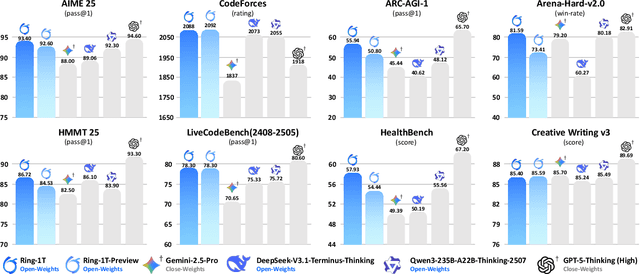
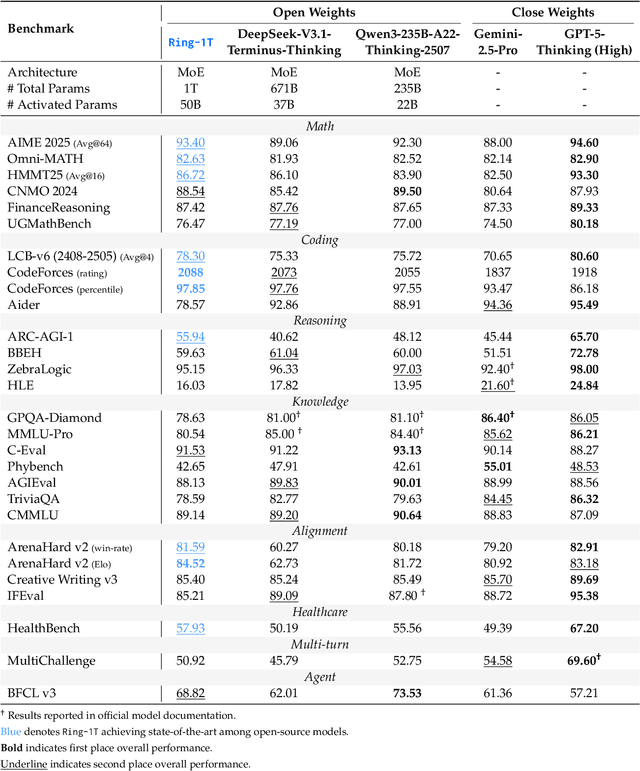
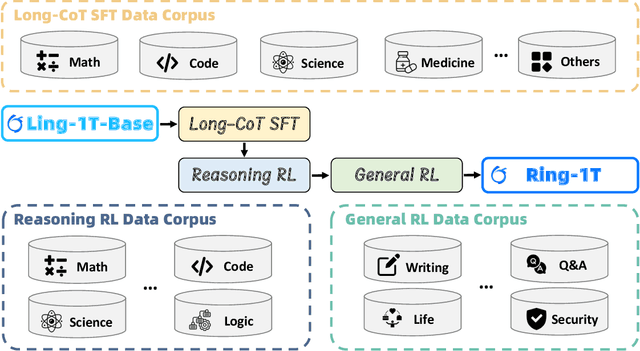
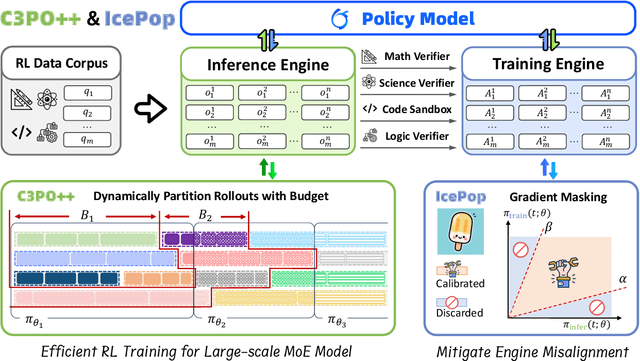
We present Ring-1T, the first open-source, state-of-the-art thinking model with a trillion-scale parameter. It features 1 trillion total parameters and activates approximately 50 billion per token. Training such models at a trillion-parameter scale introduces unprecedented challenges, including train-inference misalignment, inefficiencies in rollout processing, and bottlenecks in the RL system. To address these, we pioneer three interconnected innovations: (1) IcePop stabilizes RL training via token-level discrepancy masking and clipping, resolving instability from training-inference mismatches; (2) C3PO++ improves resource utilization for long rollouts under a token budget by dynamically partitioning them, thereby obtaining high time efficiency; and (3) ASystem, a high-performance RL framework designed to overcome the systemic bottlenecks that impede trillion-parameter model training. Ring-1T delivers breakthrough results across critical benchmarks: 93.4 on AIME-2025, 86.72 on HMMT-2025, 2088 on CodeForces, and 55.94 on ARC-AGI-v1. Notably, it attains a silver medal-level result on the IMO-2025, underscoring its exceptional reasoning capabilities. By releasing the complete 1T parameter MoE model to the community, we provide the research community with direct access to cutting-edge reasoning capabilities. This contribution marks a significant milestone in democratizing large-scale reasoning intelligence and establishes a new baseline for open-source model performance.
Ring-lite: Scalable Reasoning via C3PO-Stabilized Reinforcement Learning for LLMs
Jun 18, 2025We present Ring-lite, a Mixture-of-Experts (MoE)-based large language model optimized via reinforcement learning (RL) to achieve efficient and robust reasoning capabilities. Built upon the publicly available Ling-lite model, a 16.8 billion parameter model with 2.75 billion activated parameters, our approach matches the performance of state-of-the-art (SOTA) small-scale reasoning models on challenging benchmarks (e.g., AIME, LiveCodeBench, GPQA-Diamond) while activating only one-third of the parameters required by comparable models. To accomplish this, we introduce a joint training pipeline integrating distillation with RL, revealing undocumented challenges in MoE RL training. First, we identify optimization instability during RL training, and we propose Constrained Contextual Computation Policy Optimization(C3PO), a novel approach that enhances training stability and improves computational throughput via algorithm-system co-design methodology. Second, we empirically demonstrate that selecting distillation checkpoints based on entropy loss for RL training, rather than validation metrics, yields superior performance-efficiency trade-offs in subsequent RL training. Finally, we develop a two-stage training paradigm to harmonize multi-domain data integration, addressing domain conflicts that arise in training with mixed dataset. We will release the model, dataset, and code.
Incentivizing Dual Process Thinking for Efficient Large Language Model Reasoning
May 22, 2025Large reasoning models (LRMs) have demonstrated strong performance on complex reasoning tasks, but often suffer from overthinking, generating redundant content regardless of task difficulty. Inspired by the dual process theory in cognitive science, we propose Adaptive Cognition Policy Optimization (ACPO), a reinforcement learning framework that enables LRMs to achieve efficient reasoning through adaptive cognitive allocation and dynamic system switch. ACPO incorporates two key components: (1) introducing system-aware reasoning tokens to explicitly represent the thinking modes thereby making the model's cognitive process transparent, and (2) integrating online difficulty estimation and token length budget to guide adaptive system switch and reasoning during reinforcement learning. To this end, we propose a two-stage training strategy. The first stage begins with supervised fine-tuning to cold start the model, enabling it to generate reasoning paths with explicit thinking modes. In the second stage, we apply ACPO to further enhance adaptive system switch for difficulty-aware reasoning. Experimental results demonstrate that ACPO effectively reduces redundant reasoning while adaptively adjusting cognitive allocation based on task complexity, achieving efficient hybrid reasoning.
Risk Taxonomy, Mitigation, and Assessment Benchmarks of Large Language Model Systems
Jan 11, 2024


Large language models (LLMs) have strong capabilities in solving diverse natural language processing tasks. However, the safety and security issues of LLM systems have become the major obstacle to their widespread application. Many studies have extensively investigated risks in LLM systems and developed the corresponding mitigation strategies. Leading-edge enterprises such as OpenAI, Google, Meta, and Anthropic have also made lots of efforts on responsible LLMs. Therefore, there is a growing need to organize the existing studies and establish comprehensive taxonomies for the community. In this paper, we delve into four essential modules of an LLM system, including an input module for receiving prompts, a language model trained on extensive corpora, a toolchain module for development and deployment, and an output module for exporting LLM-generated content. Based on this, we propose a comprehensive taxonomy, which systematically analyzes potential risks associated with each module of an LLM system and discusses the corresponding mitigation strategies. Furthermore, we review prevalent benchmarks, aiming to facilitate the risk assessment of LLM systems. We hope that this paper can help LLM participants embrace a systematic perspective to build their responsible LLM systems.
A Multi-Grained Self-Interpretable Symbolic-Neural Model For Single/Multi-Labeled Text Classification
Mar 06, 2023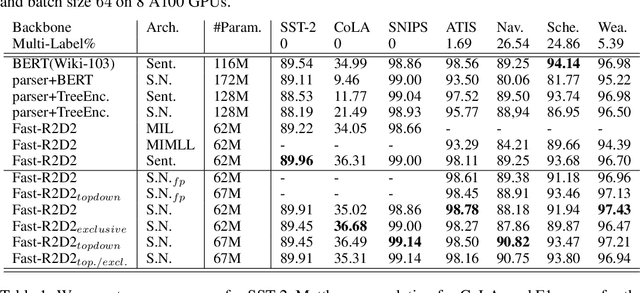
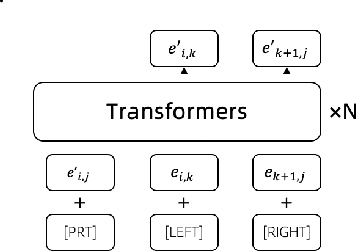
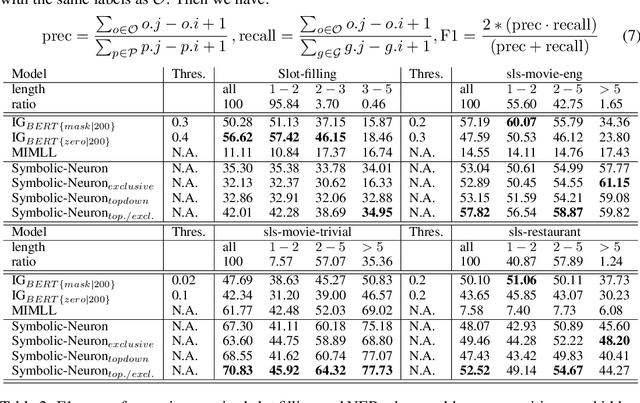
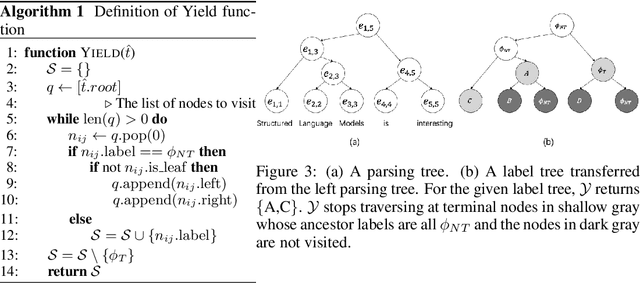
Deep neural networks based on layer-stacking architectures have historically suffered from poor inherent interpretability. Meanwhile, symbolic probabilistic models function with clear interpretability, but how to combine them with neural networks to enhance their performance remains to be explored. In this paper, we try to marry these two systems for text classification via a structured language model. We propose a Symbolic-Neural model that can learn to explicitly predict class labels of text spans from a constituency tree without requiring any access to span-level gold labels. As the structured language model learns to predict constituency trees in a self-supervised manner, only raw texts and sentence-level labels are required as training data, which makes it essentially a general constituent-level self-interpretable classification model. Our experiments demonstrate that our approach could achieve good prediction accuracy in downstream tasks. Meanwhile, the predicted span labels are consistent with human rationales to a certain degree.