 Add to Chrome
 Add to Firefox
 Add to Edge
Diffusion Knows Transparency: Repurposing Video Diffusion for Transparent Object Depth and Normal Estimation
Dec 29, 2025
Transparent objects remain notoriously hard for perception systems: refraction, reflection and transmission break the assumptions behind stereo, ToF and purely discriminative monocular depth, causing holes and temporally unstable estimates. Our key observation is that modern video diffusion models already synthesize convincing transparent phenomena, suggesting they have internalized the optical rules. We build TransPhy3D, a synthetic video corpus of transparent/reflective scenes: 11k sequences rendered with Blender/Cycles. Scenes are assembled from a curated bank of category-rich static assets and shape-rich procedural assets paired with glass/plastic/metal materials. We render RGB + depth + normals with physically based ray tracing and OptiX denoising. Starting from a large video diffusion model, we learn a video-to-video translator for depth (and normals) via lightweight LoRA adapters. During training we concatenate RGB and (noisy) depth latents in the DiT backbone and co-train on TransPhy3D and existing frame-wise synthetic datasets, yielding temporally consistent predictions for arbitrary-length input videos. The resulting model, DKT, achieves zero-shot SOTA on real and synthetic video benchmarks involving transparency: ClearPose, DREDS (CatKnown/CatNovel), and TransPhy3D-Test. It improves accuracy and temporal consistency over strong image/video baselines, and a normal variant sets the best video normal estimation results on ClearPose. A compact 1.3B version runs at ~0.17 s/frame. Integrated into a grasping stack, DKT's depth boosts success rates across translucent, reflective and diffuse surfaces, outperforming prior estimators. Together, these results support a broader claim: "Diffusion knows transparency." Generative video priors can be repurposed, efficiently and label-free, into robust, temporally coherent perception for challenging real-world manipulation.

GaussianArt: Unified Modeling of Geometry and Motion for Articulated Objects
Aug 20, 2025Reconstructing articulated objects is essential for building digital twins of interactive environments. However, prior methods typically decouple geometry and motion by first reconstructing object shape in distinct states and then estimating articulation through post-hoc alignment. This separation complicates the reconstruction pipeline and restricts scalability, especially for objects with complex, multi-part articulation. We introduce a unified representation that jointly models geometry and motion using articulated 3D Gaussians. This formulation improves robustness in motion decomposition and supports articulated objects with up to 20 parts, significantly outperforming prior approaches that often struggle beyond 2--3 parts due to brittle initialization. To systematically assess scalability and generalization, we propose MPArt-90, a new benchmark consisting of 90 articulated objects across 20 categories, each with diverse part counts and motion configurations. Extensive experiments show that our method consistently achieves superior accuracy in part-level geometry reconstruction and motion estimation across a broad range of object types. We further demonstrate applicability to downstream tasks such as robotic simulation and human-scene interaction modeling, highlighting the potential of unified articulated representations in scalable physical modeling.
Gaussian Time Machine: A Real-Time Rendering Methodology for Time-Variant Appearances
May 22, 2024
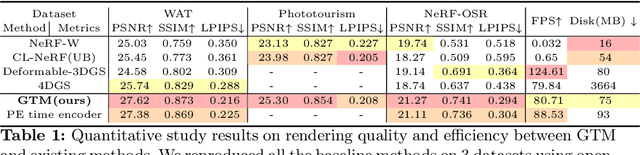


Recent advancements in neural rendering techniques have significantly enhanced the fidelity of 3D reconstruction. Notably, the emergence of 3D Gaussian Splatting (3DGS) has marked a significant milestone by adopting a discrete scene representation, facilitating efficient training and real-time rendering. Several studies have successfully extended the real-time rendering capability of 3DGS to dynamic scenes. However, a challenge arises when training images are captured under vastly differing weather and lighting conditions. This scenario poses a challenge for 3DGS and its variants in achieving accurate reconstructions. Although NeRF-based methods (NeRF-W, CLNeRF) have shown promise in handling such challenging conditions, their computational demands hinder real-time rendering capabilities. In this paper, we present Gaussian Time Machine (GTM) which models the time-dependent attributes of Gaussian primitives with discrete time embedding vectors decoded by a lightweight Multi-Layer-Perceptron(MLP). By adjusting the opacity of Gaussian primitives, we can reconstruct visibility changes of objects. We further propose a decomposed color model for improved geometric consistency. GTM achieved state-of-the-art rendering fidelity on 3 datasets and is 100 times faster than NeRF-based counterparts in rendering. Moreover, GTM successfully disentangles the appearance changes and renders smooth appearance interpolation.