 Add to Chrome
 Add to Firefox
 Add to Edge
Selective, Regularized, and Calibrated: Harnessing Vision Foundation Models for Cross-Domain Few-Shot Semantic Segmentation
May 19, 2026
Vision foundation models (VFMs) have achieved strong performance across various vision tasks. However, it still remains challenging to apply VFMs for cross-domain few-shot segmentation (CD-FSS), which segments objects of novel classes under domain shifts using only a few labeled exemplars. The challenge is mainly driven by two factors: (1) limited labeled exemplars per novel class relative to the scale of VFM pre-training, making the model prone to overfitting during retraining, and (2) target-domain shifts underrepresented during pre-training, inducing cross-domain inconsistency and layer-wise sensitivity. To address these issues, we propose Hierarchical Exemplar Representation Adaptation (HERA), a three-stage select-regularize-calibrate VFM-based segmentation framework that learns effectively from limited labels and adapts to novel domains without source-data retraining. We first design Hierarchical Layer Selection (HLS) to adaptively identify the most informative VFM layer using a data-dependent Exemplar Transfer Risk (ETR) computed for each candidate layer. Then, Prior-Guided Regularization (PGR) regularizes interactions on the selected representation, yielding well-structured local signals for the subsequent stage. Furthermore, Pixelwise Adaptive Calibration (PAC) combines the selected representation with the refined interaction maps to calibrate pixel-wise predictions, producing consistent masks. Together, these stages form a hierarchical select-regularize-calibrate pipeline that guides frozen VFM features in new domains while fine-tuning less than 2.7% of parameters at test time. Extensive experiments show that HERA surpasses the state of the art by more than 4.1 mIoU across multiple CD-FSS benchmarks.

GraphiContact: Pose-aware Human-Scene Robust Contact Perception for Interactive Systems
Mar 19, 2026Monocular vertex-level human-scene contact prediction is a fundamental capability for interactive systems such as assistive monitoring, embodied AI, and rehabilitation analysis. In this work, we study this task jointly with single-image 3D human mesh reconstruction, using reconstructed body geometry as a scaffold for contact reasoning. Existing approaches either focus on contact prediction without sufficiently exploiting explicit 3D human priors, or emphasize pose/mesh reconstruction without directly optimizing robust vertex-level contact inference under occlusion and perceptual noise. To address this gap, we propose GraphiContact, a pose-aware framework that transfers complementary human priors from two pretrained Transformer encoders and predicts per-vertex human-scene contact on the reconstructed mesh. To improve robustness in real-world scenarios, we further introduce a Single-Image Multi-Infer Uncertainty (SIMU) training strategy with token-level adaptive routing, which simulates occlusion and noisy observations during training while preserving efficient single-branch inference at test time. Experiments on five benchmark datasets show that GraphiContact achieves consistent gains on both contact prediction and 3D human reconstruction. Our code, based on the GraphiContact method, provides comprehensive 3D human reconstruction and interaction analysis, and will be publicly available at https://github.com/Aveiro-Lin/GraphiContact.
SyncTalk++: High-Fidelity and Efficient Synchronized Talking Heads Synthesis Using Gaussian Splatting
Jun 17, 2025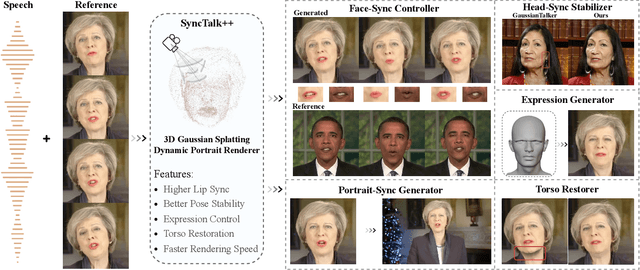
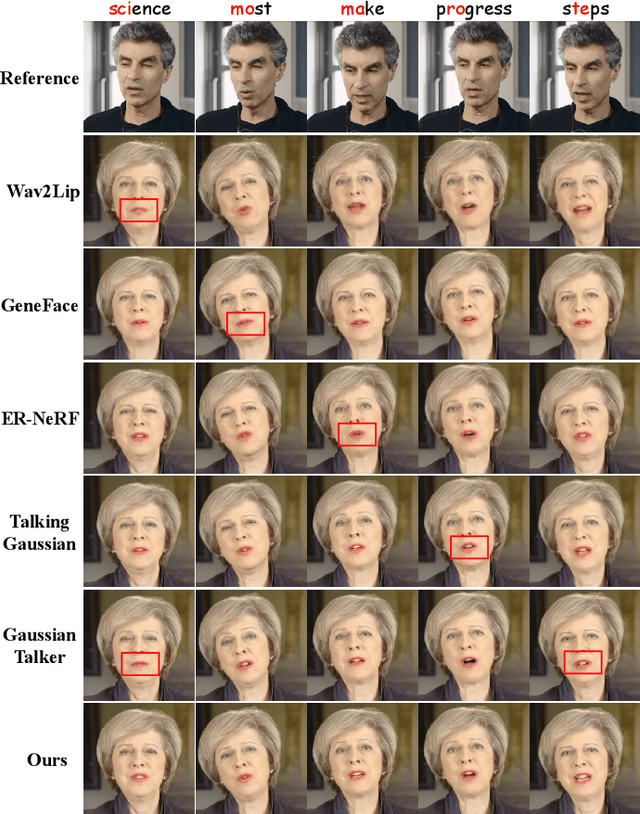
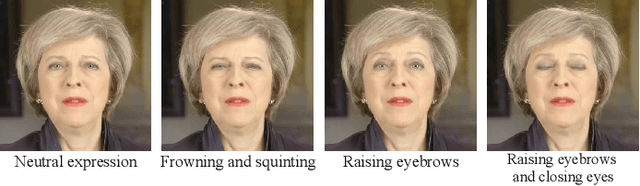
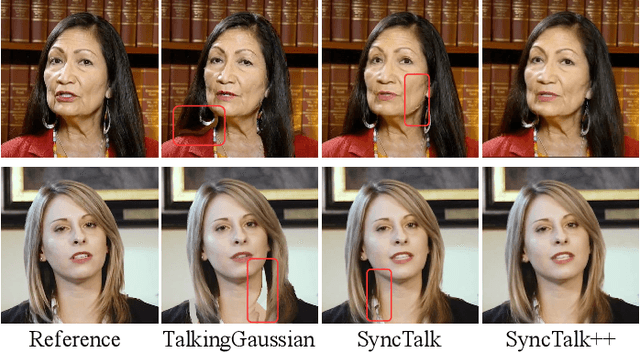
Achieving high synchronization in the synthesis of realistic, speech-driven talking head videos presents a significant challenge. A lifelike talking head requires synchronized coordination of subject identity, lip movements, facial expressions, and head poses. The absence of these synchronizations is a fundamental flaw, leading to unrealistic results. To address the critical issue of synchronization, identified as the ''devil'' in creating realistic talking heads, we introduce SyncTalk++, which features a Dynamic Portrait Renderer with Gaussian Splatting to ensure consistent subject identity preservation and a Face-Sync Controller that aligns lip movements with speech while innovatively using a 3D facial blendshape model to reconstruct accurate facial expressions. To ensure natural head movements, we propose a Head-Sync Stabilizer, which optimizes head poses for greater stability. Additionally, SyncTalk++ enhances robustness to out-of-distribution (OOD) audio by incorporating an Expression Generator and a Torso Restorer, which generate speech-matched facial expressions and seamless torso regions. Our approach maintains consistency and continuity in visual details across frames and significantly improves rendering speed and quality, achieving up to 101 frames per second. Extensive experiments and user studies demonstrate that SyncTalk++ outperforms state-of-the-art methods in synchronization and realism. We recommend watching the supplementary video: https://ziqiaopeng.github.io/synctalk++.