 Add to Chrome
 Add to Firefox
 Add to Edge
SurMo: Surface-based 4D Motion Modeling for Dynamic Human Rendering
Apr 02, 2024
Dynamic human rendering from video sequences has achieved remarkable progress by formulating the rendering as a mapping from static poses to human images. However, existing methods focus on the human appearance reconstruction of every single frame while the temporal motion relations are not fully explored. In this paper, we propose a new 4D motion modeling paradigm, SurMo, that jointly models the temporal dynamics and human appearances in a unified framework with three key designs: 1) Surface-based motion encoding that models 4D human motions with an efficient compact surface-based triplane. It encodes both spatial and temporal motion relations on the dense surface manifold of a statistical body template, which inherits body topology priors for generalizable novel view synthesis with sparse training observations. 2) Physical motion decoding that is designed to encourage physical motion learning by decoding the motion triplane features at timestep t to predict both spatial derivatives and temporal derivatives at the next timestep t+1 in the training stage. 3) 4D appearance decoding that renders the motion triplanes into images by an efficient volumetric surface-conditioned renderer that focuses on the rendering of body surfaces with motion learning conditioning. Extensive experiments validate the state-of-the-art performance of our new paradigm and illustrate the expressiveness of surface-based motion triplanes for rendering high-fidelity view-consistent humans with fast motions and even motion-dependent shadows. Our project page is at: https://taohuumd.github.io/projects/SurMo/

StructLDM: Structured Latent Diffusion for 3D Human Generation
Apr 02, 2024Recent 3D human generative models have achieved remarkable progress by learning 3D-aware GANs from 2D images. However, existing 3D human generative methods model humans in a compact 1D latent space, ignoring the articulated structure and semantics of human body topology. In this paper, we explore more expressive and higher-dimensional latent space for 3D human modeling and propose StructLDM, a diffusion-based unconditional 3D human generative model, which is learned from 2D images. StructLDM solves the challenges imposed due to the high-dimensional growth of latent space with three key designs: 1) A semantic structured latent space defined on the dense surface manifold of a statistical human body template. 2) A structured 3D-aware auto-decoder that factorizes the global latent space into several semantic body parts parameterized by a set of conditional structured local NeRFs anchored to the body template, which embeds the properties learned from the 2D training data and can be decoded to render view-consistent humans under different poses and clothing styles. 3) A structured latent diffusion model for generative human appearance sampling. Extensive experiments validate StructLDM's state-of-the-art generation performance and illustrate the expressiveness of the structured latent space over the well-adopted 1D latent space. Notably, StructLDM enables different levels of controllable 3D human generation and editing, including pose/view/shape control, and high-level tasks including compositional generations, part-aware clothing editing, 3D virtual try-on, etc. Our project page is at: https://taohuumd.github.io/projects/StructLDM/.
Large Motion Model for Unified Multi-Modal Motion Generation
Apr 01, 2024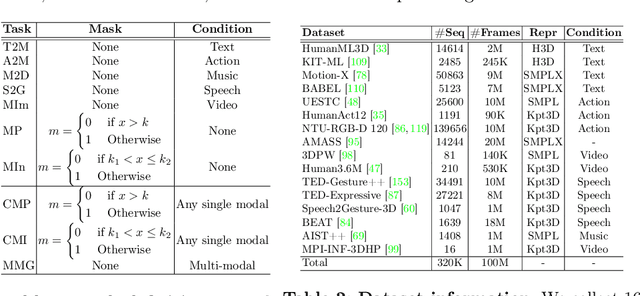

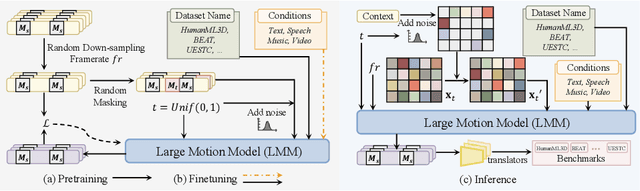
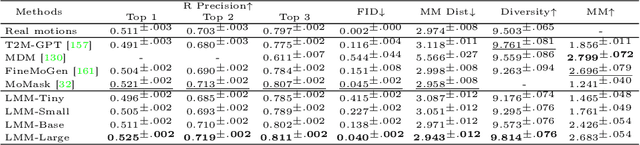
Human motion generation, a cornerstone technique in animation and video production, has widespread applications in various tasks like text-to-motion and music-to-dance. Previous works focus on developing specialist models tailored for each task without scalability. In this work, we present Large Motion Model (LMM), a motion-centric, multi-modal framework that unifies mainstream motion generation tasks into a generalist model. A unified motion model is appealing since it can leverage a wide range of motion data to achieve broad generalization beyond a single task. However, it is also challenging due to the heterogeneous nature of substantially different motion data and tasks. LMM tackles these challenges from three principled aspects: 1) Data: We consolidate datasets with different modalities, formats and tasks into a comprehensive yet unified motion generation dataset, MotionVerse, comprising 10 tasks, 16 datasets, a total of 320k sequences, and 100 million frames. 2) Architecture: We design an articulated attention mechanism ArtAttention that incorporates body part-aware modeling into Diffusion Transformer backbone. 3) Pre-Training: We propose a novel pre-training strategy for LMM, which employs variable frame rates and masking forms, to better exploit knowledge from diverse training data. Extensive experiments demonstrate that our generalist LMM achieves competitive performance across various standard motion generation tasks over state-of-the-art specialist models. Notably, LMM exhibits strong generalization capabilities and emerging properties across many unseen tasks. Additionally, our ablation studies reveal valuable insights about training and scaling up large motion models for future research.
Unsolvable Problem Detection: Evaluating Trustworthiness of Vision Language Models
Mar 29, 2024This paper introduces a novel and significant challenge for Vision Language Models (VLMs), termed Unsolvable Problem Detection (UPD). UPD examines the VLM's ability to withhold answers when faced with unsolvable problems in the context of Visual Question Answering (VQA) tasks. UPD encompasses three distinct settings: Absent Answer Detection (AAD), Incompatible Answer Set Detection (IASD), and Incompatible Visual Question Detection (IVQD). To deeply investigate the UPD problem, extensive experiments indicate that most VLMs, including GPT-4V and LLaVA-Next-34B, struggle with our benchmarks to varying extents, highlighting significant room for the improvements. To address UPD, we explore both training-free and training-based solutions, offering new insights into their effectiveness and limitations. We hope our insights, together with future efforts within the proposed UPD settings, will enhance the broader understanding and development of more practical and reliable VLMs.
Duolando: Follower GPT with Off-Policy Reinforcement Learning for Dance Accompaniment
Mar 27, 2024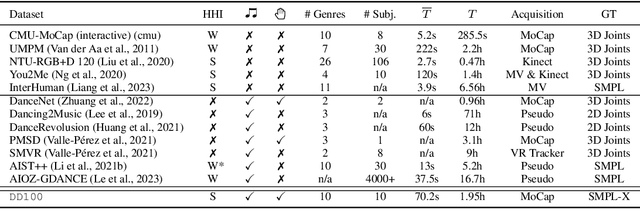
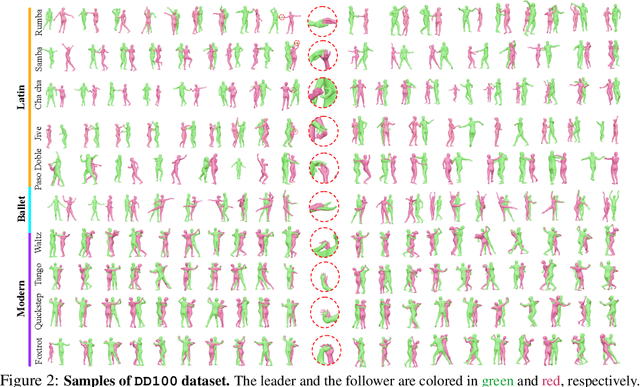
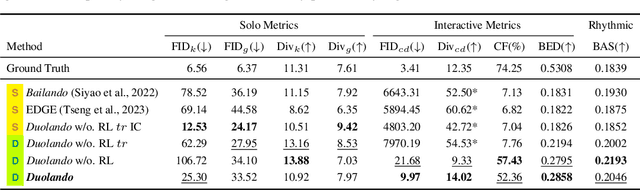
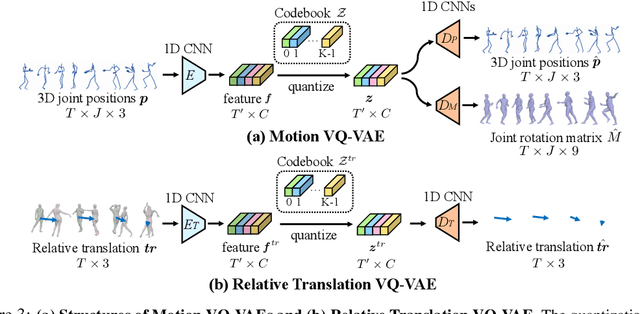
We introduce a novel task within the field of 3D dance generation, termed dance accompaniment, which necessitates the generation of responsive movements from a dance partner, the "follower", synchronized with the lead dancer's movements and the underlying musical rhythm. Unlike existing solo or group dance generation tasks, a duet dance scenario entails a heightened degree of interaction between the two participants, requiring delicate coordination in both pose and position. To support this task, we first build a large-scale and diverse duet interactive dance dataset, DD100, by recording about 117 minutes of professional dancers' performances. To address the challenges inherent in this task, we propose a GPT-based model, Duolando, which autoregressively predicts the subsequent tokenized motion conditioned on the coordinated information of the music, the leader's and the follower's movements. To further enhance the GPT's capabilities of generating stable results on unseen conditions (music and leader motions), we devise an off-policy reinforcement learning strategy that allows the model to explore viable trajectories from out-of-distribution samplings, guided by human-defined rewards. Based on the collected dataset and proposed method, we establish a benchmark with several carefully designed metrics.
AiOS: All-in-One-Stage Expressive Human Pose and Shape Estimation
Mar 26, 2024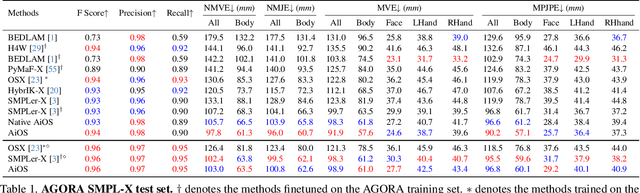
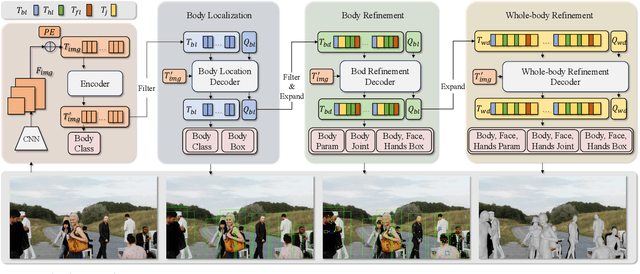
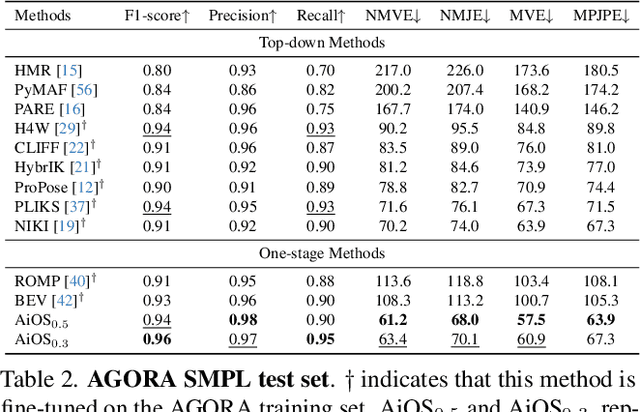
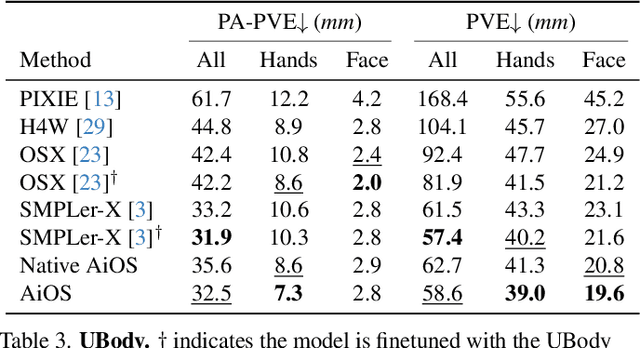
Expressive human pose and shape estimation (a.k.a. 3D whole-body mesh recovery) involves the human body, hand, and expression estimation. Most existing methods have tackled this task in a two-stage manner, first detecting the human body part with an off-the-shelf detection model and inferring the different human body parts individually. Despite the impressive results achieved, these methods suffer from 1) loss of valuable contextual information via cropping, 2) introducing distractions, and 3) lacking inter-association among different persons and body parts, inevitably causing performance degradation, especially for crowded scenes. To address these issues, we introduce a novel all-in-one-stage framework, AiOS, for multiple expressive human pose and shape recovery without an additional human detection step. Specifically, our method is built upon DETR, which treats multi-person whole-body mesh recovery task as a progressive set prediction problem with various sequential detection. We devise the decoder tokens and extend them to our task. Specifically, we first employ a human token to probe a human location in the image and encode global features for each instance, which provides a coarse location for the later transformer block. Then, we introduce a joint-related token to probe the human joint in the image and encoder a fine-grained local feature, which collaborates with the global feature to regress the whole-body mesh. This straightforward but effective model outperforms previous state-of-the-art methods by a 9% reduction in NMVE on AGORA, a 30% reduction in PVE on EHF, a 10% reduction in PVE on ARCTIC, and a 3% reduction in PVE on EgoBody.
AID: Attention Interpolation of Text-to-Image Diffusion
Mar 26, 2024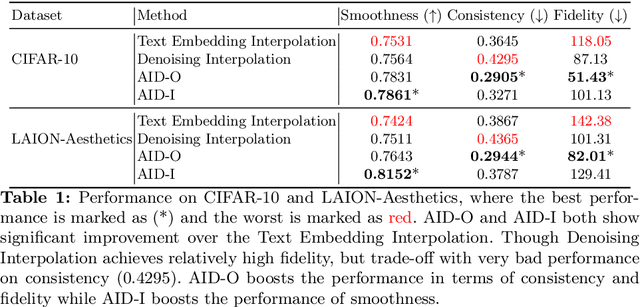

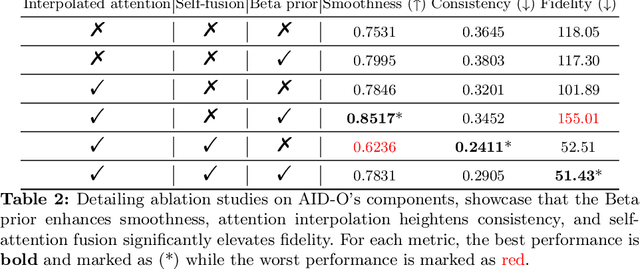
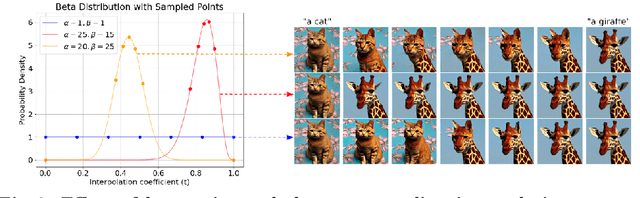
Conditional diffusion models can create unseen images in various settings, aiding image interpolation. Interpolation in latent spaces is well-studied, but interpolation with specific conditions like text or poses is less understood. Simple approaches, such as linear interpolation in the space of conditions, often result in images that lack consistency, smoothness, and fidelity. To that end, we introduce a novel training-free technique named Attention Interpolation via Diffusion (AID). Our key contributions include 1) proposing an inner/outer interpolated attention layer; 2) fusing the interpolated attention with self-attention to boost fidelity; and 3) applying beta distribution to selection to increase smoothness. We also present a variant, Prompt-guided Attention Interpolation via Diffusion (PAID), that considers interpolation as a condition-dependent generative process. This method enables the creation of new images with greater consistency, smoothness, and efficiency, and offers control over the exact path of interpolation. Our approach demonstrates effectiveness for conceptual and spatial interpolation. Code and demo are available at https://github.com/QY-H00/attention-interpolation-diffusion.
Calib3D: Calibrating Model Preferences for Reliable 3D Scene Understanding
Mar 25, 2024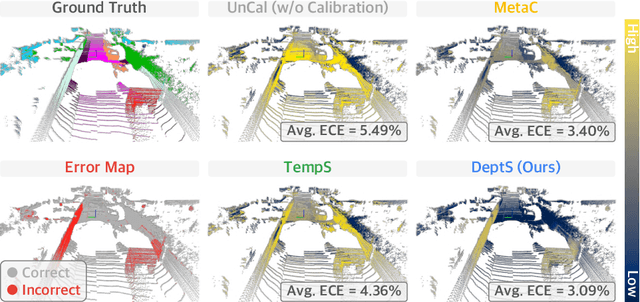
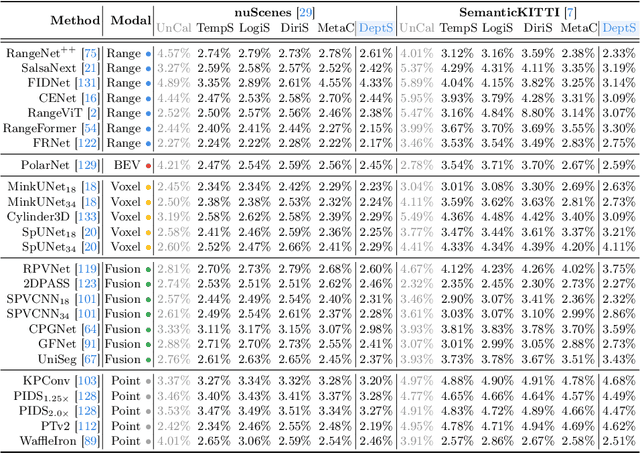
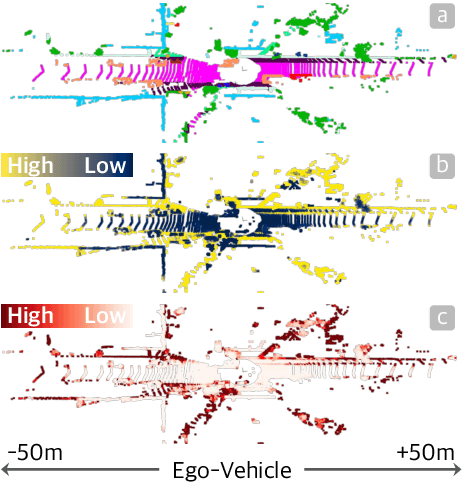
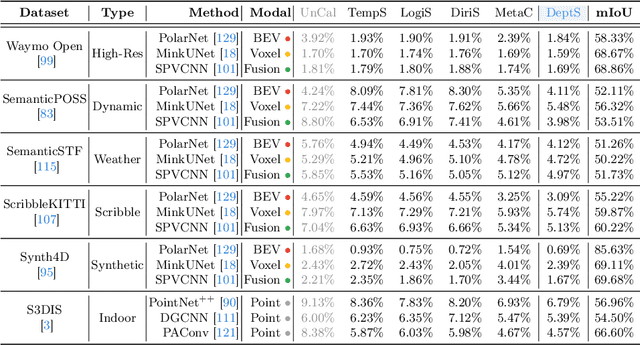
Safety-critical 3D scene understanding tasks necessitate not only accurate but also confident predictions from 3D perception models. This study introduces Calib3D, a pioneering effort to benchmark and scrutinize the reliability of 3D scene understanding models from an uncertainty estimation viewpoint. We comprehensively evaluate 28 state-of-the-art models across 10 diverse 3D datasets, uncovering insightful phenomena that cope with both the aleatoric and epistemic uncertainties in 3D scene understanding. We discover that despite achieving impressive levels of accuracy, existing models frequently fail to provide reliable uncertainty estimates -- a pitfall that critically undermines their applicability in safety-sensitive contexts. Through extensive analysis of key factors such as network capacity, LiDAR representations, rasterization resolutions, and 3D data augmentation techniques, we correlate these aspects directly with the model calibration efficacy. Furthermore, we introduce DeptS, a novel depth-aware scaling approach aimed at enhancing 3D model calibration. Extensive experiments across a wide range of configurations validate the superiority of our method. We hope this work could serve as a cornerstone for fostering reliable 3D scene understanding. Code and benchmark toolkits are publicly available.
ThemeStation: Generating Theme-Aware 3D Assets from Few Exemplars
Mar 22, 2024Real-world applications often require a large gallery of 3D assets that share a consistent theme. While remarkable advances have been made in general 3D content creation from text or image, synthesizing customized 3D assets following the shared theme of input 3D exemplars remains an open and challenging problem. In this work, we present ThemeStation, a novel approach for theme-aware 3D-to-3D generation. ThemeStation synthesizes customized 3D assets based on given few exemplars with two goals: 1) unity for generating 3D assets that thematically align with the given exemplars and 2) diversity for generating 3D assets with a high degree of variations. To this end, we design a two-stage framework that draws a concept image first, followed by a reference-informed 3D modeling stage. We propose a novel dual score distillation (DSD) loss to jointly leverage priors from both the input exemplars and the synthesized concept image. Extensive experiments and user studies confirm that ThemeStation surpasses prior works in producing diverse theme-aware 3D models with impressive quality. ThemeStation also enables various applications such as controllable 3D-to-3D generation.
FRESCO: Spatial-Temporal Correspondence for Zero-Shot Video Translation
Mar 19, 2024The remarkable efficacy of text-to-image diffusion models has motivated extensive exploration of their potential application in video domains. Zero-shot methods seek to extend image diffusion models to videos without necessitating model training. Recent methods mainly focus on incorporating inter-frame correspondence into attention mechanisms. However, the soft constraint imposed on determining where to attend to valid features can sometimes be insufficient, resulting in temporal inconsistency. In this paper, we introduce FRESCO, intra-frame correspondence alongside inter-frame correspondence to establish a more robust spatial-temporal constraint. This enhancement ensures a more consistent transformation of semantically similar content across frames. Beyond mere attention guidance, our approach involves an explicit update of features to achieve high spatial-temporal consistency with the input video, significantly improving the visual coherence of the resulting translated videos. Extensive experiments demonstrate the effectiveness of our proposed framework in producing high-quality, coherent videos, marking a notable improvement over existing zero-shot methods.