 Add to Chrome
 Add to Firefox
 Add to Edge
TCAM for Autonomous Deformable Manipulation: The RMC2 Champion System for WBCD 2026 Track 4
Aug 11, 2026
This technical report describes the RMC2 Team's champion solution for the WBCD 2026 Track 4: Deformable Manipulation Challenge. The task requires a robot to pick a single T-shirt from a stack, load it onto a printing pallet, align the collar with a target area, and smooth the printing region, a sequence that involves single-layer separation, deformable transport, precise placement, and contact-rich surface adjustment. The competition strongly incentivizes fully autonomous execution, motivating the development of an autonomous solution. We built a fully autonomous system around the TCAM (TermiBrain Causal Action Model) framework, with the design principle that hardware, perception, data, and learning should jointly reduce the physical interaction complexity the policy must handle. A custom 3D-printed gripper designed for single-layer fabric separation improves picking reliability on a dual-arm ARX X5 platform. A wrist-centric four-camera setup pairs upper fisheye cameras for task-level context with lower RGB cameras for close-range gripper-cloth contact observation. We combine portable UMI-style demonstrations with real-robot demonstrations collected on the deployable platform to provide both broad manipulation priors and deployment-specific dynamics. TCAM ties these components into a closed loop: each trajectory is analyzed to identify the physical factors contributing to its outcome, driving targeted data recollection and policy fine-tuning. The policy outputs 30-step end-effector delta-pose action chunks from a multi-view VLA backbone. In the final competition, our system loaded 25 T-shirts at an average of approximately 23 seconds per attempt, with 22 achieving the required surface smoothness, securing first place in Track 4.

Retrieving and Refining Winning Noise Tickets for Diffusion-Based Motion Generation
Jul 07, 2026Diffusion-based text-to-motion models synthesize realistic human motions but often exhibit semantic drift from the input text. Motion is inherently temporal, especially in compositional and long-duration sequences that require semantic consistency across multiple action segments and smooth kinematic transitions throughout the trajectory. We posit that the initial noise is central to this consistency: within the Gaussian noise space, certain instances, i.e. winning noise tickets, carry latent structure that biases denoising toward particular motion semantics, even under null prompts. We propose WInning Noise Retrieval and Optimization (WINRO), a training-free, model-agnostic framework that improves text-motion alignment by selecting and refining such tickets before diffusion sampling. WINRO maps random noises to motion features generated under null prompts, retrieves the best-aligned noise for a given text, and refines it via a KL-regularized objective that reduces the residual semantic gap while preserving the Gaussian prior. An optional LoRA-based adapter amortizes this refinement into a single forward pass. WINRO consistently improves text-motion fidelity across different base models, MDM and MotionLCM, on HumanML3D without retraining, improves temporal robustness on the MTT benchmark, and generalizes to applications such as motion stylization and spatial constraint satisfaction.
ARMS: Anchor-Relational Motion Streaming for Seamless Solo-Social Motion Transitions
Jul 07, 2026Generating temporally continuous and socially coherent human motion from text remains a fundamental challenge, particularly in realistic streams where people act alone, enter interactions, and later disengage. Most existing methods generate fixed-length motion clips under static agent configurations, which makes them brittle to solo-social transitions and unsuitable for incremental generation over long horizons. We propose ARMS, an Anchor-Relational Motion Streaming framework that unifies solo motion and human-human interaction within a single causal generative process. ARMS introduces a dynamics-asymmetric representation that decouples per-person temporal evolution from inter-person alignment via a partner-referenced relative-translation term, enabling seamless switching of social coupling without sacrificing long-horizon stability or spatial consistency between agents. On top of a causal latent space, a causal relational diffusion model progressively refines motion segment by segment using only past context, capturing both intra-person temporal dependencies and inter-person relations. Mode-aware relational gating activates or masks cross-agent connections, allowing the same model to support both solo and interaction generation. Experiments show that ARMS improves transition smoothness and social coherence compared to interaction-centric baselines, while also achieving competitive results on human-human interaction benchmarks.
InterCMDM: Block-Causal Diffusion for Autoregressive Human Interaction Generation
Jul 02, 2026Text-conditioned human interaction generation must capture both long-range temporal causality within each individual and tightly coupled coordination between partners. Existing interaction diffusion models typically denoise full sequences using bidirectional attention, which obscures causality and hinders streaming and long-horizon generation. Autoregressive alternatives enforce causality but often suffer from temporal drift, leading to coordination degradation and unstable interaction dynamics over time. We propose InterCMDM, a block-causal latent diffusion framework for autoregressive two-person interaction generation. InterCMDM introduces a Dual-Stream Causal Diffusion Transformer that maintains separate causal streams for each person while modeling inter-person dependencies via unified dual-stream attention with multi-task attention masks. These masks unify interaction modeling within a single attention mechanism and support diverse coordination behaviors, including simultaneous actions, reactive responses, leader-follower dynamics, and independent motion. By training a single model across these mask configurations as a form of data augmentation, InterCMDM enables controllable interaction generation by simply selecting the desired attention mask at inference time. Finally, a block-wise diffusion objective enables stable latent rollout over long sequences without repeated decode-encode cycles. InterCMDM achieves state-of-the-art performance on InterHuman and Inter-X, improving text-motion alignment, realism, and long-horizon continuity.
A Unified Framework for Multi-Contact Path Planning in the Rolling Robot Systems
Jun 27, 2026Rolling motion planning is challenging because rolling contact imposes nonholonomic constraints and the configuration evolves on a curved manifold. The problem becomes substantially harder in multi-contact settings, where multiple bodies roll without slip and the contact states are coupled. This paper presents a new framework for multi-contact path planning in spherical rolling robotics under no-slip constraints. We first derive a compact kinematic model for multi-sphere rolling using Montana's contact-coordinate formulation, where each contact is represented by a stacked five-state vector. Building on this model, we construct a Voronoi-based roadmap directly on the spherical contact manifold, incorporating spherical-cap obstacles and mutual-exclusion regions via on-manifold collision checking, and refine discrete graph paths using manifold-consistent log-exp smoothing. The resulting smoothed surface paths are then lifted to admissible multi-contact rolling motions through the derived Montana kinematics and validated via forward simulation. We further evaluate feasibility and path quality versus trajectory smoothness, Voronoi seed density, and computation time. The proposed framework provides a foundation for extending the method to non-spherical geometries, time-varying obstacle environments, and experimental validation on physical rolling robotic platforms.
PenduMorph: Development and Motion Analysis of Pendulum-Actuated Rolling Reconfigurable Spherical Robot with Magnetic-Coupling
Jun 21, 2026This paper presents "PenduMorph", a wireless reconfigurable rolling spherical robot designed as a modular platform for enclosed locomotion and inter-module interaction in challenging environments. The proposed robot extends our previous pendulum-actuated rolling disk concept to a fully enclosed spherical architecture integrating a 2-DoF internal pendulum, onboard control, battery-powered operation, and magnetic docking. The design aims to combine independent rolling mobility with protected hardware and reliable reconfigurability. We first present the robot design and an analytical study of the magnetic coupling mechanism to evaluate retention and interaction between coupled modules. We then experimentally investigate key motion behaviors at both the single-module and dual-module levels, including independent rolling, magnetic coupling, and coordinated coupled motion. The results show that the proposed platform enables stable wireless operation and a set of distinctive reconfigurable rolling behaviors, providing a useful foundation for future modular spherical robots operating in contact-rich and demanding environments.
ProjFlow: Projection Sampling with Flow Matching for Zero-Shot Exact Spatial Motion Control
Feb 26, 2026Generating human motion with precise spatial control is a challenging problem. Existing approaches often require task-specific training or slow optimization, and enforcing hard constraints frequently disrupts motion naturalness. Building on the observation that many animation tasks can be formulated as a linear inverse problem, we introduce ProjFlow, a training-free sampler that achieves zero-shot, exact satisfaction of linear spatial constraints while preserving motion realism. Our key advance is a novel kinematics-aware metric that encodes skeletal topology. This metric allows the sampler to enforce hard constraints by distributing corrections coherently across the entire skeleton, avoiding the unnatural artifacts of naive projection. Furthermore, for sparse inputs, such as filling in long gaps between a few keyframes, we introduce a time-varying formulation using pseudo-observations that fade during sampling. Extensive experiments on representative applications, motion inpainting, and 2D-to-3D lifting, demonstrate that ProjFlow achieves exact constraint satisfaction and matches or improves realism over zero-shot baselines, while remaining competitive with training-based controllers.
Causal Motion Diffusion Models for Autoregressive Motion Generation
Feb 26, 2026Recent advances in motion diffusion models have substantially improved the realism of human motion synthesis. However, existing approaches either rely on full-sequence diffusion models with bidirectional generation, which limits temporal causality and real-time applicability, or autoregressive models that suffer from instability and cumulative errors. In this work, we present Causal Motion Diffusion Models (CMDM), a unified framework for autoregressive motion generation based on a causal diffusion transformer that operates in a semantically aligned latent space. CMDM builds upon a Motion-Language-Aligned Causal VAE (MAC-VAE), which encodes motion sequences into temporally causal latent representations. On top of this latent representation, an autoregressive diffusion transformer is trained using causal diffusion forcing to perform temporally ordered denoising across motion frames. To achieve fast inference, we introduce a frame-wise sampling schedule with causal uncertainty, where each subsequent frame is predicted from partially denoised previous frames. The resulting framework supports high-quality text-to-motion generation, streaming synthesis, and long-horizon motion generation at interactive rates. Experiments on HumanML3D and SnapMoGen demonstrate that CMDM outperforms existing diffusion and autoregressive models in both semantic fidelity and temporal smoothness, while substantially reducing inference latency.
Who You Are Matters: Bridging Topics and Social Roles via LLM-Enhanced Logical Recommendation
May 16, 2025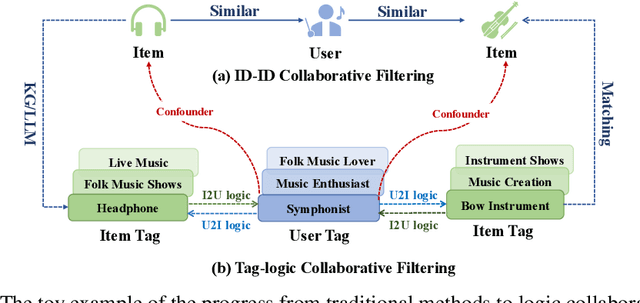
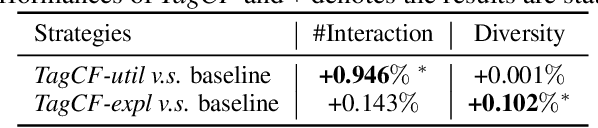
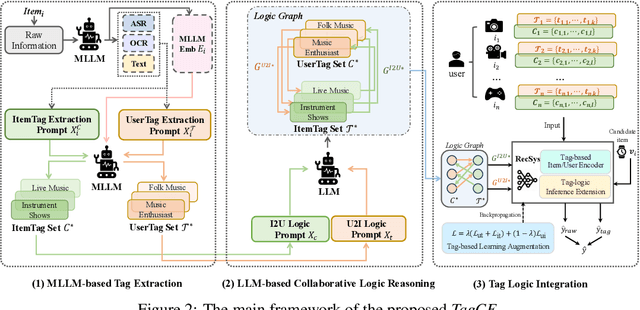
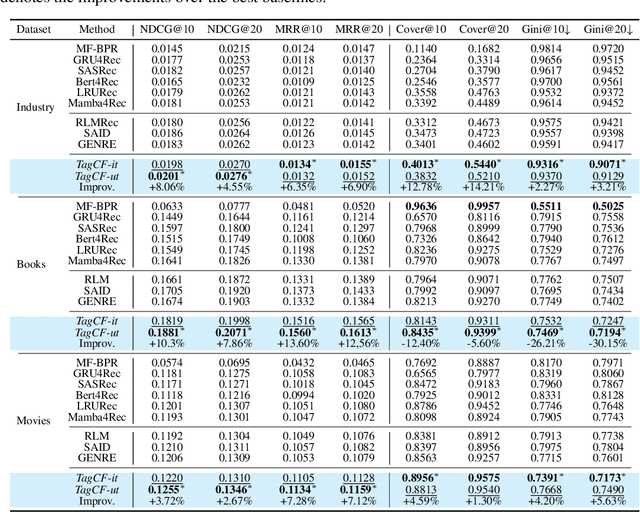
Recommender systems filter contents/items valuable to users by inferring preferences from user features and historical behaviors. Mainstream approaches follow the learning-to-rank paradigm, which focus on discovering and modeling item topics (e.g., categories), and capturing user preferences on these topics based on historical interactions. However, this paradigm often neglects the modeling of user characteristics and their social roles, which are logical confounders influencing the correlated interest and user preference transition. To bridge this gap, we introduce the user role identification task and the behavioral logic modeling task that aim to explicitly model user roles and learn the logical relations between item topics and user social roles. We show that it is possible to explicitly solve these tasks through an efficient integration framework of Large Language Model (LLM) and recommendation systems, for which we propose TagCF. On the one hand, the exploitation of the LLM's world knowledge and logic inference ability produces a virtual logic graph that reveals dynamic and expressive knowledge of users, augmenting the recommendation performance. On the other hand, the user role aligns the user behavioral logic with the observed user feedback, refining our understanding of user behaviors. Additionally, we also show that the extracted user-item logic graph is empirically a general knowledge that can benefit a wide range of recommendation tasks, and conduct experiments on industrial and several public datasets as verification.
A Benchmark and Evaluation for Real-World Out-of-Distribution Detection Using Vision-Language Models
Jan 30, 2025
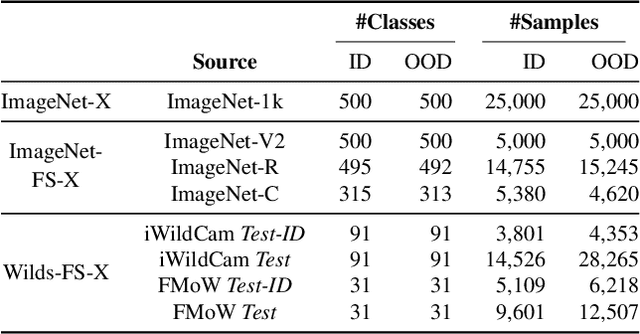

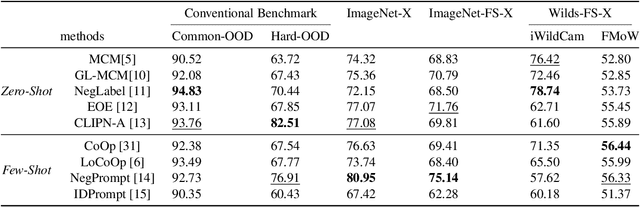
Out-of-distribution (OOD) detection is a task that detects OOD samples during inference to ensure the safety of deployed models. However, conventional benchmarks have reached performance saturation, making it difficult to compare recent OOD detection methods. To address this challenge, we introduce three novel OOD detection benchmarks that enable a deeper understanding of method characteristics and reflect real-world conditions. First, we present ImageNet-X, designed to evaluate performance under challenging semantic shifts. Second, we propose ImageNet-FS-X for full-spectrum OOD detection, assessing robustness to covariate shifts (feature distribution shifts). Finally, we propose Wilds-FS-X, which extends these evaluations to real-world datasets, offering a more comprehensive testbed. Our experiments reveal that recent CLIP-based OOD detection methods struggle to varying degrees across the three proposed benchmarks, and none of them consistently outperforms the others. We hope the community goes beyond specific benchmarks and includes more challenging conditions reflecting real-world scenarios. The code is https://github.com/hoshi23/OOD-X-Banchmarks.