 Add to Chrome
 Add to Firefox
 Add to Edge
ACRL: Adaptive Control of Training-Inference Discrepancy for Stable Reinforcement Learning
Jul 27, 2026
Reinforcement Learning (RL) training for Large Language Models (LLMs) often suffers from instability due to the discrepancy between training and inference. This training-inference discrepancy stems from two primary factors: an architectural separation between training and inference engines, and the use of low-precision quantization in inference versus higher-precision computation in training. To address training instability issues caused by high training-inference discrepancy, we present the principles and methods for its adaptive control. We propose Adaptive Control Reinforcement Learning (ACRL), which adaptively maintains the training-inference discrepancy within a reasonable range to ensure stable RL training. Beyond stabilization, ACRL inherently increases policy entropy, thereby enhancing exploration and improving accuracy. The experimental results show that when the inference engine utilizes FP8 quantization, ACRL consistently maintains the training-inference discrepancy within a reasonable range and stabilizes RL training. Furthermore, ACRL not only matches the accuracy of the BF16 baseline but also outperforms importance sampling (IS) fixes.

MXAttention: Data-Free Optimal Scaling and Pre-Normalization Quantization for MXFP4 Attention
Jul 27, 2026The quadratic cost of attention is a major bottleneck in diffusion-based video generation models. MXFP4 attention provides a promising path toward efficient inference, but direct MXFP4 quantization often degrades generation quality due to two numerical issues: the clipping-underflow trade-off from power-of-two scaling and the row-wise normalization error introduced in the softmax loop. We propose MXAttention, a data-free post-training quantization framework for MXFP4 attention. MXAttention introduces two components: Universal Optimal Scaling (UOS), which exploits the periodic structure of power-of-two microscaling to derive a distribution-independent optimal scaling boundary Qmax=7.25 without calibration or search, and Pre-Normalization Quantization (PNQ), which quantizes unnormalized softmax exponentials before row-wise summation to preserve normalization by construction. Experiments on Wan2.2 and HunyuanVideo show that MXAttention closes at least 95% of the VBench Imaging Quality gap between OCP MXFP4 and FP16, substantially improves frame-level similarity, and preserves FP16-level generation quality with less than 0.01 absolute degradation on all reported VBench metrics. MXAttention also achieves performance competitive with strong NVFP4-based baselines with negligible overhead when fused into the attention pipeline. The implementation is publicly available in MindIE-SD.
Can LLM Agents Respond to Disasters? Benchmarking Heterogeneous Geospatial Reasoning in Emergency Operations
May 12, 2026Operational disaster response goes beyond damage assessment, requiring responders to integrate multi-sensor signals, reason over road networks, populations and key facilities, plan evacuations, and produce actionable reports. However, prior work largely isolates remote-sensing perception or evaluates generic tool use, leaving the end-to-end workflows of emergency operations underexplored. In this paper, we introduce Disaster Operational Response Agent benchmark (DORA), the first agentic benchmark for end-to-end disaster response: 515 expert-authored tasks across 45 real-world disaster events spanning 10 types, paired with expert-verified, replayable gold trajectories totaling 3,500 tool-call steps. Tasks span five dimensions that cover the operational disaster-response pipeline: disaster perception, spatial relational analysis, rescue and evacuation planning, temporal evolution reasoning, and multi-modal report synthesis. Agents compose calls from a 108-tool MCP library over heterogeneous geospatial data: optical, SAR, and multi-spectral imagery across single-, bi-, and multi-temporal sequences (0.015-10m GSD), complemented by elevation and social vector layers. We comprehensively evaluate 13 frontier LLMs on our benchmark, revealing three persistent challenges: 1) disaster-domain grounding exposes unique failure modes (damage-semantic grounding, sensor-modality mismatch, and disaster-pipeline composition); 2) agents are doubly bottlenecked by tool selection and argument grounding, where gold tool-order hints improve accuracy by only 1.08-4.40%, and alternative scaffolds yield at most a 3.24% gain; 3) compositional fragility scales with trajectory length, the agent-to-gold gap widening from 7% to 56% on long pipelines. DORA establishes a rigorous testbed for operationally reliable disaster-response agents.
A satellite foundation model for improved wealth monitoring
Apr 25, 2026Poverty statistics guide social policy, but in many low- and middle-income countries, censuses and household surveys that collect these data are costly, infrequent, quickly outdated, and sometimes error-prone. Satellite imagery offers global coverage and the possibility of predicting economic livelihoods at scale, yet existing approaches to predicting livelihoods with imagery or other non-traditional data often fail to reliably identify local-level variation and, as we show, degrade under temporal shift. Here we introduce Tempov, a satellite foundation model pretrained by self-supervision on three million bi-temporal Landsat pairs and adapted with parameter-efficient fine-tuning to sparse survey labels. The model enables large-scale, high-resolution wealth mapping and dynamic measurement, including zero-shot nowcasting up to a decade after observed labels, retrospective hindcasting, and decadal change tracking, while outperforming existing neural network and geospatial foundation-model baselines. In low-label regimes, Tempov achieves competitive accuracy with only 10% of survey samples, indicating substantially reduced dependence on expensive label collection. The model further generalizes across populous countries within and outside Africa, and scales to a unified Africa-wide model with strong continent-level performance ($R^2=0.63$, $r^2=0.68$), from which we generate high-resolution decadal maps of wealth and wealth changes for the African continent. Analysis of these maps shows large variation in recent economic performance both within and across countries. Our open-source approach provides a pathway to timely, scalable, low-cost monitoring of wealth and poverty from routinely collected satellite data.
Rethinking Token-Level Credit Assignment in RLVR: A Polarity-Entropy Analysis
Apr 13, 2026Reinforcement Learning with Verifiable Rewards (RLVR) has substantially improved the reasoning ability of Large Language Models (LLMs). However, its sparse outcome-based rewards pose a fundamental credit assignment problem. We analyze this problem through the joint lens of reward polarity and token entropy. Our diagnostic tool, the Four Quadrant Decomposition, isolates token updates by polarity and entropy, and controlled ablations show that reasoning improvements concentrate in the high-entropy quadrants. To justify this observation theoretically, we adapt Conditional Mutual Information to the autoregressive RLVR setting and prove that the credit a token can carry is upper-bounded by its entropy. This view yields testable predictions that reasoning gains arise primarily from high-entropy tokens, with unique roles for positive and negative updates. A gradient analysis of GRPO further reveals how uniform reward broadcast dilutes signal at high-entropy positions while over-crediting deterministic tokens. Grounded in these insights, we propose Entropy-Aware Policy Optimization (EAPO) that modulates token-level learning signals accordingly. Extensive experiments demonstrate that EAPO outperforms strong baselines across two model families.
EarthVL: A Progressive Earth Vision-Language Understanding and Generation Framework
Jan 06, 2026Earth vision has achieved milestones in geospatial object recognition but lacks exploration in object-relational reasoning, limiting comprehensive scene understanding. To address this, a progressive Earth vision-language understanding and generation framework is proposed, including a multi-task dataset (EarthVLSet) and a semantic-guided network (EarthVLNet). Focusing on city planning applications, EarthVLSet includes 10.9k sub-meter resolution remote sensing images, land-cover masks, and 761.5k textual pairs involving both multiple-choice and open-ended visual question answering (VQA) tasks. In an object-centric way, EarthVLNet is proposed to progressively achieve semantic segmentation, relational reasoning, and comprehensive understanding. The first stage involves land-cover segmentation to generate object semantics for VQA guidance. Guided by pixel-wise semantics, the object awareness based large language model (LLM) performs relational reasoning and knowledge summarization to generate the required answers. As for optimization, the numerical difference loss is proposed to dynamically add difference penalties, addressing the various objects' statistics. Three benchmarks, including semantic segmentation, multiple-choice, and open-ended VQA demonstrated the superiorities of EarthVLNet, yielding three future directions: 1) segmentation features consistently enhance VQA performance even in cross-dataset scenarios; 2) multiple-choice tasks show greater sensitivity to the vision encoder than to the language decoder; and 3) open-ended tasks necessitate advanced vision encoders and language decoders for an optimal performance. We believe this dataset and method will provide a beneficial benchmark that connects ''image-mask-text'', advancing geographical applications for Earth vision.
Toward Global Large Language Models in Medicine
Jan 05, 2026Despite continuous advances in medical technology, the global distribution of health care resources remains uneven. The development of large language models (LLMs) has transformed the landscape of medicine and holds promise for improving health care quality and expanding access to medical information globally. However, existing LLMs are primarily trained on high-resource languages, limiting their applicability in global medical scenarios. To address this gap, we constructed GlobMed, a large multilingual medical dataset, containing over 500,000 entries spanning 12 languages, including four low-resource languages. Building on this, we established GlobMed-Bench, which systematically assesses 56 state-of-the-art proprietary and open-weight LLMs across multiple multilingual medical tasks, revealing significant performance disparities across languages, particularly for low-resource languages. Additionally, we introduced GlobMed-LLMs, a suite of multilingual medical LLMs trained on GlobMed, with parameters ranging from 1.7B to 8B. GlobMed-LLMs achieved an average performance improvement of over 40% relative to baseline models, with a more than threefold increase in performance on low-resource languages. Together, these resources provide an important foundation for advancing the equitable development and application of LLMs globally, enabling broader language communities to benefit from technological advances.
Advancing Weakly-Supervised Change Detection in Satellite Images via Adversarial Class Prompting
Aug 24, 2025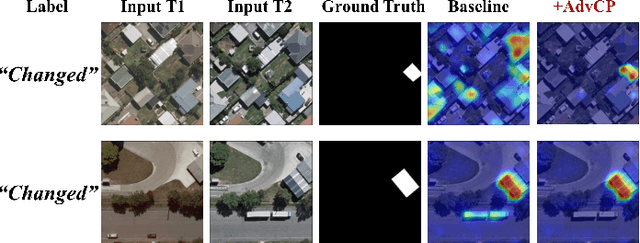
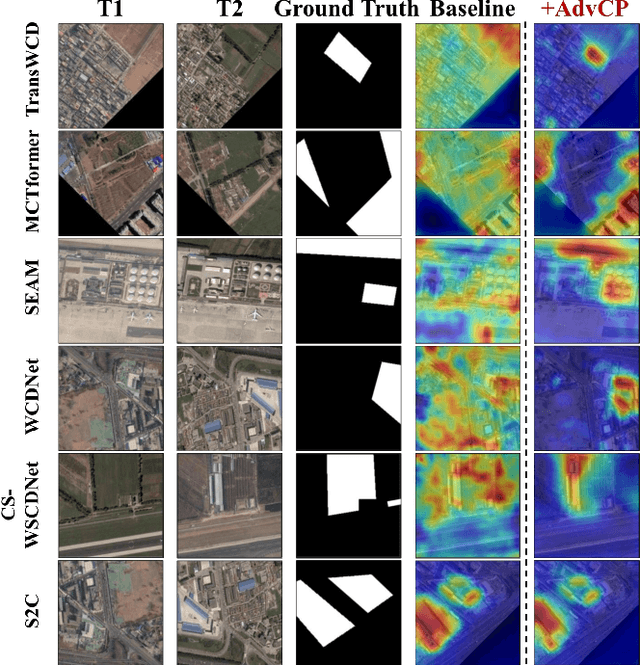
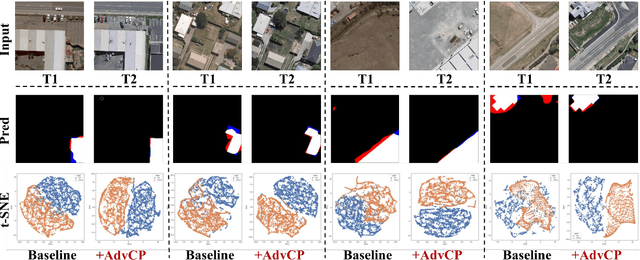
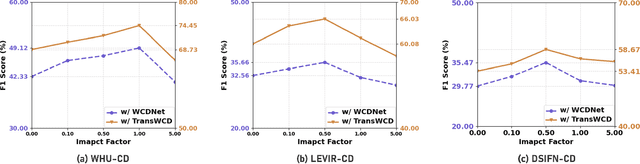
Weakly-Supervised Change Detection (WSCD) aims to distinguish specific object changes (e.g., objects appearing or disappearing) from background variations (e.g., environmental changes due to light, weather, or seasonal shifts) in paired satellite images, relying only on paired image (i.e., image-level) classification labels. This technique significantly reduces the need for dense annotations required in fully-supervised change detection. However, as image-level supervision only indicates whether objects have changed in a scene, WSCD methods often misclassify background variations as object changes, especially in complex remote-sensing scenarios. In this work, we propose an Adversarial Class Prompting (AdvCP) method to address this co-occurring noise problem, including two phases: a) Adversarial Prompt Mining: After each training iteration, we introduce adversarial prompting perturbations, using incorrect one-hot image-level labels to activate erroneous feature mappings. This process reveals co-occurring adversarial samples under weak supervision, namely background variation features that are likely to be misclassified as object changes. b) Adversarial Sample Rectification: We integrate these adversarially prompt-activated pixel samples into training by constructing an online global prototype. This prototype is built from an exponentially weighted moving average of the current batch and all historical training data. Our AdvCP can be seamlessly integrated into current WSCD methods without adding additional inference cost. Experiments on ConvNet, Transformer, and Segment Anything Model (SAM)-based baselines demonstrate significant performance enhancements. Furthermore, we demonstrate the generalizability of AdvCP to other multi-class weakly-supervised dense prediction scenarios. Code is available at https://github.com/zhenghuizhao/AdvCP
DynamicVL: Benchmarking Multimodal Large Language Models for Dynamic City Understanding
May 27, 2025Multimodal large language models have demonstrated remarkable capabilities in visual understanding, but their application to long-term Earth observation analysis remains limited, primarily focusing on single-temporal or bi-temporal imagery. To address this gap, we introduce DVL-Suite, a comprehensive framework for analyzing long-term urban dynamics through remote sensing imagery. Our suite comprises 15,063 high-resolution (1.0m) multi-temporal images spanning 42 megacities in the U.S. from 2005 to 2023, organized into two components: DVL-Bench and DVL-Instruct. The DVL-Bench includes seven urban understanding tasks, from fundamental change detection (pixel-level) to quantitative analyses (regional-level) and comprehensive urban narratives (scene-level), capturing diverse urban dynamics including expansion/transformation patterns, disaster assessment, and environmental challenges. We evaluate 17 state-of-the-art multimodal large language models and reveal their limitations in long-term temporal understanding and quantitative analysis. These challenges motivate the creation of DVL-Instruct, a specialized instruction-tuning dataset designed to enhance models' capabilities in multi-temporal Earth observation. Building upon this dataset, we develop DVLChat, a baseline model capable of both image-level question-answering and pixel-level segmentation, facilitating a comprehensive understanding of city dynamics through language interactions.
DisasterM3: A Remote Sensing Vision-Language Dataset for Disaster Damage Assessment and Response
May 27, 2025Large vision-language models (VLMs) have made great achievements in Earth vision. However, complex disaster scenes with diverse disaster types, geographic regions, and satellite sensors have posed new challenges for VLM applications. To fill this gap, we curate a remote sensing vision-language dataset (DisasterM3) for global-scale disaster assessment and response. DisasterM3 includes 26,988 bi-temporal satellite images and 123k instruction pairs across 5 continents, with three characteristics: 1) Multi-hazard: DisasterM3 involves 36 historical disaster events with significant impacts, which are categorized into 10 common natural and man-made disasters. 2)Multi-sensor: Extreme weather during disasters often hinders optical sensor imaging, making it necessary to combine Synthetic Aperture Radar (SAR) imagery for post-disaster scenes. 3) Multi-task: Based on real-world scenarios, DisasterM3 includes 9 disaster-related visual perception and reasoning tasks, harnessing the full potential of VLM's reasoning ability with progressing from disaster-bearing body recognition to structural damage assessment and object relational reasoning, culminating in the generation of long-form disaster reports. We extensively evaluated 14 generic and remote sensing VLMs on our benchmark, revealing that state-of-the-art models struggle with the disaster tasks, largely due to the lack of a disaster-specific corpus, cross-sensor gap, and damage object counting insensitivity. Focusing on these issues, we fine-tune four VLMs using our dataset and achieve stable improvements across all tasks, with robust cross-sensor and cross-disaster generalization capabilities.