 Add to Chrome
 Add to Firefox
 Add to Edge
Argus-Unified: Towards A Compact and Economical Unified Model for Image Understanding and Generation
Jul 28, 2026
Unifying visual understanding and generation in one model holds immense promise, but remains challenging and expensive due to heavy compute and data demands and conflicts between the visual features needed for these two capabilities. To address these challenges, we present Argus-Unified, a compact, effective and unified multimodal model built with low demand on computation and data. Instead of aligning modalities from scratch, Argus-Unified effectively leverages pretrained vision-language models (VLMs) that provide strong multimodal priors. Specifically, we introduce hybrid visual tokens that preserve continuous tokens for understanding while learning discrete tokens for generation from a frozen unified vision encoder. Our training pipeline includes two stages: the first stage learns a quantizer and image decoder on top of the frozen vision encoder, the second stage trains the LLM initialized from a pretrained VLM for the unified multimodal modeling. Using by far the least amount of data (15.6M) and the lowest cost (~$2,000), we demonstrate that unified multimodal models can be trained economically while achieving strong performance in both understanding and generation. Notably, our model attains state-of-the-art multimodal understanding on GQA, POPE, and VQAv2, and competitive generation quality compared to models with dedicated vision encoders (e.g., Janus, Janus-Pro), all at ~10x lower cost and with ~5x less data. We envision Argus-Unified as a useful baseline that lowers the development barrier for unified models.

HyperImageNet: A Large-Scale High-Spatial Resolution Hyperspectral Imagery Classification Benchmark
Jul 27, 2026We present HyperImageNet, a large-scale benchmark for fine-grained hyperspectral land-cover understanding. The dataset contains 26,084 airborne hyperspectral image patches with 224 spectral bands and 138 fine-grained land-cover categories. Unlike existing datasets, HyperImageNet provides raw imagery, pixel-level semantic labels, and object-level instance masks, supporting both semantic and instance segmentation. Furthermore, we establish an open-environment benchmark with strict spatial separation to evaluate representative methods and the HyperFree foundation model. Experimental results demonstrate the effectiveness of HyperImageNet for fine-grained hyperspectral understanding and open-environment remote sensing research.
On the Limits of Token Reduction for Efficient Unified Vision Language Training
May 31, 2026Unified vision-language models (VLMs) integrate visual understanding and visual generation within a single autoregressive backbone, but their joint training is computationally expensive and largely overlooked from an efficiency perspective. In this work, we study the feasibility and limits of token-reduction-based acceleration for unified VLM training. Through a systematic analysis of layerwise attention allocation, we uncover a fundamental asymmetry: visual understanding exhibits substantial late-layer visual redundancy, whereas visual generation maintains persistent dependence on image tokens across depth. Guided by this observation, we design task-specific accelerators that selectively reduce image-token computation for each objective. While these methods achieve significant efficiency gains in isolated settings, we observe a consistent synergy loss under unified training -- task-specific token dropping necessitates divergent parameter pathways and eliminates the mutual performance gains typically observed in joint optimization. Our findings suggest that efficient unified modeling requires preserving shared cross-task structures, highlighting the need for synergy-aware acceleration strategies. Project page: https://chicychen.github.io/TokenReductionUnifiedVLM/.
VibeToken: Scaling 1D Image Tokenizers and Autoregressive Models for Dynamic Resolution Generations
Apr 27, 2026We introduce an efficient, resolution-agnostic autoregressive (AR) image synthesis approach that generalizes to arbitrary resolutions and aspect ratios, narrowing the gap to diffusion models at scale. At its core is VibeToken, a novel resolution-agnostic 1D Transformer-based image tokenizer that encodes images into a dynamic, user-controllable sequence of 32-256 tokens, achieving a state-of-the-art efficiency and performance trade-off. Building on VibeToken, we present VibeToken-Gen, a class-conditioned AR generator with out-of-the-box support for arbitrary resolutions while requiring significantly fewer compute resources. Notably, VibeToken-Gen synthesizes 1024x1024 images using only 64 tokens and achieves 3.94 gFID; by comparison, a diffusion-based state-of-the-art alternative requires 1,024 tokens and attains 5.87 gFID. In contrast to fixed-resolution AR models such as LlamaGen -- whose inference FLOPs grow quadratically with resolution (11T FLOPs at 1024x1024) -- VibeToken-Gen maintains a constant 179G FLOPs (63.4x efficient) independent of resolution. We hope VibeToken can help unlock the wide adoption of AR visual generative models in production use cases.
Ran Score: a LLM-based Evaluation Score for Radiology Report Generation
Mar 24, 2026Chest X-ray report generation and automated evaluation are limited by poor recognition of low-prevalence abnormalities and inadequate handling of clinically important language, including negation and ambiguity. We develop a clinician-guided framework combining human expertise and large language models for multi-label finding extraction from free-text chest X-ray reports and use it to define Ran Score, a finding-level metric for report evaluation. Using three non-overlapping MIMIC-CXR-EN cohorts from a public chest X-ray dataset and an independent ChestX-CN validation cohort, we optimize prompts, establish radiologist-derived reference labels and evaluate report generation models. The optimized framework improves the macro-averaged score from 0.753 to 0.956 on the MIMIC-CXR-EN development cohort, exceeds the CheXbert benchmark by 15.7 percentage points on directly comparable labels, and shows robust generalization on the ChestX-CN validation cohort. Here we show that clinician-guided prompt optimization improves agreement with a radiologist-derived reference standard and that Ran Score enables finding-level evaluation of report fidelity, particularly for low-prevalence abnormalities.
UniCompress: Token Compression for Unified Vision-Language Understanding and Generation
Mar 11, 2026Unified models aim to support both understanding and generation by encoding images into discrete tokens and processing them alongside text within a single autoregressive framework. This unified design offers architectural simplicity and cross-modal synergy, which facilitates shared parameterization, consistent training objectives, and seamless transfer between modalities. However, the large number of visual tokens required by such models introduces substantial computation and memory overhead, and this inefficiency directly hinders deployment in resource constrained scenarios such as embodied AI systems. In this work, we propose a unified token compression algorithm UniCompress that significantly reduces visual token count while preserving performance on both image understanding and generation tasks. Our method introduces a plug-in compression and decompression mechanism guided with learnable global meta tokens. The framework is lightweight and modular, enabling efficient integration into existing models without full retraining. Experimental results show that our approach reduces image tokens by up to 4 times, achieves substantial gains in inference latency and training cost, and incurs only minimal performance degradation, which demonstrates the promise of token-efficient unified modeling for real world multimodal applications.
Unlocking Cognitive Capabilities and Analyzing the Perception-Logic Trade-off
Feb 27, 2026Recent advancements in Multimodal Large Language Models (MLLMs) pursue omni-perception capabilities, yet integrating robust sensory grounding with complex reasoning remains a challenge, particularly for underrepresented regions. In this report, we introduce the research preview of MERaLiON2-Omni (Alpha), a 10B-parameter multilingual omni-perception tailored for Southeast Asia (SEA). We present a progressive training pipeline that explicitly decouples and then integrates "System 1" (Perception) and "System 2" (Reasoning) capabilities. First, we establish a robust Perception Backbone by aligning region-specific audio-visual cues (e.g., Singlish code-switching, local cultural landmarks) with a multilingual LLM through orthogonal modality adaptation. Second, to inject cognitive capabilities without large-scale supervision, we propose a cost-effective Generate-Judge-Refine pipeline. By utilizing a Super-LLM to filter hallucinations and resolve conflicts via a consensus mechanism, we synthesize high-quality silver data that transfers textual Chain-of-Thought reasoning to multimodal scenarios. Comprehensive evaluation on our newly introduced SEA-Omni Benchmark Suite reveals an Efficiency-Stability Paradox: while reasoning acts as a non-linear amplifier for abstract tasks (boosting mathematical and instruction-following performance significantly), it introduces instability in low-level sensory processing. Specifically, we identify Temporal Drift in long-context audio, where extended reasoning desynchronizes the model from acoustic timestamps, and Visual Over-interpretation, where logic overrides pixel-level reality. This report details the architecture, the data-efficient training recipe, and a diagnostic analysis of the trade-offs between robust perception and structured reasoning.
StelLA: Subspace Learning in Low-rank Adaptation using Stiefel Manifold
Oct 02, 2025


Low-rank adaptation (LoRA) has been widely adopted as a parameter-efficient technique for fine-tuning large-scale pre-trained models. However, it still lags behind full fine-tuning in performance, partly due to its insufficient exploitation of the geometric structure underlying low-rank manifolds. In this paper, we propose a geometry-aware extension of LoRA that uses a three-factor decomposition $U\!SV^\top$. Analogous to the structure of singular value decomposition (SVD), it separates the adapter's input and output subspaces, $V$ and $U$, from the scaling factor $S$. Our method constrains $U$ and $V$ to lie on the Stiefel manifold, ensuring their orthonormality throughout the training. To optimize on the Stiefel manifold, we employ a flexible and modular geometric optimization design that converts any Euclidean optimizer to a Riemannian one. It enables efficient subspace learning while remaining compatible with existing fine-tuning pipelines. Empirical results across a wide range of downstream tasks, including commonsense reasoning, math and code generation, image classification, and image generation, demonstrate the superior performance of our approach against the recent state-of-the-art variants of LoRA. Code is available at https://github.com/SonyResearch/stella.
UNIFORM: Unifying Knowledge from Large-scale and Diverse Pre-trained Models
Aug 27, 2025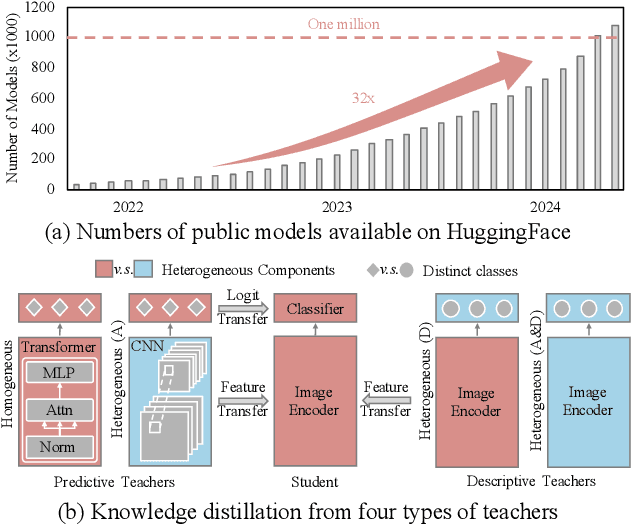
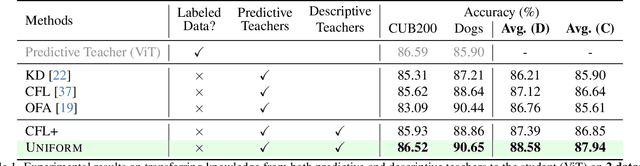
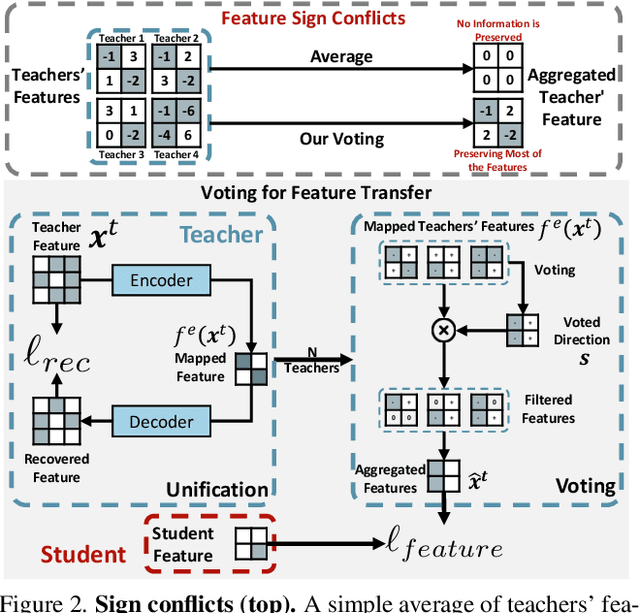
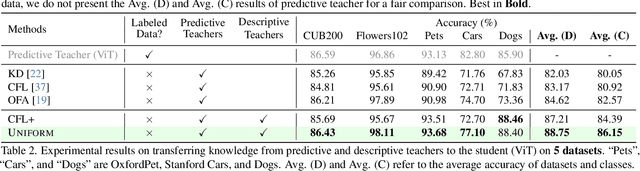
In the era of deep learning, the increasing number of pre-trained models available online presents a wealth of knowledge. These models, developed with diverse architectures and trained on varied datasets for different tasks, provide unique interpretations of the real world. Their collective consensus is likely universal and generalizable to unseen data. However, effectively harnessing this collective knowledge poses a fundamental challenge due to the heterogeneity of pre-trained models. Existing knowledge integration solutions typically rely on strong assumptions about training data distributions and network architectures, limiting them to learning only from specific types of models and resulting in data and/or inductive biases. In this work, we introduce a novel framework, namely UNIFORM, for knowledge transfer from a diverse set of off-the-shelf models into one student model without such constraints. Specifically, we propose a dedicated voting mechanism to capture the consensus of knowledge both at the logit level -- incorporating teacher models that are capable of predicting target classes of interest -- and at the feature level, utilizing visual representations learned on arbitrary label spaces. Extensive experiments demonstrate that UNIFORM effectively enhances unsupervised object recognition performance compared to strong knowledge transfer baselines. Notably, it exhibits remarkable scalability by benefiting from over one hundred teachers, while existing methods saturate at a much smaller scale.
HyperFree: A Channel-adaptive and Tuning-free Foundation Model for Hyperspectral Remote Sensing Imagery
Mar 27, 2025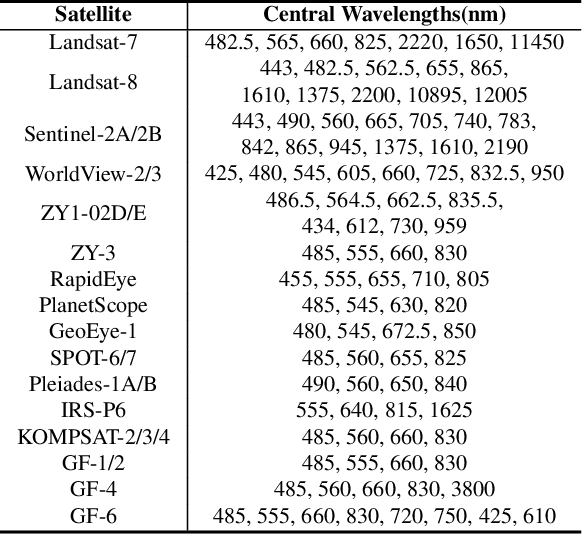
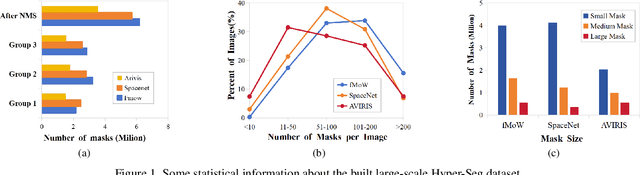
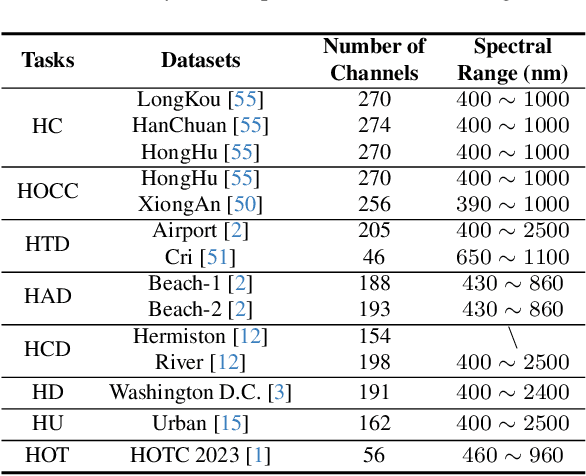
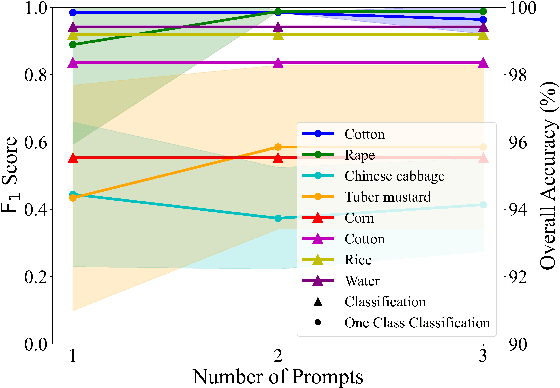
Advanced interpretation of hyperspectral remote sensing images benefits many precise Earth observation tasks. Recently, visual foundation models have promoted the remote sensing interpretation but concentrating on RGB and multispectral images. Due to the varied hyperspectral channels,existing foundation models would face image-by-image tuning situation, imposing great pressure on hardware and time resources. In this paper, we propose a tuning-free hyperspectral foundation model called HyperFree, by adapting the existing visual prompt engineering. To process varied channel numbers, we design a learned weight dictionary covering full-spectrum from $0.4 \sim 2.5 \, \mu\text{m}$, supporting to build the embedding layer dynamically. To make the prompt design more tractable, HyperFree can generate multiple semantic-aware masks for one prompt by treating feature distance as semantic-similarity. After pre-training HyperFree on constructed large-scale high-resolution hyperspectral images, HyperFree (1 prompt) has shown comparable results with specialized models (5 shots) on 5 tasks and 11 datasets.Code and dataset are accessible at https://rsidea.whu.edu.cn/hyperfree.htm.