 Add to Chrome
 Add to Firefox
 Add to Edge
LEDGERMIND: Provenance-Constrained Multimodal Agentic Reasoning with a Structured Evidence Ledger
Jul 30, 2026
Multimodal agents for visual question answering increasingly operate as multi-step trajectories that interleave perception, retrieval, and reasoning, yet evaluation still largely reduces to final-answer accuracy. This aggregate signal cannot tell whether a correct answer was reached through grounded evidence, language priors, or accidental error cancellation. We propose to treat a multimodal agent trajectory as a provenance-constrained state machine: tool outputs are normalized into a Structured Evidence Ledger that serves as the trajectory state, downstream reasoning and decision claims may cite only active ledger entries, grounding is checked at the entity and numeric level, and repair is realized as typed state transitions that cannot introduce content without tool-produced provenance. We instantiate this design as LedgerMind (Provenance-Constrained Multimodal Agentic Reasoning with a Structured Evidence Ledger), augmented by a Three-Layer Grounding Protocol, an Adaptive Dual-Path Dispatcher that matches reasoning depth to question complexity, and an Event-Triggered Verification-and-Repair engine with a formal provenance non-amplification guarantee. We use LedgerMind to target four recurring failure patterns that final-answer accuracy tends to obscure: unsupported intermediate reasoning, citation-backed entity hallucination (Phantom Grounding), over-reasoning on simple queries, and repair-time amplification. Experiments across multiple multimodal reasoning benchmarks and backbone MLLMs show that LedgerMind improves both answer accuracy and trajectory-level faithfulness.

IndustryBench-MIPU: Benchmarking Multi-Image Attribute Value Extraction for Industrial Products
Jun 12, 2026Industrial products such as valves and circuit breakers are defined by dense technical specifications that govern procurement, compatibility, and safety across supply chains. These specifications are scattered across multiple heterogeneous product images, including specification tables, nameplates, and technical drawings, yet whether Multimodal Large Language Models (MLLMs) can reliably recover them remains underexplored. To fill this gap, we introduce IndustryBench-MIPU, the first large-scale benchmark for multi-image industrial product understanding, built around structured attribute extraction -- recovering property-value pairs from product images. This task jointly probes text recognition on specification tables and nameplates, visual reasoning over technical drawings, domain knowledge to decode industrial terminology, and cross-image evidence integration to assemble scattered specifications. Concretely, the benchmark comprises 4,559 products across 27,652 images with 103,703 annotations spanning 18 industrial categories, constructed through multi-model consensus and three-tier quality assurance. Evaluating nine MLLMs under both single-image and product-level multi-image settings reveals a stark completeness gap: models achieve high precision (86--94%) but the best recovers only 49.9% of product-level attributes; moving from single-image to multi-image extraction costs 15--34 percentage points of recall. Multi-image completeness, not single-image accuracy, is the core bottleneck. Dataset and code are publicly available.
Context-Driven Incremental Compression for Multi-Turn Dialogue Generation
Jun 10, 2026Modern conversational agents condition on an ever-growing dialogue history at each turn, incurring redundant attention and encoding costs that grow with conversation length. Naive truncation or summarization degrades fidelity, while existing context compressors lack cross-turn memory sharing or revision, causing information loss and compounding errors in long dialogues. We revisit the context compression under conversational dynamics and empirically present its fragility. To improve both efficiency and robustness, we introduce Context-Driven Incremental Compression (C-DIC), which treats a conversation as interleaved contextual threads and stores revisable per-thread compression states in a single, compact dialogue memory. At each turn, a lightweight retrieve, revise, and write-back loop shares information across turns and updates stale memories, stabilizing long-horizon behavior. In addition, we adapt truncated backpropagation-through-time (TBPTT) to our multi-turn setting, learning cross-turn dependencies without full-history backpropagation. Extensive experiments on long-form dialogue benchmarks demonstrate superior performance and efficiency of C-DIC; notably, C-DIC shows stable inference latency and perplexity over hundreds of dialogue turns, supporting a scalable path to high-quality dialogue modeling.
ContextFlow: Hierarchical Task-State Alignment for Long-Horizon Embodied Agents
May 19, 2026Long-horizon embodied agents increasingly delegate navigation, search, approach, and manipulation to specialist executors. As these executors become stronger, the main bottleneck shifts from local skill execution to maintaining a coherent task frontier across planning, monitoring, memory, and execution. We study task-state misalignment, a task-level consistency failure in which the planner's active stage, runtime evidence, remembered context, and delegated executor no longer justify the same next-step decision. This failure can lead to unsupported handoffs, stage lock, executor-context mismatch, and unnecessary replanning. We propose ContextFlow, an inspectable alignment framework that represents stages as explicit contracts, converts runtime observations into evidence packets, and applies scoped updates including continue, refine, transfer, promote, and repair. ContextFlow keeps specialist executors responsible for local closed-loop control while making task-frontier alignment explicit and auditable. Experiments and demonstration traces on long-horizon embodied tasks illustrate how evidence-grounded scoped updates diagnose and mitigate recurring task-state failures.
From Instance Selection to Fixed-Pool Data Recipe Search for Supervised Fine-Tuning
May 13, 2026Supervised fine-tuning (SFT) data selection is commonly formulated as instance ranking: score each example and retain a top-$k$ subset. However, effective SFT training subsets are often produced through ordered curation recipes, where filtering, mixing, and deduplication operators jointly shape the final data distribution. We formulate this problem as fixed-pool data recipe search: given a raw instruction pool and a library of grounded operators, the goal is to discover an executable recipe that constructs a high-quality selected subset under a limited budget of full SFT evaluations, without generating, rewriting, or augmenting training samples. We introduce AutoSelection, a two-layer solver that decouples fixed-pool materialization based on cached task-, data-, and model-side signals from expensive full evaluation, using warmup probes, realized subset states, local recipe edits, Gaussian-process-assisted ranking, and stagnation-triggered reseeding. Experiments on a 90K instruction pool show that AutoSelection achieves the strongest in-distribution reasoning average across three base models, outperforming full-data training, random recipe search, random top-$k$, and single-operator selectors. Additional Out-of-distribution graph-reasoning results, search-stability analyses, structural ablations, and 1.5B-to-7B transfer checks further show that recipe structure matters beyond individual selection operators. Code is available at https://github.com/w253/AutoSelection.
Rethinking Token-Level Credit Assignment in RLVR: A Polarity-Entropy Analysis
Apr 13, 2026Reinforcement Learning with Verifiable Rewards (RLVR) has substantially improved the reasoning ability of Large Language Models (LLMs). However, its sparse outcome-based rewards pose a fundamental credit assignment problem. We analyze this problem through the joint lens of reward polarity and token entropy. Our diagnostic tool, the Four Quadrant Decomposition, isolates token updates by polarity and entropy, and controlled ablations show that reasoning improvements concentrate in the high-entropy quadrants. To justify this observation theoretically, we adapt Conditional Mutual Information to the autoregressive RLVR setting and prove that the credit a token can carry is upper-bounded by its entropy. This view yields testable predictions that reasoning gains arise primarily from high-entropy tokens, with unique roles for positive and negative updates. A gradient analysis of GRPO further reveals how uniform reward broadcast dilutes signal at high-entropy positions while over-crediting deterministic tokens. Grounded in these insights, we propose Entropy-Aware Policy Optimization (EAPO) that modulates token-level learning signals accordingly. Extensive experiments demonstrate that EAPO outperforms strong baselines across two model families.
osmAG-Nav: A Hierarchical Semantic Topometric Navigation Stack for Robust Lifelong Indoor Autonomy
Mar 30, 2026The deployment of mobile robots in large-scale, multi-floor environments demands navigation systems that achieve spatial scalability without compromising local kinematic precision. Traditional navigation stacks, reliant on monolithic occupancy grid maps, face severe bottlenecks in storage efficiency, cross-floor reasoning, and long-horizon planning. To address these limitations, this paper presents osmAG-Nav, a complete, open-source ROS2 navigation stack built upon the hierarchical semantic topometric OpenStreetMap Area Graph (osmAG) map standard. The system follows a "System of Systems" architecture that decouples global topological reasoning from local metric execution. A Hierarchical osmAG planner replaces dense grid searches with an LCA-anchored pipeline on a passage-centric graph whose edge costs derive from local raster traversability rather than Euclidean distance, yielding low-millisecond planning on long campus-scale routes. A Rolling Window mechanism rasterizes a fixed-size local metric grid around the robot, keeping the local costmap memory footprint independent of the total mapped area, while a Segmented Execution strategy dispatches intermediate goals to standard ROS2 controllers for smooth handoffs. System robustness is reinforced by a structure-aware LiDAR localization framework that filters dynamic clutter against permanent architectural priors. Extensive experiments on a real-world multi-story indoor-outdoor campus (>11,025 m^2) show that, on the same-floor benchmark subset, osmAG-Nav delivers up to 7816x lower planning latency than a grid-based baseline on long routes while maintaining low path-length overhead and lifelong localization stability. A single-floor long-range robot mission further validates the integrated stack reliability. The full stack is released as modular ROS2 Lifecycle Nodes.
Janus-Q: End-to-End Event-Driven Trading via Hierarchical-Gated Reward Modeling
Feb 23, 2026Financial market movements are often driven by discrete financial events conveyed through news, whose impacts are heterogeneous, abrupt, and difficult to capture under purely numerical prediction objectives. These limitations have motivated growing interest in using textual information as the primary source of trading signals in learning-based systems. Two key challenges hinder existing approaches: (1) the absence of large-scale, event-centric datasets that jointly model news semantics and statistically grounded market reactions, and (2) the misalignment between language model reasoning and financially valid trading behavior under dynamic market conditions. To address these challenges, we propose Janus-Q, an end-to-end event-driven trading framework that elevates financial news events from auxiliary signals to primary decision units. Janus-Q unifies event-centric data construction and model optimization under a two-stage paradigm. Stage I focuses on event-centric data construction, building a large-scale financial news event dataset comprising 62,400 articles annotated with 10 fine-grained event types, associated stocks, sentiment labels, and event-driven cumulative abnormal return (CAR). Stage II performs decision-oriented fine-tuning, combining supervised learning with reinforcement learning guided by a Hierarchical Gated Reward Model (HGRM), which explicitly captures trade-offs among multiple trading objectives. Extensive experiments demonstrate that Janus-Q achieves more consistent, interpretable, and profitable trading decisions than market indices and LLM baselines, improving the Sharpe Ratio by up to 102.0% while increasing direction accuracy by over 17.5% compared to the strongest competing strategies.
Mixture of Length and Pruning Experts for Knowledge Graphs Reasoning
Jul 28, 2025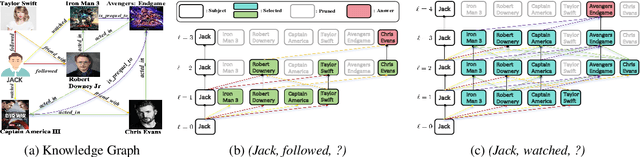
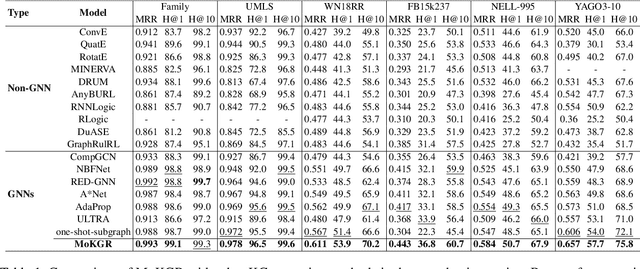
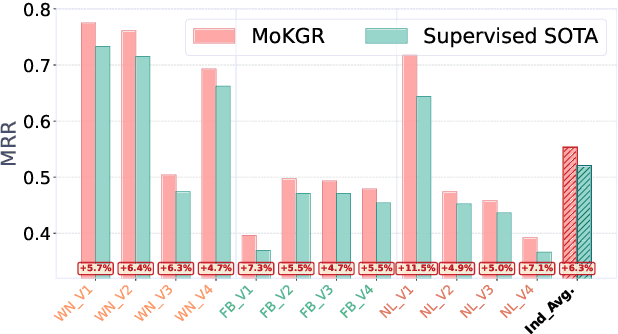
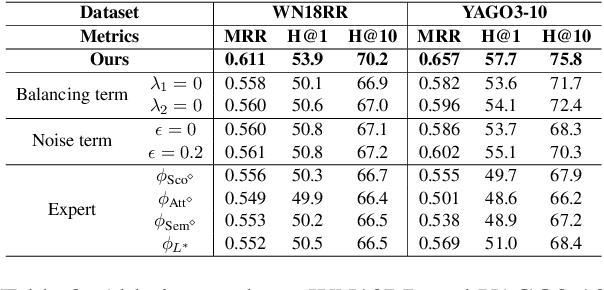
Knowledge Graph (KG) reasoning, which aims to infer new facts from structured knowledge repositories, plays a vital role in Natural Language Processing (NLP) systems. Its effectiveness critically depends on constructing informative and contextually relevant reasoning paths. However, existing graph neural networks (GNNs) often adopt rigid, query-agnostic path-exploration strategies, limiting their ability to adapt to diverse linguistic contexts and semantic nuances. To address these limitations, we propose \textbf{MoKGR}, a mixture-of-experts framework that personalizes path exploration through two complementary components: (1) a mixture of length experts that adaptively selects and weights candidate path lengths according to query complexity, providing query-specific reasoning depth; and (2) a mixture of pruning experts that evaluates candidate paths from a complementary perspective, retaining the most informative paths for each query. Through comprehensive experiments on diverse benchmark, MoKGR demonstrates superior performance in both transductive and inductive settings, validating the effectiveness of personalized path exploration in KGs reasoning.
Case-Based Reasoning Enhances the Predictive Power of LLMs in Drug-Drug Interaction
May 29, 2025Drug-drug interaction (DDI) prediction is critical for treatment safety. While large language models (LLMs) show promise in pharmaceutical tasks, their effectiveness in DDI prediction remains challenging. Inspired by the well-established clinical practice where physicians routinely reference similar historical cases to guide their decisions through case-based reasoning (CBR), we propose CBR-DDI, a novel framework that distills pharmacological principles from historical cases to improve LLM reasoning for DDI tasks. CBR-DDI constructs a knowledge repository by leveraging LLMs to extract pharmacological insights and graph neural networks (GNNs) to model drug associations. A hybrid retrieval mechanism and dual-layer knowledge-enhanced prompting allow LLMs to effectively retrieve and reuse relevant cases. We further introduce a representative sampling strategy for dynamic case refinement. Extensive experiments demonstrate that CBR-DDI achieves state-of-the-art performance, with a significant 28.7% accuracy improvement over both popular LLMs and CBR baseline, while maintaining high interpretability and flexibility.