 Add to Chrome
 Add to Firefox
 Add to Edge
MESHA: Mechanism-Enforced Sequential Halving for Strategic Linear Bandits
Jul 16, 2026
We design and analyze \underline{M}echanism-\underline{E}nforced \underline{S}equential \underline{HA}lving (MESHA), an algorithm for Best Arm Identification (BAI) in strategic linear bandits. In this setting, each arm may strategically misreport its feature vector to maximize the probability of being identified as the best arm, when rewards are generated from the arms' true but unobservable features. The design of MESHA applies the naïve uniform sampling rule and an epoch-wise Grim Trigger Condition (GTC): the former reduces the impact of arms' strategic behaviours and the latter eliminates arms whose reported features severely deviate from the ground truth. Considering an arbitrary Nash Equilibrium, we prove that any arm would attempt to pass the GTC check to maximize its identified probability and derive an upper bound on the failure probability of MESHA within a fixed budget $T$. We also show that state-of-the-art linear BAI algorithms with $G$-optimal design would fail in such strategic environment, as the optimal design (OD)-based sampling rule based on strategically reported features may {\it starve} the optimal arm of any sampling budget. Finally, extensive numerical experiments indicate that MESHA outperforms baselines that rely on OD-based sampling rules as well as the feature-agnostic baselines, corroborating the efficacy of MESHA.

Replay What Matters: Off-Policy Replay for Efficient LLM Reinforcement Unlearning
Jun 13, 2026LLM unlearning has emerged as a cost-effective alternative to full retraining for removing hazardous knowledge from pretrained models while preserving general utility. Recent RL-based methods such as RULE reformulate unlearning as learning a refusal behavior, but their on-policy optimization repeatedly samples from the same forget and retain/boundary prompts throughout training. We identify a critical inefficiency in this process: easy cases quickly converge and provide little useful gradient signal, while hard cases near the forget/retain boundary continue to produce low-reward rollouts that are discarded after a single use. To address this issue, we propose ReRULE, an off-policy replay enhancement for reinforcement unlearning. ReRULE stores low-reward hard-case rollout groups in a replay buffer during early GRPO training and reuses them in later stages through importance-sampled off-policy updates, redirecting computation toward boundary cases that still require learning. Theoretically, we show that ReRULE yields a tighter hard-case convergence bound than pure on-policy RULE. Empirically, ReRULE improves MUSE-Books Retain Quality from 46.3 to 56.2 while adding only 5--11% training time across benchmarks. Its limited improvement on the simpler TOFU setting further supports the intended conditional behavior: replay is most beneficial when the hard/easy disparity is pronounced.
On the Benefits of Free Exploration for Regret Minimization in Multi-Armed Bandits
May 25, 2026We study a stochastic multi-armed bandit problem where an agent is granted a free exploration budget before regret accumulates, a setting not captured by the classic regret minimization or pure exploration paradigms. The goal is to design an adaptive policy that strategically explores the bandit instance in the initial free exploration phase and minimizes the cumulative regret in the subsequent phase. We formalize this regret minimization with free exploration problem and identify an interesting regime where the free exploration budget scales logarithmically with the time horizon. To quantify the amount of regret saved with high probability as a result of the availability of the free exploration phase, we introduce a novel set of policies known as $(α,β)$-probably saving policies. We propose a two-phase, probably saving algorithm, UFE-KLUCB-H, which consists of a principled free exploration policy, UFE, and a history-aware regret minimization policy KLUCB-H. Instance-dependent upper bounds on UFE-KLUCB-H are derived, showing that UFE-KLUCB-H accumulates strictly less regret than policies that do not have access to a free exploration phase. Complementarily, we derive instance-dependent lower bounds based on novel multi-instance perturbation arguments tailored to the free-exploration setting, demonstrating the near-optimality of UFE-KLUCB-H for two-valued bandits. Our upper and lower bounds reveal sharp phase transitions in the accumulated regret depending on the amount of available free exploration. Simulations are conducted to demonstrate that forced exploration and adaptivity in the algorithm lead to greater regret savings.
Rethinking Token-Level Credit Assignment in RLVR: A Polarity-Entropy Analysis
Apr 13, 2026Reinforcement Learning with Verifiable Rewards (RLVR) has substantially improved the reasoning ability of Large Language Models (LLMs). However, its sparse outcome-based rewards pose a fundamental credit assignment problem. We analyze this problem through the joint lens of reward polarity and token entropy. Our diagnostic tool, the Four Quadrant Decomposition, isolates token updates by polarity and entropy, and controlled ablations show that reasoning improvements concentrate in the high-entropy quadrants. To justify this observation theoretically, we adapt Conditional Mutual Information to the autoregressive RLVR setting and prove that the credit a token can carry is upper-bounded by its entropy. This view yields testable predictions that reasoning gains arise primarily from high-entropy tokens, with unique roles for positive and negative updates. A gradient analysis of GRPO further reveals how uniform reward broadcast dilutes signal at high-entropy positions while over-crediting deterministic tokens. Grounded in these insights, we propose Entropy-Aware Policy Optimization (EAPO) that modulates token-level learning signals accordingly. Extensive experiments demonstrate that EAPO outperforms strong baselines across two model families.
Label Smoothing Improves Gradient Ascent in LLM Unlearning
Oct 25, 2025LLM unlearning has emerged as a promising approach, aiming to enable models to forget hazardous/undesired knowledge at low cost while preserving as much model utility as possible. Among existing techniques, the most straightforward method is performing Gradient Ascent (GA) w.r.t. the forget data, thereby forcing the model to unlearn the forget dataset. However, GA suffers from severe instability, as it drives updates in a divergent direction, often resulting in drastically degraded model utility. To address this issue, we propose Smoothed Gradient Ascent (SGA). SGA combines the forget data with multiple constructed normal data through a tunable smoothing rate. Intuitively, this extends GA from learning solely on the forget data to jointly learning across both forget and normal data, enabling more stable unlearning while better preserving model utility. Theoretically, we provide the theoretical guidance on the selection of the optimal smoothing rate. Empirically, we evaluate SGA on three benchmarks: TOFU, Harry Potter, and MUSE-NEWS. Experimental results demonstrate that SGA consistently outperforms the original Gradient Ascent (GA) method across all metrics and achieves top-2 performance among all baseline methods on several key metrics.
Almost Minimax Optimal Best Arm Identification in Piecewise Stationary Linear Bandits
Oct 10, 2024We propose a {\em novel} piecewise stationary linear bandit (PSLB) model, where the environment randomly samples a context from an unknown probability distribution at each changepoint, and the quality of an arm is measured by its return averaged over all contexts. The contexts and their distribution, as well as the changepoints are unknown to the agent. We design {\em Piecewise-Stationary $\varepsilon$-Best Arm Identification$^+$} (PS$\varepsilon$BAI$^+$), an algorithm that is guaranteed to identify an $\varepsilon$-optimal arm with probability $\ge 1-\delta$ and with a minimal number of samples. PS$\varepsilon$BAI$^+$ consists of two subroutines, PS$\varepsilon$BAI and {\sc Na\"ive $\varepsilon$-BAI} (N$\varepsilon$BAI), which are executed in parallel. PS$\varepsilon$BAI actively detects changepoints and aligns contexts to facilitate the arm identification process. When PS$\varepsilon$BAI and N$\varepsilon$BAI are utilized judiciously in parallel, PS$\varepsilon$BAI$^+$ is shown to have a finite expected sample complexity. By proving a lower bound, we show the expected sample complexity of PS$\varepsilon$BAI$^+$ is optimal up to a logarithmic factor. We compare PS$\varepsilon$BAI$^+$ to baseline algorithms using numerical experiments which demonstrate its efficiency. Both our analytical and numerical results corroborate that the efficacy of PS$\varepsilon$BAI$^+$ is due to the delicate change detection and context alignment procedures embedded in PS$\varepsilon$BAI.
Stochastic Gradient Succeeds for Bandits
Feb 27, 2024


We show that the \emph{stochastic gradient} bandit algorithm converges to a \emph{globally optimal} policy at an $O(1/t)$ rate, even with a \emph{constant} step size. Remarkably, global convergence of the stochastic gradient bandit algorithm has not been previously established, even though it is an old algorithm known to be applicable to bandits. The new result is achieved by establishing two novel technical findings: first, the noise of the stochastic updates in the gradient bandit algorithm satisfies a strong ``growth condition'' property, where the variance diminishes whenever progress becomes small, implying that additional noise control via diminishing step sizes is unnecessary; second, a form of ``weak exploration'' is automatically achieved through the stochastic gradient updates, since they prevent the action probabilities from decaying faster than $O(1/t)$, thus ensuring that every action is sampled infinitely often with probability $1$. These two findings can be used to show that the stochastic gradient update is already ``sufficient'' for bandits in the sense that exploration versus exploitation is automatically balanced in a manner that ensures almost sure convergence to a global optimum. These novel theoretical findings are further verified by experimental results.
Probably Anytime-Safe Stochastic Combinatorial Semi-Bandits
Jan 31, 2023Motivated by concerns about making online decisions that incur undue amount of risk at each time step, in this paper, we formulate the probably anytime-safe stochastic combinatorial semi-bandits problem. In this problem, the agent is given the option to select a subset of size at most $K$ from a set of $L$ ground items. Each item is associated to a certain mean reward as well as a variance that represents its risk. To mitigate the risk that the agent incurs, we require that with probability at least $1-\delta$, over the entire horizon of time $T$, each of the choices that the agent makes should contain items whose sum of variances does not exceed a certain variance budget. We call this probably anytime-safe constraint. Under this constraint, we design and analyze an algorithm {\sc PASCombUCB} that minimizes the regret over the horizon of time $T$. By developing accompanying information-theoretic lower bounds, we show under both the problem-dependent and problem-independent paradigms, {\sc PASCombUCB} is almost asymptotically optimal. Our problem setup, the proposed {\sc PASCombUCB} algorithm, and novel analyses are applicable to domains such as recommendation systems and transportation in which an agent is allowed to choose multiple items at a single time step and wishes to control the risk over the whole time horizon.
Fast Beam Alignment via Pure Exploration in Multi-armed Bandits
Oct 23, 2022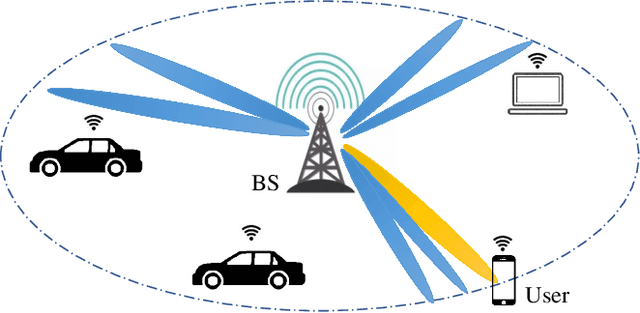

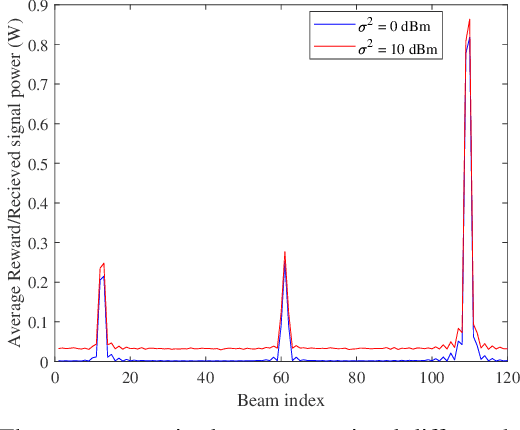
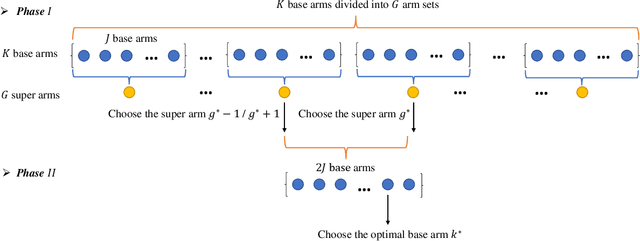
The beam alignment (BA) problem consists in accurately aligning the transmitter and receiver beams to establish a reliable communication link in wireless communication systems. Existing BA methods search the entire beam space to identify the optimal transmit-receive beam pair. This incurs a significant latency when the number of antennas is large. In this work, we develop a bandit-based fast BA algorithm to reduce BA latency for millimeter-wave (mmWave) communications. Our algorithm is named Two-Phase Heteroscedastic Track-and-Stop (2PHT\&S). We first formulate the BA problem as a pure exploration problem in multi-armed bandits in which the objective is to minimize the required number of time steps given a certain fixed confidence level. By taking advantage of the correlation structure among beams that the information from nearby beams is similar and the heteroscedastic property that the variance of the reward of an arm (beam) is related to its mean, the proposed algorithm groups all beams into several beam sets such that the optimal beam set is first selected and the optimal beam is identified in this set after that. Theoretical analysis and simulation results on synthetic and semi-practical channel data demonstrate the clear superiority of the proposed algorithm vis-\`a-vis other baseline competitors.
Optimal Clustering with Bandit Feedback
Feb 09, 2022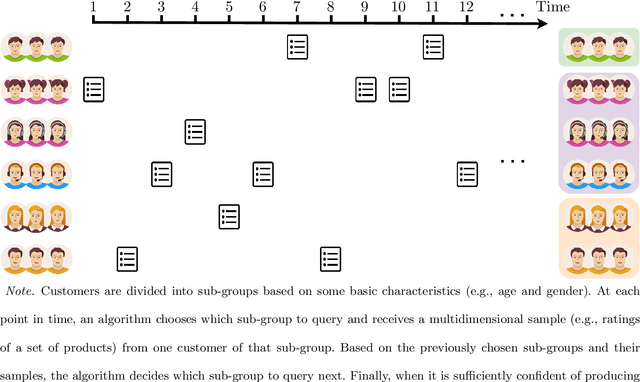
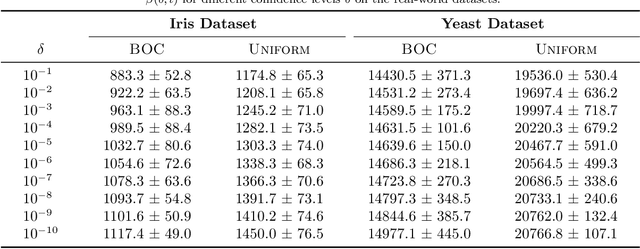
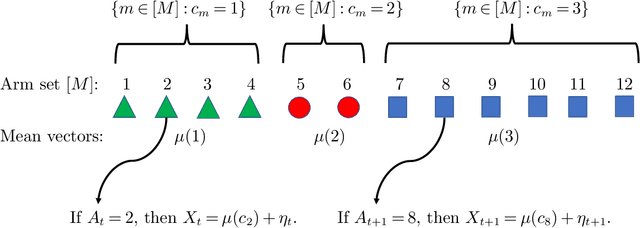
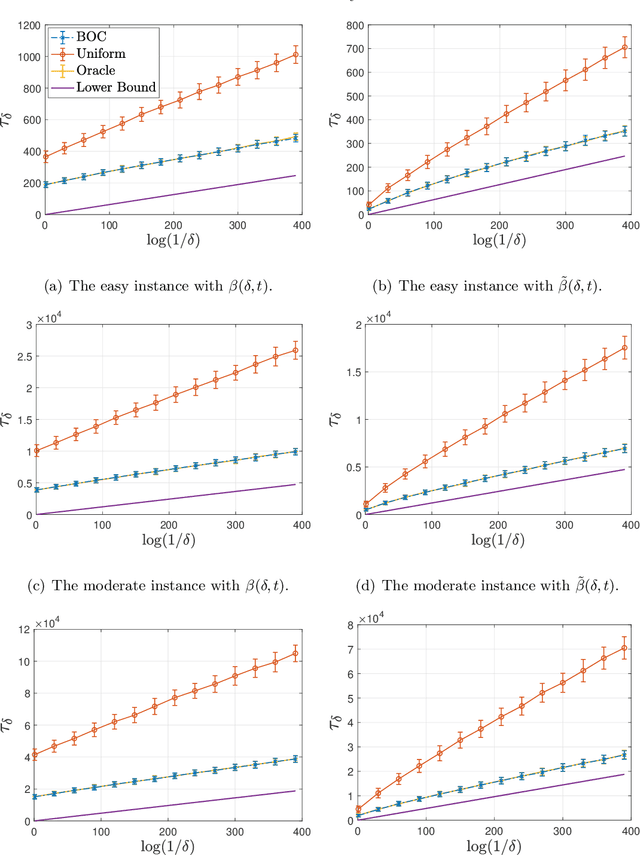
This paper considers the problem of online clustering with bandit feedback. A set of arms (or items) can be partitioned into various groups that are unknown. Within each group, the observations associated to each of the arms follow the same distribution with the same mean vector. At each time step, the agent queries or pulls an arm and obtains an independent observation from the distribution it is associated to. Subsequent pulls depend on previous ones as well as the previously obtained samples. The agent's task is to uncover the underlying partition of the arms with the least number of arm pulls and with a probability of error not exceeding a prescribed constant $\delta$. The problem proposed finds numerous applications from clustering of variants of viruses to online market segmentation. We present an instance-dependent information-theoretic lower bound on the expected sample complexity for this task, and design a computationally efficient and asymptotically optimal algorithm, namely Bandit Online Clustering (BOC). The algorithm includes a novel stopping rule for adaptive sequential testing that circumvents the need to exactly solve any NP-hard weighted clustering problem as its subroutines. We show through extensive simulations on synthetic and real-world datasets that BOC's performance matches the lower bound asymptotically, and significantly outperforms a non-adaptive baseline algorithm.