 Add to Chrome
 Add to Firefox
 Add to Edge
Speech Meets ELF: Audio Conditional Continuous-Target Diffusion for Speech Recognition and Translation
Jun 09, 2026
Speech-to-text (S2T) systems for recognition (ASR) and translation (S2TT) typically generate discrete text tokens. In contrast, continuous-target language modelling performs generation in a continuous space, yet its potential for S2T remains unexplored. To bridge this gap, we propose ELF-S2T, an audio-conditioned continuous-target generative model for S2T. Built upon the pre-trained Embedded Language Flows (ELF) backbone, ELF-S2T processes speech via a frozen Whisper encoder and a single linear projector, prepending the resulting audio condition to the noisy text latent for in-context, flow-matching denoising. To prevent the model from over-relying on its pre-trained text context, we introduce audio forcing during training, and further amplify the audio condition via classifier-free guidance at inference. Experiments on LibriSpeech and CoVoST2 show that ELF-S2T achieves competitive ASR and S2TT performance. Crucially, our error analysis reveals that, although ASR and S2TT errors look very different on the surface, both stem from the same underlying cause, a close distance confusion in the continuous latent space. This finding naturally aligns with the continuous representation generation paradigm, indicating a common semantic mapping process beneath recognition and translation. Our code and pretrained models are publicly available at https://github.com/Sslnon/ELF-S2T.

Separate First, Fuse Later: Mitigating Cross-Modal Interference in Audio-Visual LLMs Reasoning with Modality-Specific Chain-of-Thought
May 11, 2026Audio and vision provide complementary evidence for audio-visual question answering, yet current audio-visual large language models may suffer from cross-modal interference: information from one modality misguides the interpretation of another, thereby inducing hallucinations. We attribute this issue to uncontrolled cross-modal interactions during intermediate reasoning. To mitigate this, we propose Separate First, Fuse Later (SFFL), an audio-visual reasoning framework designed to reduce cross-modal interference. SFFL enforces modality-specific chain-of-thought reasoning, producing separate audio and visual reasoning traces and integrating evidence for answering. We construct modality-preference labels via a data pipeline under different modality input settings. We use these labels as an auxiliary reward in reinforcement learning to encourage a instance-dependent preference for modality cues when answering. We further introduce a modality-specific reasoning mechanism that preserves modality isolation during the separated reasoning stage while enabling full access to cross-modal information at the evidence fusion stage. Experiments demonstrate consistent improvements in both accuracy and robustness, yielding an average relative gain of 5.16\% on general AVQA benchmarks and 11.17\% on a cross-modal hallucination benchmark.
POTSA: A Cross-Lingual Speech Alignment Framework for Low Resource Speech-to-Text Translation
Nov 12, 2025Speech Large Language Models (SpeechLLMs) have achieved breakthroughs in multilingual speech-to-text translation (S2TT). However, existing approaches often overlook semantic commonalities across source languages, leading to biased translation performance. In this work, we propose \textbf{POTSA} (Parallel Optimal Transport for Speech Alignment), a new framework based on cross-lingual parallel speech pairs and Optimal Transport (OT), designed to bridge high- and low-resource translation gaps. First, we introduce a Bias Compensation module to coarsely align initial speech representations across languages. Second, we impose token-level OT constraints on a Q-Former using parallel speech pairs to establish fine-grained consistency of representations. Then, we apply a layer scheduling strategy to focus OT constraints on the most semantically beneficial layers. Experiments on the FLEURS dataset show that our method achieves SOTA performance, with +0.93 BLEU on average over five common languages and +5.05 BLEU on zero-shot languages, using only 10 hours of parallel speech per source language.
Reducing the Gap Between Pretrained Speech Enhancement and Recognition Models Using a Real Speech-Trained Bridging Module
Jan 05, 2025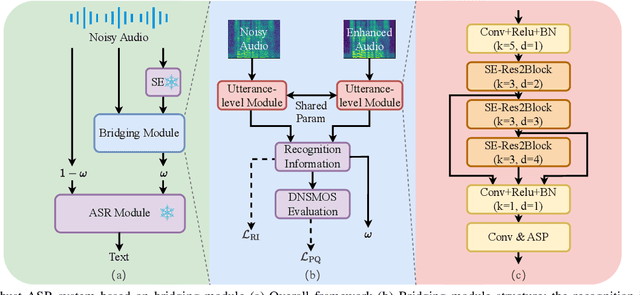
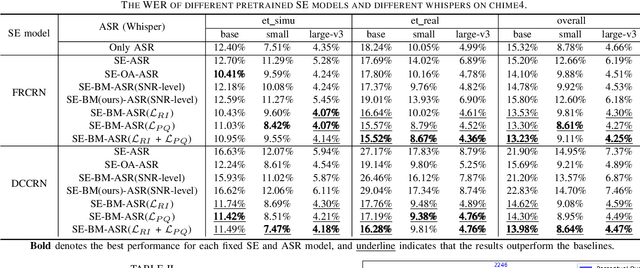
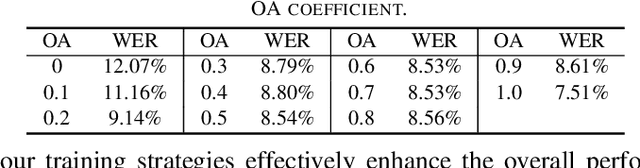
The information loss or distortion caused by single-channel speech enhancement (SE) harms the performance of automatic speech recognition (ASR). Observation addition (OA) is an effective post-processing method to improve ASR performance by balancing noisy and enhanced speech. Determining the OA coefficient is crucial. However, the currently supervised OA coefficient module, called the bridging module, only utilizes simulated noisy speech for training, which has a severe mismatch with real noisy speech. In this paper, we propose training strategies to train the bridging module with real noisy speech. First, DNSMOS is selected to evaluate the perceptual quality of real noisy speech with no need for the corresponding clean label to train the bridging module. Additional constraints during training are introduced to enhance the robustness of the bridging module further. Each utterance is evaluated by the ASR back-end using various OA coefficients to obtain the word error rates (WERs). The WERs are used to construct a multidimensional vector. This vector is introduced into the bridging module with multi-task learning and is used to determine the optimal OA coefficients. The experimental results on the CHiME-4 dataset show that the proposed methods all had significant improvement compared with the simulated data trained bridging module, especially under real evaluation sets.
Adapting Whisper for Code-Switching through Encoding Refining and Language-Aware Decoding
Dec 24, 2024


Code-switching (CS) automatic speech recognition (ASR) faces challenges due to the language confusion resulting from accents, auditory similarity, and seamless language switches. Adaptation on the pre-trained multi-lingual model has shown promising performance for CS-ASR. In this paper, we adapt Whisper, which is a large-scale multilingual pre-trained speech recognition model, to CS from both encoder and decoder parts. First, we propose an encoder refiner to enhance the encoder's capacity of intra-sentence swithching. Second, we propose using two sets of language-aware adapters with different language prompt embeddings to achieve language-specific decoding information in each decoder layer. Then, a fusion module is added to fuse the language-aware decoding. The experimental results using the SEAME dataset show that, compared with the baseline model, the proposed approach achieves a relative MER reduction of 4.1% and 7.2% on the dev_man and dev_sge test sets, respectively, surpassing state-of-the-art methods. Through experiments, we found that the proposed method significantly improves the performance on non-native language in CS speech, indicating that our approach enables Whisper to better distinguish between the two languages.