 Add to Chrome
 Add to Firefox
 Add to Edge
OmniVoice: Towards Omnilingual Zero-Shot Text-to-Speech with Diffusion Language Models
Apr 02, 2026
We present OmniVoice, a massive multilingual zero-shot text-to-speech (TTS) model that scales to over 600 languages. At its core is a novel diffusion language model-style discrete non-autoregressive (NAR) architecture. Unlike conventional discrete NAR models that suffer from performance bottlenecks in complex two-stage (text-to-semantic-to-acoustic) pipelines, OmniVoice directly maps text to multi-codebook acoustic tokens. This simplified approach is facilitated by two key technical innovations: (1) a full-codebook random masking strategy for efficient training, and (2) initialization from a pre-trained LLM to ensure superior intelligibility. By leveraging a 581k-hour multilingual dataset curated entirely from open-source data, OmniVoice achieves the broadest language coverage to date and delivers state-of-the-art performance across Chinese, English, and diverse multilingual benchmarks. Our code and pre-trained models are publicly available at https://github.com/k2-fsa/OmniVoice.

Flow2GAN: Hybrid Flow Matching and GAN with Multi-Resolution Network for Few-step High-Fidelity Audio Generation
Dec 29, 2025Existing dominant methods for audio generation include Generative Adversarial Networks (GANs) and diffusion-based methods like Flow Matching. GANs suffer from slow convergence and potential mode collapse during training, while diffusion methods require multi-step inference that introduces considerable computational overhead. In this work, we introduce Flow2GAN, a two-stage framework that combines Flow Matching training for learning generative capabilities with GAN fine-tuning for efficient few-step inference. Specifically, given audio's unique properties, we first improve Flow Matching for audio modeling through: 1) reformulating the objective as endpoint estimation, avoiding velocity estimation difficulties when involving empty regions; 2) applying spectral energy-based loss scaling to emphasize perceptually salient quieter regions. Building on these Flow Matching adaptations, we demonstrate that a further stage of lightweight GAN fine-tuning enables us to obtain one-step generator that produces high-quality audio. In addition, we develop a multi-branch network architecture that processes Fourier coefficients at different time-frequency resolutions, which improves the modeling capabilities compared to prior single-resolution designs. Experimental results indicate that our Flow2GAN delivers high-fidelity audio generation from Mel-spectrograms or discrete audio tokens, achieving better quality-efficiency trade-offs than existing state-of-the-art GAN-based and Flow Matching-based methods. Online demo samples are available at https://flow2gan.github.io, and the source code is released at https://github.com/k2-fsa/Flow2GAN.
Adapting Whisper for Code-Switching through Encoding Refining and Language-Aware Decoding
Dec 24, 2024


Code-switching (CS) automatic speech recognition (ASR) faces challenges due to the language confusion resulting from accents, auditory similarity, and seamless language switches. Adaptation on the pre-trained multi-lingual model has shown promising performance for CS-ASR. In this paper, we adapt Whisper, which is a large-scale multilingual pre-trained speech recognition model, to CS from both encoder and decoder parts. First, we propose an encoder refiner to enhance the encoder's capacity of intra-sentence swithching. Second, we propose using two sets of language-aware adapters with different language prompt embeddings to achieve language-specific decoding information in each decoder layer. Then, a fusion module is added to fuse the language-aware decoding. The experimental results using the SEAME dataset show that, compared with the baseline model, the proposed approach achieves a relative MER reduction of 4.1% and 7.2% on the dev_man and dev_sge test sets, respectively, surpassing state-of-the-art methods. Through experiments, we found that the proposed method significantly improves the performance on non-native language in CS speech, indicating that our approach enables Whisper to better distinguish between the two languages.
The Conversational Short-phrase Speaker Diarization (CSSD) Task: Dataset, Evaluation Metric and Baselines
Aug 17, 2022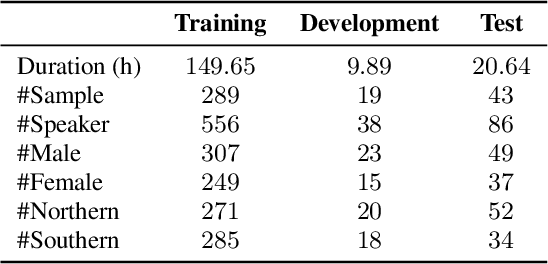
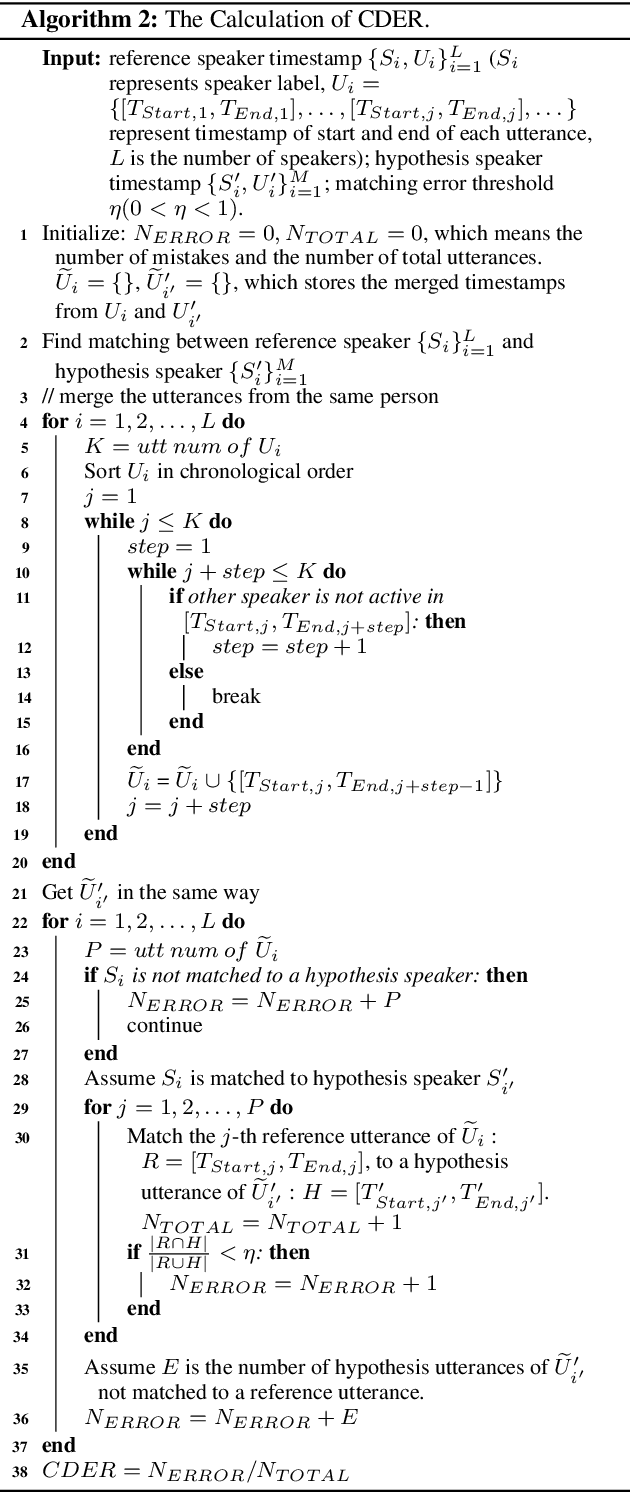
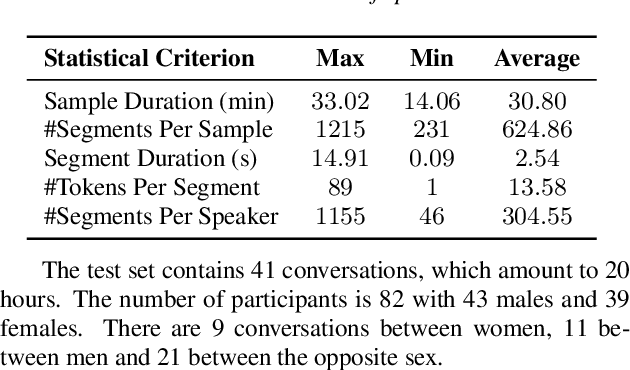
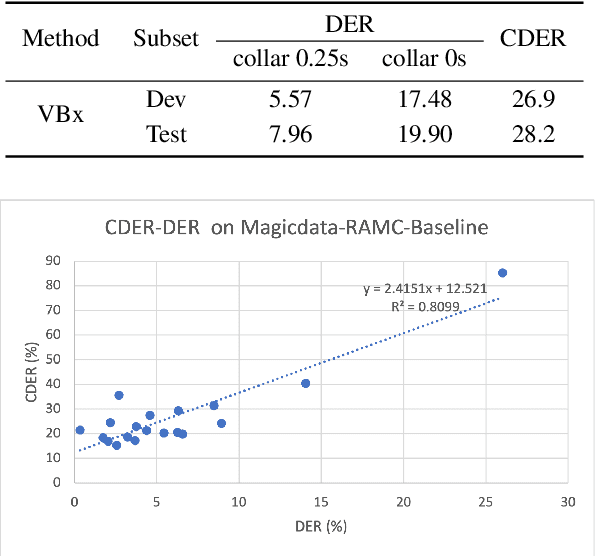
The conversation scenario is one of the most important and most challenging scenarios for speech processing technologies because people in conversation respond to each other in a casual style. Detecting the speech activities of each person in a conversation is vital to downstream tasks, like natural language processing, machine translation, etc. People refer to the detection technology of "who speak when" as speaker diarization (SD). Traditionally, diarization error rate (DER) has been used as the standard evaluation metric of SD systems for a long time. However, DER fails to give enough importance to short conversational phrases, which are short but important on the semantic level. Also, a carefully and accurately manually-annotated testing dataset suitable for evaluating the conversational SD technologies is still unavailable in the speech community. In this paper, we design and describe the Conversational Short-phrases Speaker Diarization (CSSD) task, which consists of training and testing datasets, evaluation metric and baselines. In the dataset aspect, despite the previously open-sourced 180-hour conversational MagicData-RAMC dataset, we prepare an individual 20-hour conversational speech test dataset with carefully and artificially verified speakers timestamps annotations for the CSSD task. In the metric aspect, we design the new conversational DER (CDER) evaluation metric, which calculates the SD accuracy at the utterance level. In the baseline aspect, we adopt a commonly used method: Variational Bayes HMM x-vector system, as the baseline of the CSSD task. Our evaluation metric is publicly available at https://github.com/SpeechClub/CDER_Metric.
Open Source MagicData-RAMC: A Rich Annotated Mandarin Conversational Speech Dataset
Mar 31, 2022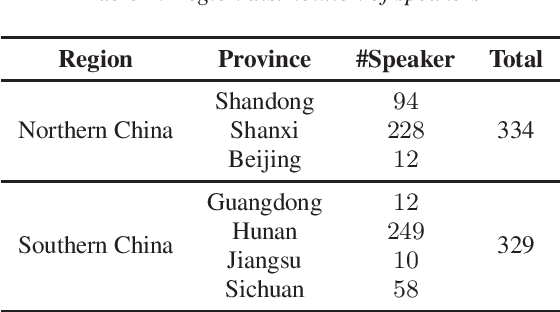
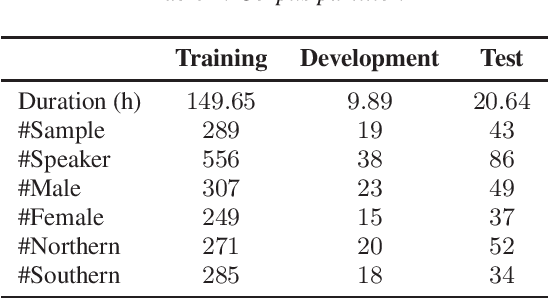
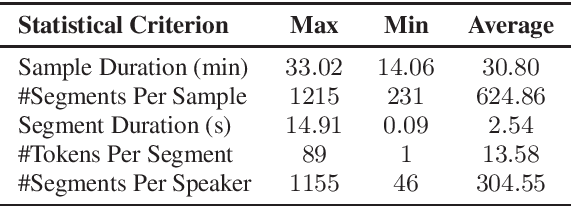
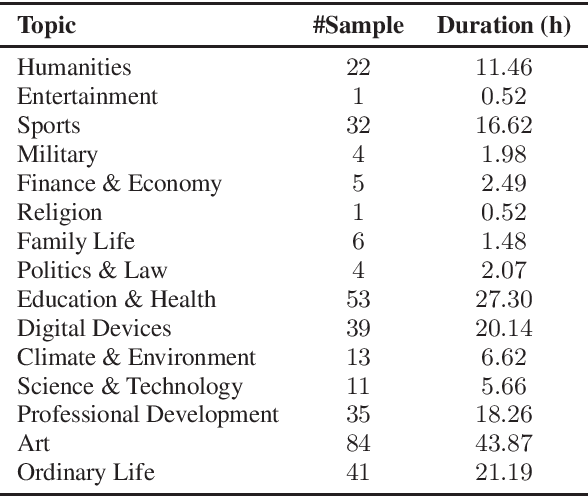
This paper introduces a high-quality rich annotated Mandarin conversational (RAMC) speech dataset called MagicData-RAMC. The MagicData-RAMC corpus contains 180 hours of conversational speech data recorded from native speakers of Mandarin Chinese over mobile phones with a sampling rate of 16 kHz. The dialogs in MagicData-RAMC are classified into 15 diversified domains and tagged with topic labels, ranging from science and technology to ordinary life. Accurate transcription and precise speaker voice activity timestamps are manually labeled for each sample. Speakers' detailed information is also provided. As a Mandarin speech dataset designed for dialog scenarios with high quality and rich annotations, MagicData-RAMC enriches the data diversity in the Mandarin speech community and allows extensive research on a series of speech-related tasks, including automatic speech recognition, speaker diarization, topic detection, keyword search, text-to-speech, etc. We also conduct several relevant tasks and provide experimental results to help evaluate the dataset.