 Add to Chrome
 Add to Firefox
 Add to Edge
Breaking the Passive Learning Trap: An Active Perception Strategy for Human Motion Prediction
Nov 18, 2025
Forecasting 3D human motion is an important embodiment of fine-grained understanding and cognition of human behavior by artificial agents. Current approaches excessively rely on implicit network modeling of spatiotemporal relationships and motion characteristics, falling into the passive learning trap that results in redundant and monotonous 3D coordinate information acquisition while lacking actively guided explicit learning mechanisms. To overcome these issues, we propose an Active Perceptual Strategy (APS) for human motion prediction, leveraging quotient space representations to explicitly encode motion properties while introducing auxiliary learning objectives to strengthen spatio-temporal modeling. Specifically, we first design a data perception module that projects poses into the quotient space, decoupling motion geometry from coordinate redundancy. By jointly encoding tangent vectors and Grassmann projections, this module simultaneously achieves geometric dimension reduction, semantic decoupling, and dynamic constraint enforcement for effective motion pose characterization. Furthermore, we introduce a network perception module that actively learns spatio-temporal dependencies through restorative learning. This module deliberately masks specific joints or injects noise to construct auxiliary supervision signals. A dedicated auxiliary learning network is designed to actively adapt and learn from perturbed information. Notably, APS is model agnostic and can be integrated with different prediction models to enhance active perceptual. The experimental results demonstrate that our method achieves the new state-of-the-art, outperforming existing methods by large margins: 16.3% on H3.6M, 13.9% on CMU Mocap, and 10.1% on 3DPW.

Hi-Reco: High-Fidelity Real-Time Conversational Digital Humans
Nov 16, 2025High-fidelity digital humans are increasingly used in interactive applications, yet achieving both visual realism and real-time responsiveness remains a major challenge. We present a high-fidelity, real-time conversational digital human system that seamlessly combines a visually realistic 3D avatar, persona-driven expressive speech synthesis, and knowledge-grounded dialogue generation. To support natural and timely interaction, we introduce an asynchronous execution pipeline that coordinates multi-modal components with minimal latency. The system supports advanced features such as wake word detection, emotionally expressive prosody, and highly accurate, context-aware response generation. It leverages novel retrieval-augmented methods, including history augmentation to maintain conversational flow and intent-based routing for efficient knowledge access. Together, these components form an integrated system that enables responsive and believable digital humans, suitable for immersive applications in communication, education, and entertainment.
EmoVid: A Multimodal Emotion Video Dataset for Emotion-Centric Video Understanding and Generation
Nov 14, 2025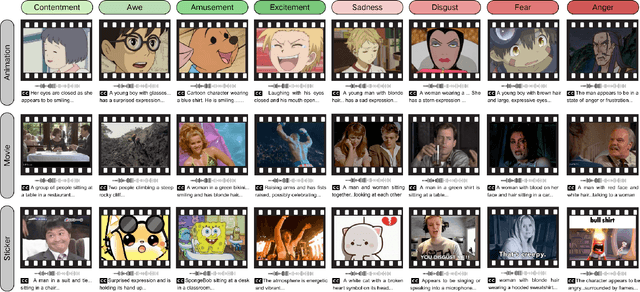

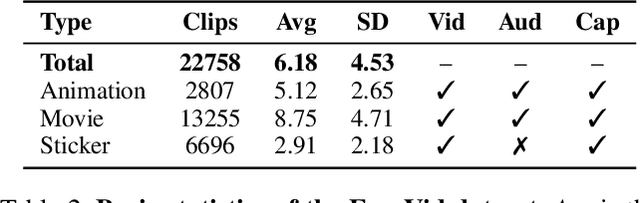
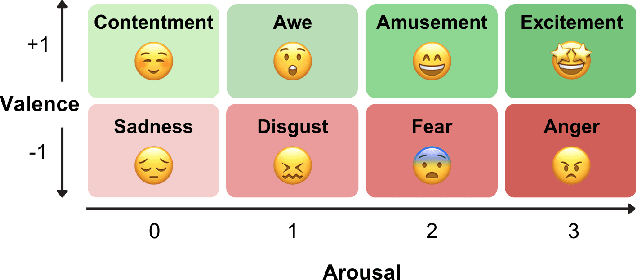
Emotion plays a pivotal role in video-based expression, but existing video generation systems predominantly focus on low-level visual metrics while neglecting affective dimensions. Although emotion analysis has made progress in the visual domain, the video community lacks dedicated resources to bridge emotion understanding with generative tasks, particularly for stylized and non-realistic contexts. To address this gap, we introduce EmoVid, the first multimodal, emotion-annotated video dataset specifically designed for creative media, which includes cartoon animations, movie clips, and animated stickers. Each video is annotated with emotion labels, visual attributes (brightness, colorfulness, hue), and text captions. Through systematic analysis, we uncover spatial and temporal patterns linking visual features to emotional perceptions across diverse video forms. Building on these insights, we develop an emotion-conditioned video generation technique by fine-tuning the Wan2.1 model. The results show a significant improvement in both quantitative metrics and the visual quality of generated videos for text-to-video and image-to-video tasks. EmoVid establishes a new benchmark for affective video computing. Our work not only offers valuable insights into visual emotion analysis in artistically styled videos, but also provides practical methods for enhancing emotional expression in video generation.
LightBagel: A Light-weighted, Double Fusion Framework for Unified Multimodal Understanding and Generation
Oct 27, 2025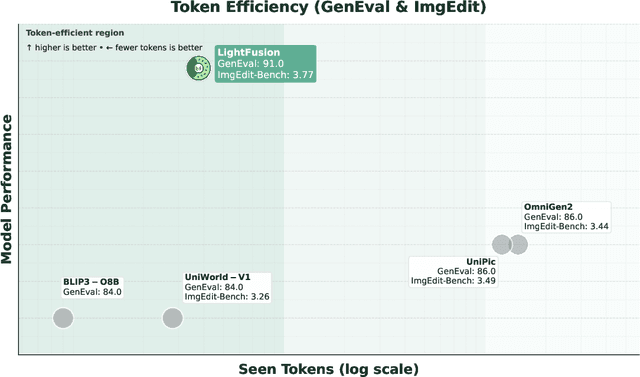
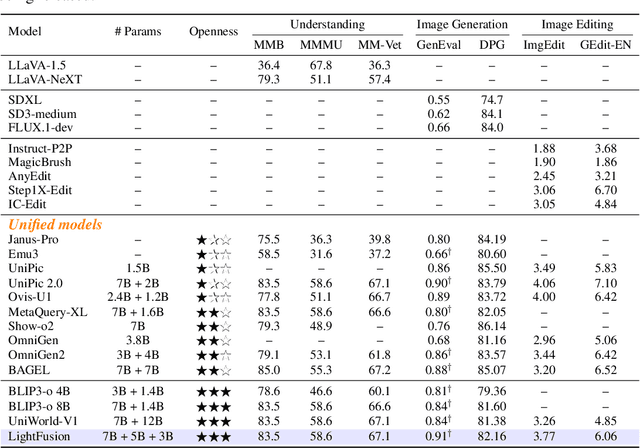
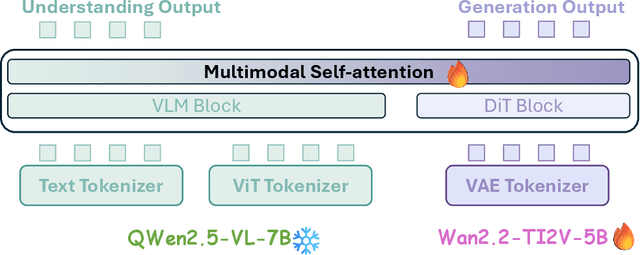
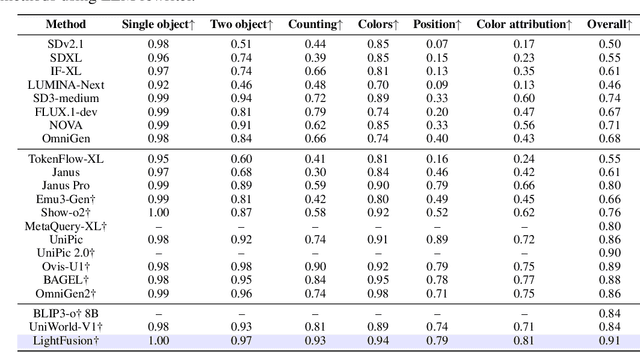
Unified multimodal models have recently shown remarkable gains in both capability and versatility, yet most leading systems are still trained from scratch and require substantial computational resources. In this paper, we show that competitive performance can be obtained far more efficiently by strategically fusing publicly available models specialized for either generation or understanding. Our key design is to retain the original blocks while additionally interleaving multimodal self-attention blocks throughout the networks. This double fusion mechanism (1) effectively enables rich multi-modal fusion while largely preserving the original strengths of the base models, and (2) catalyzes synergistic fusion of high-level semantic representations from the understanding encoder with low-level spatial signals from the generation encoder. By training with only ~ 35B tokens, this approach achieves strong results across multiple benchmarks: 0.91 on GenEval for compositional text-to-image generation, 82.16 on DPG-Bench for complex text-to-image generation, 6.06 on GEditBench, and 3.77 on ImgEdit-Bench for image editing. By fully releasing the entire suite of code, model weights, and datasets, we hope to support future research on unified multimodal modeling.
Resolving Ambiguity in Gaze-Facilitated Visual Assistant Interaction Paradigm
Sep 26, 2025With the rise in popularity of smart glasses, users' attention has been integrated into Vision-Language Models (VLMs) to streamline multi-modal querying in daily scenarios. However, leveraging gaze data to model users' attention may introduce ambiguity challenges: (1) users' verbal questions become ambiguous by using pronouns or skipping context, (2) humans' gaze patterns can be noisy and exhibit complex spatiotemporal relationships with their spoken questions. Previous works only consider single image as visual modality input, failing to capture the dynamic nature of the user's attention. In this work, we introduce GLARIFY, a novel method to leverage spatiotemporal gaze information to enhance the model's effectiveness in real-world applications. Initially, we analyzed hundreds of querying samples with the gaze modality to demonstrate the noisy nature of users' gaze patterns. We then utilized GPT-4o to design an automatic data synthesis pipeline to generate the GLARIFY-Ambi dataset, which includes a dedicated chain-of-thought (CoT) process to handle noisy gaze patterns. Finally, we designed a heatmap module to incorporate gaze information into cutting-edge VLMs while preserving their pretrained knowledge. We evaluated GLARIFY using a hold-out test set. Experiments demonstrate that GLARIFY significantly outperforms baselines. By robustly aligning VLMs with human attention, GLARIFY paves the way for a usable and intuitive interaction paradigm with a visual assistant.
Follow-Your-Instruction: A Comprehensive MLLM Agent for World Data Synthesis
Aug 07, 2025With the growing demands of AI-generated content (AIGC), the need for high-quality, diverse, and scalable data has become increasingly crucial. However, collecting large-scale real-world data remains costly and time-consuming, hindering the development of downstream applications. While some works attempt to collect task-specific data via a rendering process, most approaches still rely on manual scene construction, limiting their scalability and accuracy. To address these challenges, we propose Follow-Your-Instruction, a Multimodal Large Language Model (MLLM)-driven framework for automatically synthesizing high-quality 2D, 3D, and 4D data. Our \textbf{Follow-Your-Instruction} first collects assets and their associated descriptions through multimodal inputs using the MLLM-Collector. Then it constructs 3D layouts, and leverages Vision-Language Models (VLMs) for semantic refinement through multi-view scenes with the MLLM-Generator and MLLM-Optimizer, respectively. Finally, it uses MLLM-Planner to generate temporally coherent future frames. We evaluate the quality of the generated data through comprehensive experiments on the 2D, 3D, and 4D generative tasks. The results show that our synthetic data significantly boosts the performance of existing baseline models, demonstrating Follow-Your-Instruction's potential as a scalable and effective data engine for generative intelligence.
MagicAnime: A Hierarchically Annotated, Multimodal and Multitasking Dataset with Benchmarks for Cartoon Animation Generation
Jul 27, 2025Generating high-quality cartoon animations multimodal control is challenging due to the complexity of non-human characters, stylistically diverse motions and fine-grained emotions. There is a huge domain gap between real-world videos and cartoon animation, as cartoon animation is usually abstract and has exaggerated motion. Meanwhile, public multimodal cartoon data are extremely scarce due to the difficulty of large-scale automatic annotation processes compared with real-life scenarios. To bridge this gap, We propose the MagicAnime dataset, a large-scale, hierarchically annotated, and multimodal dataset designed to support multiple video generation tasks, along with the benchmarks it includes. Containing 400k video clips for image-to-video generation, 50k pairs of video clips and keypoints for whole-body annotation, 12k pairs of video clips for video-to-video face animation, and 2.9k pairs of video and audio clips for audio-driven face animation. Meanwhile, we also build a set of multi-modal cartoon animation benchmarks, called MagicAnime-Bench, to support the comparisons of different methods in the tasks above. Comprehensive experiments on four tasks, including video-driven face animation, audio-driven face animation, image-to-video animation, and pose-driven character animation, validate its effectiveness in supporting high-fidelity, fine-grained, and controllable generation.
Gradientsys: A Multi-Agent LLM Scheduler with ReAct Orchestration
Jul 09, 2025We present Gradientsys, a next-generation multi-agent scheduling framework that coordinates diverse specialized AI agents using a typed Model-Context Protocol (MCP) and a ReAct-based dynamic planning loop. At its core, Gradientsys employs an LLM-powered scheduler for intelligent one-to-many task dispatch, enabling parallel execution of heterogeneous agents such as PDF parsers, web search modules, GUI controllers, and web builders. The framework supports hybrid synchronous/asynchronous execution, respects agent capacity constraints, and incorporates a robust retry-and-replan mechanism to handle failures gracefully. To promote transparency and trust, Gradientsys includes an observability layer streaming real-time agent activity and intermediate reasoning via Server-Sent Events (SSE). We offer an architectural overview and evaluate Gradientsys against existing frameworks in terms of extensibility, scheduling topology, tool reusability, parallelism, and observability. Experiments on the GAIA general-assistant benchmark show that Gradientsys achieves higher task success rates with reduced latency and lower API costs compared to a MinionS-style baseline, demonstrating the strength of its LLM-driven multi-agent orchestration.
Rethinking Brain Tumor Segmentation from the Frequency Domain Perspective
Jun 11, 2025Precise segmentation of brain tumors, particularly contrast-enhancing regions visible in post-contrast MRI (areas highlighted by contrast agent injection), is crucial for accurate clinical diagnosis and treatment planning but remains challenging. However, current methods exhibit notable performance degradation in segmenting these enhancing brain tumor areas, largely due to insufficient consideration of MRI-specific tumor features such as complex textures and directional variations. To address this, we propose the Harmonized Frequency Fusion Network (HFF-Net), which rethinks brain tumor segmentation from a frequency-domain perspective. To comprehensively characterize tumor regions, we develop a Frequency Domain Decomposition (FDD) module that separates MRI images into low-frequency components, capturing smooth tumor contours and high-frequency components, highlighting detailed textures and directional edges. To further enhance sensitivity to tumor boundaries, we introduce an Adaptive Laplacian Convolution (ALC) module that adaptively emphasizes critical high-frequency details using dynamically updated convolution kernels. To effectively fuse tumor features across multiple scales, we design a Frequency Domain Cross-Attention (FDCA) integrating semantic, positional, and slice-specific information. We further validate and interpret frequency-domain improvements through visualization, theoretical reasoning, and experimental analyses. Extensive experiments on four public datasets demonstrate that HFF-Net achieves an average relative improvement of 4.48\% (ranging from 2.39\% to 7.72\%) in the mean Dice scores across the three major subregions, and an average relative improvement of 7.33% (ranging from 5.96% to 8.64%) in the segmentation of contrast-enhancing tumor regions, while maintaining favorable computational efficiency and clinical applicability. Code: https://github.com/VinyehShaw/HFF.
ReStNet: A Reusable & Stitchable Network for Dynamic Adaptation on IoT Devices
Jun 08, 2025With the rapid development of deep learning, a growing number of pre-trained models have been publicly available. However, deploying these fixed models in real-world IoT applications is challenging because different devices possess heterogeneous computational and memory resources, making it impossible to deploy a single model across all platforms. Although traditional compression methods, such as pruning, quantization, and knowledge distillation, can improve efficiency, they become inflexible once applied and cannot adapt to changing resource constraints. To address these issues, we propose ReStNet, a Reusable and Stitchable Network that dynamically constructs a hybrid network by stitching two pre-trained models together. Implementing ReStNet requires addressing several key challenges, including how to select the optimal stitching points, determine the stitching order of the two pre-trained models, and choose an effective fine-tuning strategy. To systematically address these challenges and adapt to varying resource constraints, ReStNet determines the stitching point by calculating layer-wise similarity via Centered Kernel Alignment (CKA). It then constructs the hybrid model by retaining early layers from a larger-capacity model and appending deeper layers from a smaller one. To facilitate efficient deployment, only the stitching layer is fine-tuned. This design enables rapid adaptation to changing budgets while fully leveraging available resources. Moreover, ReStNet supports both homogeneous (CNN-CNN, Transformer-Transformer) and heterogeneous (CNN-Transformer) stitching, allowing to combine different model families flexibly. Extensive experiments on multiple benchmarks demonstrate that ReStNet achieve flexible accuracy-efficiency trade-offs at runtime while significantly reducing training cost.