 Add to Chrome
 Add to Firefox
 Add to Edge
Where a New Concept Must Enter: Entry Point Gates Cross-Task Usability in Unified Multimodal Models
Aug 18, 2026
Unified multimodal models (UMMs) are motivated by the hope that understanding and generation reinforce each other but controlled ablations repeatedly find that adding a generation objective leaves understanding flat. Joint-training studies cannot settle the disagreement: with overlapping supervision, a gain cannot be attributed to the architecture rather than the data. To further investigate the relationship between the two directions in UMMs, we separate them by construction. A novel visual entity, a rendered 3D asset paired with a pseudo-word screened for absence from the frozen model's behavior, is bound through exactly one task direction, and the untrained direction is then measured. We find that the channel is real in both directions, but the directions differ in kind: generation training installs a name the model can only match among candidates; understanding training installs one it can also produce. What governs cross-task usability is where the binding enters the shared computation. An alignment probe predicts export across 36 configurations (Spearman $ρ= +0.68$). That objective's alignment term, maximized in closed form over activations with every weight frozen, makes a concept drawable when injected at layer 7 of 28 and is indistinguishable from the base model from layer 14 on, while the weight-based version of the same edit peaks at layers 10-14. In an observational series of four models, this window appears only where the understanding pathway is a semantic vision encoder, suggesting that unified weights are not enough: the two directions must share a semantic format at the entry point. Exploiting the rule, a mid-stack alignment objective acquires the concept for a $0.1\%$ relative loss of the model's general text-to-image ability, against $41\%$ for the standard generative route. Our code is at https://github.com/Zane-ZYQiu/entry-point-umm.

EmoSpace: Fine-Grained Emotion Prototype Learning for Immersive Affective Content Generation
Feb 12, 2026Emotion is important for creating compelling virtual reality (VR) content. Although some generative methods have been applied to lower the barrier to creating emotionally rich content, they fail to capture the nuanced emotional semantics and the fine-grained control essential for immersive experiences. To address these limitations, we introduce EmoSpace, a novel framework for emotion-aware content generation that learns dynamic, interpretable emotion prototypes through vision-language alignment. We employ a hierarchical emotion representation with rich learnable prototypes that evolve during training, enabling fine-grained emotional control without requiring explicit emotion labels. We develop a controllable generation pipeline featuring multi-prototype guidance, temporal blending, and attention reweighting that supports diverse applications, including emotional image outpainting, stylized generation, and emotional panorama generation for VR environments. Our experiments demonstrate the superior performance of EmoSpace over existing methods in both qualitative and quantitative evaluations. Additionally, we present a comprehensive user study investigating how VR environments affect emotional perception compared to desktop settings. Our work facilitates immersive visual content generation with fine-grained emotion control and supports applications like therapy, education, storytelling, artistic creation, and cultural preservation. Code and models will be made publicly available.
EmoVid: A Multimodal Emotion Video Dataset for Emotion-Centric Video Understanding and Generation
Nov 14, 2025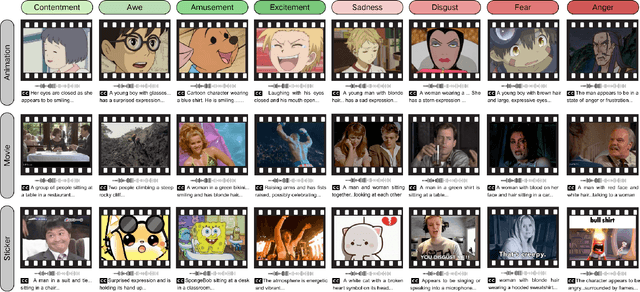

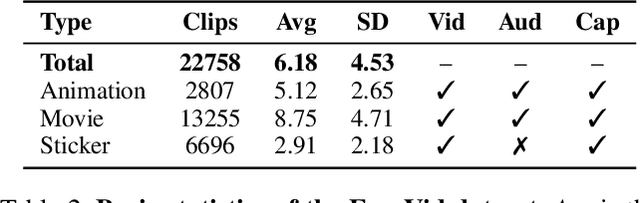
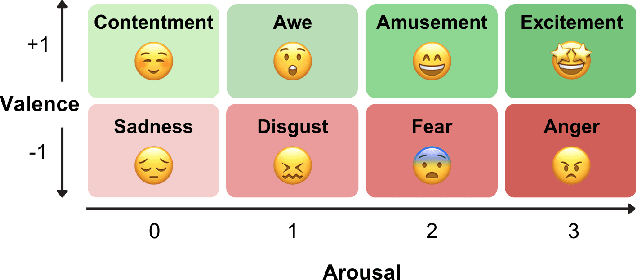
Emotion plays a pivotal role in video-based expression, but existing video generation systems predominantly focus on low-level visual metrics while neglecting affective dimensions. Although emotion analysis has made progress in the visual domain, the video community lacks dedicated resources to bridge emotion understanding with generative tasks, particularly for stylized and non-realistic contexts. To address this gap, we introduce EmoVid, the first multimodal, emotion-annotated video dataset specifically designed for creative media, which includes cartoon animations, movie clips, and animated stickers. Each video is annotated with emotion labels, visual attributes (brightness, colorfulness, hue), and text captions. Through systematic analysis, we uncover spatial and temporal patterns linking visual features to emotional perceptions across diverse video forms. Building on these insights, we develop an emotion-conditioned video generation technique by fine-tuning the Wan2.1 model. The results show a significant improvement in both quantitative metrics and the visual quality of generated videos for text-to-video and image-to-video tasks. EmoVid establishes a new benchmark for affective video computing. Our work not only offers valuable insights into visual emotion analysis in artistically styled videos, but also provides practical methods for enhancing emotional expression in video generation.