 Add to Chrome
 Add to Firefox
 Add to Edge
P-K-GCN: Physics-augmented Koopman-enhanced Graph Convolutional Network for Deep Spatiotemporal Super-resolution
Jun 17, 2026
High-fidelity simulation of spatiotemporal dynamics is computationally prohibitive, necessitating efficient super-resolution techniques to reconstruct high-resolution data from coarse-grained inputs. Traditional data-driven methods often lack physical constraints, and simple physics-informed learning struggles with irregular spatial geometries and intricately evolving temporal dynamics. To tackle these challenges, we propose a Physics-augmented Koopman-enhanced Graph Convolutional Network (P-K-GCN) for spatiotemporal super-resolution on irregular geometries. Specifically, a continuous spline-based GCN is first designed to extract spatial dependencies directly from coarse graph, and Koopman operator theory is incorporated to project the nonlinear dynamics into a compact latent space where temporal progression is linearized. Second, we augment the optimization objective with a physics-based loss to force the data-driven reconstructions to adhere to physical laws for improving predictive fidelity and robustness. Finally, we provide a rigorous theoretical analysis, establishing that the physics augmentation and Koopman regularization mathematically guarantees a reduction in super-resolution error by diminishing Rademacher complexity and tightening generalization bounds. We evaluate our framework on reconstructing spatially high-resolution cardiac electrodynamics across a 3D heart geometry from sparse low-resolution measurements. Numerical experiments demonstrate that our method achieves superior accuracy compared to baseline models.

Contrastive Action-Image Pre-training for Visuomotor Control
Jun 15, 2026Existing vision encoders for robotics face a fundamental bottleneck: robotic datasets lack the scale necessary for large-scale pre-training. Prior work circumvents this data scarcity by turning to internet-scale image and language data or egocentric human video. While these models show promise, neither paradigm learns from paired vision and action data, which downstream visuomotor control policies require. However, robot trajectories, the most direct source of this paired signal, are not available at pre-training scale, motivating us to extract action signals from abundant human video instead. To this end, we introduce CAIP (Contrastive Action-Image Pre-training), a vision encoder that treats human hand poses from large-scale egocentric video as a proxy for end-effector actions. By extracting 3D hand keypoints, a representation that aligns naturally with downstream robot action spaces, CAIP learns a unified action-image representation through a contrastive objective. Leveraging 32,041 hours of egocentric human video and only 88 hours of robotic manipulation data, CAIP outperforms state-of-the-art vision encoders including DINOv2, SigLIP, MVP, and R3M. Evaluated on a challenging real-world dexterous manipulation setup using Dexmate Vega and Sharpa Wave hands, CAIP yields performance gains of more than 30% on tasks involving folding, pouring, and fine-grained manipulation. Our results show that our method of contrastive action-centric pre-training yields a scalable path to achieving robust visual representations better suited for physical interaction.
T-Rex: Tactile-Reactive Dexterous Manipulation
Jun 15, 2026The ability to react dynamically to tactile signals has long been considered crucial to agile human-level dexterity. Yet contemporary learning-based Vision-Language-Action (VLA) models for robotic manipulation generally either overlook the tactile modality or are limited to encoders with static cues, due in part to the scarcity of diverse training data and standardized evaluation, architectural constraints in current VLA models, and limitations of static tactile encoders. In this paper, we push the frontier of tactile-reactive manipulation by addressing all of these limitations. We propose a large-scale, 100-hour tactile-rich dataset collected via a novel, data-efficient recipe that prioritizes elementary motor primitives. To effectively exploit naturally high-frequency touch signals without sacrificing the existing capabilities of existing VLAs, we introduce a variable-rate Mixture-of-Transformers (MoT) architecture equipped with a novel temporal tactile VQ-VAE encoder. We demonstrate the effectiveness of tactile-reactive policies on 12 manipulation tasks requiring delicate force control and deformable object manipulation, achieving over 30% higher average success rate than the strongest baseline.
Online Reasoning Calibration: Test-Time Training Enables Generalizable Conformal LLM Reasoning
Apr 01, 2026While test-time scaling has enabled large language models to solve highly difficult tasks, state-of-the-art results come at exorbitant compute costs. These inefficiencies can be attributed to the miscalibration of post-trained language models, and the lack of calibration in popular sampling techniques. Here, we present Online Reasoning Calibration (ORCA), a framework for calibrating the sampling process that draws upon conformal prediction and test-time training. Specifically, we introduce a meta-learning procedure that updates the calibration module for each input. This allows us to provide valid confidence estimates under distributional shift, e.g. in thought patterns that occur across different stages of reasoning, or in prompt distributions between model development and deployment. ORCA not only provides theoretical guarantees on conformal risks, but also empirically shows higher efficiency and generalization across different reasoning tasks. At risk level $δ=0.1$, ORCA improves Qwen2.5-32B efficiency on in-distribution tasks with savings up to 47.5% with supervised labels and 40.7% with self-consistency labels. Under zero-shot out-of-domain settings, it improves MATH-500 savings from 24.8% of the static calibration baseline to 67.0% while maintaining a low empirical error rate, and the same trend holds across model families and downstream benchmarks. Our code is publicly available at https://github.com/wzekai99/ORCA.
Nanbeige4.1-3B: A Small General Model that Reasons, Aligns, and Acts
Feb 13, 2026We present Nanbeige4.1-3B, a unified generalist language model that simultaneously achieves strong agentic behavior, code generation, and general reasoning with only 3B parameters. To the best of our knowledge, it is the first open-source small language model (SLM) to achieve such versatility in a single model. To improve reasoning and preference alignment, we combine point-wise and pair-wise reward modeling, ensuring high-quality, human-aligned responses. For code generation, we design complexity-aware rewards in Reinforcement Learning, optimizing both correctness and efficiency. In deep search, we perform complex data synthesis and incorporate turn-level supervision during training. This enables stable long-horizon tool interactions, allowing Nanbeige4.1-3B to reliably execute up to 600 tool-call turns for complex problem-solving. Extensive experimental results show that Nanbeige4.1-3B significantly outperforms prior models of similar scale, such as Nanbeige4-3B-2511 and Qwen3-4B, even achieving superior performance compared to much larger models, such as Qwen3-30B-A3B. Our results demonstrate that small models can achieve both broad competence and strong specialization simultaneously, redefining the potential of 3B parameter models.
FAR-AMTN: Attention Multi-Task Network for Face Attribute Recognition
Jan 04, 2026To enhance the generalization performance of Multi-Task Networks (MTN) in Face Attribute Recognition (FAR), it is crucial to share relevant information across multiple related prediction tasks effectively. Traditional MTN methods create shared low-level modules and distinct high-level modules, causing an exponential increase in model parameters with the addition of tasks. This approach also limits feature interaction at the high level, hindering the exploration of semantic relations among attributes, thereby affecting generalization negatively. In response, this study introduces FAR-AMTN, a novel Attention Multi-Task Network for FAR. It incorporates a Weight-Shared Group-Specific Attention (WSGSA) module with shared parameters to minimize complexity while improving group feature representation. Furthermore, a Cross-Group Feature Fusion (CGFF) module is utilized to foster interactions between attribute groups, enhancing feature learning. A Dynamic Weighting Strategy (DWS) is also introduced for synchronized task convergence. Experiments on the CelebA and LFWA datasets demonstrate that the proposed FAR-AMTN demonstrates superior accuracy with significantly fewer parameters compared to existing models.
* 28 pages, 8figures
Mask-Guided Multi-Task Network for Face Attribute Recognition
Jan 04, 2026Face Attribute Recognition (FAR) plays a crucial role in applications such as person re-identification, face retrieval, and face editing. Conventional multi-task attribute recognition methods often process the entire feature map for feature extraction and attribute classification, which can produce redundant features due to reliance on global regions. To address these challenges, we propose a novel approach emphasizing the selection of specific feature regions for efficient feature learning. We introduce the Mask-Guided Multi-Task Network (MGMTN), which integrates Adaptive Mask Learning (AML) and Group-Global Feature Fusion (G2FF) to address the aforementioned limitations. Leveraging a pre-trained keypoint annotation model and a fully convolutional network, AML accurately localizes critical facial parts (e.g., eye and mouth groups) and generates group masks that delineate meaningful feature regions, thereby mitigating negative transfer from global region usage. Furthermore, G2FF combines group and global features to enhance FAR learning, enabling more precise attribute identification. Extensive experiments on two challenging facial attribute recognition datasets demonstrate the effectiveness of MGMTN in improving FAR performance.
In-Context Learning Enables Robot Action Prediction in LLMs
Oct 16, 2024Recently, Large Language Models (LLMs) have achieved remarkable success using in-context learning (ICL) in the language domain. However, leveraging the ICL capabilities within LLMs to directly predict robot actions remains largely unexplored. In this paper, we introduce RoboPrompt, a framework that enables off-the-shelf text-only LLMs to directly predict robot actions through ICL without training. Our approach first heuristically identifies keyframes that capture important moments from an episode. Next, we extract end-effector actions from these keyframes as well as the estimated initial object poses, and both are converted into textual descriptions. Finally, we construct a structured template to form ICL demonstrations from these textual descriptions and a task instruction. This enables an LLM to directly predict robot actions at test time. Through extensive experiments and analysis, RoboPrompt shows stronger performance over zero-shot and ICL baselines in simulated and real-world settings.
MUSE-Net: Missingness-aware mUlti-branching Self-attention Encoder for Irregular Longitudinal Electronic Health Records
Jun 30, 2024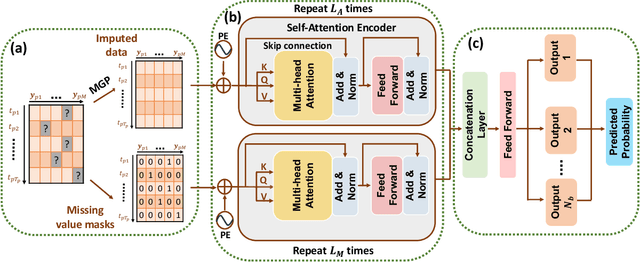
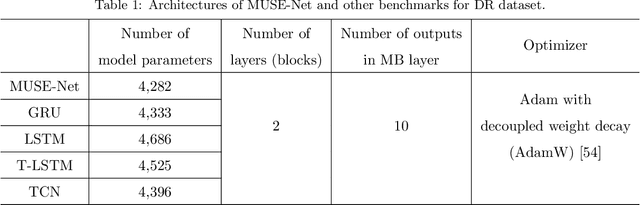
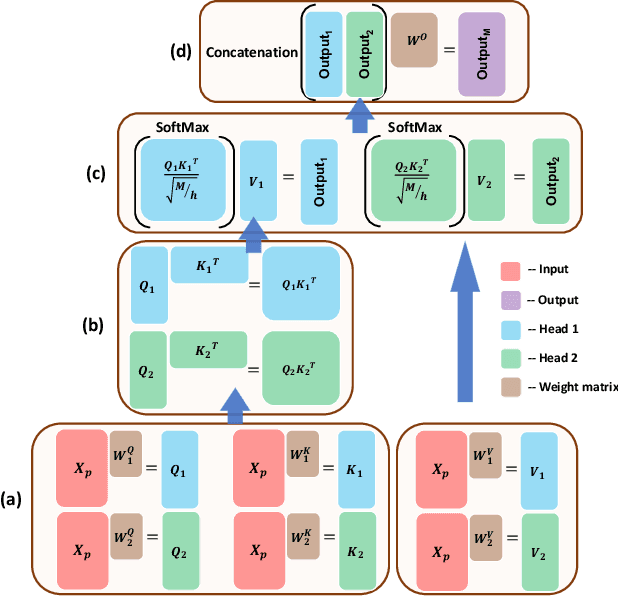
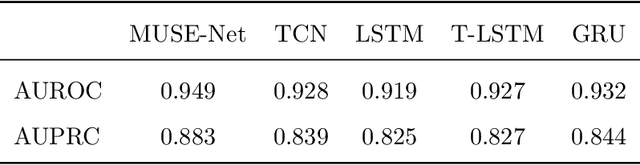
The era of big data has made vast amounts of clinical data readily available, particularly in the form of electronic health records (EHRs), which provides unprecedented opportunities for developing data-driven diagnostic tools to enhance clinical decision making. However, the application of EHRs in data-driven modeling faces challenges such as irregularly spaced multi-variate time series, issues of incompleteness, and data imbalance. Realizing the full data potential of EHRs hinges on the development of advanced analytical models. In this paper, we propose a novel Missingness-aware mUlti-branching Self-attention Encoder (MUSE-Net) to cope with the challenges in modeling longitudinal EHRs for data-driven disease prediction. The MUSE-Net leverages a multi-task Gaussian process (MGP) with missing value masks for data imputation, a multi-branching architecture to address the data imbalance problem, and a time-aware self-attention encoder to account for the irregularly spaced time interval in longitudinal EHRs. We evaluate the proposed MUSE-Net using both synthetic and real-world datasets. Experimental results show that our MUSE-Net outperforms existing methods that are widely used to investigate longitudinal signals.
Exploring Large Language Model based Intelligent Agents: Definitions, Methods, and Prospects
Jan 07, 2024Intelligent agents stand out as a potential path toward artificial general intelligence (AGI). Thus, researchers have dedicated significant effort to diverse implementations for them. Benefiting from recent progress in large language models (LLMs), LLM-based agents that use universal natural language as an interface exhibit robust generalization capabilities across various applications -- from serving as autonomous general-purpose task assistants to applications in coding, social, and economic domains, LLM-based agents offer extensive exploration opportunities. This paper surveys current research to provide an in-depth overview of LLM-based intelligent agents within single-agent and multi-agent systems. It covers their definitions, research frameworks, and foundational components such as their composition, cognitive and planning methods, tool utilization, and responses to environmental feedback. We also delve into the mechanisms of deploying LLM-based agents in multi-agent systems, including multi-role collaboration, message passing, and strategies to alleviate communication issues between agents. The discussions also shed light on popular datasets and application scenarios. We conclude by envisioning prospects for LLM-based agents, considering the evolving landscape of AI and natural language processing.