 Add to Chrome
 Add to Firefox
 Add to Edge
Nanbeige4.2-3B: Unlocking Agentic Capabilities in a Compact Model
Jul 27, 2026
We present Nanbeige4.2-3B, a compact general agentic model with 3B non-embedding parameters. It delivers strong performance across code-agent, office-agent, and complex tool-use tasks while maintaining highly competitive reasoning capabilities in mathematics, coding, and science. Nanbeige4.2-3B is pretrained from scratch on 28T tokens with a Looped Transformer that reuses the layer stack to increase capacity without adding parameters. For SFT data and trajectory construction, we expand the diversity of executable environments, task assets, and agentic scaffolds through real-world deployment and large-scale synthesis. Our RL pipeline applies mixed-mode RLHF over Think and Non-Think responses to improve overall model quality and reduce failure cases, length-controlled reasoning RL to balance accuracy and reasoning efficiency, and agentic RL with outcome and process rewards to stabilize long-horizon training. Extensive evaluations show that Nanbeige4.2-3B outperforms larger models, including Qwen3.5-9B and Gemma4-12B, across diverse agentic benchmarks while remaining competitive on reasoning and alignment tasks. Performance with OpenClaw further supports its use as a compact local personal assistant.

Measuring and Mitigating Post-hoc Rationalization in Reverse Chain-of-Thought Generation
Feb 16, 2026Reverse Chain-of-Thought Generation (RCG) synthesizes reasoning traces from query-answer pairs, but runs the risk of producing post-hoc rationalizations: when models can see the answer during generation, the answer serves as a cognitive anchor that shapes the entire explanation. We formalize this phenomenon through a three-level measurement hierarchy: lexical, entropic, and probabilistic anchoring, each captures surface artifacts, entropy dynamics, and latent answer dependence, respectively. We analyze semantic suppression, the intuitive mitigation strategy that instructs models to ignore the answer, to find out its counterproduction: while it reduces lexical overlap, it paradoxically increases entropic and probabilistic anchoring. Drawing on Ironic Process Theory from cognitive psychology, we attribute this failure to active monitoring of the forbidden answer, which inadvertently deepens dependence on it. To break this cycle, we propose Structural Skeleton-guided Reasoning (SSR), a two-phase approach that first generates an answer-invariant functional skeleton structure, then uses this skeleton to guide full trace generation. By redirecting the information flow to structural planning rather than answer monitoring, SSR consistently reduces anchoring across all three levels. We further introduce Distilled SSR (SSR-D), which fine-tunes models on teacher-generated SSR traces to ensure reliable structural adherence. Experiments across open-ended reasoning benchmarks demonstrate that SSR-D achieves up to 10% improvement over suppression baselines while preserving out-of-distribution (OOD) generalization.
Nanbeige4.1-3B: A Small General Model that Reasons, Aligns, and Acts
Feb 13, 2026We present Nanbeige4.1-3B, a unified generalist language model that simultaneously achieves strong agentic behavior, code generation, and general reasoning with only 3B parameters. To the best of our knowledge, it is the first open-source small language model (SLM) to achieve such versatility in a single model. To improve reasoning and preference alignment, we combine point-wise and pair-wise reward modeling, ensuring high-quality, human-aligned responses. For code generation, we design complexity-aware rewards in Reinforcement Learning, optimizing both correctness and efficiency. In deep search, we perform complex data synthesis and incorporate turn-level supervision during training. This enables stable long-horizon tool interactions, allowing Nanbeige4.1-3B to reliably execute up to 600 tool-call turns for complex problem-solving. Extensive experimental results show that Nanbeige4.1-3B significantly outperforms prior models of similar scale, such as Nanbeige4-3B-2511 and Qwen3-4B, even achieving superior performance compared to much larger models, such as Qwen3-30B-A3B. Our results demonstrate that small models can achieve both broad competence and strong specialization simultaneously, redefining the potential of 3B parameter models.
PACE: Prefix-Protected and Difficulty-Aware Compression for Efficient Reasoning
Feb 12, 2026Language Reasoning Models (LRMs) achieve strong performance by scaling test-time computation but often suffer from ``overthinking'', producing excessively long reasoning traces that increase latency and memory usage. Existing LRMs typically enforce conciseness with uniform length penalties, which over-compress crucial early deduction steps at the sequence level and indiscriminately penalize all queries at the group level. To solve these limitations, we propose \textbf{\model}, a dual-level framework for prefix-protected and difficulty-aware compression under hierarchical supervision. At the sequence level, prefix-protected optimization employs decaying mixed rollouts to maintain valid reasoning paths while promoting conciseness. At the group level, difficulty-aware penalty dynamically scales length constraints based on query complexity, maintaining exploration for harder questions while curbing redundancy on easier ones. Extensive experiments on DeepSeek-R1-Distill-Qwen (1.5B/7B) demonstrate that \model achieves a substantial reduction in token usage (up to \textbf{55.7\%}) while simultaneously improving accuracy (up to \textbf{4.1\%}) on math benchmarks, with generalization ability to code, science, and general domains.
TOOL4POI: A Tool-Augmented LLM Framework for Next POI Recommendation
Nov 09, 2025Next Point-of-Interest (POI) recommendation is a fundamental task in location-based services. While recent advances leverage Large Language Model (LLM) for sequential modeling, existing LLM-based approaches face two key limitations: (i) strong reliance on the contextual completeness of user histories, resulting in poor performance on out-of-history (OOH) scenarios; (ii) limited scalability, due to the restricted context window of LLMs, which limits their ability to access and process a large number of candidate POIs. To address these challenges, we propose Tool4POI, a novel tool-augmented framework that enables LLMs to perform open-set POI recommendation through external retrieval and reasoning. Tool4POI consists of three key modules: preference extraction module, multi-turn candidate retrieval module, and reranking module, which together summarize long-term user interests, interact with external tools to retrieve relevant POIs, and refine final recommendations based on recent behaviors. Unlike existing methods, Tool4POI requires no task-specific fine-tuning and is compatible with off-the-shelf LLMs in a plug-and-play manner. Extensive experiments on three real-world datasets show that Tool4POI substantially outperforms state-of-the-art baselines, achieving up to 40% accuracy on challenging OOH scenarios where existing methods fail, and delivering average improvements of 20% and 30% on Acc@5 and Acc@10, respectively.
CulFiT: A Fine-grained Cultural-aware LLM Training Paradigm via Multilingual Critique Data Synthesis
May 26, 2025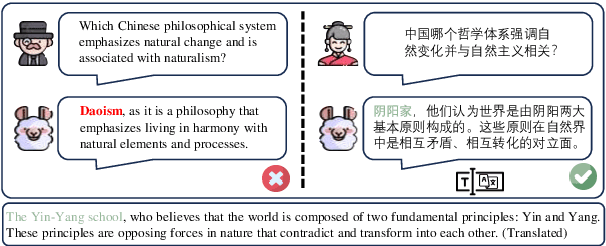
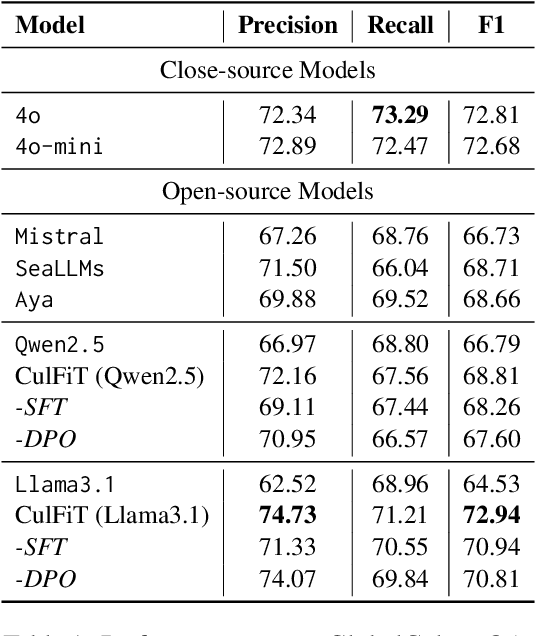
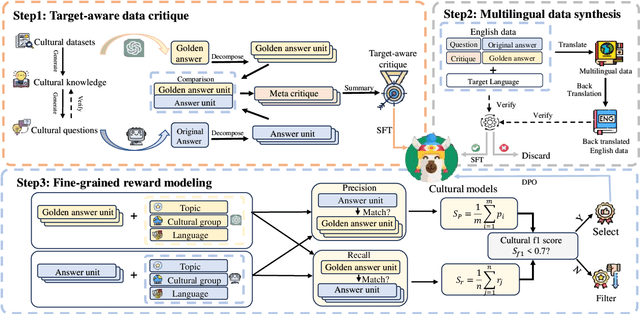
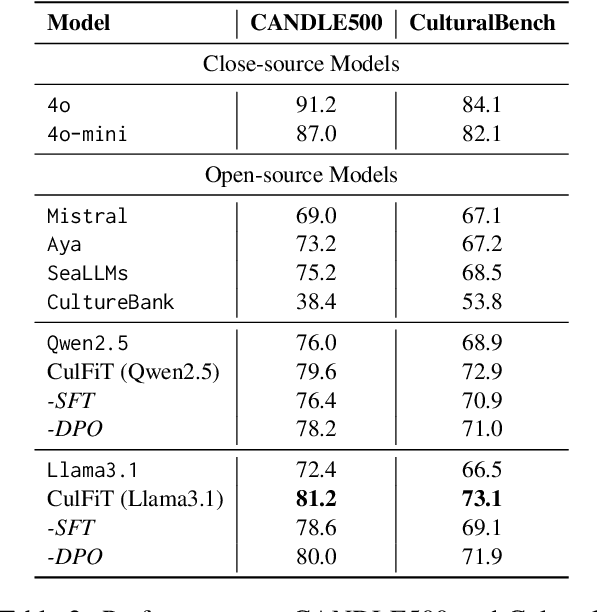
Large Language Models (LLMs) have demonstrated remarkable capabilities across various tasks, yet they often exhibit a specific cultural biases, neglecting the values and linguistic diversity of low-resource regions. This cultural bias not only undermines universal equality, but also risks reinforcing stereotypes and perpetuating discrimination. To address this, we propose CulFiT, a novel culturally-aware training paradigm that leverages multilingual data and fine-grained reward modeling to enhance cultural sensitivity and inclusivity. Our approach synthesizes diverse cultural-related questions, constructs critique data in culturally relevant languages, and employs fine-grained rewards to decompose cultural texts into verifiable knowledge units for interpretable evaluation. We also introduce GlobalCultureQA, a multilingual open-ended question-answering dataset designed to evaluate culturally-aware responses in a global context. Extensive experiments on three existing benchmarks and our GlobalCultureQA demonstrate that CulFiT achieves state-of-the-art open-source model performance in cultural alignment and general reasoning.