 Add to Chrome
 Add to Firefox
 Add to Edge
Verifier-Induced Support Reshaping in On-Policy Optimization
Jul 31, 2026
We show that on-policy reinforcement learning with verifiable rewards (RLVR) can improve the current objective while making successful behaviors for later objectives too rare to sample and reinforce. We call this verifier-induced support reshaping and define effective rewardable support as successful trajectories reachable within a fixed rollout budget. Across two model families, we study this effect through repeated verifier-scored sampling and bidirectional training on mathematical reasoning and constrained instruction following, including sequential training with the opposite verifier. Math-RLVR raises average instruction-following success but reduces the number of prompts with any successful response under repeated sampling. On IFEval with Qwen3-8B-Base, pass@1 rises by 6.5 percentage points while best@32 falls by 9.8 percentage points, and the same divergence appears across both models and IF benchmarks. Conversely, IF-RLVR shifts math responses from step-by-step openings toward direct answers, lowers best@k across sampling budgets, and reduces reward variation for later Math-RLVR. Token-distribution analyses and controlled opening interventions show that these changes concentrate in the first few response tokens. RLVR mainly reranks openings already available in the base policy, and the selected opening causally affects math searchability. The tested reference-policy constraints, routing priors, and on-policy distillation preserve cross-task support only partially; MathIF and ReasonIF show that marginal gains translate only partly into responses that are both correct and constraint-following. Therefore, endpoint improvements do not guarantee future trainability or joint capability under on-policy optimization. Code is available at https://github.com/sylvain-wei/verifier-induced-support-reshaping

Encode Errors: Representational Retrieval of In-Context Demonstrations for Multilingual Grammatical Error Correction
Jun 13, 2026Grammatical Error Correction (GEC) involves detecting and correcting the wrong usage of grammar. While large language models (LLMs) with in-context learning (ICL) capabilities have shown significant progress on various natural language processing (NLP) tasks, their few-shot performance on GEC remains suboptimal. This is mainly due to the challenge of retrieving suitable in-context demonstrations that capture error patterns instead of semantic similarity. In this paper, we demonstrate that LLMs can inherently capture information related to grammatical errors through their internal states. From these states, we extract the Grammatical Error Representation (GER), an informative and semantically neutral encoding of grammatical errors. Our novel GER-based retrieval method significantly boosts performance in ICL settings on multilingual GEC datasets, improving the precision of correction. For high-resource languages, our results on 8B-sized open-source models match those of closed-source models such as Deepseek2.5 and GPT-4o-mini. For low-resource languages, our $F_{0.5}$ scores surpass the baseline by up to a factor of 1.20. This method provides a more precise and resource-efficient solution for multilingual GEC, offering a promising direction for interpretable GEC research.
* 15 pages, 6 figures
Only Say What You Know: Calibration-Aware Generation for Long-Form Factuality
May 03, 2026Large Reasoning Models achieve strong performance on complex tasks but remain prone to hallucinations, particularly in long-form generation where errors compound across reasoning steps. Existing approaches to improving factuality, including abstention and factuality-driven optimization, follow a \emph{coupled exploration-commitment} paradigm, in which intermediate reasoning is unconditionally propagated to the final output, limiting fine-grained control over information selection and integration. In this paper, we propose an \textbf{Exploration-Commitment Decoupling} paradigm that disentangles knowledge exploration from final commitment, enabling models to explore with awareness while answering cautiously. We instantiate the paradigm with \textbf{Calibration-Aware Generation (CAG)}, a framework that equips models with end-to-end, calibration-aware generation capabilities, by augmenting intermediate reasoning with calibrated reliability estimates and prioritizing reliable content in final outputs. Across five long-form factuality benchmarks and multiple model families, CAG improves factuality by up to 13%, while reducing decoding time by up to 37%. Overall, our work highlights decoupling as a principled approach for more reliable long-form generation, offering directions for trustworthy and self-aware generative systems.
Measuring and Mitigating Post-hoc Rationalization in Reverse Chain-of-Thought Generation
Feb 16, 2026Reverse Chain-of-Thought Generation (RCG) synthesizes reasoning traces from query-answer pairs, but runs the risk of producing post-hoc rationalizations: when models can see the answer during generation, the answer serves as a cognitive anchor that shapes the entire explanation. We formalize this phenomenon through a three-level measurement hierarchy: lexical, entropic, and probabilistic anchoring, each captures surface artifacts, entropy dynamics, and latent answer dependence, respectively. We analyze semantic suppression, the intuitive mitigation strategy that instructs models to ignore the answer, to find out its counterproduction: while it reduces lexical overlap, it paradoxically increases entropic and probabilistic anchoring. Drawing on Ironic Process Theory from cognitive psychology, we attribute this failure to active monitoring of the forbidden answer, which inadvertently deepens dependence on it. To break this cycle, we propose Structural Skeleton-guided Reasoning (SSR), a two-phase approach that first generates an answer-invariant functional skeleton structure, then uses this skeleton to guide full trace generation. By redirecting the information flow to structural planning rather than answer monitoring, SSR consistently reduces anchoring across all three levels. We further introduce Distilled SSR (SSR-D), which fine-tunes models on teacher-generated SSR traces to ensure reliable structural adherence. Experiments across open-ended reasoning benchmarks demonstrate that SSR-D achieves up to 10% improvement over suppression baselines while preserving out-of-distribution (OOD) generalization.
Nanbeige4.1-3B: A Small General Model that Reasons, Aligns, and Acts
Feb 13, 2026We present Nanbeige4.1-3B, a unified generalist language model that simultaneously achieves strong agentic behavior, code generation, and general reasoning with only 3B parameters. To the best of our knowledge, it is the first open-source small language model (SLM) to achieve such versatility in a single model. To improve reasoning and preference alignment, we combine point-wise and pair-wise reward modeling, ensuring high-quality, human-aligned responses. For code generation, we design complexity-aware rewards in Reinforcement Learning, optimizing both correctness and efficiency. In deep search, we perform complex data synthesis and incorporate turn-level supervision during training. This enables stable long-horizon tool interactions, allowing Nanbeige4.1-3B to reliably execute up to 600 tool-call turns for complex problem-solving. Extensive experimental results show that Nanbeige4.1-3B significantly outperforms prior models of similar scale, such as Nanbeige4-3B-2511 and Qwen3-4B, even achieving superior performance compared to much larger models, such as Qwen3-30B-A3B. Our results demonstrate that small models can achieve both broad competence and strong specialization simultaneously, redefining the potential of 3B parameter models.
PACE: Prefix-Protected and Difficulty-Aware Compression for Efficient Reasoning
Feb 12, 2026Language Reasoning Models (LRMs) achieve strong performance by scaling test-time computation but often suffer from ``overthinking'', producing excessively long reasoning traces that increase latency and memory usage. Existing LRMs typically enforce conciseness with uniform length penalties, which over-compress crucial early deduction steps at the sequence level and indiscriminately penalize all queries at the group level. To solve these limitations, we propose \textbf{\model}, a dual-level framework for prefix-protected and difficulty-aware compression under hierarchical supervision. At the sequence level, prefix-protected optimization employs decaying mixed rollouts to maintain valid reasoning paths while promoting conciseness. At the group level, difficulty-aware penalty dynamically scales length constraints based on query complexity, maintaining exploration for harder questions while curbing redundancy on easier ones. Extensive experiments on DeepSeek-R1-Distill-Qwen (1.5B/7B) demonstrate that \model achieves a substantial reduction in token usage (up to \textbf{55.7\%}) while simultaneously improving accuracy (up to \textbf{4.1\%}) on math benchmarks, with generalization ability to code, science, and general domains.
Two Pathways to Truthfulness: On the Intrinsic Encoding of LLM Hallucinations
Jan 12, 2026Despite their impressive capabilities, large language models (LLMs) frequently generate hallucinations. Previous work shows that their internal states encode rich signals of truthfulness, yet the origins and mechanisms of these signals remain unclear. In this paper, we demonstrate that truthfulness cues arise from two distinct information pathways: (1) a Question-Anchored pathway that depends on question-answer information flow, and (2) an Answer-Anchored pathway that derives self-contained evidence from the generated answer itself. First, we validate and disentangle these pathways through attention knockout and token patching. Afterwards, we uncover notable and intriguing properties of these two mechanisms. Further experiments reveal that (1) the two mechanisms are closely associated with LLM knowledge boundaries; and (2) internal representations are aware of their distinctions. Finally, building on these insightful findings, two applications are proposed to enhance hallucination detection performance. Overall, our work provides new insight into how LLMs internally encode truthfulness, offering directions for more reliable and self-aware generative systems.
Odysseus Navigates the Sirens' Song: Dynamic Focus Decoding for Factual and Diverse Open-Ended Text Generation
Mar 11, 2025Large Language Models (LLMs) are increasingly required to generate text that is both factually accurate and diverse across various open-ended applications. However, current stochastic decoding methods struggle to balance such objectives. We introduce Dynamic Focus Decoding (DFD), a novel plug-and-play stochastic approach that resolves this trade-off without requiring additional data, knowledge, or models. DFD adaptively adjusts the decoding focus based on distributional differences across layers, leveraging the modular and hierarchical nature of factual knowledge within LLMs. This dynamic adjustment improves factuality in knowledge-intensive decoding steps and promotes diversity in less knowledge-reliant steps. DFD can be easily integrated with existing decoding methods, enhancing both factuality and diversity with minimal computational overhead. Extensive experiments across seven datasets demonstrate that DFD significantly improves performance, providing a scalable and efficient solution for open-ended text generation.
FEA-Bench: A Benchmark for Evaluating Repository-Level Code Generation for Feature Implementation
Mar 09, 2025Implementing new features in repository-level codebases is a crucial application of code generation models. However, current benchmarks lack a dedicated evaluation framework for this capability. To fill this gap, we introduce FEA-Bench, a benchmark designed to assess the ability of large language models (LLMs) to perform incremental development within code repositories. We collect pull requests from 83 GitHub repositories and use rule-based and intent-based filtering to construct task instances focused on new feature development. Each task instance containing code changes is paired with relevant unit test files to ensure that the solution can be verified. The feature implementation requires LLMs to simultaneously possess code completion capabilities for new components and code editing abilities for other relevant parts in the code repository, providing a more comprehensive evaluation method of LLMs' automated software engineering capabilities. Experimental results show that LLMs perform significantly worse in the FEA-Bench, highlighting considerable challenges in such repository-level incremental code development.
Explanation based In-Context Demonstrations Retrieval for Multilingual Grammatical Error Correction
Feb 12, 2025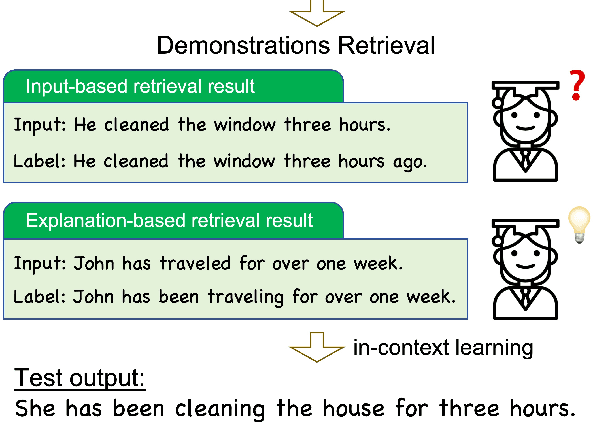
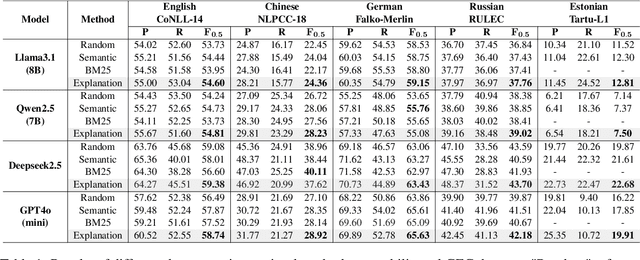
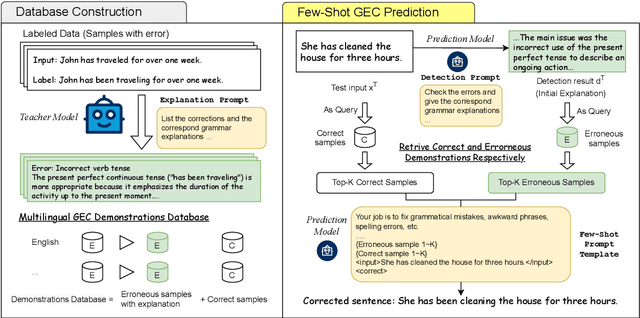
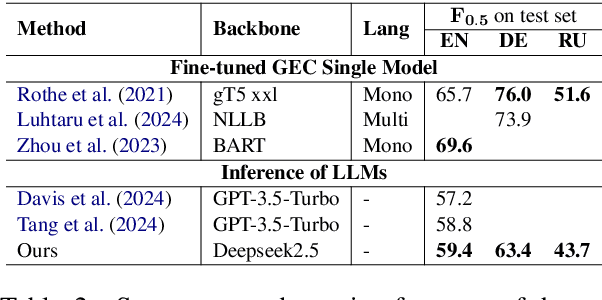
Grammatical error correction (GEC) aims to correct grammatical, spelling, and semantic errors in natural language text. With the growing of large language models (LLMs), direct text generation has gradually become the focus of the GEC methods, and few-shot in-context learning presents a cost-effective solution. However, selecting effective in-context examples remains challenging, as the similarity between input texts does not necessarily correspond to similar grammatical error patterns. In this paper, we propose a novel retrieval method based on natural language grammatical error explanations (GEE) to address this issue. Our method retrieves suitable few-shot demonstrations by matching the GEE of the test input with that of pre-constructed database samples, where explanations for erroneous samples are generated by LLMs. We conducted multilingual GEC few-shot experiments on both major open-source and closed-source LLMs. Experiments across five languages show that our method outperforms existing semantic and BM25-based retrieval techniques, without requiring additional training or language adaptation. This also suggests that matching error patterns is key to selecting examples.