 Add to Chrome
 Add to Firefox
 Add to Edge
Playful Agentic Robot Learning
Jun 17, 2026
Current agentic robot systems can write executable Code-as-Policy programs, observe feedback, and revise behavior across multiple attempts, but they remain largely task-driven: reusable skills are acquired only after explicit instructions. We study Playful Agentic Robot Learning, where an embodied coding agent uses self-directed play as a continual skill-learning stage before downstream tasks arrive. We introduce RATs, Robotics Agent Teams designed for play-time skill acquisition. During play, RATs proposes novel yet learnable exploratory tasks, plans and executes robot-code policies, verifies intermediate progress, diagnoses failures, retries with dense, step-level feedback, and distills successful executions into a persistent code skill library. At test time, the agent reuses relevant skills from this frozen library to help solve new tasks. Experiments in LIBERO-PRO and MolmoSpaces show that play-learned skills improve held-out downstream tasks over no-play and random-play baselines, with 20.6 and 17.0 percentage-point gains over CaP-Agent0 on LIBERO-PRO and MolmoSpaces, respectively. Moreover, the learned skills can be plugged into other inference-time Code-as-Policy agents by simply retrieving them into the context, improving RoboSuite and real-world transfer by 8.9 and 8.8 points, respectively, without finetuning the underlying model.

Contrastive Action-Image Pre-training for Visuomotor Control
Jun 15, 2026Existing vision encoders for robotics face a fundamental bottleneck: robotic datasets lack the scale necessary for large-scale pre-training. Prior work circumvents this data scarcity by turning to internet-scale image and language data or egocentric human video. While these models show promise, neither paradigm learns from paired vision and action data, which downstream visuomotor control policies require. However, robot trajectories, the most direct source of this paired signal, are not available at pre-training scale, motivating us to extract action signals from abundant human video instead. To this end, we introduce CAIP (Contrastive Action-Image Pre-training), a vision encoder that treats human hand poses from large-scale egocentric video as a proxy for end-effector actions. By extracting 3D hand keypoints, a representation that aligns naturally with downstream robot action spaces, CAIP learns a unified action-image representation through a contrastive objective. Leveraging 32,041 hours of egocentric human video and only 88 hours of robotic manipulation data, CAIP outperforms state-of-the-art vision encoders including DINOv2, SigLIP, MVP, and R3M. Evaluated on a challenging real-world dexterous manipulation setup using Dexmate Vega and Sharpa Wave hands, CAIP yields performance gains of more than 30% on tasks involving folding, pouring, and fine-grained manipulation. Our results show that our method of contrastive action-centric pre-training yields a scalable path to achieving robust visual representations better suited for physical interaction.
T-Rex: Tactile-Reactive Dexterous Manipulation
Jun 15, 2026The ability to react dynamically to tactile signals has long been considered crucial to agile human-level dexterity. Yet contemporary learning-based Vision-Language-Action (VLA) models for robotic manipulation generally either overlook the tactile modality or are limited to encoders with static cues, due in part to the scarcity of diverse training data and standardized evaluation, architectural constraints in current VLA models, and limitations of static tactile encoders. In this paper, we push the frontier of tactile-reactive manipulation by addressing all of these limitations. We propose a large-scale, 100-hour tactile-rich dataset collected via a novel, data-efficient recipe that prioritizes elementary motor primitives. To effectively exploit naturally high-frequency touch signals without sacrificing the existing capabilities of existing VLAs, we introduce a variable-rate Mixture-of-Transformers (MoT) architecture equipped with a novel temporal tactile VQ-VAE encoder. We demonstrate the effectiveness of tactile-reactive policies on 12 manipulation tasks requiring delicate force control and deformable object manipulation, achieving over 30% higher average success rate than the strongest baseline.
FTP-1: A Generalist Foundation Tactile Policy Across Tactile Sensors for Contact-Rich Manipulation
Jun 11, 2026Despite the success of vision-based generalist robotic policies, existing tactile-based policies remain tied to fixed embodiments and sensor setups. This is because tactile signals are highly heterogeneous across hardware, making cross-sensor generalization difficult. We present FTP-1,the first generalist foundation tactile policy pretrained to acquire transferable tactile manipulation abilities across diverse sensors and embodiments. FTP-1 supports varied tactile inputs, including image-, array-, and state-based signals, by using heterogeneous encoders to project them into unified morphology-aware latent tokens that are jointly modeled by a shared tactile Transformer expert. Pretrained on around 3,000 hours of tactile manipulation data aggregated from 26 data sources, spanning human and robot demonstrations across 21 sensors, FTP-1 learns tactile skills that transfer beyond the sensors seen during pretraining. Across downstream finetuning experiments spanning 5 hardware configurations, FTP-1 improves contact-rich manipulation on seen sensor setups by +17.2% and, surprisingly, transfers to two previously unseen tactile-sensor setups, achieving a +31% gain in success rate. FTP-1 establishes the first unified foundation baseline for tactile manipulation, providing future tactile policies with a shared model-level starting point. Pretrained models, datasets, training code and more visualization at https://ftp1-policy.github.io.
EgoScale: Scaling Dexterous Manipulation with Diverse Egocentric Human Data
Feb 18, 2026Human behavior is among the most scalable sources of data for learning physical intelligence, yet how to effectively leverage it for dexterous manipulation remains unclear. While prior work demonstrates human to robot transfer in constrained settings, it is unclear whether large scale human data can support fine grained, high degree of freedom dexterous manipulation. We present EgoScale, a human to dexterous manipulation transfer framework built on large scale egocentric human data. We train a Vision Language Action (VLA) model on over 20,854 hours of action labeled egocentric human video, more than 20 times larger than prior efforts, and uncover a log linear scaling law between human data scale and validation loss. This validation loss strongly correlates with downstream real robot performance, establishing large scale human data as a predictable supervision source. Beyond scale, we introduce a simple two stage transfer recipe: large scale human pretraining followed by lightweight aligned human robot mid training. This enables strong long horizon dexterous manipulation and one shot task adaptation with minimal robot supervision. Our final policy improves average success rate by 54% over a no pretraining baseline using a 22 DoF dexterous robotic hand, and transfers effectively to robots with lower DoF hands, indicating that large scale human motion provides a reusable, embodiment agnostic motor prior.
World Action Models are Zero-shot Policies
Feb 17, 2026State-of-the-art Vision-Language-Action (VLA) models excel at semantic generalization but struggle to generalize to unseen physical motions in novel environments. We introduce DreamZero, a World Action Model (WAM) built upon a pretrained video diffusion backbone. Unlike VLAs, WAMs learn physical dynamics by predicting future world states and actions, using video as a dense representation of how the world evolves. By jointly modeling video and action, DreamZero learns diverse skills effectively from heterogeneous robot data without relying on repetitive demonstrations. This results in over 2x improvement in generalization to new tasks and environments compared to state-of-the-art VLAs in real robot experiments. Crucially, through model and system optimizations, we enable a 14B autoregressive video diffusion model to perform real-time closed-loop control at 7Hz. Finally, we demonstrate two forms of cross-embodiment transfer: video-only demonstrations from other robots or humans yield a relative improvement of over 42% on unseen task performance with just 10-20 minutes of data. More surprisingly, DreamZero enables few-shot embodiment adaptation, transferring to a new embodiment with only 30 minutes of play data while retaining zero-shot generalization.
DreamDojo: A Generalist Robot World Model from Large-Scale Human Videos
Feb 06, 2026Being able to simulate the outcomes of actions in varied environments will revolutionize the development of generalist agents at scale. However, modeling these world dynamics, especially for dexterous robotics tasks, poses significant challenges due to limited data coverage and scarce action labels. As an endeavor towards this end, we introduce DreamDojo, a foundation world model that learns diverse interactions and dexterous controls from 44k hours of egocentric human videos. Our data mixture represents the largest video dataset to date for world model pretraining, spanning a wide range of daily scenarios with diverse objects and skills. To address the scarcity of action labels, we introduce continuous latent actions as unified proxy actions, enhancing interaction knowledge transfer from unlabeled videos. After post-training on small-scale target robot data, DreamDojo demonstrates a strong understanding of physics and precise action controllability. We also devise a distillation pipeline that accelerates DreamDojo to a real-time speed of 10.81 FPS and further improves context consistency. Our work enables several important applications based on generative world models, including live teleoperation, policy evaluation, and model-based planning. Systematic evaluation on multiple challenging out-of-distribution (OOD) benchmarks verifies the significance of our method for simulating open-world, contact-rich tasks, paving the way for general-purpose robot world models.
LeVERB: Humanoid Whole-Body Control with Latent Vision-Language Instruction
Jun 16, 2025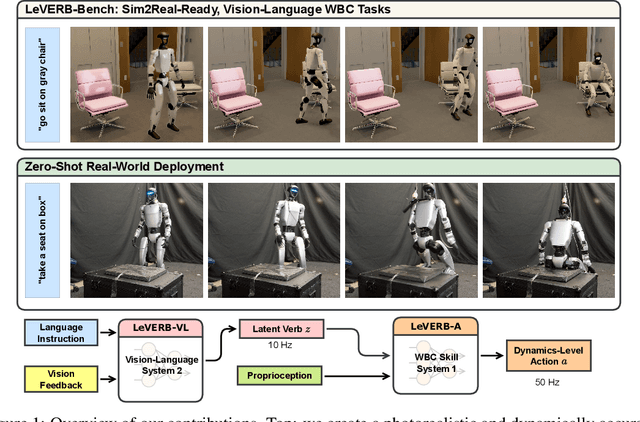
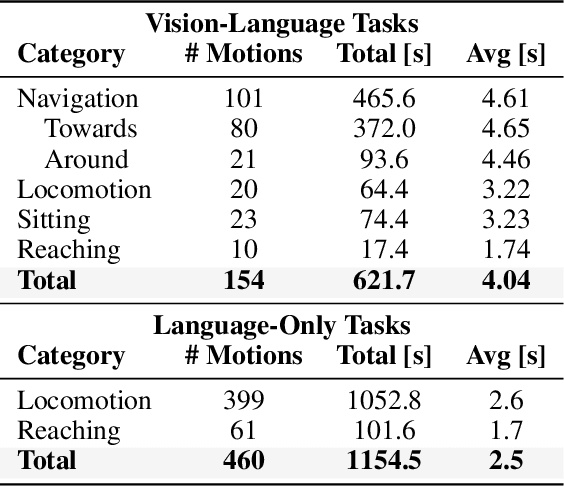
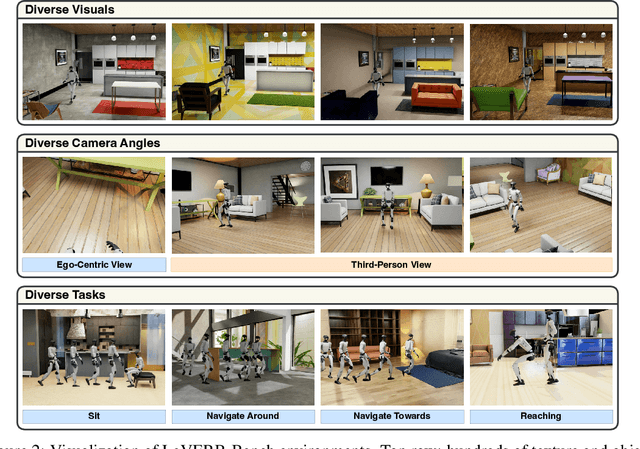
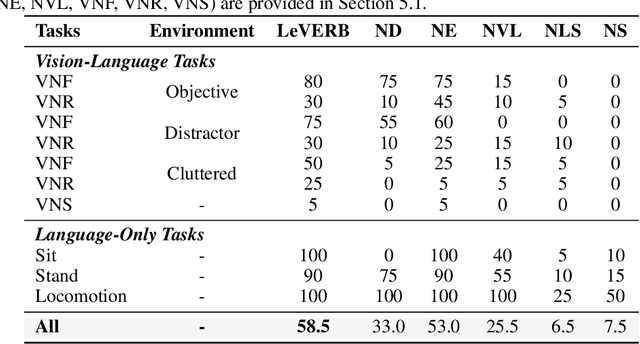
Vision-language-action (VLA) models have demonstrated strong semantic understanding and zero-shot generalization, yet most existing systems assume an accurate low-level controller with hand-crafted action "vocabulary" such as end-effector pose or root velocity. This assumption confines prior work to quasi-static tasks and precludes the agile, whole-body behaviors required by humanoid whole-body control (WBC) tasks. To capture this gap in the literature, we start by introducing the first sim-to-real-ready, vision-language, closed-loop benchmark for humanoid WBC, comprising over 150 tasks from 10 categories. We then propose LeVERB: Latent Vision-Language-Encoded Robot Behavior, a hierarchical latent instruction-following framework for humanoid vision-language WBC, the first of its kind. At the top level, a vision-language policy learns a latent action vocabulary from synthetically rendered kinematic demonstrations; at the low level, a reinforcement-learned WBC policy consumes these latent verbs to generate dynamics-level commands. In our benchmark, LeVERB can zero-shot attain a 80% success rate on simple visual navigation tasks, and 58.5% success rate overall, outperforming naive hierarchical whole-body VLA implementation by 7.8 times.
Pre-training Auto-regressive Robotic Models with 4D Representations
Feb 18, 2025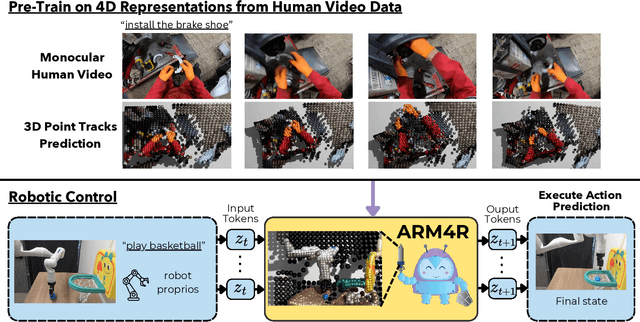
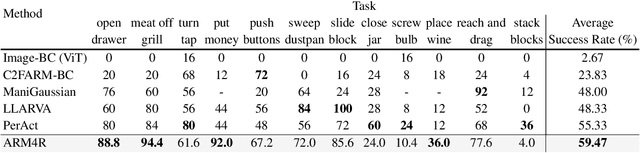
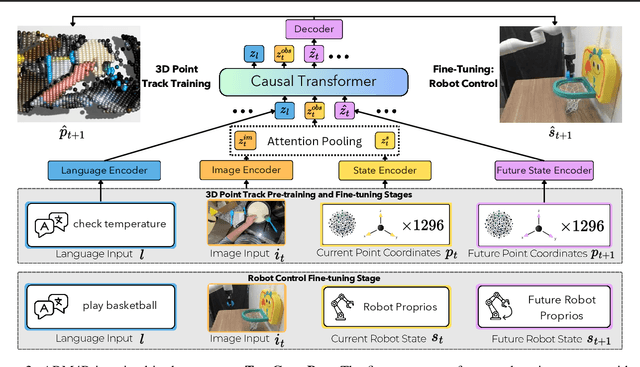
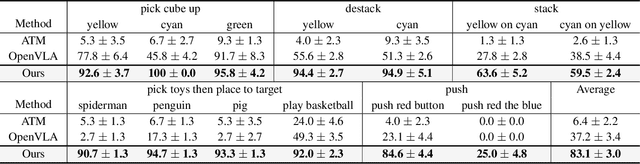
Foundation models pre-trained on massive unlabeled datasets have revolutionized natural language and computer vision, exhibiting remarkable generalization capabilities, thus highlighting the importance of pre-training. Yet, efforts in robotics have struggled to achieve similar success, limited by either the need for costly robotic annotations or the lack of representations that effectively model the physical world. In this paper, we introduce ARM4R, an Auto-regressive Robotic Model that leverages low-level 4D Representations learned from human video data to yield a better pre-trained robotic model. Specifically, we focus on utilizing 3D point tracking representations from videos derived by lifting 2D representations into 3D space via monocular depth estimation across time. These 4D representations maintain a shared geometric structure between the points and robot state representations up to a linear transformation, enabling efficient transfer learning from human video data to low-level robotic control. Our experiments show that ARM4R can transfer efficiently from human video data to robotics and consistently improves performance on tasks across various robot environments and configurations.
In-Context Learning Enables Robot Action Prediction in LLMs
Oct 16, 2024Recently, Large Language Models (LLMs) have achieved remarkable success using in-context learning (ICL) in the language domain. However, leveraging the ICL capabilities within LLMs to directly predict robot actions remains largely unexplored. In this paper, we introduce RoboPrompt, a framework that enables off-the-shelf text-only LLMs to directly predict robot actions through ICL without training. Our approach first heuristically identifies keyframes that capture important moments from an episode. Next, we extract end-effector actions from these keyframes as well as the estimated initial object poses, and both are converted into textual descriptions. Finally, we construct a structured template to form ICL demonstrations from these textual descriptions and a task instruction. This enables an LLM to directly predict robot actions at test time. Through extensive experiments and analysis, RoboPrompt shows stronger performance over zero-shot and ICL baselines in simulated and real-world settings.