 Add to Chrome
 Add to Firefox
 Add to Edge
PILA: Plug-and-Play Insertion for LLM-native Advertising
Jul 28, 2026
How to monetize large language models (LLMs) by naturally integrating sponsored content into their responses, known as LLM-native advertising, has recently emerged as a critical problem. However, existing solutions entangle advertising with content generation inside a single model, which is incompatible with modern API-only or workflow-based LLM applications and inevitably compromises the original response quality. To address this, we propose PILA, which reformulates ad insertion as a conditional response rewriting problem and decouples it from the upstream service as a lightweight sidecar module. PILA is model-agnostic and can be seamlessly integrated with existing LLM services without modifying the base model or its workflow. It also exposes a controllable trade-off between user-side naturalness and ad-side exposure, offering a practical interface for downstream pricing and deployment. Experiments across diverse upstream models show that \pila consistently improves ad effectiveness while preserving response quality, highlighting its promise as a practical solution for LLM-native advertising.

One Demonstration Is Enough for Real-World Robotic Reinforcement Learning
Jul 02, 2026Learning effective robot control policies on physical hardware is challenging due to costly data collection and the difficulty of reward specification. Prior work has incorporated demonstrations into reinforcement learning (RL), yet existing approaches either require large numbers of demonstrations or depend on continuous human intervention during training. To address these limitations, we present AutoSERL, a framework that leverages a single demonstration to fully automate the intervention process in real-world robot RL. The framework includes three complementary mechanisms to accomplish certain tasks: a sliding window intervention mechanism that continuously guides exploration to prevent local optima and unsafe deviations, a safety recovery mechanism that detects and corrects failure states via predefined trajectory recovery points, and an intervention termination criterion that automatically disables guidance once the policy can independently complete the task, preserving its exploration advantage. We evaluate AutoSERL on six contact-intensive manipulation tasks across two robot platforms, spanning insertion, hanging, and hinge-based tasks. AutoSERL consistently outperforms SERL initialized with 20 demonstrations, behavior cloning, and MILES -- a dedicated one-shot imitation learning baseline -- across all tasks while matching HIL-SERL, achieves 100% success rate on insertion tasks, and demonstrates improved robustness to positional variations, all from a single demonstration. Code and videos are available on our project website: https://autoserl.github.io/.
Agora: Toward Autonomous Bug Detection in Production-Level Consensus Protocols with LLM Agents
May 28, 2026Consensus protocols form the backbone of distributed systems and blockchains, where implementation bugs can cause data corruption and financial losses. While LLM-based approaches show promise in code analysis, they struggle with deep protocol-level logic bugs involving complex state-dependent behaviors across multiple execution stages. We present Agora, a domain-aware multi-agent framework that integrates hypothesis-driven testing with LLM capabilities for systematic protocol verification. Agora employs specialized agents that collaboratively explore protocol state spaces, synthesize attack scenarios using domain-specific constraints, and validate findings through iterative refinement. This explicit role separation enables reasoning about global protocol invariants beyond single-function code analysis. We evaluate Agora on four consensus implementations (Raft, EPaxos, HotStuff, BullShark) using four state-of-the-art LLMs. Agora discovers 15 previously unknown protocol-level logic bugs that violate safety properties, while existing LLM-based agents fail to detect any such protocol-level logic bugs. Our results demonstrate that domain-aware multi-agent collaboration is essential for detecting deep logic bugs in complex protocols.
System Design for Maintaining Internal State Consistency in Long-Horizon Robotic Tabletop Games
Mar 26, 2026Long-horizon tabletop games pose a distinct systems challenge for robotics: small perceptual or execution errors can invalidate accumulated task state, propagate across decision-making modules, and ultimately derail interaction. This paper studies how to maintain internal state consistency in turn-based, multi-human robotic tabletop games through deliberate system design rather than isolated component improvement. Using Mahjong as a representative long-horizon setting, we present an integrated architecture that explicitly maintains perceptual, execution, and interaction state, partitions high-level semantic reasoning from time-critical perception and control, and incorporates verified action primitives with tactile-triggered recovery to prevent premature state corruption. We further introduce interaction-level monitoring mechanisms to detect turn violations and hidden-information breaches that threaten execution assumptions. Beyond demonstrating complete-game operation, we provide an empirical characterization of failure modes, recovery effectiveness, cross-module error propagation, and hardware-algorithm trade-offs observed during deployment. Our results show that explicit partitioning, monitored state transitions, and recovery mechanisms are critical for sustaining executable consistency over extended play, whereas monolithic or unverified pipelines lead to measurable degradation in end-to-end reliability. The proposed system serves as an empirical platform for studying system-level design principles in long-horizon, turn-based interaction.
Does LLM Alignment Really Need Diversity? An Empirical Study of Adapting RLVR Methods for Moral Reasoning
Mar 11, 2026Reinforcement learning with verifiable rewards (RLVR) has achieved remarkable success in logical reasoning tasks, yet whether large language model (LLM) alignment requires fundamentally different approaches remains unclear. Given the apparent tolerance for multiple valid responses in moral reasoning, a natural hypothesis is that alignment tasks inherently require diversity-seeking distribution-matching algorithms rather than reward-maximizing policy-based methods. We conduct the first comprehensive empirical study comparing both paradigms on MoReBench. To enable stable RLVR training, we build a rubric-grounded reward pipeline by training a Qwen3-1.7B judge model. Contrary to our hypothesis, we find that distribution-matching approaches do not demonstrate significant advantages over reward-maximizing methods as expected on alignment tasks. Through semantic visualization mapping high-reward responses to semantic space, we demonstrate that moral reasoning exhibits more concentrated high-reward distributions than mathematical reasoning, where diverse solution strategies yield similarly high rewards. This counter-intuitive finding explains why mode-seeking optimization proves equally or more effective for alignment tasks. Our results suggest that alignment tasks do not inherently require diversity-preserving algorithms, and standard reward-maximizing RLVR methods can effectively transfer to moral reasoning without explicit diversity mechanisms.
Enhancing Zero-Shot Time Series Forecasting in Off-the-Shelf LLMs via Noise Injection
Dec 23, 2025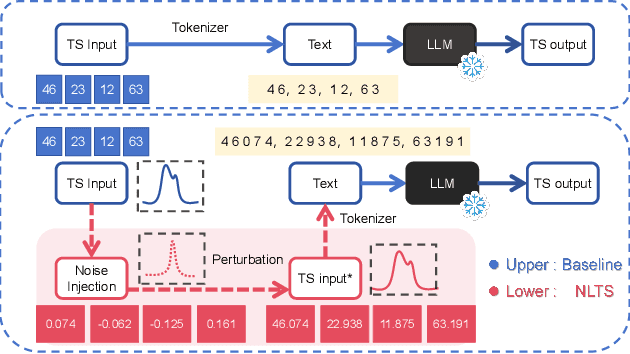
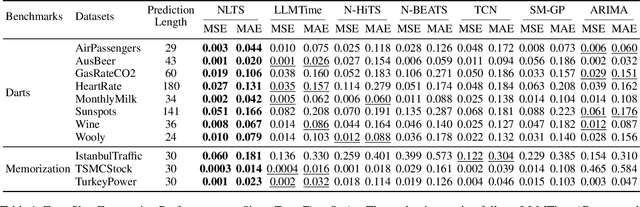
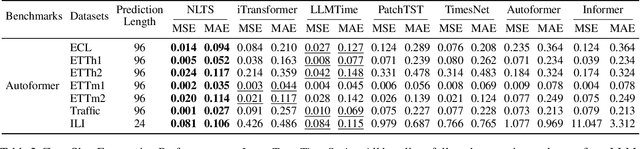
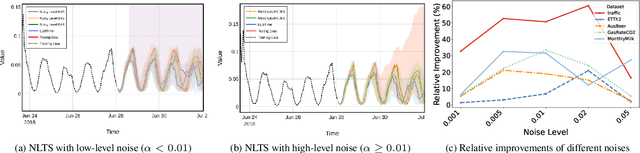
Large Language Models (LLMs) have demonstrated effectiveness as zero-shot time series (TS) forecasters. The key challenge lies in tokenizing TS data into textual representations that align with LLMs' pre-trained knowledge. While existing work often relies on fine-tuning specialized modules to bridge this gap, a distinct, yet challenging, paradigm aims to leverage truly off-the-shelf LLMs without any fine-tuning whatsoever, relying solely on strategic tokenization of numerical sequences. The performance of these fully frozen models is acutely sensitive to the textual representation of the input data, as their parameters cannot adapt to distribution shifts. In this paper, we introduce a simple yet highly effective strategy to overcome this brittleness: injecting noise into the raw time series before tokenization. This non-invasive intervention acts as a form of inference-time augmentation, compelling the frozen LLM to extrapolate based on robust underlying temporal patterns rather than superficial numerical artifacts. We theoretically analyze this phenomenon and empirically validate its effectiveness across diverse benchmarks. Notably, to fully eliminate potential biases from data contamination during LLM pre-training, we introduce two novel TS datasets that fall outside all utilized LLMs' pre-training scopes, and consistently observe improved performance. This study provides a further step in directly leveraging off-the-shelf LLMs for time series forecasting.
DexGraspVLA: A Vision-Language-Action Framework Towards General Dexterous Grasping
Feb 28, 2025Dexterous grasping remains a fundamental yet challenging problem in robotics. A general-purpose robot must be capable of grasping diverse objects in arbitrary scenarios. However, existing research typically relies on specific assumptions, such as single-object settings or limited environments, leading to constrained generalization. Our solution is DexGraspVLA, a hierarchical framework that utilizes a pre-trained Vision-Language model as the high-level task planner and learns a diffusion-based policy as the low-level Action controller. The key insight lies in iteratively transforming diverse language and visual inputs into domain-invariant representations, where imitation learning can be effectively applied due to the alleviation of domain shift. Thus, it enables robust generalization across a wide range of real-world scenarios. Notably, our method achieves a 90+% success rate under thousands of unseen object, lighting, and background combinations in a ``zero-shot'' environment. Empirical analysis further confirms the consistency of internal model behavior across environmental variations, thereby validating our design and explaining its generalization performance. We hope our work can be a step forward in achieving general dexterous grasping. Our demo and code can be found at https://dexgraspvla.github.io/.
SELA: Tree-Search Enhanced LLM Agents for Automated Machine Learning
Oct 22, 2024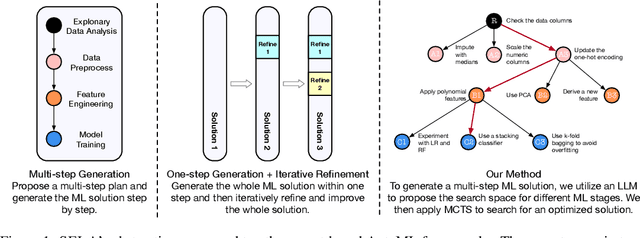

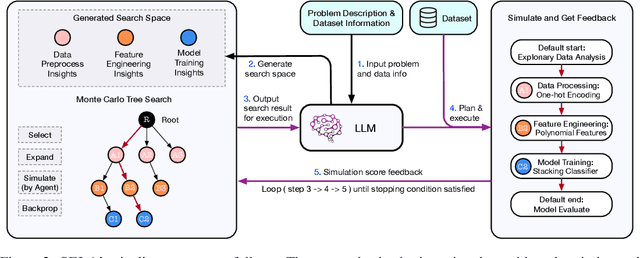

Automated Machine Learning (AutoML) approaches encompass traditional methods that optimize fixed pipelines for model selection and ensembling, as well as newer LLM-based frameworks that autonomously build pipelines. While LLM-based agents have shown promise in automating machine learning tasks, they often generate low-diversity and suboptimal code, even after multiple iterations. To overcome these limitations, we introduce Tree-Search Enhanced LLM Agents (SELA), an innovative agent-based system that leverages Monte Carlo Tree Search (MCTS) to optimize the AutoML process. By representing pipeline configurations as trees, our framework enables agents to conduct experiments intelligently and iteratively refine their strategies, facilitating a more effective exploration of the machine learning solution space. This novel approach allows SELA to discover optimal pathways based on experimental feedback, improving the overall quality of the solutions. In an extensive evaluation across 20 machine learning datasets, we compare the performance of traditional and agent-based AutoML methods, demonstrating that SELA achieves a win rate of 65% to 80% against each baseline across all datasets. These results underscore the significant potential of agent-based strategies in AutoML, offering a fresh perspective on tackling complex machine learning challenges.
OmniJARVIS: Unified Vision-Language-Action Tokenization Enables Open-World Instruction Following Agents
Jun 27, 2024


We present OmniJARVIS, a novel Vision-Language-Action (VLA) model for open-world instruction-following agents in open-world Minecraft. Compared to prior works that either emit textual goals to separate controllers or produce the control command directly, OmniJARVIS seeks a different path to ensure both strong reasoning and efficient decision-making capabilities via unified tokenization of multimodal interaction data. First, we introduce a self-supervised approach to learn a behavior encoder that produces discretized tokens for behavior trajectories $\tau$ = {$o_0$, $a_0$, $\dots$} and an imitation learning (IL) policy decoder conditioned on these tokens. These additional behavior tokens will be augmented to the vocabulary of pretrained Multimodal Language Models (MLMs). With this encoder, we then pack long-term multimodal interactions involving task instructions, memories, thoughts, observations, textual responses, behavior trajectories, etc. into unified token sequences and model them with autoregressive transformers. Thanks to the semantically meaningful behavior tokens, the resulting VLA model, OmniJARVIS, can reason (by producing chain-of-thoughts), plan, answer questions, and act (by producing behavior tokens for the IL policy decoder). OmniJARVIS demonstrates excellent performances on a comprehensive collection of atomic, programmatic, and open-ended tasks in open-world Minecraft. Our analysis further unveils the crucial design principles in interaction data formation, unified tokenization, and its scaling potentials.
Inverse Design of Photonic Crystal Surface Emitting Lasers is a Sequence Modeling Problem
Mar 08, 2024

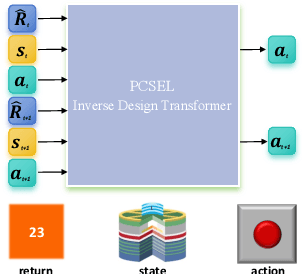

Photonic Crystal Surface Emitting Lasers (PCSEL)'s inverse design demands expert knowledge in physics, materials science, and quantum mechanics which is prohibitively labor-intensive. Advanced AI technologies, especially reinforcement learning (RL), have emerged as a powerful tool to augment and accelerate this inverse design process. By modeling the inverse design of PCSEL as a sequential decision-making problem, RL approaches can construct a satisfactory PCSEL structure from scratch. However, the data inefficiency resulting from online interactions with precise and expensive simulation environments impedes the broader applicability of RL approaches. Recently, sequential models, especially the Transformer architecture, have exhibited compelling performance in sequential decision-making problems due to their simplicity and scalability to large language models. In this paper, we introduce a novel framework named PCSEL Inverse Design Transformer (PiT) that abstracts the inverse design of PCSEL as a sequence modeling problem. The central part of our PiT is a Transformer-based structure that leverages the past trajectories and current states to predict the current actions. Compared with the traditional RL approaches, PiT can output the optimal actions and achieve target PCSEL designs by leveraging offline data and conditioning on the desired return. Results demonstrate that PiT achieves superior performance and data efficiency compared to baselines.