 Add to Chrome
 Add to Firefox
 Add to Edge
Nanbeige4.2-3B: Unlocking Agentic Capabilities in a Compact Model
Jul 27, 2026
We present Nanbeige4.2-3B, a compact general agentic model with 3B non-embedding parameters. It delivers strong performance across code-agent, office-agent, and complex tool-use tasks while maintaining highly competitive reasoning capabilities in mathematics, coding, and science. Nanbeige4.2-3B is pretrained from scratch on 28T tokens with a Looped Transformer that reuses the layer stack to increase capacity without adding parameters. For SFT data and trajectory construction, we expand the diversity of executable environments, task assets, and agentic scaffolds through real-world deployment and large-scale synthesis. Our RL pipeline applies mixed-mode RLHF over Think and Non-Think responses to improve overall model quality and reduce failure cases, length-controlled reasoning RL to balance accuracy and reasoning efficiency, and agentic RL with outcome and process rewards to stabilize long-horizon training. Extensive evaluations show that Nanbeige4.2-3B outperforms larger models, including Qwen3.5-9B and Gemma4-12B, across diverse agentic benchmarks while remaining competitive on reasoning and alignment tasks. Performance with OpenClaw further supports its use as a compact local personal assistant.

From GPS Points to Travel Patterns: Flexible and Semantic Trajectory Generation with LLMs
May 28, 2026Urban trajectories play a crucial role in modeling urban dynamics and supporting various smart city applications. However, privacy concerns restrict access to large-scale and high-quality trajectory datasets. Trajectory generation provides a promising alternative by synthesizing realistic data to mitigate privacy risks. However, existing methods fail to explicitly capture travel patterns and can only generate fixed-length trajectories under a single condition. To address these limitations, we propose \textbf{HTP}, which \textbf{H}ierarchically generates \textbf{T}ravel patterns first and then generates GPS \textbf{P}oints by using large language models (LLMs), rather than directly generating GPS points. We first design a trajectory-specific residual quantization variational autoencoder (RQ-VAE) that quantizes micro-level GPS trajectories into compact, macro-level travel pattern tokens in a coarse-to-fine manner. These tokens capture rich segment spatial irregularities, such as point density variations caused by traffic conditions. Then, we extend the LLM vocabulary with travel pattern tokens to align trajectory representations with the LLM input, and apply supervised fine-tuning (SFT) to align the LLM with the trajectory generation task, enabling generation of travel pattern sequences under various conditions. Extensive experiments on two real-world datasets show that HTP outperforms the strongest baseline by an average of 29.78\% in terms of generation quality. Our code is available at https://github.com/slzhou-xy/HTP.
Measuring and Mitigating Post-hoc Rationalization in Reverse Chain-of-Thought Generation
Feb 16, 2026Reverse Chain-of-Thought Generation (RCG) synthesizes reasoning traces from query-answer pairs, but runs the risk of producing post-hoc rationalizations: when models can see the answer during generation, the answer serves as a cognitive anchor that shapes the entire explanation. We formalize this phenomenon through a three-level measurement hierarchy: lexical, entropic, and probabilistic anchoring, each captures surface artifacts, entropy dynamics, and latent answer dependence, respectively. We analyze semantic suppression, the intuitive mitigation strategy that instructs models to ignore the answer, to find out its counterproduction: while it reduces lexical overlap, it paradoxically increases entropic and probabilistic anchoring. Drawing on Ironic Process Theory from cognitive psychology, we attribute this failure to active monitoring of the forbidden answer, which inadvertently deepens dependence on it. To break this cycle, we propose Structural Skeleton-guided Reasoning (SSR), a two-phase approach that first generates an answer-invariant functional skeleton structure, then uses this skeleton to guide full trace generation. By redirecting the information flow to structural planning rather than answer monitoring, SSR consistently reduces anchoring across all three levels. We further introduce Distilled SSR (SSR-D), which fine-tunes models on teacher-generated SSR traces to ensure reliable structural adherence. Experiments across open-ended reasoning benchmarks demonstrate that SSR-D achieves up to 10% improvement over suppression baselines while preserving out-of-distribution (OOD) generalization.
Nanbeige4.1-3B: A Small General Model that Reasons, Aligns, and Acts
Feb 13, 2026We present Nanbeige4.1-3B, a unified generalist language model that simultaneously achieves strong agentic behavior, code generation, and general reasoning with only 3B parameters. To the best of our knowledge, it is the first open-source small language model (SLM) to achieve such versatility in a single model. To improve reasoning and preference alignment, we combine point-wise and pair-wise reward modeling, ensuring high-quality, human-aligned responses. For code generation, we design complexity-aware rewards in Reinforcement Learning, optimizing both correctness and efficiency. In deep search, we perform complex data synthesis and incorporate turn-level supervision during training. This enables stable long-horizon tool interactions, allowing Nanbeige4.1-3B to reliably execute up to 600 tool-call turns for complex problem-solving. Extensive experimental results show that Nanbeige4.1-3B significantly outperforms prior models of similar scale, such as Nanbeige4-3B-2511 and Qwen3-4B, even achieving superior performance compared to much larger models, such as Qwen3-30B-A3B. Our results demonstrate that small models can achieve both broad competence and strong specialization simultaneously, redefining the potential of 3B parameter models.
PACE: Prefix-Protected and Difficulty-Aware Compression for Efficient Reasoning
Feb 12, 2026Language Reasoning Models (LRMs) achieve strong performance by scaling test-time computation but often suffer from ``overthinking'', producing excessively long reasoning traces that increase latency and memory usage. Existing LRMs typically enforce conciseness with uniform length penalties, which over-compress crucial early deduction steps at the sequence level and indiscriminately penalize all queries at the group level. To solve these limitations, we propose \textbf{\model}, a dual-level framework for prefix-protected and difficulty-aware compression under hierarchical supervision. At the sequence level, prefix-protected optimization employs decaying mixed rollouts to maintain valid reasoning paths while promoting conciseness. At the group level, difficulty-aware penalty dynamically scales length constraints based on query complexity, maintaining exploration for harder questions while curbing redundancy on easier ones. Extensive experiments on DeepSeek-R1-Distill-Qwen (1.5B/7B) demonstrate that \model achieves a substantial reduction in token usage (up to \textbf{55.7\%}) while simultaneously improving accuracy (up to \textbf{4.1\%}) on math benchmarks, with generalization ability to code, science, and general domains.
From Failure to Mastery: Generating Hard Samples for Tool-use Agents
Jan 04, 2026The advancement of LLM agents with tool-use capabilities requires diverse and complex training corpora. Existing data generation methods, which predominantly follow a paradigm of random sampling and shallow generation, often yield simple and homogeneous trajectories that fail to capture complex, implicit logical dependencies. To bridge this gap, we introduce HardGen, an automatic agentic pipeline designed to generate hard tool-use training samples with verifiable reasoning. Firstly, HardGen establishes a dynamic API Graph built upon agent failure cases, from which it samples to synthesize hard traces. Secondly, these traces serve as conditional priors to guide the instantiation of modular, abstract advanced tools, which are subsequently leveraged to formulate hard queries. Finally, the advanced tools and hard queries enable the generation of verifiable complex Chain-of-Thought (CoT), with a closed-loop evaluation feedback steering the continuous refinement of the process. Extensive evaluations demonstrate that a 4B parameter model trained with our curated dataset achieves superior performance compared to several leading open-source and closed-source competitors (e.g., GPT-5.2, Gemini-3-Pro and Claude-Opus-4.5). Our code, models, and dataset will be open-sourced to facilitate future research.
Beyond Superficial Forgetting: Thorough Unlearning through Knowledge Density Estimation and Block Re-insertion
Nov 11, 2025Machine unlearning, which selectively removes harmful knowledge from a pre-trained model without retraining from scratch, is crucial for addressing privacy, regulatory compliance, and ethical concerns in Large Language Models (LLMs). However, existing unlearning methods often struggle to thoroughly remove harmful knowledge, leaving residual harmful knowledge that can be easily recovered. To address these limitations, we propose Knowledge Density-Guided Unlearning via Blocks Reinsertion (KUnBR), a novel approach that first identifies layers with rich harmful knowledge and then thoroughly eliminates the harmful knowledge via re-insertion strategy. Our method introduces knowledge density estimation to quantify and locate layers containing the most harmful knowledge, enabling precise unlearning. Additionally, we design a layer re-insertion strategy that extracts and re-inserts harmful knowledge-rich layers into the original LLM, bypassing gradient obstruction caused by cover layers and ensuring effective gradient propagation during unlearning. Extensive experiments conducted on several unlearning and general capability benchmarks demonstrate that KUnBR achieves state-of-the-art forgetting performance while maintaining model utility.
What Affects the Stability of Tool Learning? An Empirical Study on the Robustness of Tool Learning Frameworks
Jul 03, 2024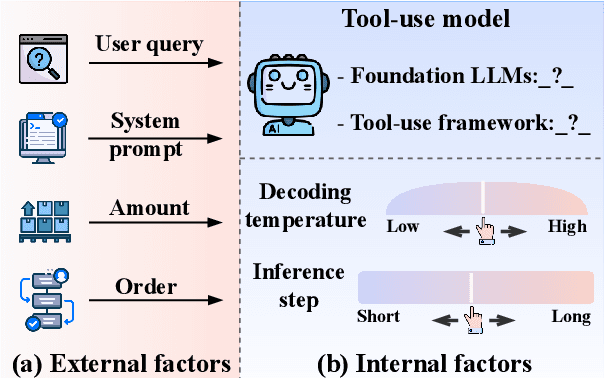


Tool learning methods have enhanced the ability of large language models (LLMs) to interact with real-world applications. Many existing works fine-tune LLMs or design prompts to enable LLMs to select appropriate tools and correctly invoke them to meet user requirements. However, it is observed in previous works that the performance of tool learning varies from tasks, datasets, training settings, and algorithms. Without understanding the impact of these factors, it can lead to inconsistent results, inefficient model deployment, and suboptimal tool utilization, ultimately hindering the practical integration and scalability of LLMs in real-world scenarios. Therefore, in this paper, we explore the impact of both internal and external factors on the performance of tool learning frameworks. Through extensive experiments on two benchmark datasets, we find several insightful conclusions for future work, including the observation that LLMs can benefit significantly from increased trial and exploration. We believe our empirical study provides a new perspective for future tool learning research.
Simulating Financial Market via Large Language Model based Agents
Jun 28, 2024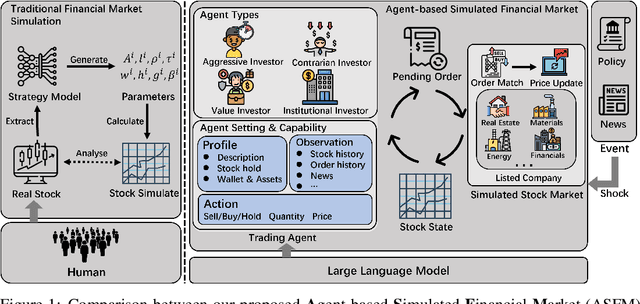


Most economic theories typically assume that financial market participants are fully rational individuals and use mathematical models to simulate human behavior in financial markets. However, human behavior is often not entirely rational and is challenging to predict accurately with mathematical models. In this paper, we propose \textbf{A}gent-based \textbf{S}imulated \textbf{F}inancial \textbf{M}arket (ASFM), which first constructs a simulated stock market with a real order matching system. Then, we propose a large language model based agent as the stock trader, which contains the profile, observation, and tool-learning based action module. The trading agent can comprehensively understand current market dynamics and financial policy information, and make decisions that align with their trading strategy. In the experiments, we first verify that the reactions of our ASFM are consistent with the real stock market in two controllable scenarios. In addition, we also conduct experiments in two popular economics research directions, and we find that conclusions drawn in our \model align with the preliminary findings in economics research. Based on these observations, we believe our proposed ASFM provides a new paradigm for economic research.