 Add to Chrome
 Add to Firefox
 Add to Edge
TAMEn: Tactile-Aware Manipulation Engine for Closed-Loop Data Collection in Contact-Rich Tasks
Apr 08, 2026
Handheld paradigms offer an efficient and intuitive way for collecting large-scale demonstration of robot manipulation. However, achieving contact-rich bimanual manipulation through these methods remains a pivotal challenge, which is substantially hindered by hardware adaptability and data efficacy. Prior hardware designs remain gripper-specific and often face a trade-off between tracking precision and portability. Furthermore, the lack of online feasibility checking during demonstration leads to poor replayability. More importantly, existing handheld setups struggle to collect interactive recovery data during robot execution, lacking the authentic tactile information necessary for robust policy refinement. To bridge these gaps, we present TAMEn, a tactile-aware manipulation engine for closed-loop data collection in contact-rich tasks. Our system features a cross-morphology wearable interface that enables rapid adaptation across heterogeneous grippers. To balance data quality and environmental diversity, we implement a dual-modal acquisition pipeline: a precision mode leveraging motion capture for high-fidelity demonstrations, and a portable mode utilizing VR-based tracking for in-the-wild acquisition and tactile-visualized recovery teleoperation. Building on this hardware, we unify large-scale tactile pretraining, task-specific bimanual demonstrations, and human-in-the-loop recovery data into a pyramid-structured data regime, enabling closed-loop policy refinement. Experiments show that our feasibility-aware pipeline significantly improves demonstration replayability, and that the proposed visuo-tactile learning framework increases task success rates from 34% to 75% across diverse bimanual manipulation tasks. We further open-source the hardware and dataset to facilitate reproducibility and support research in visuo-tactile manipulation.

EgoHumanoid: Unlocking In-the-Wild Loco-Manipulation with Robot-Free Egocentric Demonstration
Feb 10, 2026Human demonstrations offer rich environmental diversity and scale naturally, making them an appealing alternative to robot teleoperation. While this paradigm has advanced robot-arm manipulation, its potential for the more challenging, data-hungry problem of humanoid loco-manipulation remains largely unexplored. We present EgoHumanoid, the first framework to co-train a vision-language-action policy using abundant egocentric human demonstrations together with a limited amount of robot data, enabling humanoids to perform loco-manipulation across diverse real-world environments. To bridge the embodiment gap between humans and robots, including discrepancies in physical morphology and viewpoint, we introduce a systematic alignment pipeline spanning from hardware design to data processing. A portable system for scalable human data collection is developed, and we establish practical collection protocols to improve transferability. At the core of our human-to-humanoid alignment pipeline lies two key components. The view alignment reduces visual domain discrepancies caused by camera height and perspective variation. The action alignment maps human motions into a unified, kinematically feasible action space for humanoid control. Extensive real-world experiments demonstrate that incorporating robot-free egocentric data significantly outperforms robot-only baselines by 51\%, particularly in unseen environments. Our analysis further reveals which behaviors transfer effectively and the potential for scaling human data.
$χ_{0}$: Resource-Aware Robust Manipulation via Taming Distributional Inconsistencies
Feb 09, 2026High-reliability long-horizon robotic manipulation has traditionally relied on large-scale data and compute to understand complex real-world dynamics. However, we identify that the primary bottleneck to real-world robustness is not resource scale alone, but the distributional shift among the human demonstration distribution, the inductive bias learned by the policy, and the test-time execution distribution -- a systematic inconsistency that causes compounding errors in multi-stage tasks. To mitigate these inconsistencies, we propose $χ_{0}$, a resource-efficient framework with effective modules designated to achieve production-level robustness in robotic manipulation. Our approach builds off three technical pillars: (i) Model Arithmetic, a weight-space merging strategy that efficiently soaks up diverse distributions of different demonstrations, varying from object appearance to state variations; (ii) Stage Advantage, a stage-aware advantage estimator that provides stable, dense progress signals, overcoming the numerical instability of prior non-stage approaches; and (iii) Train-Deploy Alignment, which bridges the distribution gap via spatio-temporal augmentation, heuristic DAgger corrections, and temporal chunk-wise smoothing. $χ_{0}$ enables two sets of dual-arm robots to collaboratively orchestrate long-horizon garment manipulation, spanning tasks from flattening, folding, to hanging different clothes. Our method exhibits high-reliability autonomy; we are able to run the system from arbitrary initial state for consecutive 24 hours non-stop. Experiments validate that $χ_{0}$ surpasses the state-of-the-art $π_{0.5}$ in success rate by nearly 250%, with only 20-hour data and 8 A100 GPUs. Code, data and models will be released to facilitate the community.
G3Flow: Generative 3D Semantic Flow for Pose-aware and Generalizable Object Manipulation
Nov 27, 2024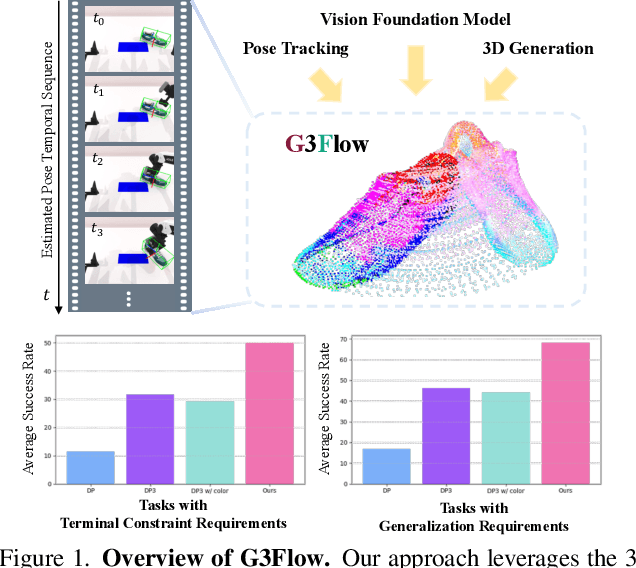

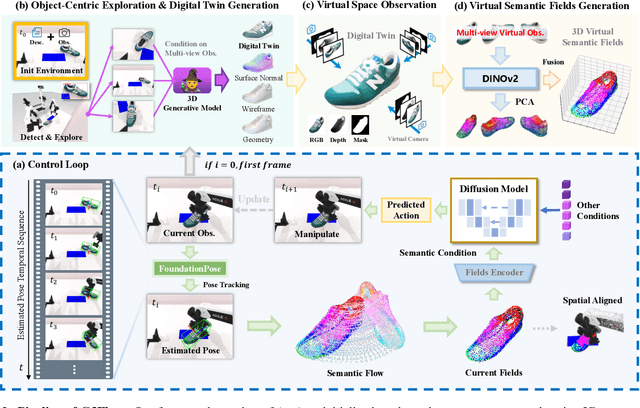
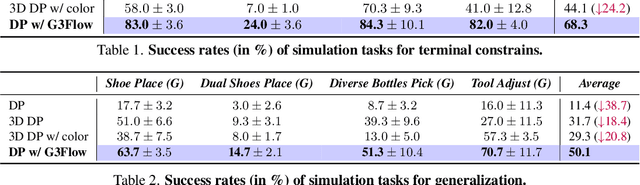
Recent advances in imitation learning for 3D robotic manipulation have shown promising results with diffusion-based policies. However, achieving human-level dexterity requires seamless integration of geometric precision and semantic understanding. We present G3Flow, a novel framework that constructs real-time semantic flow, a dynamic, object-centric 3D semantic representation by leveraging foundation models. Our approach uniquely combines 3D generative models for digital twin creation, vision foundation models for semantic feature extraction, and robust pose tracking for continuous semantic flow updates. This integration enables complete semantic understanding even under occlusions while eliminating manual annotation requirements. By incorporating semantic flow into diffusion policies, we demonstrate significant improvements in both terminal-constrained manipulation and cross-object generalization. Extensive experiments across five simulation tasks show that G3Flow consistently outperforms existing approaches, achieving up to 68.3% and 50.1% average success rates on terminal-constrained manipulation and cross-object generalization tasks respectively. Our results demonstrate the effectiveness of G3Flow in enhancing real-time dynamic semantic feature understanding for robotic manipulation policies.
RoboTwin: Dual-Arm Robot Benchmark with Generative Digital Twins (early version)
Sep 04, 2024


Effective collaboration of dual-arm robots and their tool use capabilities are increasingly important areas in the advancement of robotics. These skills play a significant role in expanding robots' ability to operate in diverse real-world environments. However, progress is impeded by the scarcity of specialized training data. This paper introduces RoboTwin, a novel benchmark dataset combining real-world teleoperated data with synthetic data from digital twins, designed for dual-arm robotic scenarios. Using the COBOT Magic platform, we have collected diverse data on tool usage and human-robot interaction. We present a innovative approach to creating digital twins using AI-generated content, transforming 2D images into detailed 3D models. Furthermore, we utilize large language models to generate expert-level training data and task-specific pose sequences oriented toward functionality. Our key contributions are: 1) the RoboTwin benchmark dataset, 2) an efficient real-to-simulation pipeline, and 3) the use of language models for automatic expert-level data generation. These advancements are designed to address the shortage of robotic training data, potentially accelerating the development of more capable and versatile robotic systems for a wide range of real-world applications. The project page is available at https://robotwin-benchmark.github.io/early-version/