 Add to Chrome
 Add to Firefox
 Add to Edge
Towards Trustworthy Embodied Intelligence: A Systems Framework and Graded Trustworthiness Levels
Jul 28, 2026
Embodied intelligence integrates learned perception and decision making with real-time computation, control, and physical interaction. Because failures can cause immediate physical or operational harm, task completion alone does not establish trustworthiness. We define trustworthy embodied intelligence as the sustained capacity to execute specified tasks reliably under environmental and system variation while maintaining risk within acceptable bounds. We term this objective sustained safe success. Its supporting mechanisms are organized into four interdependent layers. The model layer generates task-competent action proposals with calibrated uncertainty and explicit safety preferences. The system layer realizes authorized actions dependably through integrated sensing, computation, control, hardware safeguards, fault containment, and fallback. The evidence layer substantiates bounded claims through evaluation, verification, validation, traceability, and structured assurance arguments. The deployment layer maintains claim validity through runtime monitoring, authority management, intervention, incident response, and controlled updates. Because assumptions and failures propagate across these layers, neither model capability, isolated safeguards, nor benchmark performance alone can establish end-to-end trustworthiness. Drawing on embodied AI, robotics, control, dependable computing, distributed systems, and autonomous driving, we further propose a non-normative hierarchy of trustworthiness levels. This hierarchy grades the strength of bounded deployment claims across task capability, safety, system assurance, operational governance, and supporting evidence, providing a basis for bounded deployment, comparative evaluation, research prioritization, and future standardization.

ManiTwin: Scaling Data-Generation-Ready Digital Object Dataset to 100K
Mar 17, 2026Learning in simulation provides a useful foundation for scaling robotic manipulation capabilities. However, this paradigm often suffers from a lack of data-generation-ready digital assets, in both scale and diversity. In this work, we present ManiTwin, an automated and efficient pipeline for generating data-generation-ready digital object twins. Our pipeline transforms a single image into simulation-ready and semantically annotated 3D asset, enabling large-scale robotic manipulation data generation. Using this pipeline, we construct ManiTwin-100K, a dataset containing 100K high-quality annotated 3D assets. Each asset is equipped with physical properties, language descriptions, functional annotations, and verified manipulation proposals. Experiments demonstrate that ManiTwin provides an efficient asset synthesis and annotation workflow, and that ManiTwin-100K offers high-quality and diverse assets for manipulation data generation, random scene synthesis, and VQA data generation, establishing a strong foundation for scalable simulation data synthesis and policy learning. Our webpage is available at https://manitwin.github.io/.
A Comparative Study of Algorithms for Realtime Panoramic Video Blending
Dec 24, 2016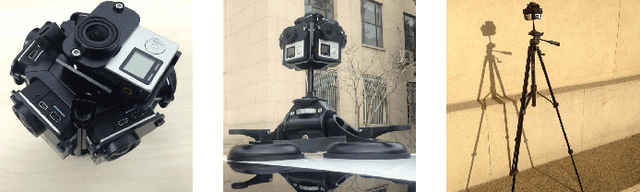
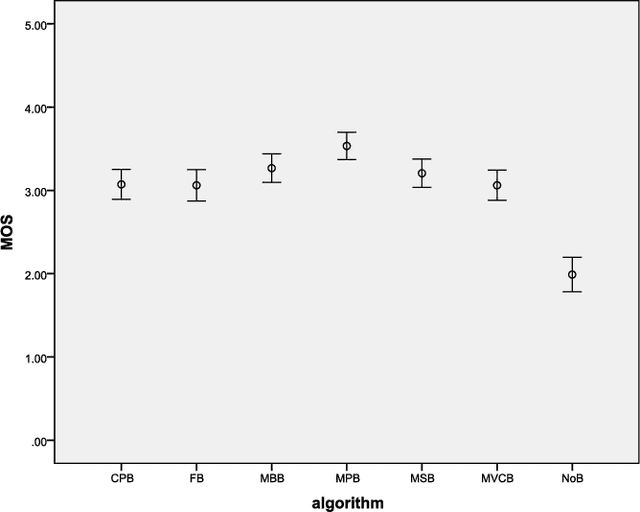
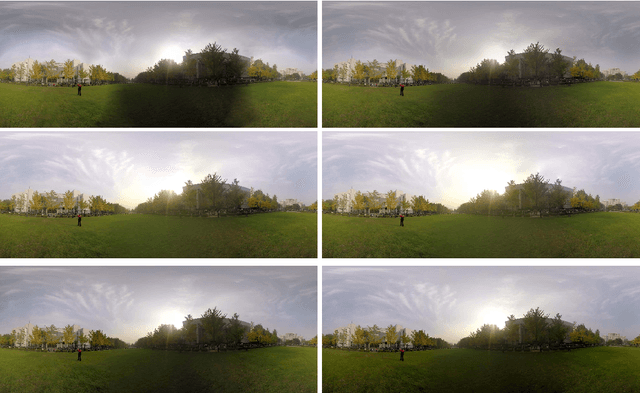
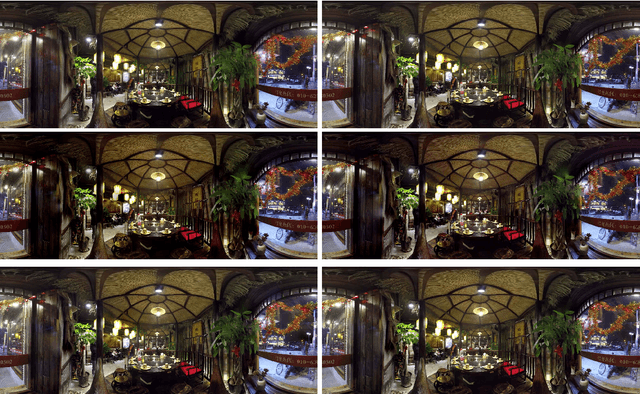
Unlike image blending algorithms, video blending algorithms have been little studied. In this paper, we investigate 6 popular blending algorithms---feather blending, multi-band blending, modified Poisson blending, mean value coordinate blending, multi-spline blending and convolution pyramid blending. We consider in particular realtime panoramic video blending, a key problem in various virtual reality tasks. To evaluate the performance of the 6 algorithms on this problem, we have created a video benchmark of several videos captured under various conditions. We analyze the time and memory needed by the above 6 algorithms, for both CPU and GPU implementations (where readily parallelizable). The visual quality provided by these algorithms is also evaluated both objectively and subjectively. The video benchmark and algorithm implementations are publicly available.