 Add to Chrome
 Add to Firefox
 Add to Edge
PhysForge: Generating Physics-Grounded 3D Assets for Interactive Virtual World
May 06, 2026
Synthesizing physics-grounded 3D assets is a critical bottleneck for interactive virtual worlds and embodied AI. Existing methods predominantly focus on static geometry, overlooking the functional properties essential for interaction. We propose that interactive asset generation must be rooted in functional logic and hierarchical physics. To bridge this gap, we introduce PhysForge, a decoupled two-stage framework supported by PhysDB, a large-scale dataset of 150,000 assets with four-tier physical annotations. First, a VLM acts as a "physical architect" to plan a "Hierarchical Physical Blueprint" defining material, functional, and kinematic constraints. Second, a physics-grounded diffusion model realizes this blueprint by synthesizing high-fidelity geometry alongside precise kinematic parameters via a novel KineVoxel Injection (KVI) mechanism. Experiments demonstrate that PhysForge produces functionally plausible, simulation-ready assets, providing a robust data engine for interactive 3D content and embodied agents.

Stereo World Model: Camera-Guided Stereo Video Generation
Mar 18, 2026We present StereoWorld, a camera-conditioned stereo world model that jointly learns appearance and binocular geometry for end-to-end stereo video generation.Unlike monocular RGB or RGBD approaches, StereoWorld operates exclusively within the RGB modality, while simultaneously grounding geometry directly from disparity. To efficiently achieve consistent stereo generation, our approach introduces two key designs: (1) a unified camera-frame RoPE that augments latent tokens with camera-aware rotary positional encoding, enabling relative, view- and time-consistent conditioning while preserving pretrained video priors via a stable attention initialization; and (2) a stereo-aware attention decomposition that factors full 4D attention into 3D intra-view attention plus horizontal row attention, leveraging the epipolar prior to capture disparity-aligned correspondences with substantially lower compute. Across benchmarks, StereoWorld improves stereo consistency, disparity accuracy, and camera-motion fidelity over strong monocular-then-convert pipelines, achieving more than 3x faster generation with an additional 5% gain in viewpoint consistency. Beyond benchmarks, StereoWorld enables end-to-end binocular VR rendering without depth estimation or inpainting, enhances embodied policy learning through metric-scale depth grounding, and is compatible with long-video distillation for extended interactive stereo synthesis.
SegviGen: Repurposing 3D Generative Model for Part Segmentation
Mar 17, 2026We introduce SegviGen, a framework that repurposes native 3D generative models for 3D part segmentation. Existing pipelines either lift strong 2D priors into 3D via distillation or multi-view mask aggregation, often suffering from cross-view inconsistency and blurred boundaries, or explore native 3D discriminative segmentation, which typically requires large-scale annotated 3D data and substantial training resources. In contrast, SegviGen leverages the structured priors encoded in pretrained 3D generative model to induce segmentation through distinctive part colorization, establishing a novel and efficient framework for part segmentation. Specifically, SegviGen encodes a 3D asset and predicts part-indicative colors on active voxels of a geometry-aligned reconstruction. It supports interactive part segmentation, full segmentation, and full segmentation with 2D guidance in a unified framework. Extensive experiments show that SegviGen improves over the prior state of the art by 40% on interactive part segmentation and by 15% on full segmentation, while using only 0.32% of the labeled training data. It demonstrates that pretrained 3D generative priors transfer effectively to 3D part segmentation, enabling strong performance with limited supervision. See our project page at https://fenghora.github.io/SegviGen-Page/.
MoCA: Mixture-of-Components Attention for Scalable Compositional 3D Generation
Dec 08, 2025Compositionality is critical for 3D object and scene generation, but existing part-aware 3D generation methods suffer from poor scalability due to quadratic global attention costs when increasing the number of components. In this work, we present MoCA, a compositional 3D generative model with two key designs: (1) importance-based component routing that selects top-k relevant components for sparse global attention, and (2) unimportant components compression that preserve contextual priors of unselected components while reducing computational complexity of global attention. With these designs, MoCA enables efficient, fine-grained compositional 3D asset creation with scalable number of components. Extensive experiments show MoCA outperforms baselines on both compositional object and scene generation tasks. Project page: https://lizhiqi49.github.io/MoCA
InterMoE: Individual-Specific 3D Human Interaction Generation via Dynamic Temporal-Selective MoE
Nov 17, 2025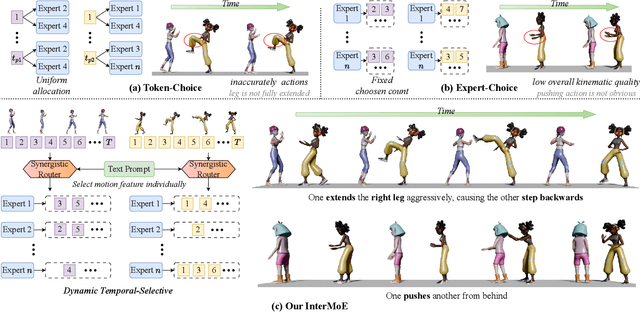
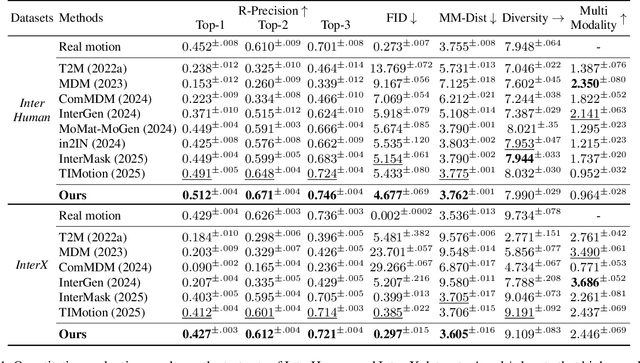
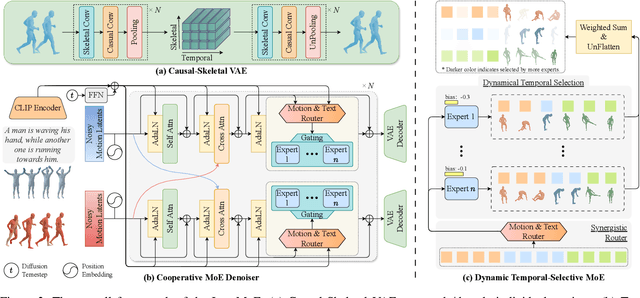
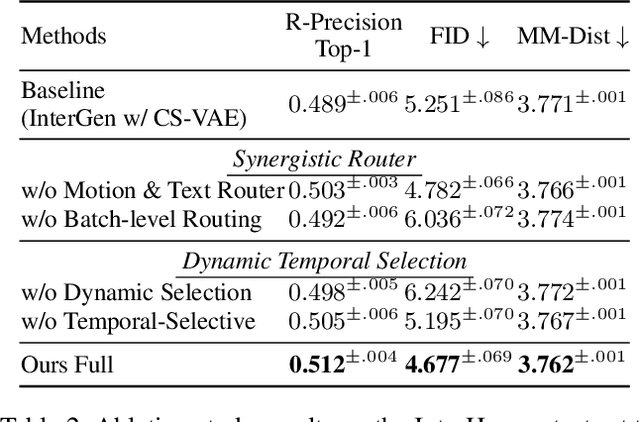
Generating high-quality human interactions holds significant value for applications like virtual reality and robotics. However, existing methods often fail to preserve unique individual characteristics or fully adhere to textual descriptions. To address these challenges, we introduce InterMoE, a novel framework built on a Dynamic Temporal-Selective Mixture of Experts. The core of InterMoE is a routing mechanism that synergistically uses both high-level text semantics and low-level motion context to dispatch temporal motion features to specialized experts. This allows experts to dynamically determine the selection capacity and focus on critical temporal features, thereby preserving specific individual characteristic identities while ensuring high semantic fidelity. Extensive experiments show that InterMoE achieves state-of-the-art performance in individual-specific high-fidelity 3D human interaction generation, reducing FID scores by 9% on the InterHuman dataset and 22% on InterX.
VoxHammer: Training-Free Precise and Coherent 3D Editing in Native 3D Space
Aug 26, 2025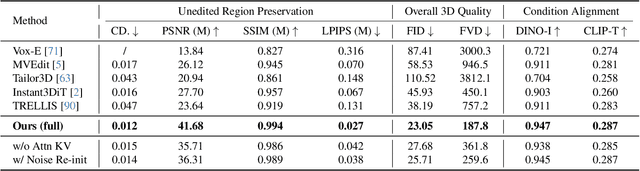
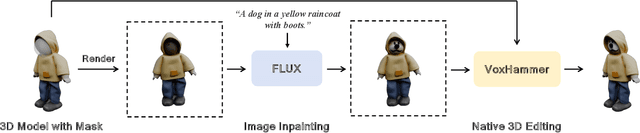
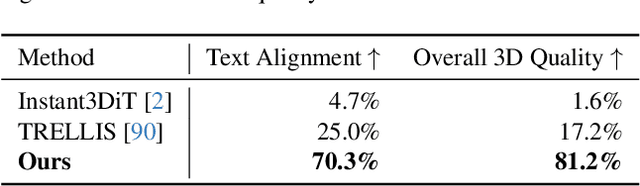
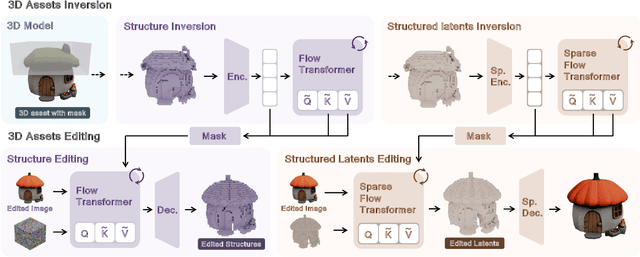
3D local editing of specified regions is crucial for game industry and robot interaction. Recent methods typically edit rendered multi-view images and then reconstruct 3D models, but they face challenges in precisely preserving unedited regions and overall coherence. Inspired by structured 3D generative models, we propose VoxHammer, a novel training-free approach that performs precise and coherent editing in 3D latent space. Given a 3D model, VoxHammer first predicts its inversion trajectory and obtains its inverted latents and key-value tokens at each timestep. Subsequently, in the denoising and editing phase, we replace the denoising features of preserved regions with the corresponding inverted latents and cached key-value tokens. By retaining these contextual features, this approach ensures consistent reconstruction of preserved areas and coherent integration of edited parts. To evaluate the consistency of preserved regions, we constructed Edit3D-Bench, a human-annotated dataset comprising hundreds of samples, each with carefully labeled 3D editing regions. Experiments demonstrate that VoxHammer significantly outperforms existing methods in terms of both 3D consistency of preserved regions and overall quality. Our method holds promise for synthesizing high-quality edited paired data, thereby laying the data foundation for in-context 3D generation. See our project page at https://huanngzh.github.io/VoxHammer-Page/.
AnimaX: Animating the Inanimate in 3D with Joint Video-Pose Diffusion Models
Jun 24, 2025We present AnimaX, a feed-forward 3D animation framework that bridges the motion priors of video diffusion models with the controllable structure of skeleton-based animation. Traditional motion synthesis methods are either restricted to fixed skeletal topologies or require costly optimization in high-dimensional deformation spaces. In contrast, AnimaX effectively transfers video-based motion knowledge to the 3D domain, supporting diverse articulated meshes with arbitrary skeletons. Our method represents 3D motion as multi-view, multi-frame 2D pose maps, and enables joint video-pose diffusion conditioned on template renderings and a textual motion prompt. We introduce shared positional encodings and modality-aware embeddings to ensure spatial-temporal alignment between video and pose sequences, effectively transferring video priors to motion generation task. The resulting multi-view pose sequences are triangulated into 3D joint positions and converted into mesh animation via inverse kinematics. Trained on a newly curated dataset of 160,000 rigged sequences, AnimaX achieves state-of-the-art results on VBench in generalization, motion fidelity, and efficiency, offering a scalable solution for category-agnostic 3D animation. Project page: \href{https://anima-x.github.io/}{https://anima-x.github.io/}.
UniGeo: Taming Video Diffusion for Unified Consistent Geometry Estimation
May 30, 2025Recently, methods leveraging diffusion model priors to assist monocular geometric estimation (e.g., depth and normal) have gained significant attention due to their strong generalization ability. However, most existing works focus on estimating geometric properties within the camera coordinate system of individual video frames, neglecting the inherent ability of diffusion models to determine inter-frame correspondence. In this work, we demonstrate that, through appropriate design and fine-tuning, the intrinsic consistency of video generation models can be effectively harnessed for consistent geometric estimation. Specifically, we 1) select geometric attributes in the global coordinate system that share the same correspondence with video frames as the prediction targets, 2) introduce a novel and efficient conditioning method by reusing positional encodings, and 3) enhance performance through joint training on multiple geometric attributes that share the same correspondence. Our results achieve superior performance in predicting global geometric attributes in videos and can be directly applied to reconstruction tasks. Even when trained solely on static video data, our approach exhibits the potential to generalize to dynamic video scenes.
Personalize Anything for Free with Diffusion Transformer
Mar 16, 2025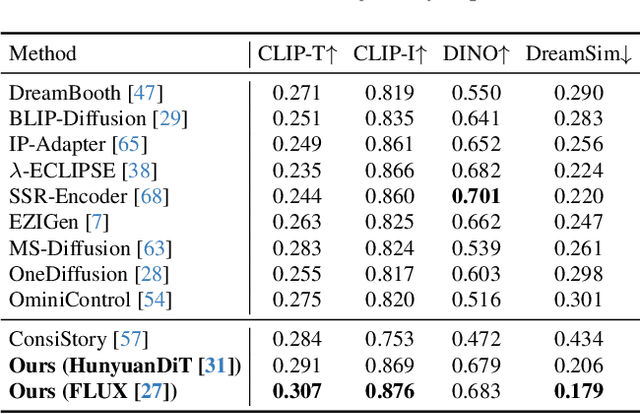
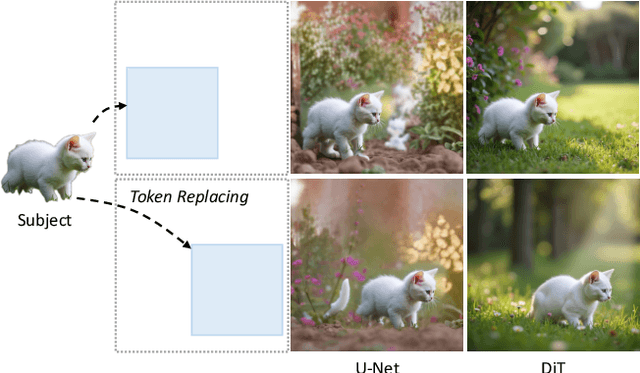
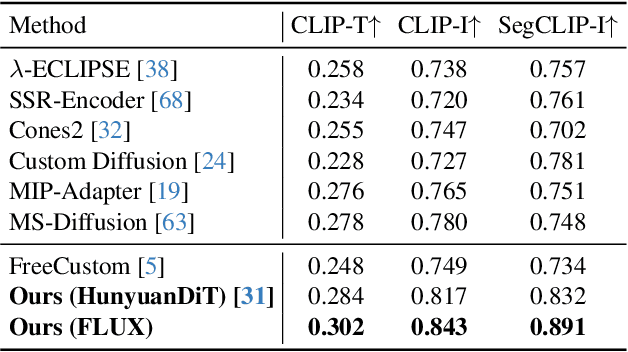
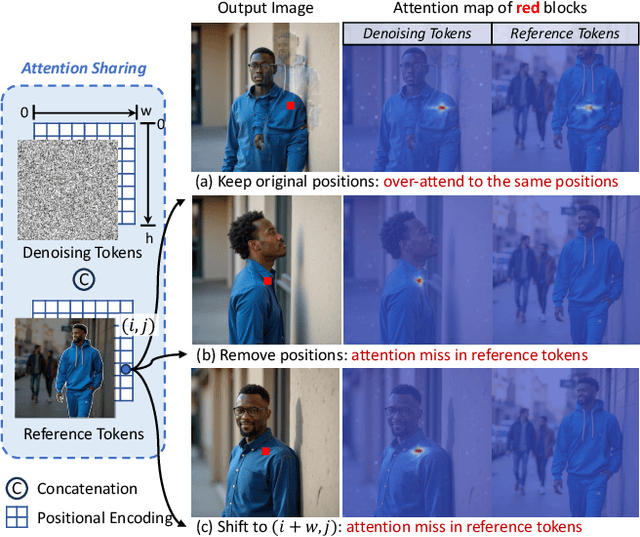
Personalized image generation aims to produce images of user-specified concepts while enabling flexible editing. Recent training-free approaches, while exhibit higher computational efficiency than training-based methods, struggle with identity preservation, applicability, and compatibility with diffusion transformers (DiTs). In this paper, we uncover the untapped potential of DiT, where simply replacing denoising tokens with those of a reference subject achieves zero-shot subject reconstruction. This simple yet effective feature injection technique unlocks diverse scenarios, from personalization to image editing. Building upon this observation, we propose \textbf{Personalize Anything}, a training-free framework that achieves personalized image generation in DiT through: 1) timestep-adaptive token replacement that enforces subject consistency via early-stage injection and enhances flexibility through late-stage regularization, and 2) patch perturbation strategies to boost structural diversity. Our method seamlessly supports layout-guided generation, multi-subject personalization, and mask-controlled editing. Evaluations demonstrate state-of-the-art performance in identity preservation and versatility. Our work establishes new insights into DiTs while delivering a practical paradigm for efficient personalization.
MV-Adapter: Multi-view Consistent Image Generation Made Easy
Dec 04, 2024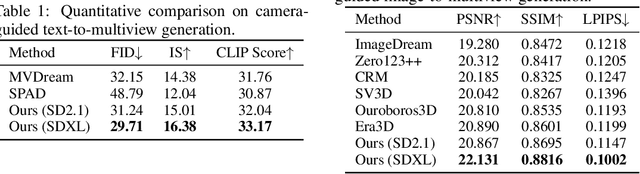
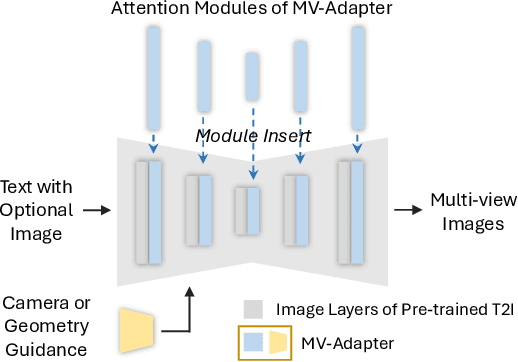
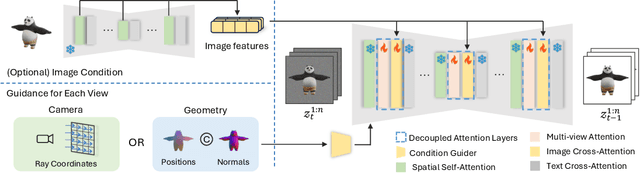
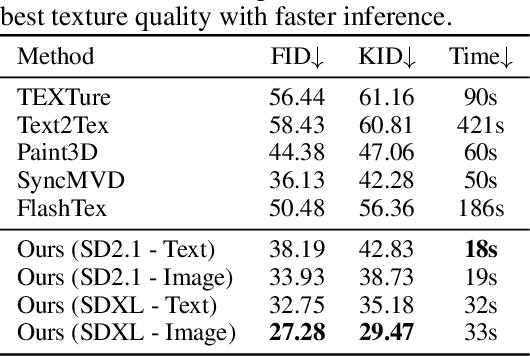
Existing multi-view image generation methods often make invasive modifications to pre-trained text-to-image (T2I) models and require full fine-tuning, leading to (1) high computational costs, especially with large base models and high-resolution images, and (2) degradation in image quality due to optimization difficulties and scarce high-quality 3D data. In this paper, we propose the first adapter-based solution for multi-view image generation, and introduce MV-Adapter, a versatile plug-and-play adapter that enhances T2I models and their derivatives without altering the original network structure or feature space. By updating fewer parameters, MV-Adapter enables efficient training and preserves the prior knowledge embedded in pre-trained models, mitigating overfitting risks. To efficiently model the 3D geometric knowledge within the adapter, we introduce innovative designs that include duplicated self-attention layers and parallel attention architecture, enabling the adapter to inherit the powerful priors of the pre-trained models to model the novel 3D knowledge. Moreover, we present a unified condition encoder that seamlessly integrates camera parameters and geometric information, facilitating applications such as text- and image-based 3D generation and texturing. MV-Adapter achieves multi-view generation at 768 resolution on Stable Diffusion XL (SDXL), and demonstrates adaptability and versatility. It can also be extended to arbitrary view generation, enabling broader applications. We demonstrate that MV-Adapter sets a new quality standard for multi-view image generation, and opens up new possibilities due to its efficiency, adaptability and versatility.