 Add to Chrome
 Add to Firefox
 Add to Edge
Reducing Symmetry Increase in Equivariant Neural Networks
Aug 12, 2026
Equivariant Neural Networks (ENNs) have empowered numerous applications in scientific fields. Despite their remarkable capacity for representing geometric structures, ENNs suffer from degraded expressivity when processing symmetric inputs: the output representations are invariant to transformations that extend beyond the input's symmetries. The mathematical essence of this phenomenon is that a symmetric input, after being processed by an equivariant map, experiences an increase in symmetry. While prior research has documented symmetry increase in specific cases, a rigorous understanding of its underlying causes and general reduction strategies remains lacking. In this paper, we provide a detailed and in-depth characterization of symmetry increase together with a principled framework for its reduction: (i) For any given feature space and input symmetry group, we prove that the increased symmetry admits an infimum determined by the structure of the feature space; (ii) Building on this foundation, we develop a computable algorithm to derive this infimum, and propose practical guidelines for feature design to prevent harmful symmetry increases. (iii) Under standard regularity assumptions, we demonstrate that for most equivariant maps, our guidelines effectively reduce symmetry increase. To complement our theoretical findings, we provide visualizations and experiments on both synthetic datasets and the real-world QM9 dataset. The results validate our theoretical predictions.

Agentic Fusion of Large Atomic and Language Models to Accelerate Materials Discovery
Apr 26, 2026The discovery of novel materials is critical for global energy and quantum technology transitions. While deep learning has fundamentally reshaped this landscape, existing predictive or generative models typically operate in isolation, lacking the autonomous orchestration required to execute the full discovery process. Here we present ElementsClaw, an agentic framework for materials discovery that synergizes Large Atomic Models (LAMs) with Large Language Models (LLMs). In response to varied human requirements, ElementsClaw dynamically orchestrates a suite of LAM tools finetuned from our proposed model Elements for atomic-scale numerical computation, while leveraging LLMs for high-level semantic reasoning. This shift moves AI-driven materials science from isolated processes toward integrated and human interactive discovery. In the demanding domain of superconductors, our agentic system guides the experimental synthesis of four new superconductors, including Zr3ScRe8 with a transition temperature of 6.8 K and HfZrRe4 at 6.7 K. At scale, ElementsClaw screens more than 2.4 million stable crystals within only 28 GPU hours, identifying 68,000 high-confidence superconducting candidates and vastly expanding the known superconducting space. These results demonstrate how our agent accelerates materials discovery with high physical fidelity.
AI-assisted workflow enables rapid, high-fidelity breast cancer clinical trial eligibility prescreening
Nov 07, 2025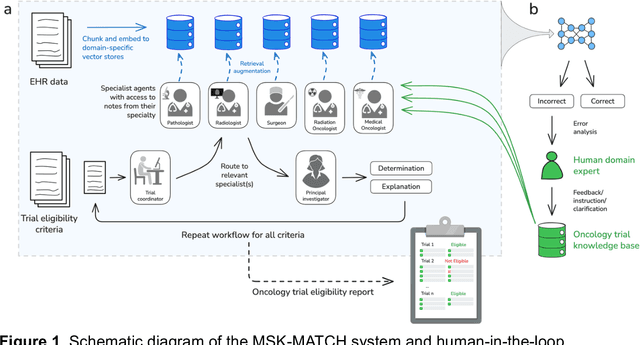
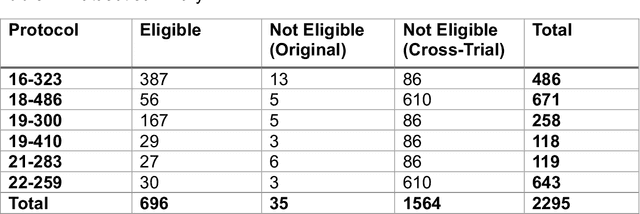
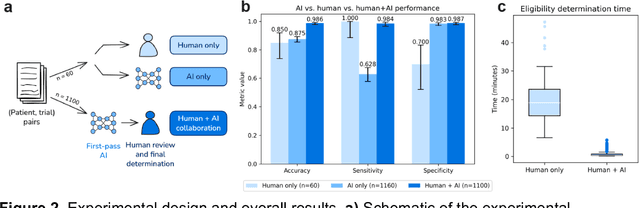
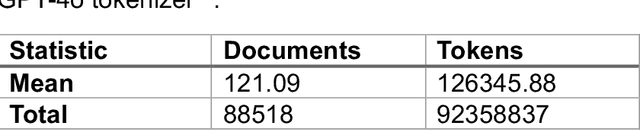
Clinical trials play an important role in cancer care and research, yet participation rates remain low. We developed MSK-MATCH (Memorial Sloan Kettering Multi-Agent Trial Coordination Hub), an AI system for automated eligibility screening from clinical text. MSK-MATCH integrates a large language model with a curated oncology trial knowledge base and retrieval-augmented architecture providing explanations for all AI predictions grounded in source text. In a retrospective dataset of 88,518 clinical documents from 731 patients across six breast cancer trials, MSK-MATCH automatically resolved 61.9% of cases and triaged 38.1% for human review. This AI-assisted workflow achieved 98.6% accuracy, 98.4% sensitivity, and 98.7% specificity for patient-level eligibility classification, matching or exceeding performance of the human-only and AI-only comparisons. For the triaged cases requiring manual review, prepopulating eligibility screens with AI-generated explanations reduced screening time from 20 minutes to 43 seconds at an average cost of $0.96 per patient-trial pair.
Are High-Degree Representations Really Unnecessary in Equivariant Graph Neural Networks?
Oct 15, 2024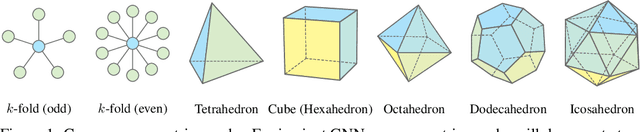
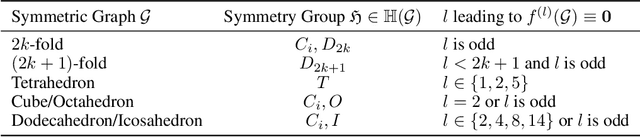
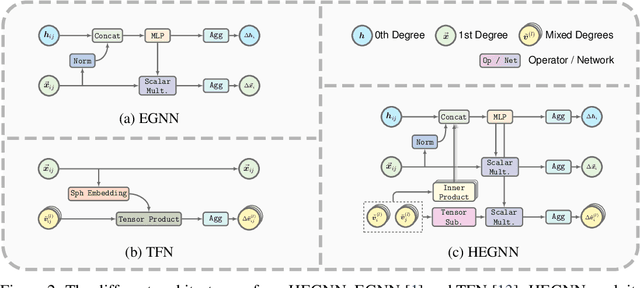
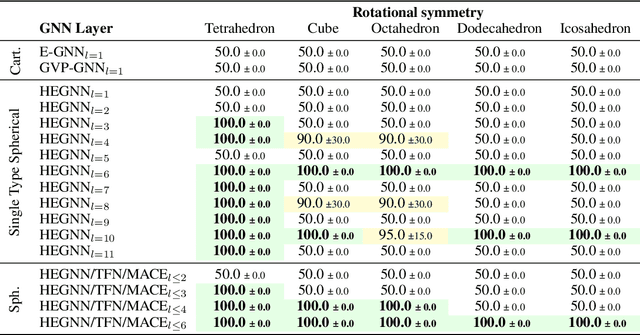
Equivariant Graph Neural Networks (GNNs) that incorporate E(3) symmetry have achieved significant success in various scientific applications. As one of the most successful models, EGNN leverages a simple scalarization technique to perform equivariant message passing over only Cartesian vectors (i.e., 1st-degree steerable vectors), enjoying greater efficiency and efficacy compared to equivariant GNNs using higher-degree steerable vectors. This success suggests that higher-degree representations might be unnecessary. In this paper, we disprove this hypothesis by exploring the expressivity of equivariant GNNs on symmetric structures, including $k$-fold rotations and regular polyhedra. We theoretically demonstrate that equivariant GNNs will always degenerate to a zero function if the degree of the output representations is fixed to 1 or other specific values. Based on this theoretical insight, we propose HEGNN, a high-degree version of EGNN to increase the expressivity by incorporating high-degree steerable vectors while maintaining EGNN's efficiency through the scalarization trick. Our extensive experiments demonstrate that HEGNN not only aligns with our theoretical analyses on toy datasets consisting of symmetric structures, but also shows substantial improvements on more complicated datasets such as $N$-body and MD17. Our theoretical findings and empirical results potentially open up new possibilities for the research of equivariant GNNs.