 Add to Chrome
 Add to Firefox
 Add to Edge
Beyond the Mean: Multi-Moment Policy Optimization for LLM Reasoning
Aug 03, 2026
Reinforcement learning has become a central paradigm for improving the reasoning capabilities of large language models. Existing methods generally aim to reduce the failure probabilities induced across problems. In this paper, we introduce a moment-based perspective on policy optimization for LLM reasoning by treating the failure probability of a randomly sampled problem as a random variable and characterizing optimization objectives through its moments. Under this perspective, many existing methods optimize only a single moment of the failure-probability distribution, leaving its broader distributional structure largely uncharacterized. We propose \textbf{M}ulti-\textbf{M}oment \textbf{P}olicy \textbf{O}ptimization (MMPO), a novel policy optimization framework that jointly minimizes multiple moments of the failure-probability distribution. MMPO admits a direct operational interpretation as minimizing the expected truncated time required to obtain the first successful response. Beyond MMPO, we further develop a general moment-transformation framework that systematically induces different moment profiles and provides a unified view of a broader family of policy optimization objectives. Experiments across five mathematical reasoning benchmarks and models of different scales demonstrate that MMPO consistently outperforms strong baselines. We hope this moment-based perspective offers new insights into the design of policy optimization objectives for LLM reasoning.

Information Gain-based Rollout Policy Optimization: An Adaptive Tree-Structured Rollout Approach for Multi-Turn LLM Agents
Jul 07, 2026Reinforcement learning has become a promising paradigm for improving large language model (LLM) agents on long-horizon search tasks, where the agent must make a sequence of intermediate decisions before receiving a final outcome. However, existing methods still face a key limitation: the rollout budget is often allocated without explicitly assessing the utility of intermediate states. As a result, substantial computation may be spent on low-value states, even though different branches can vary drastically in their informativeness. In this paper, we propose Information Gain-based Rollout Policy Optimization (IGRPO), a policy optimization framework that treats intermediate-state informativeness as the organizing principle of rollout collection. Specifically, IGRPO performs budget-aware tree-structured rollouts by allocating expansion budget according to node-level informativeness, so that more informative branches are expanded more frequently while unpromising branches are progressively suppressed. We further demonstrate that the information gain-based rollout induces an explicit limiting teacher distribution over trajectories, which naturally yields a clear policy optimization target, thereby unifying adaptive tree-structured exploration with principled policy learning under a single framework. Experiments on seven challenging search-augmented QA benchmarks demonstrate that IGRPO consistently outperforms strong baselines under the same rollout budget constraints, validating the effectiveness of leveraging the induced teacher distribution to guide policy optimization for long-horizon search agents.
Characterizing the Influence of Topology on Graph Learning Tasks
Apr 11, 2024
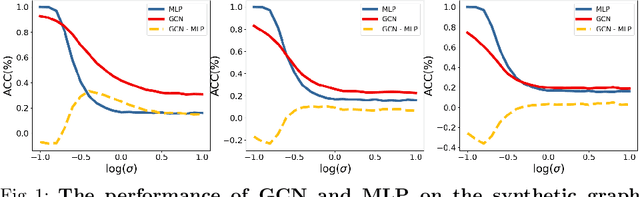
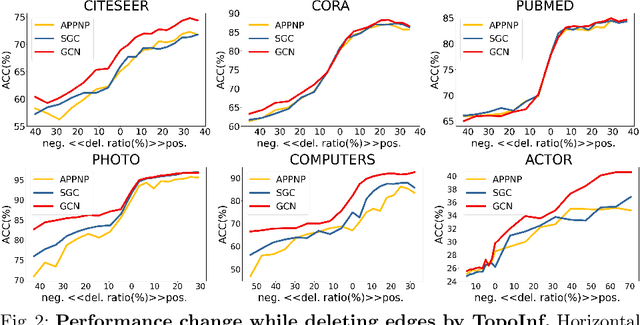
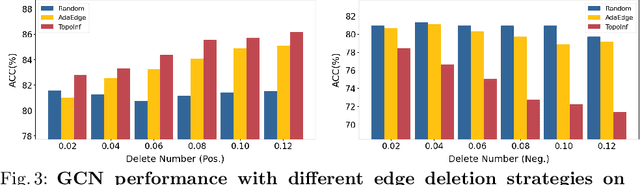
Graph neural networks (GNN) have achieved remarkable success in a wide range of tasks by encoding features combined with topology to create effective representations. However, the fundamental problem of understanding and analyzing how graph topology influences the performance of learning models on downstream tasks has not yet been well understood. In this paper, we propose a metric, TopoInf, which characterizes the influence of graph topology by measuring the level of compatibility between the topological information of graph data and downstream task objectives. We provide analysis based on the decoupled GNNs on the contextual stochastic block model to demonstrate the effectiveness of the metric. Through extensive experiments, we demonstrate that TopoInf is an effective metric for measuring topological influence on corresponding tasks and can be further leveraged to enhance graph learning.