 Add to Chrome
 Add to Firefox
 Add to Edge
Political-LLM: Large Language Models in Political Science
Dec 09, 2024
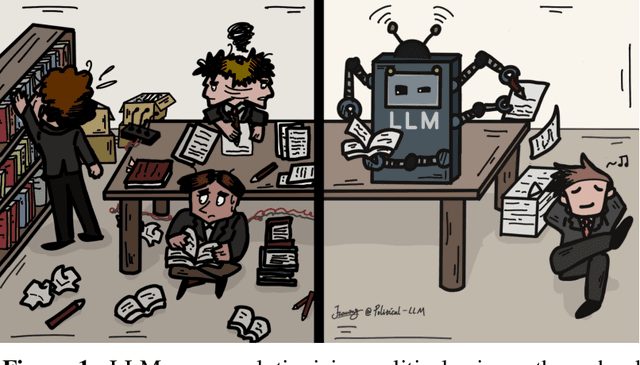
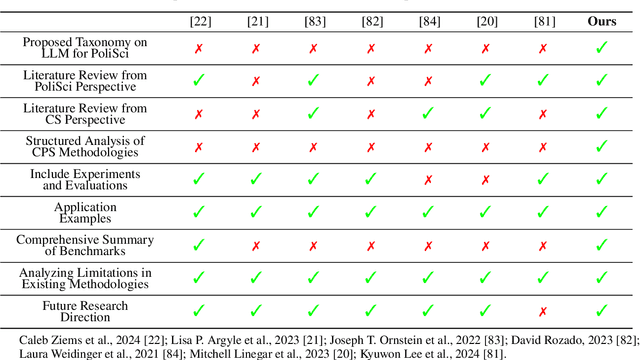
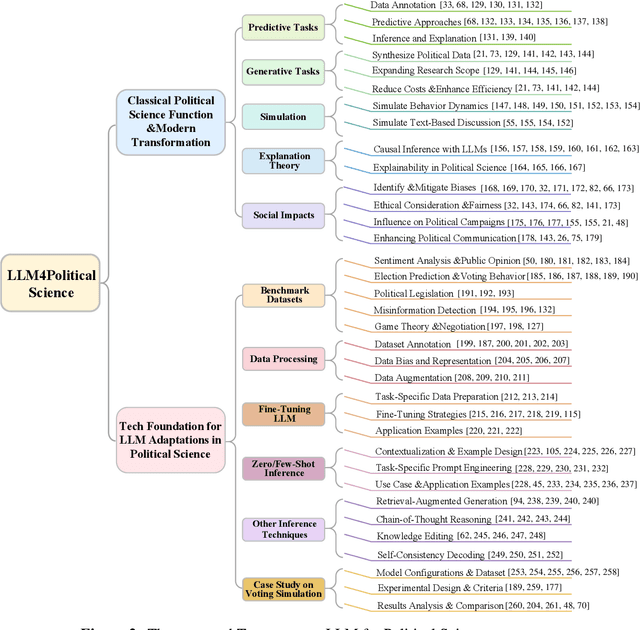

In recent years, large language models (LLMs) have been widely adopted in political science tasks such as election prediction, sentiment analysis, policy impact assessment, and misinformation detection. Meanwhile, the need to systematically understand how LLMs can further revolutionize the field also becomes urgent. In this work, we--a multidisciplinary team of researchers spanning computer science and political science--present the first principled framework termed Political-LLM to advance the comprehensive understanding of integrating LLMs into computational political science. Specifically, we first introduce a fundamental taxonomy classifying the existing explorations into two perspectives: political science and computational methodologies. In particular, from the political science perspective, we highlight the role of LLMs in automating predictive and generative tasks, simulating behavior dynamics, and improving causal inference through tools like counterfactual generation; from a computational perspective, we introduce advancements in data preparation, fine-tuning, and evaluation methods for LLMs that are tailored to political contexts. We identify key challenges and future directions, emphasizing the development of domain-specific datasets, addressing issues of bias and fairness, incorporating human expertise, and redefining evaluation criteria to align with the unique requirements of computational political science. Political-LLM seeks to serve as a guidebook for researchers to foster an informed, ethical, and impactful use of Artificial Intelligence in political science. Our online resource is available at: http://political-llm.org/.

Multi-Party Supervised Fine-tuning of Language Models for Multi-Party Dialogue Generation
Dec 06, 2024Large Language Models (LLM) are usually fine-tuned to participate in dyadic or two-party dialogues, which can not adapt well to multi-party dialogues (MPD), which hinders their applications in such scenarios including multi-personal meetings, discussions and daily communication. Previous LLM-based researches mainly focus on the multi-agent framework, while their base LLMs are still pairwisely fine-tuned. In this work, we design a multi-party fine-tuning framework (MuPaS) for LLMs on the multi-party dialogue datasets, and prove such a straightforward framework can let the LLM align with the multi-party conversation style efficiently and effectively. We also design two training strategies which can convert MuPaS into the MPD simulator. Substantial experiments show that MuPaS can achieve state-of-the-art multi-party response, higher accuracy of the-next-speaker prediction, higher human and automatic evaluated utterance qualities, and can even generate reasonably with out-of-distribution scene, topic and role descriptions. The MuPaS framework bridges the LLM training with more complicated multi-party applications, such as conversation generation, virtual rehearsal or meta-universe.
NLP-ADBench: NLP Anomaly Detection Benchmark
Dec 06, 2024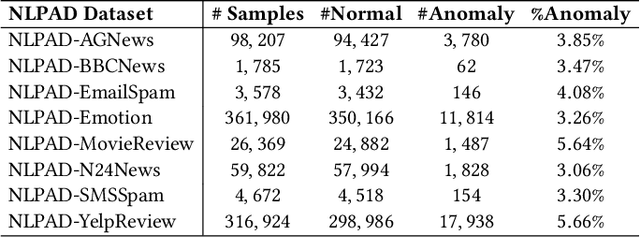

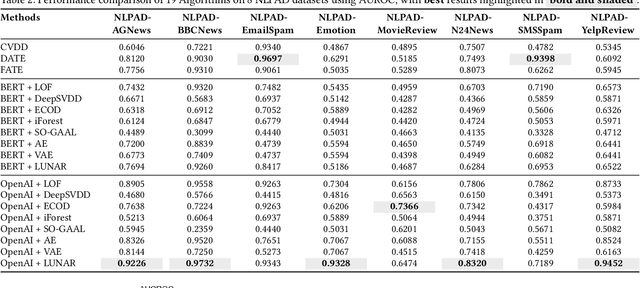
Anomaly detection (AD) is a critical machine learning task with diverse applications in web systems, including fraud detection, content moderation, and user behavior analysis. Despite its significance, AD in natural language processing (NLP) remains underexplored, limiting advancements in detecting anomalies in text data such as harmful content, phishing attempts, or spam reviews. In this paper, we introduce NLP-ADBench, the most comprehensive benchmark for NLP anomaly detection (NLP-AD), comprising eight curated datasets and evaluations of nineteen state-of-the-art algorithms. These include three end-to-end methods and sixteen two-step algorithms that apply traditional anomaly detection techniques to language embeddings generated by bert-base-uncased and OpenAI's text-embedding-3-large models. Our results reveal critical insights and future directions for NLP-AD. Notably, no single model excels across all datasets, highlighting the need for automated model selection. Moreover, two-step methods leveraging transformer-based embeddings consistently outperform specialized end-to-end approaches, with OpenAI embeddings demonstrating superior performance over BERT embeddings. By releasing NLP-ADBench at https://github.com/USC-FORTIS/NLP-ADBench, we provide a standardized framework for evaluating NLP-AD methods, fostering the development of innovative approaches. This work fills a crucial gap in the field and establishes a foundation for advancing NLP anomaly detection, particularly in the context of improving the safety and reliability of web-based systems.
Personalized Multimodal Large Language Models: A Survey
Dec 03, 2024Multimodal Large Language Models (MLLMs) have become increasingly important due to their state-of-the-art performance and ability to integrate multiple data modalities, such as text, images, and audio, to perform complex tasks with high accuracy. This paper presents a comprehensive survey on personalized multimodal large language models, focusing on their architecture, training methods, and applications. We propose an intuitive taxonomy for categorizing the techniques used to personalize MLLMs to individual users, and discuss the techniques accordingly. Furthermore, we discuss how such techniques can be combined or adapted when appropriate, highlighting their advantages and underlying rationale. We also provide a succinct summary of personalization tasks investigated in existing research, along with the evaluation metrics commonly used. Additionally, we summarize the datasets that are useful for benchmarking personalized MLLMs. Finally, we outline critical open challenges. This survey aims to serve as a valuable resource for researchers and practitioners seeking to understand and advance the development of personalized multimodal large language models.
Edit Away and My Face Will not Stay: Personal Biometric Defense against Malicious Generative Editing
Nov 25, 2024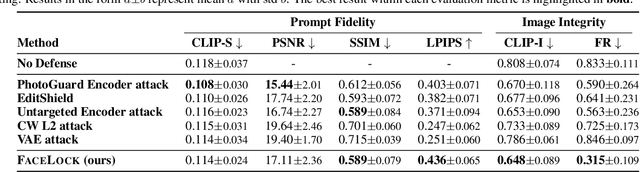
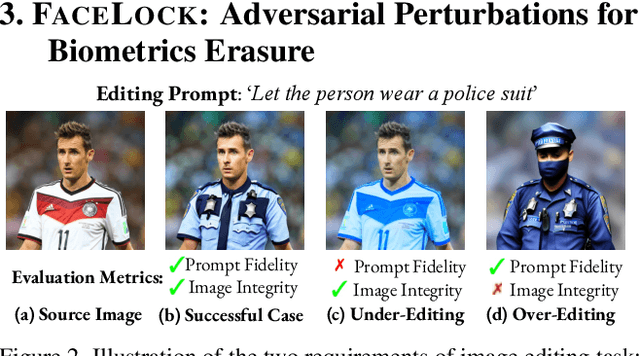

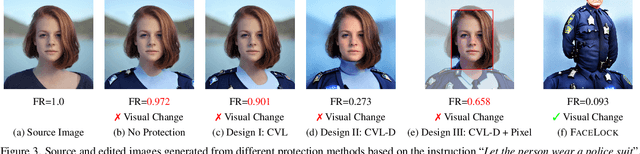
Recent advancements in diffusion models have made generative image editing more accessible, enabling creative edits but raising ethical concerns, particularly regarding malicious edits to human portraits that threaten privacy and identity security. Existing protection methods primarily rely on adversarial perturbations to nullify edits but often fail against diverse editing requests. We propose FaceLock, a novel approach to portrait protection that optimizes adversarial perturbations to destroy or significantly alter biometric information, rendering edited outputs biometrically unrecognizable. FaceLock integrates facial recognition and visual perception into perturbation optimization to provide robust protection against various editing attempts. We also highlight flaws in commonly used evaluation metrics and reveal how they can be manipulated, emphasizing the need for reliable assessments of protection. Experiments show FaceLock outperforms baselines in defending against malicious edits and is robust against purification techniques. Ablation studies confirm its stability and broad applicability across diffusion-based editing algorithms. Our work advances biometric defense and sets the foundation for privacy-preserving practices in image editing. The code is available at: https://github.com/taco-group/FaceLock.
DrugAgent: Automating AI-aided Drug Discovery Programming through LLM Multi-Agent Collaboration
Nov 24, 2024


Recent advancements in Large Language Models (LLMs) have opened new avenues for accelerating drug discovery processes. Despite their potential, several critical challenges remain unsolved, particularly in translating theoretical ideas into practical applications within the highly specialized field of pharmaceutical research, limiting practitioners from leveraging the latest AI development in drug discovery. To this end, we introduce DrugAgent, a multi-agent framework aimed at automating machine learning (ML) programming in drug discovery. DrugAgent incorporates domain expertise by identifying specific requirements and building domain-specific tools, while systematically exploring different ideas to find effective solutions. A preliminary case study demonstrates DrugAgent's potential to overcome key limitations LLMs face in drug discovery, moving toward AI-driven innovation. For example, DrugAgent is able to complete the ML programming pipeline end-to-end, from data acquisition to performance evaluation for the ADMET prediction task, and finally select the best model, where the random forest model achieves an F1 score of 0.92 when predicting absorption using the PAMPA dataset.
COOD: Concept-based Zero-shot OOD Detection
Nov 15, 2024
How can models effectively detect out-of-distribution (OOD) samples in complex, multi-label settings without extensive retraining? Existing OOD detection methods struggle to capture the intricate semantic relationships and label co-occurrences inherent in multi-label settings, often requiring large amounts of training data and failing to generalize to unseen label combinations. While large language models have revolutionized zero-shot OOD detection, they primarily focus on single-label scenarios, leaving a critical gap in handling real-world tasks where samples can be associated with multiple interdependent labels. To address these challenges, we introduce COOD, a novel zero-shot multi-label OOD detection framework. COOD leverages pre-trained vision-language models, enhancing them with a concept-based label expansion strategy and a new scoring function. By enriching the semantic space with both positive and negative concepts for each label, our approach models complex label dependencies, precisely differentiating OOD samples without the need for additional training. Extensive experiments demonstrate that our method significantly outperforms existing approaches, achieving approximately 95% average AUROC on both VOC and COCO datasets, while maintaining robust performance across varying numbers of labels and different types of OOD samples.
DPU: Dynamic Prototype Updating for Multimodal Out-of-Distribution Detection
Nov 12, 2024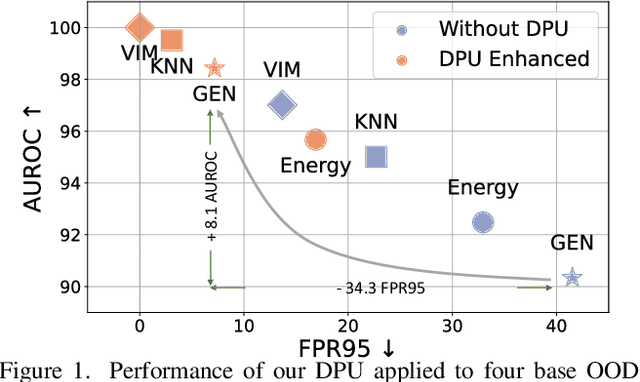


Out-of-distribution (OOD) detection is essential for ensuring the robustness of machine learning models by identifying samples that deviate from the training distribution. While traditional OOD detection has primarily focused on single-modality inputs, such as images, recent advances in multimodal models have demonstrated the potential of leveraging multiple modalities (e.g., video, optical flow, audio) to enhance detection performance. However, existing methods often overlook intra-class variability within in-distribution (ID) data, assuming that samples of the same class are perfectly cohesive and consistent. This assumption can lead to performance degradation, especially when prediction discrepancies are uniformly amplified across all samples. To address this issue, we propose Dynamic Prototype Updating (DPU), a novel plug-and-play framework for multimodal OOD detection that accounts for intra-class variations. Our method dynamically updates class center representations for each class by measuring the variance of similar samples within each batch, enabling adaptive adjustments. This approach allows us to amplify prediction discrepancies based on the updated class centers, thereby improving the model's robustness and generalization across different modalities. Extensive experiments on two tasks, five datasets, and nine base OOD algorithms demonstrate that DPU significantly improves OOD detection performance, setting a new state-of-the-art in multimodal OOD detection, with improvements of up to 80 percent in Far-OOD detection. To facilitate accessibility and reproducibility, our code is publicly available on GitHub.
Meta-Learning for Speeding Up Large Model Inference in Decentralized Environments
Oct 28, 2024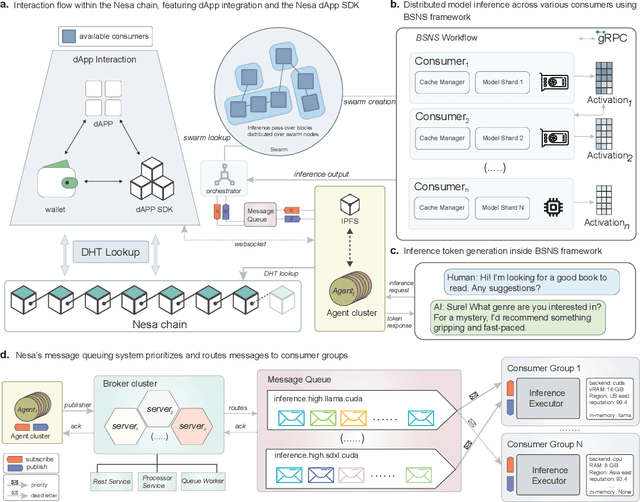
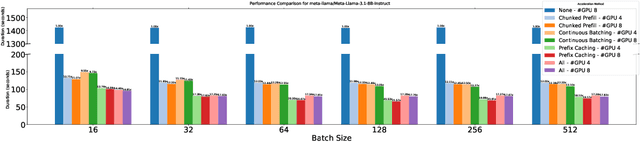
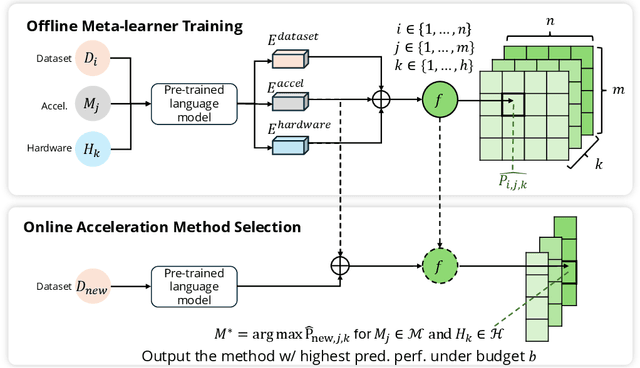
The deployment of large-scale models, such as large language models (LLMs) and sophisticated image generation systems, incurs substantial costs due to their computational demands. To mitigate these costs and address challenges related to scalability and data security, there is a growing shift towards decentralized systems for deploying such models. In these decentralized environments, efficient inference acceleration becomes crucial to manage computational resources effectively and enhance system responsiveness. In this work, we address the challenge of selecting optimal acceleration methods in decentralized systems by introducing a meta-learning-based framework. This framework automates the selection process by learning from historical performance data of various acceleration techniques across different tasks. Unlike traditional methods that rely on random selection or expert intuition, our approach systematically identifies the best acceleration strategies based on the specific characteristics of each task. We demonstrate that our meta-learning framework not only streamlines the decision-making process but also consistently outperforms conventional methods in terms of efficiency and performance. Our results highlight the potential of meta-learning to revolutionize inference acceleration in decentralized AI systems, offering a path towards more democratic and economically feasible artificial intelligence solutions.
LEGO-Learn: Label-Efficient Graph Open-Set Learning
Oct 21, 2024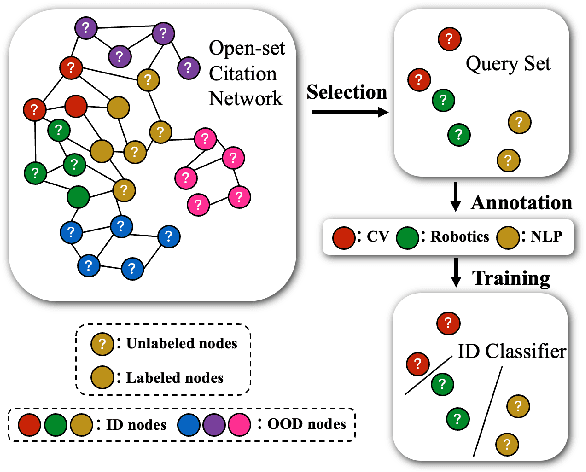
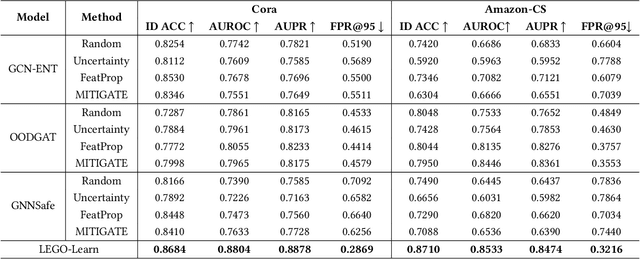
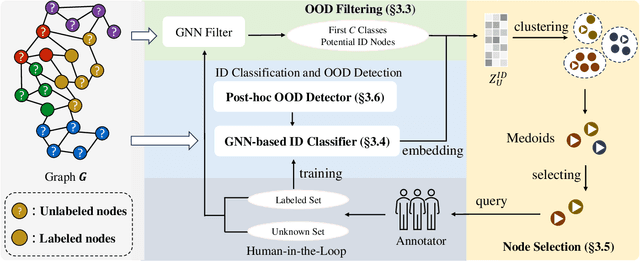
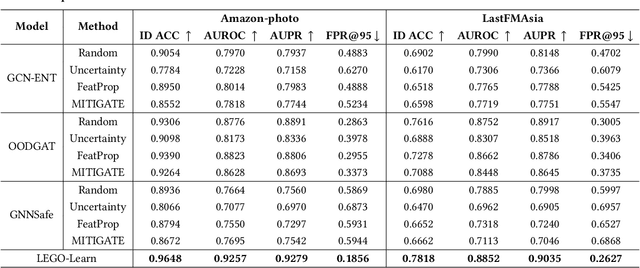
How can we train graph-based models to recognize unseen classes while keeping labeling costs low? Graph open-set learning (GOL) and out-of-distribution (OOD) detection aim to address this challenge by training models that can accurately classify known, in-distribution (ID) classes while identifying and handling previously unseen classes during inference. It is critical for high-stakes, real-world applications where models frequently encounter unexpected data, including finance, security, and healthcare. However, current GOL methods assume access to many labeled ID samples, which is unrealistic for large-scale graphs due to high annotation costs. In this paper, we propose LEGO-Learn (Label-Efficient Graph Open-set Learning), a novel framework that tackles open-set node classification on graphs within a given label budget by selecting the most informative ID nodes. LEGO-Learn employs a GNN-based filter to identify and exclude potential OOD nodes and then select highly informative ID nodes for labeling using the K-Medoids algorithm. To prevent the filter from discarding valuable ID examples, we introduce a classifier that differentiates between the C known ID classes and an additional class representing OOD nodes (hence, a C+1 classifier). This classifier uses a weighted cross-entropy loss to balance the removal of OOD nodes while retaining informative ID nodes. Experimental results on four real-world datasets demonstrate that LEGO-Learn significantly outperforms leading methods, with up to a 6.62% improvement in ID classification accuracy and a 7.49% increase in AUROC for OOD detection.