 Add to Chrome
 Add to Firefox
 Add to Edge
Clusters are All You Need: Pre-Training the Tsetlin Machine with Semantic Clusters from Language Models for Interpretability
Jun 18, 2026
Pre-trained language models such as BERT achieve strong text classification performance but lack transparency, limiting their use in high-stakes settings. The Tsetlin Machine (TM) offers fully interpretable, clause-based reasoning but captures little semantic information, and prior attempts to bridge the two rely on static word embeddings that miss contextual meaning. We propose a semantic pre-training framework that transfers knowledge from a pre-trained language model into a TM without using embeddings. Text samples are grouped into semantically coherent clusters with K-means or Top2Vec, and the resulting cluster-sample pairs pre-train a non-negated TM with enhanced Type I feedback. The TM thereby learns interpretable semantic keywords that are fine-tuned on downstream tasks. Across five datasets, our method substantially outperforms vanilla and embedding-based TMs and reaches performance competitive with BERT while remaining interpretable.

Agents' Last Exam
Jun 03, 2026Recent AI systems have achieved strong results on a wide range of benchmarks, yet these gains have not translated into economically meaningful deployment across many professional domains. We argue that this gap is largely an evaluation problem: widely used benchmarks lack sustained performance measurement on real and economically valuable workflows. This paper introduces Agents' Last Exam (ALE), a benchmark designed to evaluate AI agents on long-horizon, economically valuable, real-world tasks with verifiable outcomes. Developed in collaboration with 250+ industry experts, ALE covers non-physical industries defined with reference to O*NET / SOC 2018 (the U.S. federal occupational taxonomy). It is organized around a task taxonomy with 55 subfields grouped into 13 industry clusters covering 1K+ tasks. Current results show that the hardest tier remains far from saturated: across mainstream harness and backbone configurations, the average full pass rate is 2.6%. ALE is designed as a living benchmark: its task pool grows continuously as new workflows and industries are onboarded. More broadly, ALE is intended not merely as another leaderboard, but as an instrument for closing the gap between benchmark success and GDP-relevant impact.
LLM-Guided Semantic Bootstrapping for Interpretable Text Classification with Tsetlin Machines
Apr 14, 2026Pretrained language models (PLMs) like BERT provide strong semantic representations but are costly and opaque, while symbolic models such as the Tsetlin Machine (TM) offer transparency but lack semantic generalization. We propose a semantic bootstrapping framework that transfers LLM knowledge into symbolic form, combining interpretability with semantic capacity. Given a class label, an LLM generates sub-intents that guide synthetic data creation through a three-stage curriculum (seed, core, enriched), expanding semantic diversity. A Non-Negated TM (NTM) learns from these examples to extract high-confidence literals as interpretable semantic cues. Injecting these cues into real data enables a TM to align clause logic with LLM-inferred semantics. Our method requires no embeddings or runtime LLM calls, yet equips symbolic models with pretrained semantic priors. Across multiple text classification tasks, it improves interpretability and accuracy over vanilla TM, achieving performance comparable to BERT while remaining fully symbolic and efficient.
Beyond Output Correctness: Benchmarking and Evaluating Large Language Model Reasoning in Coding Tasks
Apr 14, 2026Large language models (LLMs) increasingly rely on explicit reasoning to solve coding tasks, yet evaluating the quality of this reasoning remains challenging. Existing reasoning evaluators are not designed for coding, and current benchmarks focus primarily on code generation, leaving other coding tasks largely unexplored. We introduce CodeRQ-Bench, the first benchmark for evaluating LLM reasoning quality across three coding task categories: generation, summarization, and classification. Using this benchmark, we analyze 1,069 mismatch cases from existing evaluators, identify five recurring limitations, and derive four design insights for reasoning evaluation in coding tasks. Guided by these insights, we propose VERA, a two-stage evaluator that combines evidence-grounded verification with ambiguity-aware score correction. Experiments on CodeRQ-Bench show that VERA consistently outperforms strong baselines across four datasets, improving AUCROC by up to 0.26 and AUPRC by up to 0.21. We release CodeRQ-Bench at https://github.com/MrLYG/CodeRQ-Bench, supporting future investigations.
FedBCD:Communication-Efficient Accelerated Block Coordinate Gradient Descent for Federated Learning
Mar 05, 2026Although Federated Learning has been widely studied in recent years, there are still high overhead expenses in each communication round for large-scale models such as Vision Transformer. To lower the communication complexity, we propose a novel Federated Block Coordinate Gradient Descent (FedBCGD) method for communication efficiency. The proposed method splits model parameters into several blocks, including a shared block and enables uploading a specific parameter block by each client, which can significantly reduce communication overhead. Moreover, we also develop an accelerated FedBCGD algorithm (called FedBCGD+) with client drift control and stochastic variance reduction. To the best of our knowledge, this paper is the first work on parameter block communication for training large-scale deep models. We also provide the convergence analysis for the proposed algorithms. Our theoretical results show that the communication complexities of our algorithms are a factor $1/N$ lower than those of existing methods, where $N$ is the number of parameter blocks, and they enjoy much faster convergence than their counterparts. Empirical results indicate the superiority of the proposed algorithms compared to state-of-the-art algorithms. The code is available at https://github.com/junkangLiu0/FedBCGD.
S2D-ALIGN: Shallow-to-Deep Auxiliary Learning for Anatomically-Grounded Radiology Report Generation
Nov 14, 2025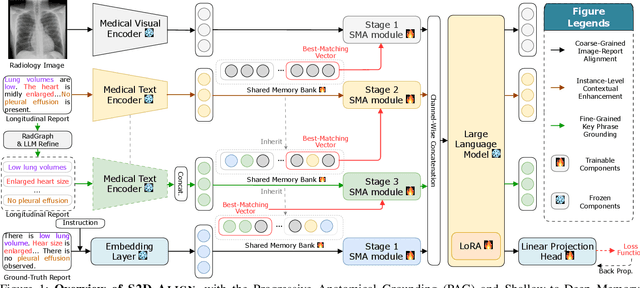
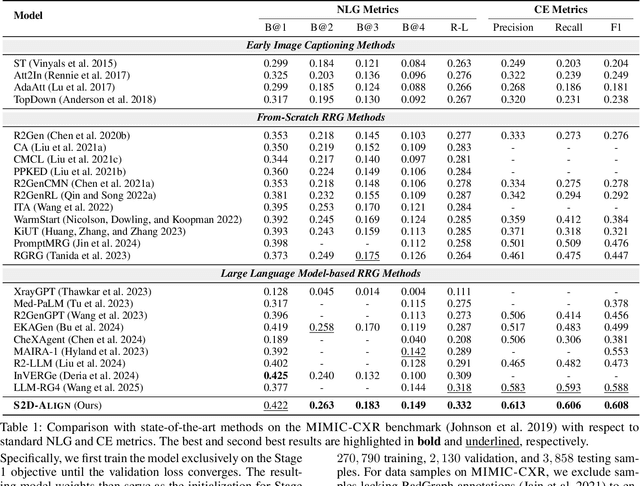
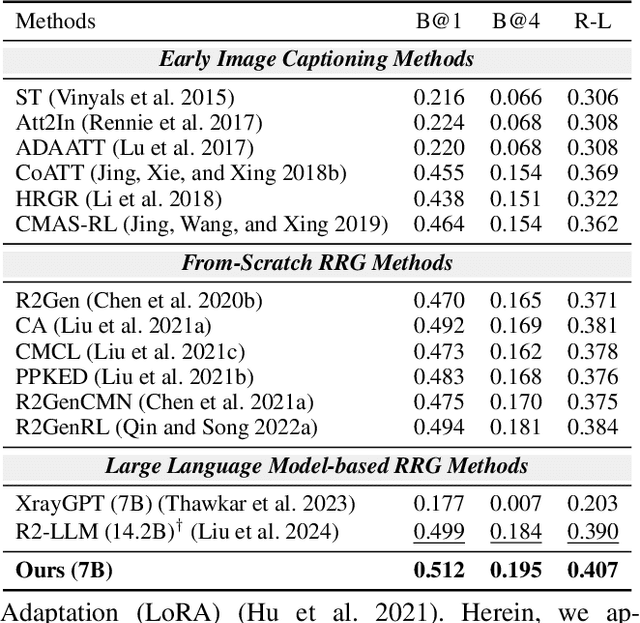
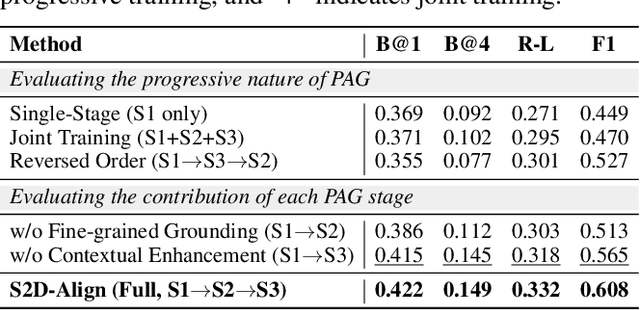
Radiology Report Generation (RRG) aims to automatically generate diagnostic reports from radiology images. To achieve this, existing methods have leveraged the powerful cross-modal generation capabilities of Multimodal Large Language Models (MLLMs), primarily focusing on optimizing cross-modal alignment between radiographs and reports through Supervised Fine-Tuning (SFT). However, by only performing instance-level alignment with the image-text pairs, the standard SFT paradigm fails to establish anatomically-grounded alignment, where the templated nature of reports often leads to sub-optimal generation quality. To address this, we propose \textsc{S2D-Align}, a novel SFT paradigm that establishes anatomically-grounded alignment by leveraging auxiliary signals of varying granularities. \textsc{S2D-Align} implements a shallow-to-deep strategy, progressively enriching the alignment process: it begins with the coarse radiograph-report pairing, then introduces reference reports for instance-level guidance, and ultimately utilizes key phrases to ground the generation in specific anatomical details. To bridge the different alignment stages, we introduce a memory-based adapter that empowers feature sharing, thereby integrating coarse and fine-grained guidance. For evaluation, we conduct experiments on the public \textsc{MIMIC-CXR} and \textsc{IU X-Ray} benchmarks, where \textsc{S2D-Align} achieves state-of-the-art performance compared to existing methods. Ablation studies validate the effectiveness of our multi-stage, auxiliary-guided approach, highlighting a promising direction for enhancing grounding capabilities in complex, multi-modal generation tasks.
A Large-scale Empirical Study on Large Language Models for Election Prediction
Dec 19, 2024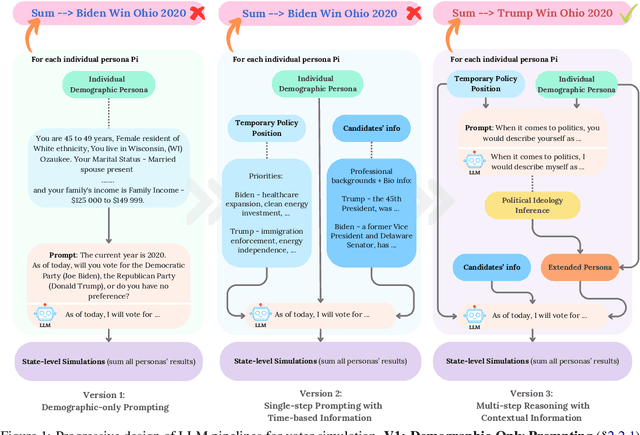
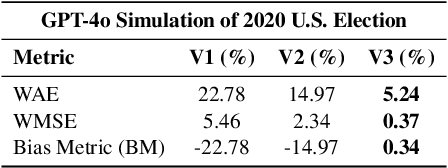
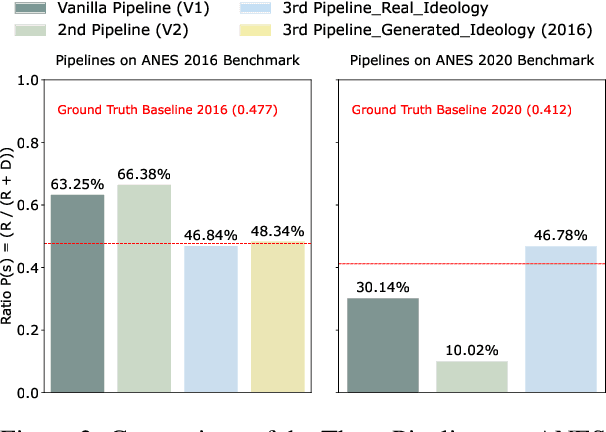

Can Large Language Models (LLMs) accurately predict election outcomes? While LLMs have demonstrated impressive performance in healthcare, legal analysis, and creative applications, their capabilities in election forecasting remain uncertain. Notably, election prediction poses unique challenges: limited voter-level data, evolving political contexts, and the complexity of modeling human behavior. In the first part of this paper, we explore and introduce a multi-step reasoning framework for election prediction, which systematically integrates demographic, ideological, and time-sensitive factors. Validated on 2016 and 2020 real-world data and extensive synthetic personas, our approach adapts to changing political landscapes, reducing bias and significantly improving predictive accuracy. We further apply our pipeline to the 2024 U.S. presidential election, illustrating its ability to generalize beyond observed historical data. Beyond enhancing accuracy, the second part of the paper provides insights into the broader implications of LLM-based election forecasting. We identify potential political biases embedded in pretrained corpora, examine how demographic patterns can become exaggerated, and suggest strategies for mitigating these issues. Together, this project, a large-scale LLM empirical study, advances the accuracy of election predictions and establishes directions for more balanced, transparent, and context-aware modeling in political science research and practice.
AD-LLM: Benchmarking Large Language Models for Anomaly Detection
Dec 15, 2024

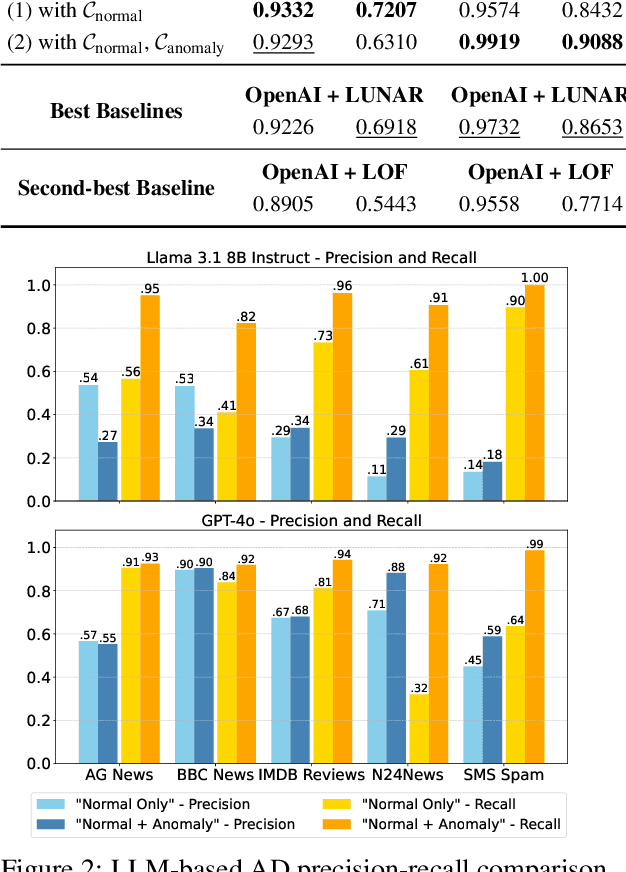

Anomaly detection (AD) is an important machine learning task with many real-world uses, including fraud detection, medical diagnosis, and industrial monitoring. Within natural language processing (NLP), AD helps detect issues like spam, misinformation, and unusual user activity. Although large language models (LLMs) have had a strong impact on tasks such as text generation and summarization, their potential in AD has not been studied enough. This paper introduces AD-LLM, the first benchmark that evaluates how LLMs can help with NLP anomaly detection. We examine three key tasks: (i) zero-shot detection, using LLMs' pre-trained knowledge to perform AD without tasks-specific training; (ii) data augmentation, generating synthetic data and category descriptions to improve AD models; and (iii) model selection, using LLMs to suggest unsupervised AD models. Through experiments with different datasets, we find that LLMs can work well in zero-shot AD, that carefully designed augmentation methods are useful, and that explaining model selection for specific datasets remains challenging. Based on these results, we outline six future research directions on LLMs for AD.
H-FedSN: Personalized Sparse Networks for Efficient and Accurate Hierarchical Federated Learning for IoT Applications
Dec 09, 2024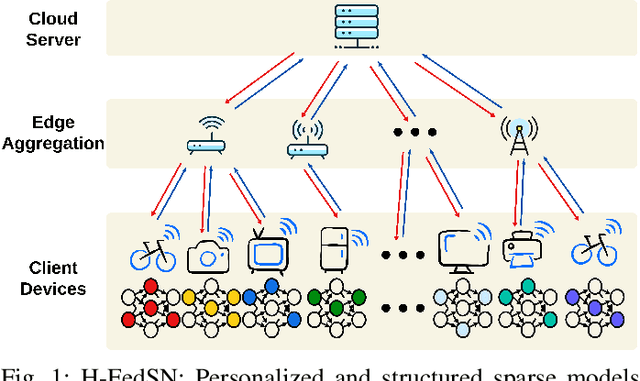
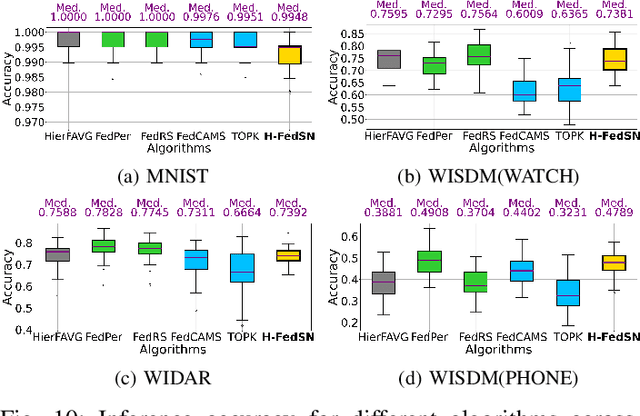
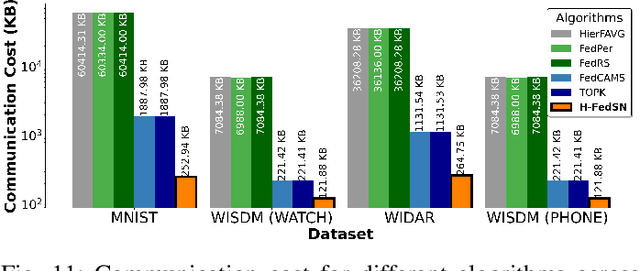
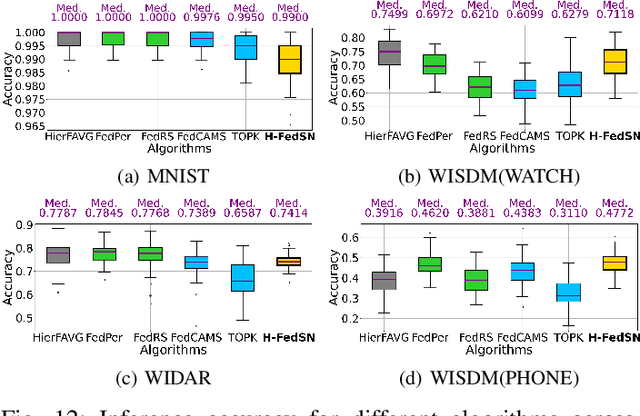
The proliferation of Internet of Things (IoT) has increased interest in federated learning (FL) for privacy-preserving distributed data utilization. However, traditional two-tier FL architectures inadequately adapt to multi-tier IoT environments. While Hierarchical Federated Learning (HFL) improves practicality in multi-tier IoT environments by multi-layer aggregation, it still faces challenges in communication efficiency and accuracy due to high data transfer volumes, data heterogeneity, and imbalanced device distribution, struggling to meet the low-latency and high-accuracy model training requirements of practical IoT scenarios. To overcome these limitations, we propose H-FedSN, an innovative approach for practical IoT environments. H-FedSN introduces a binary mask mechanism with shared and personalized layers to reduce communication overhead by creating a sparse network while keeping original weights frozen. To address data heterogeneity and imbalanced device distribution, we integrate personalized layers for local data adaptation and apply Bayesian aggregation with cumulative Beta distribution updates at edge and cloud levels, effectively balancing contributions from diverse client groups. Evaluations on three real-world IoT datasets and MNIST under non-IID settings demonstrate that H-FedSN significantly reduces communication costs by 58 to 238 times compared to HierFAVG while achieving high accuracy, making it highly effective for practical IoT applications in hierarchical federated learning scenarios.
NLP-ADBench: NLP Anomaly Detection Benchmark
Dec 06, 2024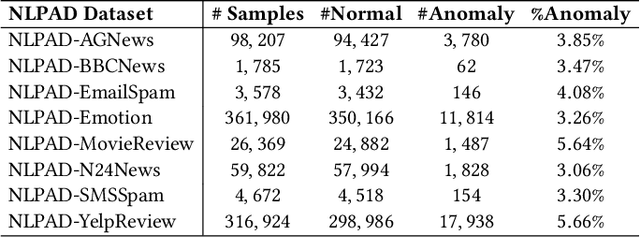

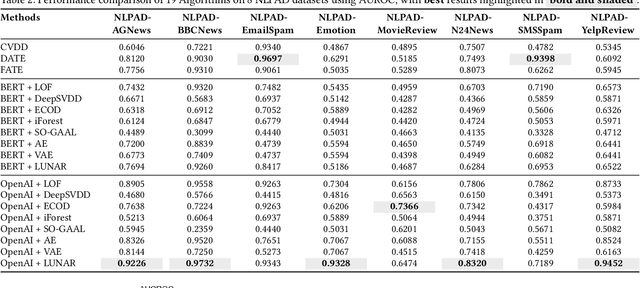
Anomaly detection (AD) is a critical machine learning task with diverse applications in web systems, including fraud detection, content moderation, and user behavior analysis. Despite its significance, AD in natural language processing (NLP) remains underexplored, limiting advancements in detecting anomalies in text data such as harmful content, phishing attempts, or spam reviews. In this paper, we introduce NLP-ADBench, the most comprehensive benchmark for NLP anomaly detection (NLP-AD), comprising eight curated datasets and evaluations of nineteen state-of-the-art algorithms. These include three end-to-end methods and sixteen two-step algorithms that apply traditional anomaly detection techniques to language embeddings generated by bert-base-uncased and OpenAI's text-embedding-3-large models. Our results reveal critical insights and future directions for NLP-AD. Notably, no single model excels across all datasets, highlighting the need for automated model selection. Moreover, two-step methods leveraging transformer-based embeddings consistently outperform specialized end-to-end approaches, with OpenAI embeddings demonstrating superior performance over BERT embeddings. By releasing NLP-ADBench at https://github.com/USC-FORTIS/NLP-ADBench, we provide a standardized framework for evaluating NLP-AD methods, fostering the development of innovative approaches. This work fills a crucial gap in the field and establishes a foundation for advancing NLP anomaly detection, particularly in the context of improving the safety and reliability of web-based systems.