 Add to Chrome
 Add to Firefox
 Add to Edge
A physics-informed foundation model for quantitative diffusion MRI
May 29, 2026
Understanding the human brain requires access to its microscopic tissue architecture. Diffusion magnetic resonance imaging (MRI) provides the only noninvasive window into whole-brain microstructure in vivo, yet reliable quantitative mapping remains confined to specialized research settings requiring dense sampling and optimized acquisition protocols. To address this gap, we present a physics-informed generative microstructure network (PIGMENT) that learns a universal generative prior of human brain microstructure and adapts it zero-shot to each participant's measured data to recover subject-specific maps. Trained on 11375 scans spanning multiple sites, vendors, and field strengths, PIGMENT enabled reliable quantitative mapping for tensor, kurtosis, and NODDI models across external datasets from five independent centers. It remains effective where conventional fitting becomes unreliable, recovering meaningful maps from extremely sparse acquisitions while supporting downstream tractography and structural connectivity mapping. PIGMENT estimates demonstrated strong biological validity, preserving submillimeter cortical microarchitectural patterns and early-childhood white matter developmental trajectories from 10-fold accelerated scans. Furthermore, PIGMENT enables reliable quantitative tensor mapping on cost-efficient low-field systems and the extraction of tumor-related biomarkers using ultra-fast clinical protocols. Together, these results establish PIGMENT as a physics-informed foundation model that extends quantitative diffusion MRI into regimes traditionally too sparse, heterogeneous, or clinically constrained for reliable analysis.

Towards Reliable Fetal Ultrasound Interpretation with Multi-Agent Collaboration
May 25, 2026Automated fetal ultrasound interpretation requires a workflow from visual perception, including plane recognition and anatomical segmentation, to clinical understanding, including biometric measurement and diagnostic reporting. However, the prevailing "one-task, one-model" paradigm limits systematic integration of evidence across this multi-step process. Although multimodal large language models (MLLMs) show promising visual understanding, their limited domain-specific grounding and hallucination risks restrict reliability in fetal ultrasound analysis. To address these limitations, we propose FetUSAgents, a tool-augmented multi-agent system for comprehensive fetal ultrasound interpretation, supporting visual question answering (VQA), report generation, image captioning, and video summarization. FetUSAgents coordinates task-specific visual tools through collaborative LLM agents and decomposes clinical queries into subtasks that progress from anatomical recognition to quantitative measurement. We further introduce Dual-Path Evidence Arbitration (DPEA), which integrates LLM-based deliberative reasoning with structured computational evidence from specialized visual tools. A retrieval-enhanced evidence bank consolidates intermediate findings to support traceable and clinically grounded conclusions. In addition, we construct FetUS-VQA, a dedicated VQA benchmark for fetal ultrasound, comprising 1,892 images and 3,205 question-answer pairs across 10 clinical tasks. Extensive out-of-distribution experiments show that FetUSAgents outperforms general and medical MLLMs, exceeding the strongest baseline by more than 25 percent in VQA accuracy. These results suggest a scalable route toward evidence-driven clinical assistants for prenatal imaging. Code is available.
INFANiTE: Implicit Neural representation for high-resolution Fetal brain spatio-temporal Atlas learNing from clinical Thick-slicE MRI
May 11, 2026Spatio-temporal fetal brain atlases are important for characterizing normative neurodevelopment and identifying congenital anomalies. However, existing atlas construction pipelines necessitate days for slice-to-volume reconstruction (SVR) to generate high-resolution 3D brain volumes and several additional days for iterative volume registration, thereby rendering atlas construction from large-scale cohorts prohibitively impractical. We address these limitations with INFANiTE, an Implicit Neural Representation (INR) framework for high-resolution Fetal brain spatio-temporal Atlas learNing from clinical Thick-slicE MRI scans, bypassing both the costly SVR and the iterative non-rigid registration steps entirely, thereby substantially accelerating atlas construction. Extensive experiments demonstrate that INFANiTE outperforms existing baselines in subject consistency, reference fidelity, intrinsic quality and biological plausibility, even under challenging sparse-data settings. Additionally, INFANiTE reduces the end-to-end processing time (i.e., from raw scans to the final atlas) from days to hours compared to the traditional 3D volume-based pipeline (e.g., SyGN), facilitating large-scale population-level fetal brain analysis. Our code is publicly available at: https://anonymous.4open.science/r/INFANiTE-5D74
Annotation-free deep learning for detection and segmentation of fetal germinal matrix-intraventricular hemorrhage in brain MRI
May 10, 2026Background: Prenatal germinal matrix-intraventricular hemorrhage (GMH-IVH) is a leading cause of infant mortality and neurodevelopmental impairment. Manual diagnosis and lesion segmentation are labor-intensive and error-prone. Deep learning models offer potential for automation but typically require large annotated datasets, which are challenging to obtain. Purpose: To develop and validate an annotation-free deep learning framework for automated detection and segmentation of GMH-IVH on brain MRI. Materials and Methods: This retrospective study analyzed 2D T2-weighted MRI data from pregnant women collected from October 2015 to October 2023 at one hospital (internal validation) and two hospitals (external validation). Eligible participants included healthy fetuses and those with GMH-IVH. FreeHemoSeg was developed and trained using pseudo GMH-IVH images synthesized from normal fetal data guided by medical priors. Primary outcomes included diagnostic accuracy (area under the ROC curve [AUROC], sensitivity, specificity) and segmentation accuracy (Dice similarity coefficient [DSC]). A reader study evaluated clinical utility. Results: A total of 1674 stacks from 558 pregnant women were analyzed. FreeHemoSeg achieved the highest performance in both internal (sensitivity: 0.914, 95% CI 0.869-0.945; specificity: 0.966, 95% CI 0.946-0.978; DSC: 0.559, 95% CI 0.546-0.571) and external validation (sensitivity: 0.824, 95% CI 0.739-0.885; specificity: 0.943, 95% CI 0.913-0.964; DSC: 0.512, 95% CI 0.497-0.526), outperforming supervised and unsupervised methods. FreeHemoSeg assistance improved radiologists' sensitivity (from 0.882 to 0.941-1.000) and diagnostic confidence while reducing interpretation time by 16.0-52.7%. Conclusion: FreeHemoSeg accurately detects and localizes fetal brain hemorrhages without annotated training data, enabling earlier diagnosis and supporting timely clinical management.
EXACT: an explainable anomaly-aware vision foundation model for analysis of 3D chest CT
Apr 27, 2026Chest computed tomography (CT) is central to the detection and management of thoracic disease, yet the growing scale and complexity of volumetric imaging increasingly exceed what can be addressed by scan-level prediction alone. Clinically useful AI for CT must not only recognize disease across the whole volume, but also localize abnormalities and provide interpretable visual evidence. Existing vision-language foundation models typically compress scans and reports into global image-text representations, limiting their ability to preserve spatial evidence and support clinically meaningful interpretation. Here we developed EXACT, an explainable anomaly-aware foundation model for three-dimensional chest CT that learns spatially resolved representations from paired clinical scans and radiology reports. EXACT was pre-trained on 25,692 CT-reports pairs using anatomy-aware weak supervision, jointly learning organ segmentation and multi-instance anomaly localization without manual voxel-level annotations. The resulting organ-specific anomaly-aware maps assign each voxel a disease-specific anomaly score confined to its corresponding anatomy, jointly encoding lesion extent and organ-level context. In retrospective multinational and multi-center evaluations, EXACT showed broad and consistent improvements across clinically relevant CT tasks, spanning multi-disease diagnosis, zero-shot anomaly localization, downstream adaptation, and visually grounded report generation, outperforming existing three-dimensional medical foundation models. By transforming routine clinical CT scans and free-text reports into explainable voxel-level representations, EXACT establishes a scalable paradigm for trustworthy volumetric medical AI.
Political-LLM: Large Language Models in Political Science
Dec 09, 2024
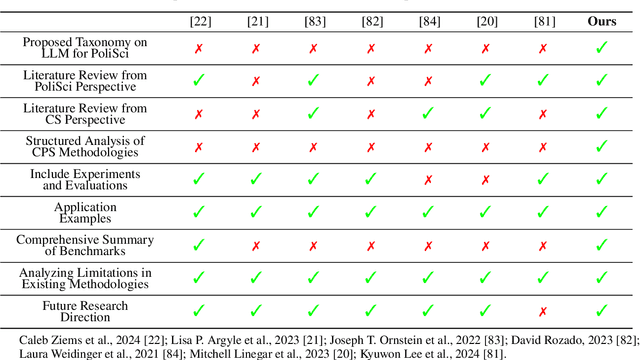
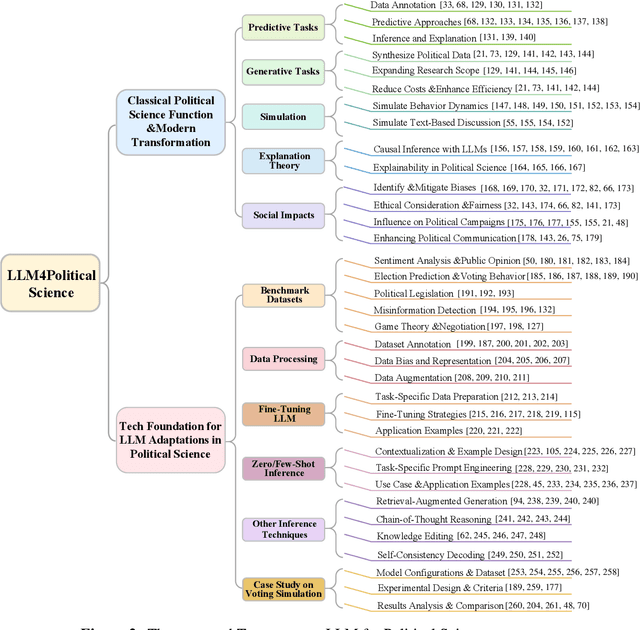

In recent years, large language models (LLMs) have been widely adopted in political science tasks such as election prediction, sentiment analysis, policy impact assessment, and misinformation detection. Meanwhile, the need to systematically understand how LLMs can further revolutionize the field also becomes urgent. In this work, we--a multidisciplinary team of researchers spanning computer science and political science--present the first principled framework termed Political-LLM to advance the comprehensive understanding of integrating LLMs into computational political science. Specifically, we first introduce a fundamental taxonomy classifying the existing explorations into two perspectives: political science and computational methodologies. In particular, from the political science perspective, we highlight the role of LLMs in automating predictive and generative tasks, simulating behavior dynamics, and improving causal inference through tools like counterfactual generation; from a computational perspective, we introduce advancements in data preparation, fine-tuning, and evaluation methods for LLMs that are tailored to political contexts. We identify key challenges and future directions, emphasizing the development of domain-specific datasets, addressing issues of bias and fairness, incorporating human expertise, and redefining evaluation criteria to align with the unique requirements of computational political science. Political-LLM seeks to serve as a guidebook for researchers to foster an informed, ethical, and impactful use of Artificial Intelligence in political science. Our online resource is available at: http://political-llm.org/.
Artificial Intelligence for Neuro MRI Acquisition: A Review
Jun 10, 2024Magnetic resonance imaging (MRI) has significantly benefited from the resurgence of artificial intelligence (AI). By leveraging AI's capabilities in large-scale optimization and pattern recognition, innovative methods are transforming the MRI acquisition workflow, including planning, sequence design, and correction of acquisition artifacts. These emerging algorithms demonstrate substantial potential in enhancing the efficiency and throughput of acquisition steps. This review discusses several pivotal AI-based methods in neuro MRI acquisition, focusing on their technological advances, impact on clinical practice, and potential risks.