 Add to Chrome
 Add to Firefox
 Add to Edge
OCTCube: A 3D foundation model for optical coherence tomography that improves cross-dataset, cross-disease, cross-device and cross-modality analysis
Aug 20, 2024
Optical coherence tomography (OCT) has become critical for diagnosing retinal diseases as it enables 3D images of the retina and optic nerve. OCT acquisition is fast, non-invasive, affordable, and scalable. Due to its broad applicability, massive numbers of OCT images have been accumulated in routine exams, making it possible to train large-scale foundation models that can generalize to various diagnostic tasks using OCT images. Nevertheless, existing foundation models for OCT only consider 2D image slices, overlooking the rich 3D structure. Here, we present OCTCube, a 3D foundation model pre-trained on 26,605 3D OCT volumes encompassing 1.62 million 2D OCT images. OCTCube is developed based on 3D masked autoencoders and exploits FlashAttention to reduce the larger GPU memory usage caused by modeling 3D volumes. OCTCube outperforms 2D models when predicting 8 retinal diseases in both inductive and cross-dataset settings, indicating that utilizing the 3D structure in the model instead of 2D data results in significant improvement. OCTCube further shows superior performance on cross-device prediction and when predicting systemic diseases, such as diabetes and hypertension, further demonstrating its strong generalizability. Finally, we propose a contrastive-self-supervised-learning-based OCT-IR pre-training framework (COIP) for cross-modality analysis on OCT and infrared retinal (IR) images, where the OCT volumes are embedded using OCTCube. We demonstrate that COIP enables accurate alignment between OCT and IR en face images. Collectively, OCTCube, a 3D OCT foundation model, demonstrates significantly better performance against 2D models on 27 out of 29 tasks and comparable performance on the other two tasks, paving the way for AI-based retinal disease diagnosis.

Enhancing LLM's Cognition via Structurization
Jul 23, 2024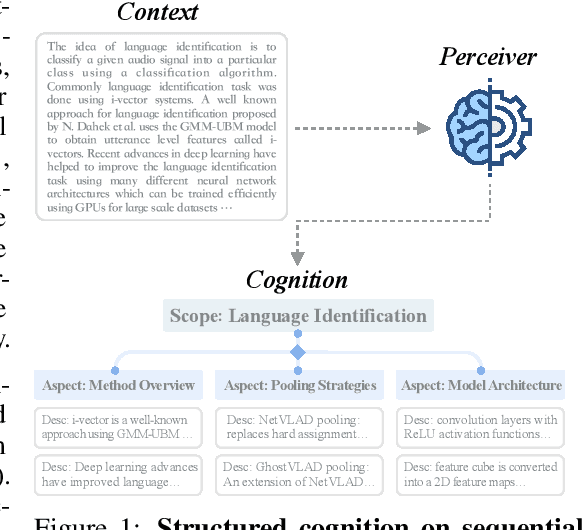
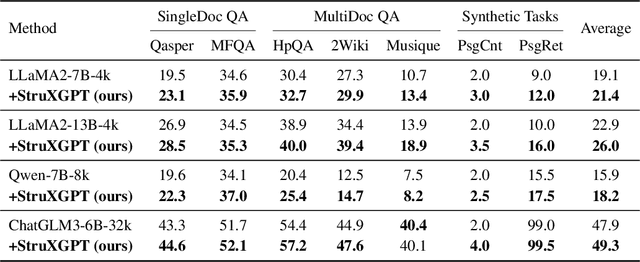
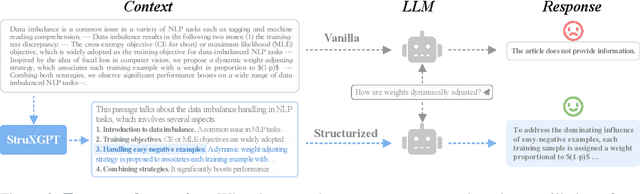
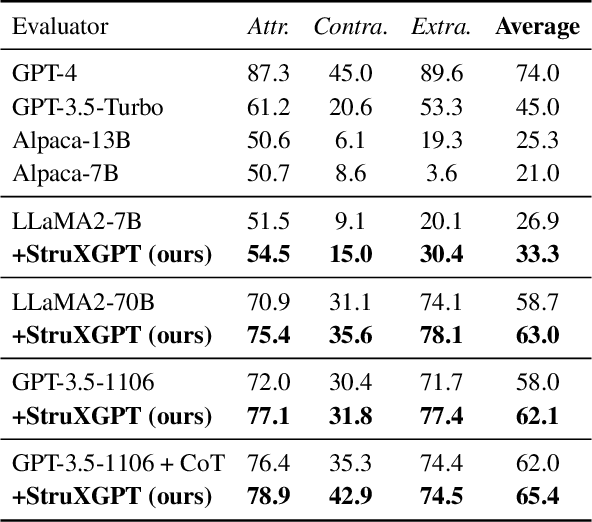
When reading long-form text, human cognition is complex and structurized. While large language models (LLMs) process input contexts through a causal and sequential perspective, this approach can potentially limit their ability to handle intricate and complex inputs effectively. To enhance LLM's cognition capability, this paper presents a novel concept of context structurization. Specifically, we transform the plain, unordered contextual sentences into well-ordered and hierarchically structurized elements. By doing so, LLMs can better grasp intricate and extended contexts through precise attention and information-seeking along the organized structures. Extensive evaluations are conducted across various model architectures and sizes (including several 7B- to 72B-size auto-regressive LLMs as well as BERT-like masking models) on a diverse set of NLP tasks (e.g., context-based question-answering, exhaustive hallucination evaluation, and passage-level dense retrieval). Empirical results show consistent and significant performance gains afforded by a single-round structurization. In particular, we boost a 72B-parameter open-source model to achieve comparable performance against GPT-3.5-Turbo as the hallucination evaluator. Besides, we show the feasibility of distilling advanced LLMs' language processing abilities to a smaller yet effective StruXGPT-7B to execute structurization, addressing the practicality of our approach. Code will be made public soon.
Educating LLMs like Human Students: Structure-aware Injection of Domain Knowledge
Jul 23, 2024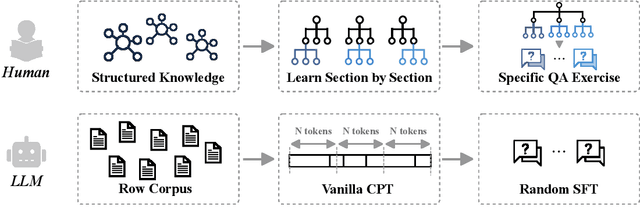
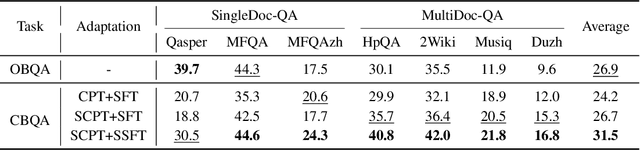
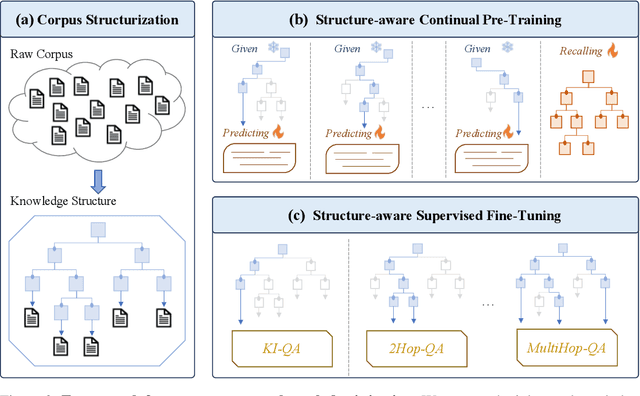
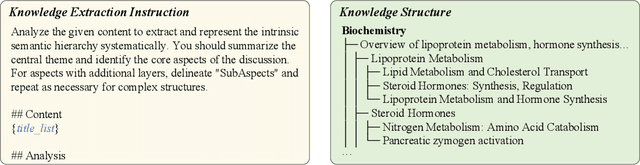
This paper presents a pioneering methodology, termed StructTuning, to efficiently transform foundation Large Language Models (LLMs) into domain specialists. It significantly minimizes the training corpus requirement to a mere 0.3% while achieving an impressive 50% of traditional knowledge injection performance. Our method is inspired by the educational processes for human students, particularly how structured domain knowledge from textbooks is absorbed and then applied to tackle real-world challenges through specific exercises. Based on this, we propose a novel two-stage knowledge injection strategy: Structure-aware Continual Pre-Training (SCPT) and Structure-aware Supervised Fine-Tuning (SSFT). In the SCPT phase, we organize the training data into an auto-generated taxonomy of domain knowledge, enabling LLMs to effectively memorize textual segments linked to specific expertise within the taxonomy's architecture. Subsequently, in the SSFT phase, we explicitly prompt models to reveal the underlying knowledge structure in their outputs, leveraging this structured domain insight to address practical problems adeptly. Our ultimate method has undergone extensive evaluations across model architectures and scales, using closed-book question-answering tasks on LongBench and MMedBench datasets. Remarkably, our method matches 50% of the improvement displayed by the state-of-the-art MMedLM2 on MMedBench, but with only 0.3% quantity of the training corpus. This breakthrough showcases the potential to scale up our StructTuning for stronger domain-specific LLMs. Code will be made public soon.
T2V-CompBench: A Comprehensive Benchmark for Compositional Text-to-video Generation
Jul 19, 2024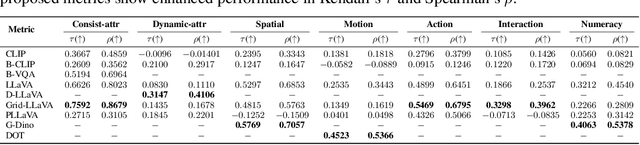

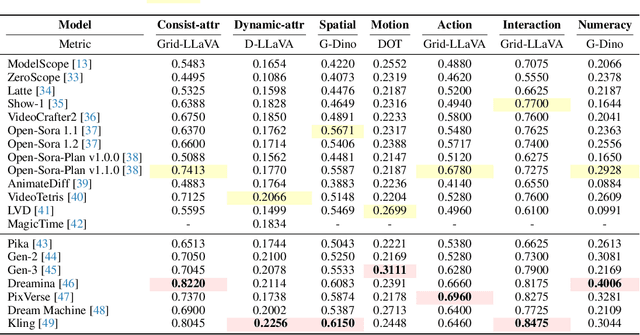

Text-to-video (T2V) generation models have advanced significantly, yet their ability to compose different objects, attributes, actions, and motions into a video remains unexplored. Previous text-to-video benchmarks also neglect this important ability for evaluation. In this work, we conduct the first systematic study on compositional text-to-video generation. We propose T2V-CompBench, the first benchmark tailored for compositional text-to-video generation. T2V-CompBench encompasses diverse aspects of compositionality, including consistent attribute binding, dynamic attribute binding, spatial relationships, motion binding, action binding, object interactions, and generative numeracy. We further carefully design evaluation metrics of MLLM-based metrics, detection-based metrics, and tracking-based metrics, which can better reflect the compositional text-to-video generation quality of seven proposed categories with 700 text prompts. The effectiveness of the proposed metrics is verified by correlation with human evaluations. We also benchmark various text-to-video generative models and conduct in-depth analysis across different models and different compositional categories. We find that compositional text-to-video generation is highly challenging for current models, and we hope that our attempt will shed light on future research in this direction.
Enhancing Text Authenticity: A Novel Hybrid Approach for AI-Generated Text Detection
Jun 01, 2024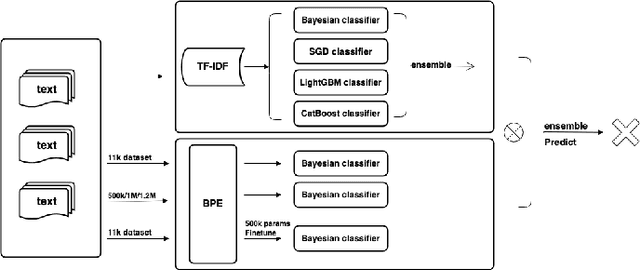
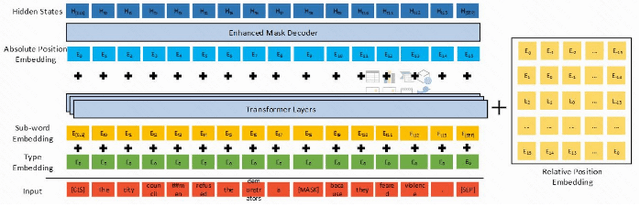
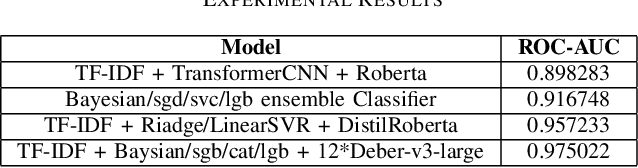
The rapid advancement of Large Language Models (LLMs) has ushered in an era where AI-generated text is increasingly indistinguishable from human-generated content. Detecting AI-generated text has become imperative to combat misinformation, ensure content authenticity, and safeguard against malicious uses of AI. In this paper, we propose a novel hybrid approach that combines traditional TF-IDF techniques with advanced machine learning models, including Bayesian classifiers, Stochastic Gradient Descent (SGD), Categorical Gradient Boosting (CatBoost), and 12 instances of Deberta-v3-large models. Our approach aims to address the challenges associated with detecting AI-generated text by leveraging the strengths of both traditional feature extraction methods and state-of-the-art deep learning models. Through extensive experiments on a comprehensive dataset, we demonstrate the effectiveness of our proposed method in accurately distinguishing between human and AI-generated text. Our approach achieves superior performance compared to existing methods. This research contributes to the advancement of AI-generated text detection techniques and lays the foundation for developing robust solutions to mitigate the challenges posed by AI-generated content.
DiM: Diffusion Mamba for Efficient High-Resolution Image Synthesis
May 23, 2024
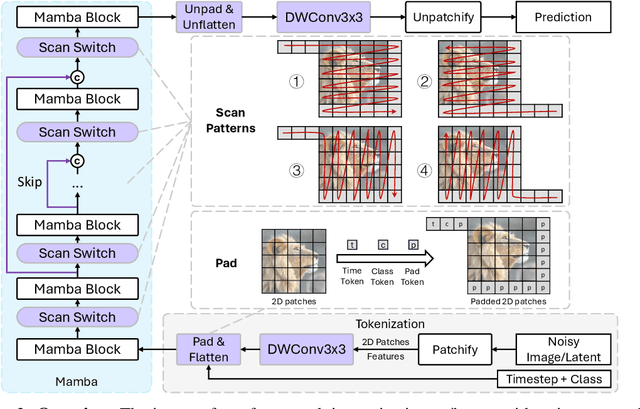


Diffusion models have achieved great success in image generation, with the backbone evolving from U-Net to Vision Transformers. However, the computational cost of Transformers is quadratic to the number of tokens, leading to significant challenges when dealing with high-resolution images. In this work, we propose Diffusion Mamba (DiM), which combines the efficiency of Mamba, a sequence model based on State Space Models (SSM), with the expressive power of diffusion models for efficient high-resolution image synthesis. To address the challenge that Mamba cannot generalize to 2D signals, we make several architecture designs including multi-directional scans, learnable padding tokens at the end of each row and column, and lightweight local feature enhancement. Our DiM architecture achieves inference-time efficiency for high-resolution images. In addition, to further improve training efficiency for high-resolution image generation with DiM, we investigate ``weak-to-strong'' training strategy that pretrains DiM on low-resolution images ($256\times 256$) and then finetune it on high-resolution images ($512 \times 512$). We further explore training-free upsampling strategies to enable the model to generate higher-resolution images (e.g., $1024\times 1024$ and $1536\times 1536$) without further fine-tuning. Experiments demonstrate the effectiveness and efficiency of our DiM.
Self-Play Preference Optimization for Language Model Alignment
May 01, 2024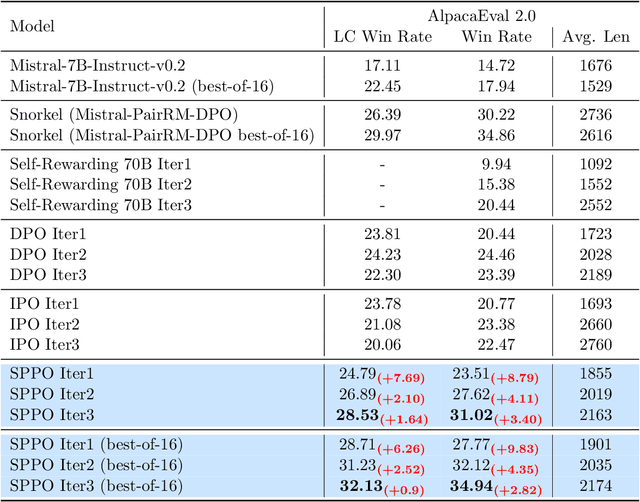
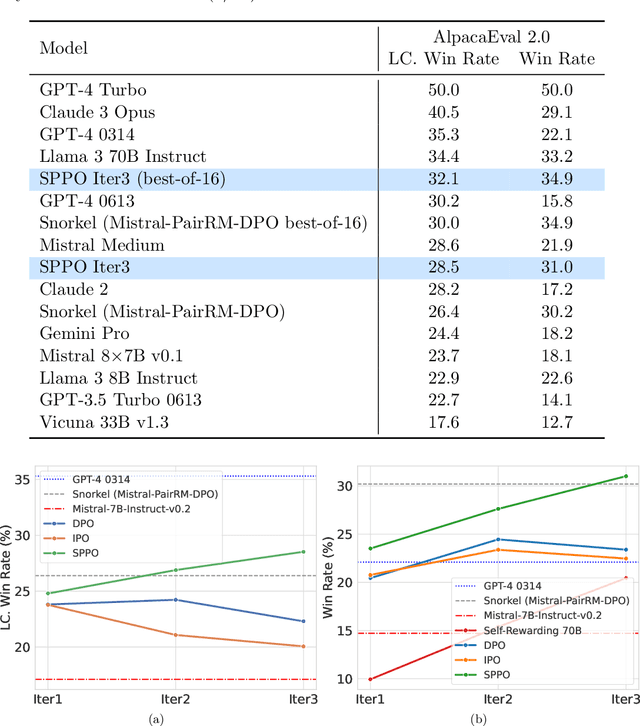
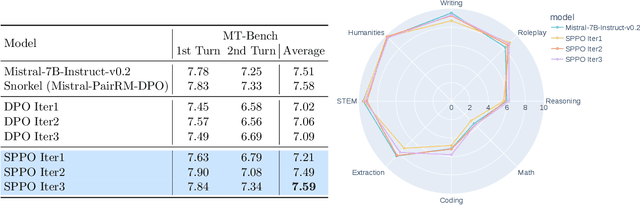
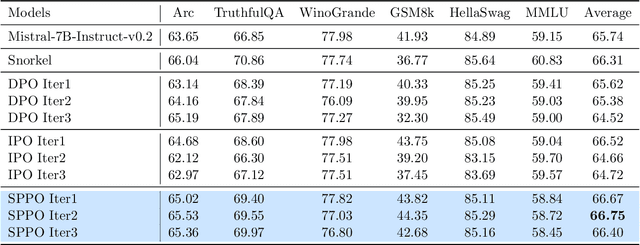
Traditional reinforcement learning from human feedback (RLHF) approaches relying on parametric models like the Bradley-Terry model fall short in capturing the intransitivity and irrationality in human preferences. Recent advancements suggest that directly working with preference probabilities can yield a more accurate reflection of human preferences, enabling more flexible and accurate language model alignment. In this paper, we propose a self-play-based method for language model alignment, which treats the problem as a constant-sum two-player game aimed at identifying the Nash equilibrium policy. Our approach, dubbed \textit{Self-Play Preference Optimization} (SPPO), approximates the Nash equilibrium through iterative policy updates and enjoys theoretical convergence guarantee. Our method can effectively increase the log-likelihood of the chosen response and decrease that of the rejected response, which cannot be trivially achieved by symmetric pairwise loss such as Direct Preference Optimization (DPO) and Identity Preference Optimization (IPO). In our experiments, using only 60k prompts (without responses) from the UltraFeedback dataset and without any prompt augmentation, by leveraging a pre-trained preference model PairRM with only 0.4B parameters, SPPO can obtain a model from fine-tuning Mistral-7B-Instruct-v0.2 that achieves the state-of-the-art length-controlled win-rate of 28.53% against GPT-4-Turbo on AlpacaEval 2.0. It also outperforms the (iterative) DPO and IPO on MT-Bench and the Open LLM Leaderboard. Notably, the strong performance of SPPO is achieved without additional external supervision (e.g., responses, preferences, etc.) from GPT-4 or other stronger language models.
AgentKit: Flow Engineering with Graphs, not Coding
Apr 17, 2024
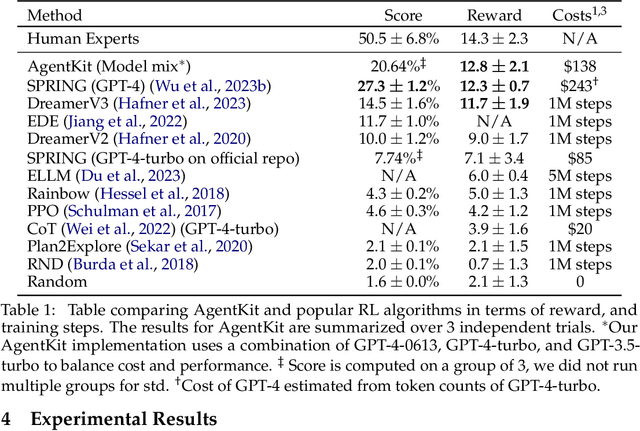
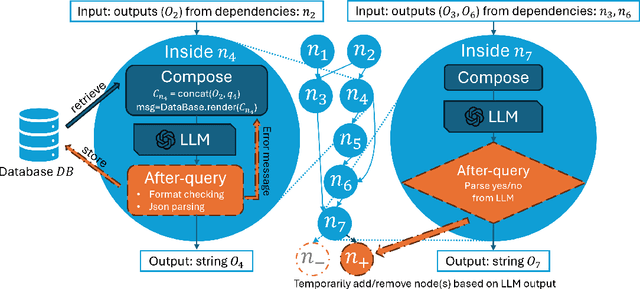
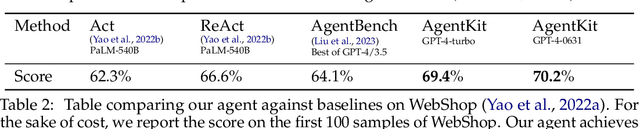
We propose an intuitive LLM prompting framework (AgentKit) for multifunctional agents. AgentKit offers a unified framework for explicitly constructing a complex "thought process" from simple natural language prompts. The basic building block in AgentKit is a node, containing a natural language prompt for a specific subtask. The user then puts together chains of nodes, like stacking LEGO pieces. The chains of nodes can be designed to explicitly enforce a naturally structured "thought process". For example, for the task of writing a paper, one may start with the thought process of 1) identify a core message, 2) identify prior research gaps, etc. The nodes in AgentKit can be designed and combined in different ways to implement multiple advanced capabilities including on-the-fly hierarchical planning, reflection, and learning from interactions. In addition, due to the modular nature and the intuitive design to simulate explicit human thought process, a basic agent could be implemented as simple as a list of prompts for the subtasks and therefore could be designed and tuned by someone without any programming experience. Quantitatively, we show that agents designed through AgentKit achieve SOTA performance on WebShop and Crafter. These advances underscore AgentKit's potential in making LLM agents effective and accessible for a wider range of applications. https://github.com/holmeswww/AgentKit
Automatic Controllable Colorization via Imagination
Apr 08, 2024We propose a framework for automatic colorization that allows for iterative editing and modifications. The core of our framework lies in an imagination module: by understanding the content within a grayscale image, we utilize a pre-trained image generation model to generate multiple images that contain the same content. These images serve as references for coloring, mimicking the process of human experts. As the synthesized images can be imperfect or different from the original grayscale image, we propose a Reference Refinement Module to select the optimal reference composition. Unlike most previous end-to-end automatic colorization algorithms, our framework allows for iterative and localized modifications of the colorization results because we explicitly model the coloring samples. Extensive experiments demonstrate the superiority of our framework over existing automatic colorization algorithms in editability and flexibility. Project page: https://xy-cong.github.io/imagine-colorization.
Robust Preference Optimization with Provable Noise Tolerance for LLMs
Apr 05, 2024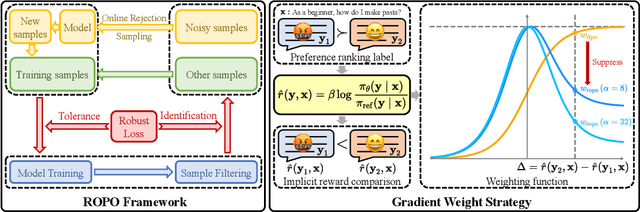
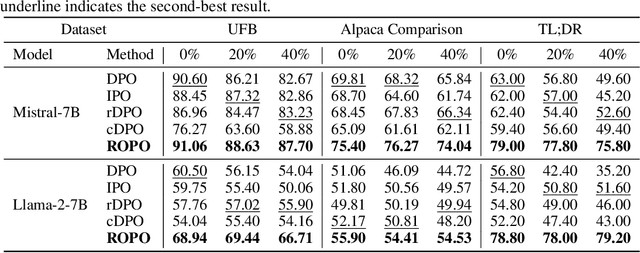


The preference alignment aims to enable large language models (LLMs) to generate responses that conform to human values, which is essential for developing general AI systems. Ranking-based methods -- a promising class of alignment approaches -- learn human preferences from datasets containing response pairs by optimizing the log-likelihood margins between preferred and dis-preferred responses. However, due to the inherent differences in annotators' preferences, ranking labels of comparisons for response pairs are unavoidably noisy. This seriously hurts the reliability of existing ranking-based methods. To address this problem, we propose a provably noise-tolerant preference alignment method, namely RObust Preference Optimization (ROPO). To the best of our knowledge, ROPO is the first preference alignment method with noise-tolerance guarantees. The key idea of ROPO is to dynamically assign conservative gradient weights to response pairs with high label uncertainty, based on the log-likelihood margins between the responses. By effectively suppressing the gradients of noisy samples, our weighting strategy ensures that the expected risk has the same gradient direction independent of the presence and proportion of noise. Experiments on three open-ended text generation tasks with four base models ranging in size from 2.8B to 13B demonstrate that ROPO significantly outperforms existing ranking-based methods.