 Add to Chrome
 Add to Firefox
 Add to Edge
Assigning Multi-Robot Tasks to Multitasking Robots
Jun 18, 2025
One simplifying assumption in existing and well-performing task allocation methods is that the robots are single-tasking: each robot operates on a single task at any given time. While this assumption is harmless to make in some situations, it can be inefficient or even infeasible in others. In this paper, we consider assigning multi-robot tasks to multitasking robots. The key contribution is a novel task allocation framework that incorporates the consideration of physical constraints introduced by multitasking. This is in contrast to the existing work where such constraints are largely ignored. After formulating the problem, we propose a compilation to weighted MAX-SAT, which allows us to leverage existing solvers for a solution. A more efficient greedy heuristic is then introduced. For evaluation, we first compare our methods with a modern baseline that is efficient for single-tasking robots to validate the benefits of multitasking in synthetic domains. Then, using a site-clearing scenario in simulation, we further illustrate the complex task interaction considered by the multitasking robots in our approach to demonstrate its performance. Finally, we demonstrate a physical experiment to show how multitasking enabled by our approach can benefit task efficiency in a realistic setting.

From Experts to a Generalist: Toward General Whole-Body Control for Humanoid Robots
Jun 15, 2025Achieving general agile whole-body control on humanoid robots remains a major challenge due to diverse motion demands and data conflicts. While existing frameworks excel in training single motion-specific policies, they struggle to generalize across highly varied behaviors due to conflicting control requirements and mismatched data distributions. In this work, we propose BumbleBee (BB), an expert-generalist learning framework that combines motion clustering and sim-to-real adaptation to overcome these challenges. BB first leverages an autoencoder-based clustering method to group behaviorally similar motions using motion features and motion descriptions. Expert policies are then trained within each cluster and refined with real-world data through iterative delta action modeling to bridge the sim-to-real gap. Finally, these experts are distilled into a unified generalist controller that preserves agility and robustness across all motion types. Experiments on two simulations and a real humanoid robot demonstrate that BB achieves state-of-the-art general whole-body control, setting a new benchmark for agile, robust, and generalizable humanoid performance in the real world.
RL from Physical Feedback: Aligning Large Motion Models with Humanoid Control
Jun 15, 2025This paper focuses on a critical challenge in robotics: translating text-driven human motions into executable actions for humanoid robots, enabling efficient and cost-effective learning of new behaviors. While existing text-to-motion generation methods achieve semantic alignment between language and motion, they often produce kinematically or physically infeasible motions unsuitable for real-world deployment. To bridge this sim-to-real gap, we propose Reinforcement Learning from Physical Feedback (RLPF), a novel framework that integrates physics-aware motion evaluation with text-conditioned motion generation. RLPF employs a motion tracking policy to assess feasibility in a physics simulator, generating rewards for fine-tuning the motion generator. Furthermore, RLPF introduces an alignment verification module to preserve semantic fidelity to text instructions. This joint optimization ensures both physical plausibility and instruction alignment. Extensive experiments show that RLPF greatly outperforms baseline methods in generating physically feasible motions while maintaining semantic correspondence with text instruction, enabling successful deployment on real humanoid robots.
A Study on Individual Spatiotemporal Activity Generation Method Using MCP-Enhanced Chain-of-Thought Large Language Models
Jun 12, 2025Human spatiotemporal behavior simulation is critical for urban planning research, yet traditional rule-based and statistical approaches suffer from high computational costs, limited generalizability, and poor scalability. While large language models (LLMs) show promise as "world simulators," they face challenges in spatiotemporal reasoning including limited spatial cognition, lack of physical constraint understanding, and group homogenization tendencies. This paper introduces a framework integrating chain-of-thought (CoT) reasoning with Model Context Protocol (MCP) to enhance LLMs' capability in simulating spatiotemporal behaviors that correspond with validation data patterns. The methodology combines human-like progressive reasoning through a five-stage cognitive framework with comprehensive data processing via six specialized MCP tool categories: temporal management, spatial navigation, environmental perception, personal memory, social collaboration, and experience evaluation. Experiments in Shanghai's Lujiazui district validate the framework's effectiveness across 1,000 generated samples. Results demonstrate high similarity with real mobile signaling data, achieving generation quality scores of 7.86 to 8.36 across different base models. Parallel processing experiments show efficiency improvements, with generation times decreasing from 1.30 to 0.17 minutes per sample when scaling from 2 to 12 processes. This work contributes to integrating CoT reasoning with MCP for urban behavior modeling, advancing LLMs applications in urban computing and providing a practical approach for synthetic mobility data generation. The framework offers a foundation for smart city planning, transportation forecasting, and participatory urban design applications.
HyColor: An Efficient Heuristic Algorithm for Graph Coloring
Jun 09, 2025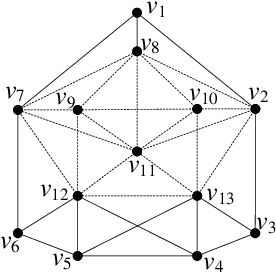
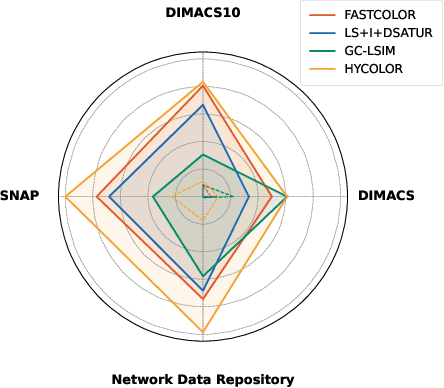

The graph coloring problem (GCP) is a classic combinatorial optimization problem that aims to find the minimum number of colors assigned to vertices of a graph such that no two adjacent vertices receive the same color. GCP has been extensively studied by researchers from various fields, including mathematics, computer science, and biological science. Due to the NP-hard nature, many heuristic algorithms have been proposed to solve GCP. However, existing GCP algorithms focus on either small hard graphs or large-scale sparse graphs (with up to 10^7 vertices). This paper presents an efficient hybrid heuristic algorithm for GCP, named HyColor, which excels in handling large-scale sparse graphs while achieving impressive results on small dense graphs. The efficiency of HyColor comes from the following three aspects: a local decision strategy to improve the lower bound on the chromatic number; a graph-reduction strategy to reduce the working graph; and a k-core and mixed degree-based greedy heuristic for efficiently coloring graphs. HyColor is evaluated against three state-of-the-art GCP algorithms across four benchmarks, comprising three large-scale sparse graph benchmarks and one small dense graph benchmark, totaling 209 instances. The results demonstrate that HyColor consistently outperforms existing heuristic algorithms in both solution accuracy and computational efficiency for the majority of instances. Notably, HyColor achieved the best solutions in 194 instances (over 93%), with 34 of these solutions significantly surpassing those of other algorithms. Furthermore, HyColor successfully determined the chromatic number and achieved optimal coloring in 128 instances.
Curriculum Reinforcement Learning from Easy to Hard Tasks Improves LLM Reasoning
Jun 07, 2025We aim to improve the reasoning capabilities of language models via reinforcement learning (RL). Recent RL post-trained models like DeepSeek-R1 have demonstrated reasoning abilities on mathematical and coding tasks. However, prior studies suggest that using RL alone to improve reasoning on inherently difficult tasks is less effective. Here, we draw inspiration from curriculum learning and propose to schedule tasks from easy to hard (E2H), allowing LLMs to build reasoning skills gradually. Our method is termed E2H Reasoner. Empirically, we observe that, although easy tasks are important initially, fading them out through appropriate scheduling is essential in preventing overfitting. Theoretically, we establish convergence guarantees for E2H Reasoner within an approximate policy iteration framework. We derive finite-sample complexity bounds and show that when tasks are appropriately decomposed and conditioned, learning through curriculum stages requires fewer total samples than direct learning. Experiments across multiple domains show that E2H Reasoner significantly improves the reasoning ability of small LLMs (1.5B to 3B), which otherwise struggle when trained with vanilla RL alone, highlighting the effectiveness of our method.
Come Together, But Not Right Now: A Progressive Strategy to Boost Low-Rank Adaptation
Jun 06, 2025Low-rank adaptation (LoRA) has emerged as a leading parameter-efficient fine-tuning technique for adapting large foundation models, yet it often locks adapters into suboptimal minima near their initialization. This hampers model generalization and limits downstream operators such as adapter merging and pruning. Here, we propose CoTo, a progressive training strategy that gradually increases adapters' activation probability over the course of fine-tuning. By stochastically deactivating adapters, CoTo encourages more balanced optimization and broader exploration of the loss landscape. We provide a theoretical analysis showing that CoTo promotes layer-wise dropout stability and linear mode connectivity, and we adopt a cooperative-game approach to quantify each adapter's marginal contribution. Extensive experiments demonstrate that CoTo consistently boosts single-task performance, enhances multi-task merging accuracy, improves pruning robustness, and reduces training overhead, all while remaining compatible with diverse LoRA variants. Code is available at https://github.com/zwebzone/coto.
DynamicMind: A Tri-Mode Thinking System for Large Language Models
Jun 06, 2025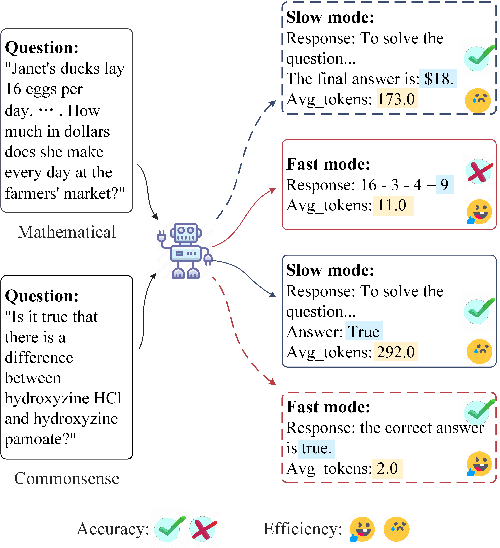
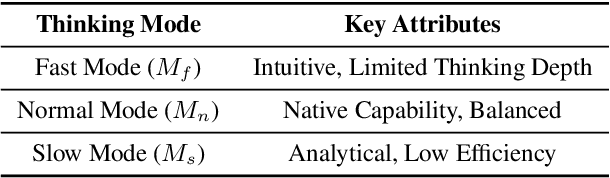
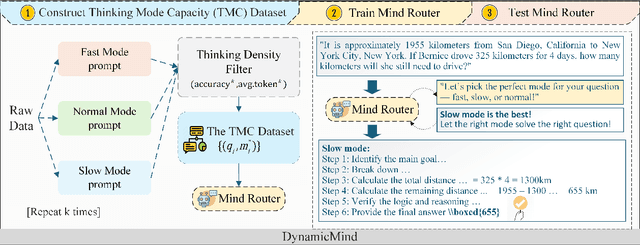
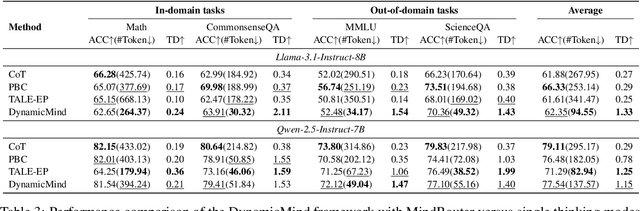
Modern large language models (LLMs) often struggle to dynamically adapt their reasoning depth to varying task complexities, leading to suboptimal performance or inefficient resource utilization. To address this, we introduce DynamicMind, a novel tri-mode thinking system. DynamicMind empowers LLMs to autonomously select between Fast, Normal, and Slow thinking modes for zero-shot question answering (ZSQA) tasks through cognitive-inspired prompt engineering. Our framework's core innovations include: (1) expanding the established dual-process framework of fast and slow thinking into a tri-mode thinking system involving a normal thinking mode to preserve the intrinsic capabilities of LLM; (2) proposing the Thinking Density metric, which aligns computational resource allocation with problem complexity; and (3) developing the Thinking Mode Capacity (TMC) dataset and a lightweight Mind Router to predict the optimal thinking mode. Extensive experiments across diverse mathematical, commonsense, and scientific QA benchmarks demonstrate that DynamicMind achieves superior ZSQA capabilities while establishing an effective trade-off between performance and computational efficiency.
Perceptual Decoupling for Scalable Multi-modal Reasoning via Reward-Optimized Captioning
Jun 05, 2025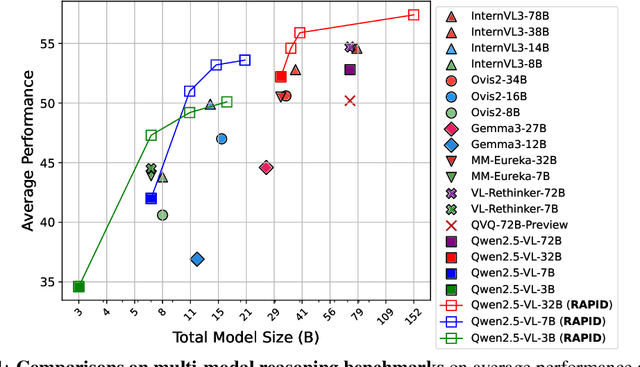
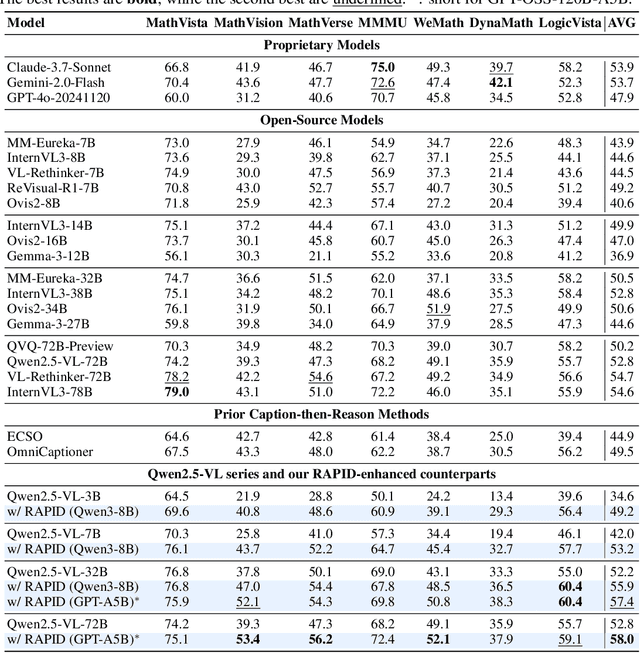
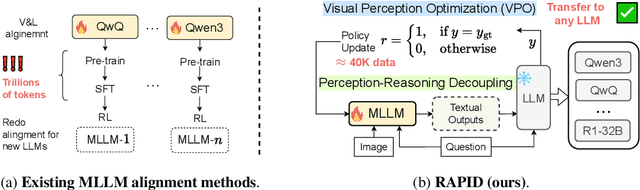
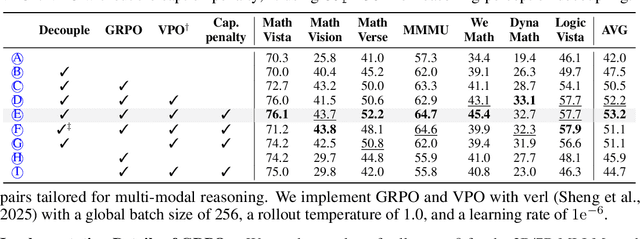
Recent advances in slow-thinking language models (e.g., OpenAI-o1 and DeepSeek-R1) have demonstrated remarkable abilities in complex reasoning tasks by emulating human-like reflective cognition. However, extending such capabilities to multi-modal large language models (MLLMs) remains challenging due to the high cost of retraining vision-language alignments when upgrading the underlying reasoner LLMs. A straightforward solution is to decouple perception from reasoning, i.e., converting visual inputs into language representations (e.g., captions) that are then passed to a powerful text-only reasoner. However, this decoupling introduces a critical challenge: the visual extractor must generate descriptions that are both faithful to the image and informative enough to support accurate downstream reasoning. To address this, we propose Reasoning-Aligned Perceptual Decoupling via Caption Reward Optimization (RACRO) - a reasoning-guided reinforcement learning strategy that aligns the extractor's captioning behavior with the reasoning objective. By closing the perception-reasoning loop via reward-based optimization, RACRO significantly enhances visual grounding and extracts reasoning-optimized representations. Experiments on multi-modal math and science benchmarks show that the proposed RACRO method achieves state-of-the-art average performance while enabling superior scalability and plug-and-play adaptation to more advanced reasoning LLMs without the necessity for costly multi-modal re-alignment.
ReasonGen-R1: CoT for Autoregressive Image generation models through SFT and RL
May 30, 2025Although chain-of-thought reasoning and reinforcement learning (RL) have driven breakthroughs in NLP, their integration into generative vision models remains underexplored. We introduce ReasonGen-R1, a two-stage framework that first imbues an autoregressive image generator with explicit text-based "thinking" skills via supervised fine-tuning on a newly generated reasoning dataset of written rationales, and then refines its outputs using Group Relative Policy Optimization. To enable the model to reason through text before generating images, We automatically generate and release a corpus of model crafted rationales paired with visual prompts, enabling controlled planning of object layouts, styles, and scene compositions. Our GRPO algorithm uses reward signals from a pretrained vision language model to assess overall visual quality, optimizing the policy in each update. Evaluations on GenEval, DPG, and the T2I benchmark demonstrate that ReasonGen-R1 consistently outperforms strong baselines and prior state-of-the-art models. More: aka.ms/reasongen.