 Add to Chrome
 Add to Firefox
 Add to Edge
Variational Cross-Graph Reasoning and Adaptive Structured Semantics Learning for Compositional Temporal Grounding
Jan 22, 2023
Temporal grounding is the task of locating a specific segment from an untrimmed video according to a query sentence. This task has achieved significant momentum in the computer vision community as it enables activity grounding beyond pre-defined activity classes by utilizing the semantic diversity of natural language descriptions. The semantic diversity is rooted in the principle of compositionality in linguistics, where novel semantics can be systematically described by combining known words in novel ways (compositional generalization). However, existing temporal grounding datasets are not carefully designed to evaluate the compositional generalizability. To systematically benchmark the compositional generalizability of temporal grounding models, we introduce a new Compositional Temporal Grounding task and construct two new dataset splits, i.e., Charades-CG and ActivityNet-CG. When evaluating the state-of-the-art methods on our new dataset splits, we empirically find that they fail to generalize to queries with novel combinations of seen words. We argue that the inherent structured semantics inside the videos and language is the crucial factor to achieve compositional generalization. Based on this insight, we propose a variational cross-graph reasoning framework that explicitly decomposes video and language into hierarchical semantic graphs, respectively, and learns fine-grained semantic correspondence between the two graphs. Furthermore, we introduce a novel adaptive structured semantics learning approach to derive the structure-informed and domain-generalizable graph representations, which facilitate the fine-grained semantic correspondence reasoning between the two graphs. Extensive experiments validate the superior compositional generalizability of our approach.

Temporal Perceiving Video-Language Pre-training
Jan 18, 2023Video-Language Pre-training models have recently significantly improved various multi-modal downstream tasks. Previous dominant works mainly adopt contrastive learning to achieve global feature alignment across modalities. However, the local associations between videos and texts are not modeled, restricting the pre-training models' generality, especially for tasks requiring the temporal video boundary for certain query texts. This work introduces a novel text-video localization pre-text task to enable fine-grained temporal and semantic alignment such that the trained model can accurately perceive temporal boundaries in videos given the text description. Specifically, text-video localization consists of moment retrieval, which predicts start and end boundaries in videos given the text description, and text localization which matches the subset of texts with the video features. To produce temporal boundaries, frame features in several videos are manually merged into a long video sequence that interacts with a text sequence. With the localization task, our method connects the fine-grained frame representations with the word representations and implicitly distinguishes representations of different instances in the single modality. Notably, comprehensive experimental results show that our method significantly improves the state-of-the-art performance on various benchmarks, covering text-to-video retrieval, video question answering, video captioning, temporal action localization and temporal moment retrieval. The code will be released soon.
DR-WLC: Dimensionality Reduction cognition for object detection and pose estimation by Watching, Learning and Checking
Jan 17, 2023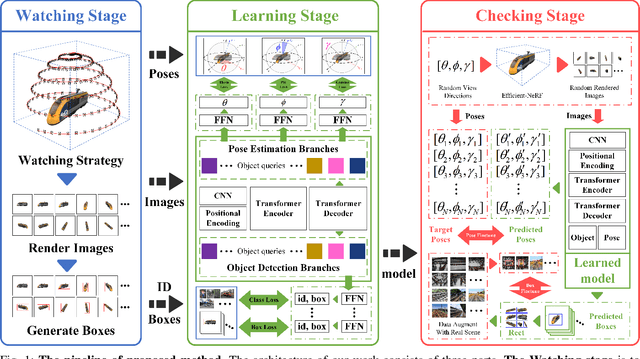
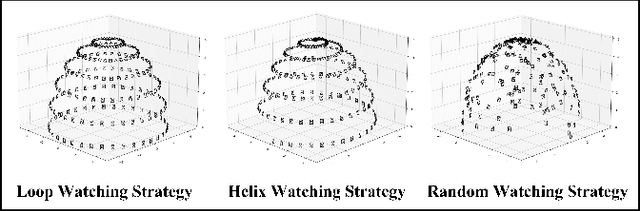
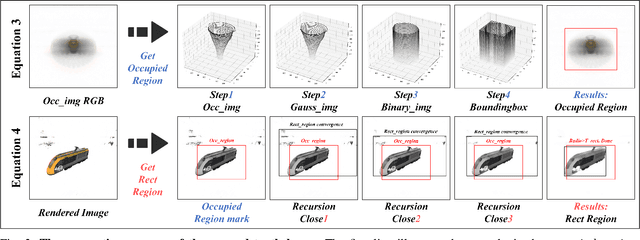
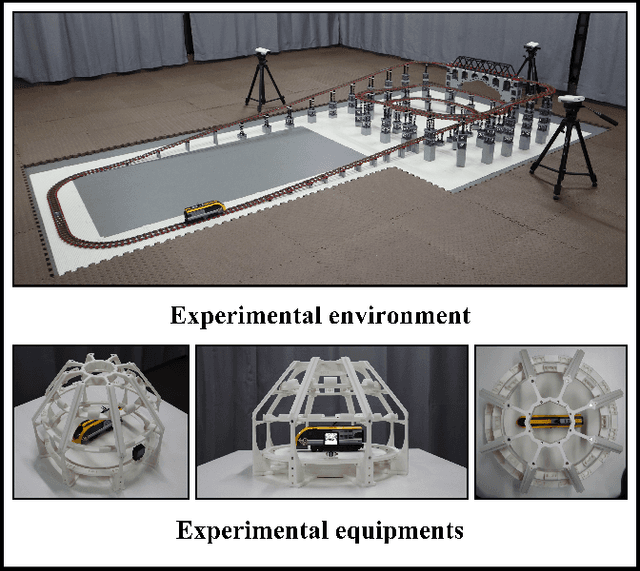
Object detection and pose estimation are difficult tasks in robotics and autonomous driving. Existing object detection and pose estimation methods mostly adopt the same-dimensional data for training. For example, 2D object detection usually requires a large amount of 2D annotation data with high cost. Using high-dimensional information to supervise lower-dimensional tasks is a feasible way to reduce datasets size. In this work, the DR-WLC, a dimensionality reduction cognitive model, which can perform both object detection and pose estimation tasks at the same time is proposed. The model only requires 3D model of objects and unlabeled environment images (with or without objects) to finish the training. In addition, a bounding boxes generation strategy is also proposed to build the relationship between 3D model and 2D object detection task. Experiments show that our method can qualify the work without any manual annotations and it is easy to deploy for practical applications. Source code is at https://github.com/IN2-ViAUn/DR-WLC.
Further Improving Weakly-supervised Object Localization via Causal Knowledge Distillation
Jan 03, 2023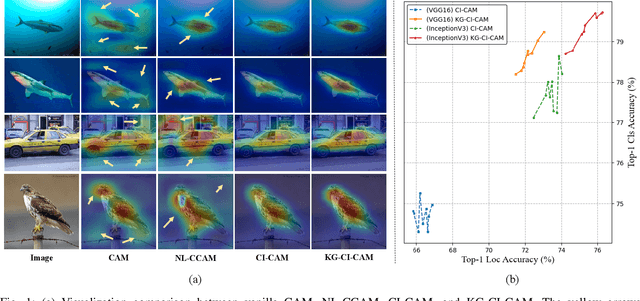
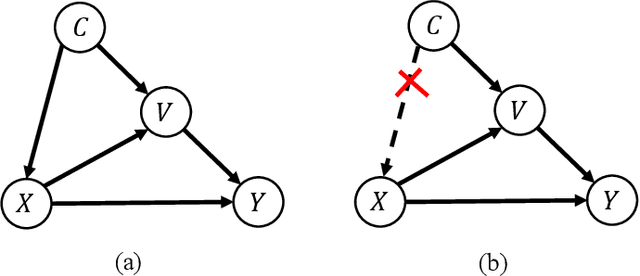
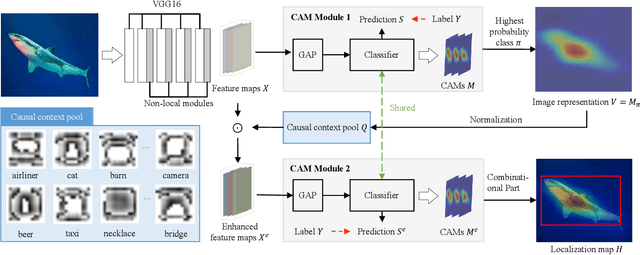
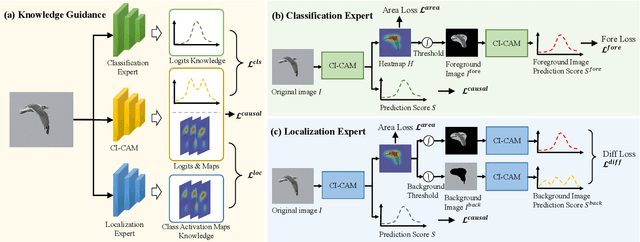
Weakly-supervised object localization aims to indicate the category as well as the scope of an object in an image given only the image-level labels. Most of the existing works are based on Class Activation Mapping (CAM) and endeavor to enlarge the discriminative area inside the activation map to perceive the whole object, yet ignore the co-occurrence confounder of the object and context (e.g., fish and water), which makes the model inspection hard to distinguish object boundaries. Besides, the use of CAM also brings a dilemma problem that the classification and localization always suffer from a performance gap and can not reach their highest accuracy simultaneously. In this paper, we propose a casual knowledge distillation method, dubbed KD-CI-CAM, to address these two under-explored issues in one go. More specifically, we tackle the co-occurrence context confounder problem via causal intervention (CI), which explores the causalities among image features, contexts, and categories to eliminate the biased object-context entanglement in the class activation maps. Based on the de-biased object feature, we additionally propose a multi-teacher causal distillation framework to balance the absorption of classification knowledge and localization knowledge during model training. Extensive experiments on several benchmarks demonstrate the effectiveness of KD-CI-CAM in learning clear object boundaries from confounding contexts and addressing the dilemma problem between classification and localization performance.
Bidirectional Cross-Modal Knowledge Exploration for Video Recognition with Pre-trained Vision-Language Models
Dec 31, 2022Vision-language models (VLMs) that are pre-trained on large-scale image-text pairs have demonstrated impressive transferability on a wide range of visual tasks. Transferring knowledge from such powerful pre-trained VLMs is emerging as a promising direction for building effective video recognition models. However, the current exploration is still limited. In our opinion, the greatest charm of pre-trained vision-language models is to build a bridge between visual and textual domains. In this paper, we present a novel framework called BIKE which utilizes the cross-modal bridge to explore bidirectional knowledge: i) We propose a Video Attribute Association mechanism which leverages the Video-to-Text knowledge to generate textual auxiliary attributes to complement video recognition. ii) We also present a Temporal Concept Spotting mechanism which uses the Text-to-Video expertise to capture temporal saliency in a parameter-free manner to yield enhanced video representation. The extensive studies on popular video datasets (ie, Kinetics-400 & 600, UCF-101, HMDB-51 and ActivityNet) show that our method achieves state-of-the-art performance in most recognition scenarios, eg, general, zero-shot, and few-shot video recognition. To the best of our knowledge, our best model achieves a state-of-the-art accuracy of 88.4% on challenging Kinetics-400 with the released CLIP pre-trained model.
StepNet: Spatial-temporal Part-aware Network for Sign Language Recognition
Dec 25, 2022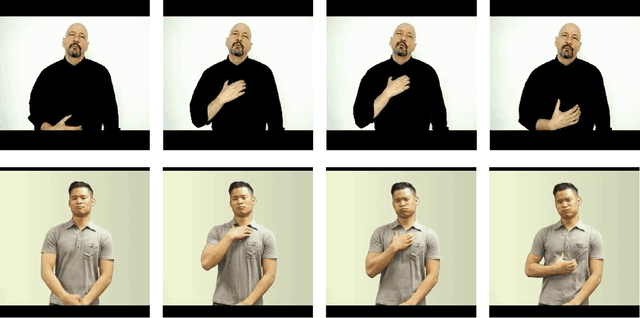
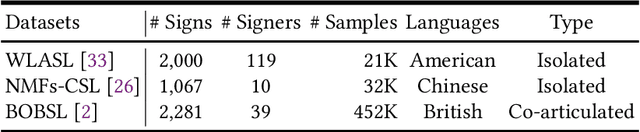
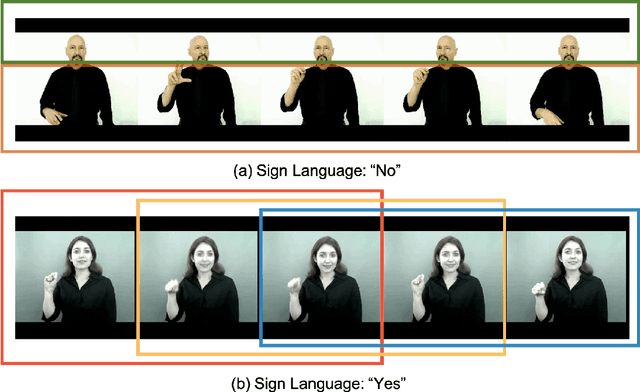
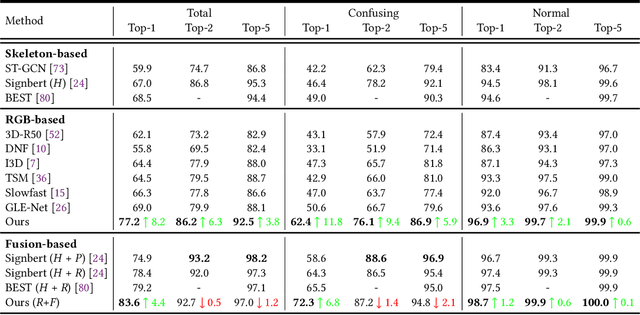
Sign language recognition (SLR) aims to overcome the communication barrier for the people with deafness or the people with hard hearing. Most existing approaches can be typically divided into two lines, i.e., Skeleton-based and RGB-based methods, but both the two lines of methods have their limitations. RGB-based approaches usually overlook the fine-grained hand structure, while Skeleton-based methods do not take the facial expression into account. In attempts to address both limitations, we propose a new framework named Spatial-temporal Part-aware network (StepNet), based on RGB parts. As the name implies, StepNet consists of two modules: Part-level Spatial Modeling and Part-level Temporal Modeling. Particularly, without using any keypoint-level annotations, Part-level Spatial Modeling implicitly captures the appearance-based properties, such as hands and faces, in the feature space. On the other hand, Part-level Temporal Modeling captures the pertinent properties over time by implicitly mining the long-short term context. Extensive experiments show that our StepNet, thanks to Spatial-temporal modules, achieves competitive Top-1 Per-instance accuracy on three widely-used SLR benchmarks, i.e., 56.89% on WLASL, 77.2% on NMFs-CSL, and 77.1% on BOBSL. Moreover, the proposed method is compatible with the optical flow input, and can yield higher performance if fused. We hope that this work can serve as a preliminary step for the people with deafness.
MIST: Multi-modal Iterative Spatial-Temporal Transformer for Long-form Video Question Answering
Dec 19, 2022To build Video Question Answering (VideoQA) systems capable of assisting humans in daily activities, seeking answers from long-form videos with diverse and complex events is a must. Existing multi-modal VQA models achieve promising performance on images or short video clips, especially with the recent success of large-scale multi-modal pre-training. However, when extending these methods to long-form videos, new challenges arise. On the one hand, using a dense video sampling strategy is computationally prohibitive. On the other hand, methods relying on sparse sampling struggle in scenarios where multi-event and multi-granularity visual reasoning are required. In this work, we introduce a new model named Multi-modal Iterative Spatial-temporal Transformer (MIST) to better adapt pre-trained models for long-form VideoQA. Specifically, MIST decomposes traditional dense spatial-temporal self-attention into cascaded segment and region selection modules that adaptively select frames and image regions that are closely relevant to the question itself. Visual concepts at different granularities are then processed efficiently through an attention module. In addition, MIST iteratively conducts selection and attention over multiple layers to support reasoning over multiple events. The experimental results on four VideoQA datasets, including AGQA, NExT-QA, STAR, and Env-QA, show that MIST achieves state-of-the-art performance and is superior at computation efficiency and interpretability.
One is All: Bridging the Gap Between Neural Radiance Fields Architectures with Progressive Volume Distillation
Nov 30, 2022Neural Radiance Fields (NeRF) methods have proved effective as compact, high-quality and versatile representations for 3D scenes, and enable downstream tasks such as editing, retrieval, navigation, etc. Various neural architectures are vying for the core structure of NeRF, including the plain Multi-Layer Perceptron (MLP), sparse tensors, low-rank tensors, hashtables and their compositions. Each of these representations has its particular set of trade-offs. For example, the hashtable-based representations admit faster training and rendering but their lack of clear geometric meaning hampers downstream tasks like spatial-relation-aware editing. In this paper, we propose Progressive Volume Distillation (PVD), a systematic distillation method that allows any-to-any conversions between different architectures, including MLP, sparse or low-rank tensors, hashtables and their compositions. PVD consequently empowers downstream applications to optimally adapt the neural representations for the task at hand in a post hoc fashion. The conversions are fast, as distillation is progressively performed on different levels of volume representations, from shallower to deeper. We also employ special treatment of density to deal with its specific numerical instability problem. Empirical evidence is presented to validate our method on the NeRF-Synthetic, LLFF and TanksAndTemples datasets. For example, with PVD, an MLP-based NeRF model can be distilled from a hashtable-based Instant-NGP model at a 10X~20X faster speed than being trained the original NeRF from scratch, while achieving a superior level of synthesis quality. Code is available at https://github.com/megvii-research/AAAI2023-PVD.
A Light-weight, Effective and Efficient Model for Label Aggregation in Crowdsourcing
Nov 19, 2022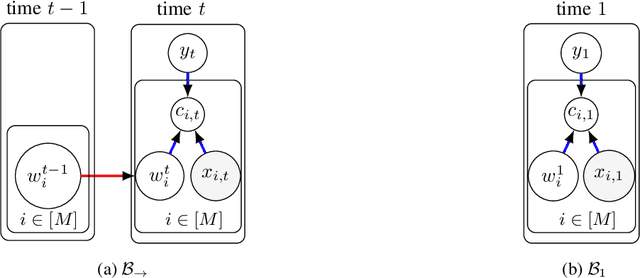
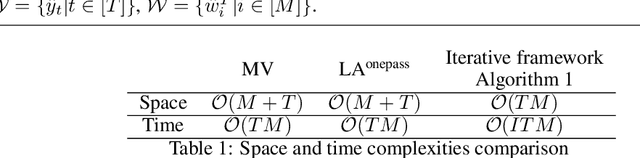
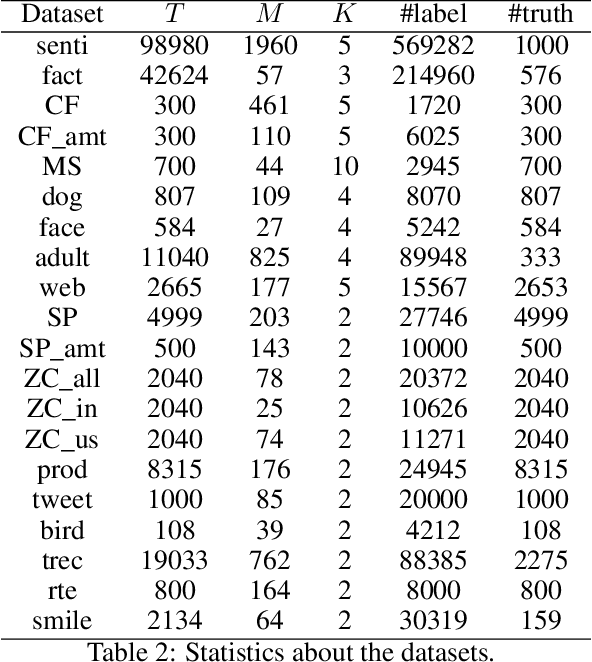
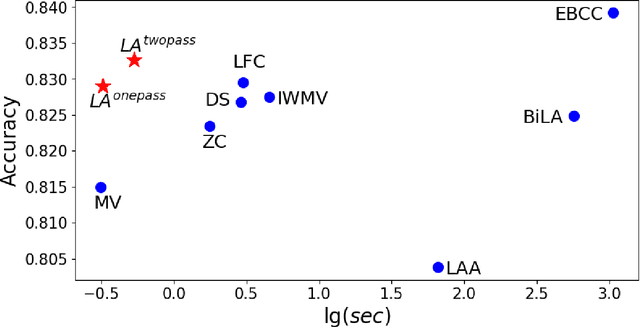
Due to the noises in crowdsourced labels, label aggregation (LA) has emerged as a standard procedure to post-process crowdsourced labels. LA methods estimate true labels from crowdsourced labels by modeling worker qualities. Most existing LA methods are iterative in nature. They need to traverse all the crowdsourced labels multiple times in order to jointly and iteratively update true labels and worker qualities until convergence. Consequently, these methods have high space and time complexities. In this paper, we treat LA as a dynamic system and model it as a Dynamic Bayesian network. From the dynamic model we derive two light-weight algorithms, LA\textsuperscript{onepass} and LA\textsuperscript{twopass}, which can effectively and efficiently estimate worker qualities and true labels by traversing all the labels at most twice. Due to the dynamic nature, the proposed algorithms can also estimate true labels online without re-visiting historical data. We theoretically prove the convergence property of the proposed algorithms, and bound the error of estimated worker qualities. We also analyze the space and time complexities of the proposed algorithms and show that they are equivalent to those of majority voting. Experiments conducted on 20 real-world datasets demonstrate that the proposed algorithms can effectively and efficiently aggregate labels in both offline and online settings even if they traverse all the labels at most twice.
Stereo Image Rain Removal via Dual-View Mutual Attention
Nov 18, 2022Stereo images, containing left and right view images with disparity, are utilized in solving low-vision tasks recently, e.g., rain removal and super-resolution. Stereo image restoration methods usually obtain better performance than monocular methods by learning the disparity between dual views either implicitly or explicitly. However, existing stereo rain removal methods still cannot make full use of the complementary information between two views, and we find it is because: 1) the rain streaks have more complex distributions in directions and densities, which severely damage the complementary information and pose greater challenges; 2) the disparity estimation is not accurate enough due to the imperfect fusion mechanism for the features between two views. To overcome such limitations, we propose a new \underline{Stereo} \underline{I}mage \underline{R}ain \underline{R}emoval method (StereoIRR) via sufficient interaction between two views, which incorporates: 1) a new Dual-view Mutual Attention (DMA) mechanism which generates mutual attention maps by taking left and right views as key information for each other to facilitate cross-view feature fusion; 2) a long-range and cross-view interaction, which is constructed with basic blocks and dual-view mutual attention, can alleviate the adverse effect of rain on complementary information to help the features of stereo images to get long-range and cross-view interaction and fusion. Notably, StereoIRR outperforms other related monocular and stereo image rain removal methods on several datasets. Our codes and datasets will be released.