 Add to Chrome
 Add to Firefox
 Add to Edge
Demo2Tutorial: From Human Experience to Multimodal Software Tutorials
Jun 02, 2026
Human experience in digital environments offers a vast, underexplored resource of authentic, untrimmed interactions that contain rich procedural knowledge. We introduce Demo2Tutorial, a framework that transforms this experience captured via screen recordings and interaction logs into structured, multimodal software tutorials for teaching both humans and agents. Demo2Tutorial first collects human experience via a dedicated recorder, then parses raw experience using a multimodal Action Parser to reconstruct perception, action, and intent. A Step Planner then abstracts these steps into hierarchical task graphs representing goals and steps. Finally, a Tutorial Composer transforms the parsed experience into structured, reusable image-text instructions. We evaluate the tutorial generation quality on a new benchmark derived from official software documentation. We further demonstrate that this distilled representation benefits (i) human learning, by automatically generating multimodal tutorials, and (ii) agent learning, by improving downstream GUI-agent planning and generalization. Experiments show Demo2Tutorial produces high-quality tutorials that surpass human-authored ones and significantly outperform baseline methods, while enabling both faster human task completion and improved GUI agent planning, demonstrating that structured tutorials distilled from human experience can serve as effective knowledge representations for advancing both human learning and agent capabilities. Code and data will be available at https://github.com/showlab/Demo2Tutorial.

CutVerse: A Compositional GUI Agents Benchmark for Media Post-Production Editing
May 19, 2026While GUI agents have made significant progress in web navigation and basic operating system tasks, their capabilities in professional creative workflows remain largely underexplored. To bridge this gap, we introduce Cutverse, a benchmark designed to systematically evaluate autonomous GUI agents in realistic media post-production environments. We curate expert demonstrations across 7 professional applications (e.g., Premiere Pro, Photoshop), covering 186 complex, long-horizon tasks grounded in authentic editing workflows, involving dense multimodal interfaces and tightly coupled interaction sequences. To support scalable evaluation, we develop a lightweight parser that transforms raw screen recordings and low-level interaction logs into structured, compositional GUI action trajectories with precise grounding. Extensive evaluations reveal that existing agents achieve only 36.0\% task success on realistic media editing tasks, underscoring the challenges posed by complex, long-horizon media post-production workflows in our benchmark.While current models demonstrate promising spatial grounding, multimodal alignment, and coordinated action execution, they remain limited in long-horizon reliability and domain-specific planning.
ShowUI-Aloha: Human-Taught GUI Agent
Jan 12, 2026Graphical User Interfaces (GUIs) are central to human-computer interaction, yet automating complex GUI tasks remains a major challenge for autonomous agents, largely due to a lack of scalable, high-quality training data. While recordings of human demonstrations offer a rich data source, they are typically long, unstructured, and lack annotations, making them difficult for agents to learn from.To address this, we introduce ShowUI-Aloha, a comprehensive pipeline that transforms unstructured, in-the-wild human screen recordings from desktop environments into structured, actionable tasks. Our framework includes four key components: A recorder that captures screen video along with precise user interactions like mouse clicks, keystrokes, and scrolls. A learner that semantically interprets these raw interactions and the surrounding visual context, translating them into descriptive natural language captions. A planner that reads the parsed demonstrations, maintains task states, and dynamically formulates the next high-level action plan based on contextual reasoning. An executor that faithfully carries out these action plans at the OS level, performing precise clicks, drags, text inputs, and window operations with safety checks and real-time feedback. Together, these components provide a scalable solution for collecting and parsing real-world human data, demonstrating a viable path toward building general-purpose GUI agents that can learn effectively from simply observing humans.
Factorized Learning for Temporally Grounded Video-Language Models
Dec 30, 2025Recent video-language models have shown great potential for video understanding, but still struggle with accurate temporal grounding for event-level perception. We observe that two main factors in video understanding (i.e., temporal grounding and textual response) form a logical hierarchy: accurate temporal evidence grounding lays the foundation for reliable textual response. However, existing works typically handle these two tasks in a coupled manner without a clear logical structure, leading to sub-optimal objectives. We address this from a factorized learning perspective. We first propose D$^2$VLM, a framework that decouples the learning of these two tasks while also emphasizing their inherent dependency. We adopt a "grounding then answering with evidence referencing" paradigm and introduce evidence tokens for evidence grounding, which emphasize event-level visual semantic capture beyond the focus on timestamp representation in existing works. To further facilitate the learning of these two tasks, we introduce a novel factorized preference optimization (FPO) algorithm. Unlike standard preference optimization, FPO explicitly incorporates probabilistic temporal grounding modeling into the optimization objective, enabling preference learning for both temporal grounding and textual response. We also construct a synthetic dataset to address the lack of suitable datasets for factorized preference learning with explicit temporal grounding. Experiments on various tasks demonstrate the clear advantage of our approach. Our source code is available at https://github.com/nusnlp/d2vlm.
AUTO-Explorer: Automated Data Collection for GUI Agent
Nov 09, 2025Recent advancements in GUI agents have significantly expanded their ability to interpret natural language commands to manage software interfaces. However, acquiring GUI data remains a significant challenge. Existing methods often involve designing automated agents that browse URLs from the Common Crawl, using webpage HTML to collect screenshots and corresponding annotations, including the names and bounding boxes of UI elements. However, this method is difficult to apply to desktop software or some newly launched websites not included in the Common Crawl. While we expect the model to possess strong generalization capabilities to handle this, it is still crucial for personalized scenarios that require rapid and perfect adaptation to new software or websites. To address this, we propose an automated data collection method with minimal annotation costs, named Auto-Explorer. It incorporates a simple yet effective exploration mechanism that autonomously parses and explores GUI environments, gathering data efficiently. Additionally, to assess the quality of exploration, we have developed the UIXplore benchmark. This benchmark creates environments for explorer agents to discover and save software states. Using the data gathered, we fine-tune a multimodal large language model (MLLM) and establish a GUI element grounding testing set to evaluate the effectiveness of the exploration strategies. Our experiments demonstrate the superior performance of Auto-Explorer, showing that our method can quickly enhance the capabilities of an MLLM in explored software.
EmoAgent: Multi-Agent Collaboration of Plan, Edit, and Critic, for Affective Image Manipulation
Mar 14, 2025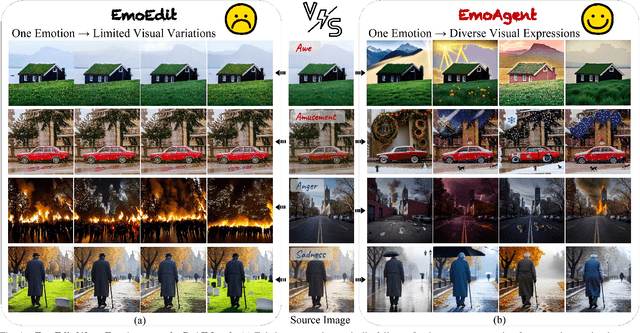
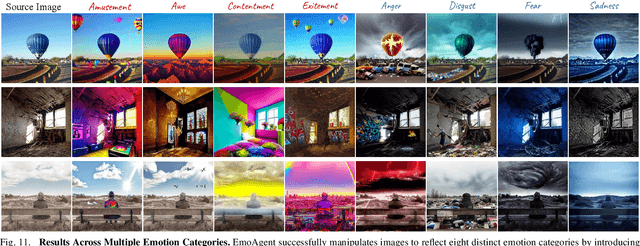
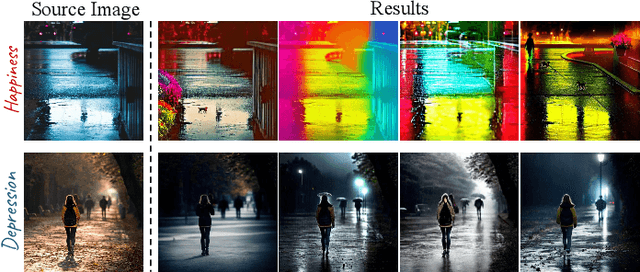
Affective Image Manipulation (AIM) aims to alter an image's emotional impact by adjusting multiple visual elements to evoke specific feelings.Effective AIM is inherently complex, necessitating a collaborative approach that involves identifying semantic cues within source images, manipulating these elements to elicit desired emotional responses, and verifying that the combined adjustments successfully evoke the target emotion.To address these challenges, we introduce EmoAgent, the first multi-agent collaboration framework for AIM. By emulating the cognitive behaviors of a human painter, EmoAgent incorporates three specialized agents responsible for planning, editing, and critical evaluation. Furthermore, we develop an emotion-factor knowledge retriever, a decision-making tree space, and a tool library to enhance EmoAgent's effectiveness in handling AIM. Experiments demonstrate that the proposed multi-agent framework outperforms existing methods, offering more reasonable and effective emotional expression.
WorldGUI: Dynamic Testing for Comprehensive Desktop GUI Automation
Feb 12, 2025Current GUI agents have achieved outstanding performance in GUI element grounding. However, planning remains highly challenging, especially due to sensitivity to the initial state of the environment. Specifically, slight differences in the initial state-such as the target software not being open or the interface not being in its default state-often lead to planning errors. This issue is widespread in real user scenarios, but existing benchmarks fail to evaluate it. In this paper, we present WorldGUI, a novel GUI benchmark that designs GUI tasks with various initial states to simulate real computer-user interactions. The benchmark spans a wide range of tasks across 10 popular software applications, including PowerPoint, VSCode, and Adobe Acrobat. In addition, to address the challenges of dynamic GUI automation tasks, we propose GUI-Thinker, a holistic framework, leveraging a critique mechanism, that effectively manages the unpredictability and complexity of GUI interactions. Experimental results demonstrate that GUI-Thinker significantly outperforms Claude-3.5 (Computer Use) by 14.9% in success rate on WorldGUI tasks. This improvement underscores the effectiveness of our critical-thinking-based framework in enhancing GUI automation.
ShowUI: One Vision-Language-Action Model for GUI Visual Agent
Nov 26, 2024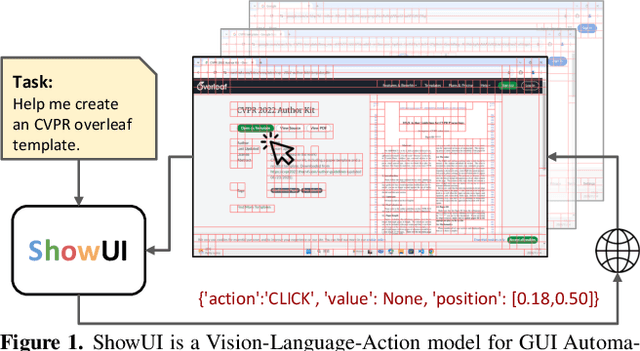
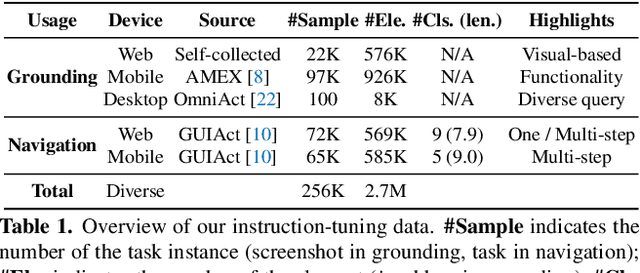


Building Graphical User Interface (GUI) assistants holds significant promise for enhancing human workflow productivity. While most agents are language-based, relying on closed-source API with text-rich meta-information (e.g., HTML or accessibility tree), they show limitations in perceiving UI visuals as humans do, highlighting the need for GUI visual agents. In this work, we develop a vision-language-action model in digital world, namely ShowUI, which features the following innovations: (i) UI-Guided Visual Token Selection to reduce computational costs by formulating screenshots as an UI connected graph, adaptively identifying their redundant relationship and serve as the criteria for token selection during self-attention blocks; (ii) Interleaved Vision-Language-Action Streaming that flexibly unifies diverse needs within GUI tasks, enabling effective management of visual-action history in navigation or pairing multi-turn query-action sequences per screenshot to enhance training efficiency; (iii) Small-scale High-quality GUI Instruction-following Datasets by careful data curation and employing a resampling strategy to address significant data type imbalances. With above components, ShowUI, a lightweight 2B model using 256K data, achieves a strong 75.1% accuracy in zero-shot screenshot grounding. Its UI-guided token selection further reduces 33% of redundant visual tokens during training and speeds up the performance by 1.4x. Navigation experiments across web Mind2Web, mobile AITW, and online MiniWob environments further underscore the effectiveness and potential of our model in advancing GUI visual agents. The models are available at https://github.com/showlab/ShowUI.
The Dawn of GUI Agent: A Preliminary Case Study with Claude 3.5 Computer Use
Nov 15, 2024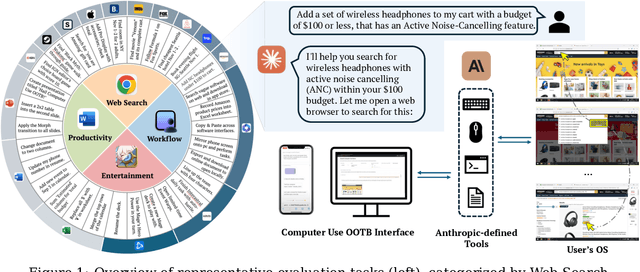


The recently released model, Claude 3.5 Computer Use, stands out as the first frontier AI model to offer computer use in public beta as a graphical user interface (GUI) agent. As an early beta, its capability in the real-world complex environment remains unknown. In this case study to explore Claude 3.5 Computer Use, we curate and organize a collection of carefully designed tasks spanning a variety of domains and software. Observations from these cases demonstrate Claude 3.5 Computer Use's unprecedented ability in end-to-end language to desktop actions. Along with this study, we provide an out-of-the-box agent framework for deploying API-based GUI automation models with easy implementation. Our case studies aim to showcase a groundwork of capabilities and limitations of Claude 3.5 Computer Use with detailed analyses and bring to the fore questions about planning, action, and critic, which must be considered for future improvement. We hope this preliminary exploration will inspire future research into the GUI agent community. All the test cases in the paper can be tried through the project: https://github.com/showlab/computer_use_ootb.
Learning Video Context as Interleaved Multimodal Sequences
Jul 31, 2024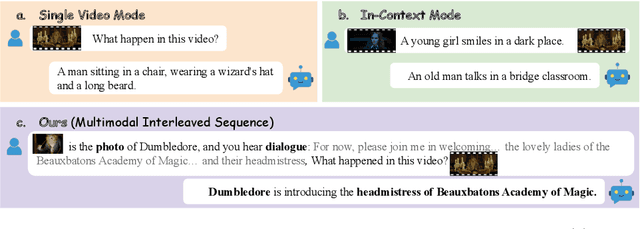

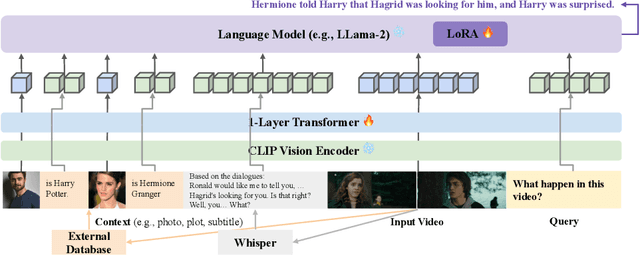

Narrative videos, such as movies, pose significant challenges in video understanding due to their rich contexts (characters, dialogues, storylines) and diverse demands (identify who, relationship, and reason). In this paper, we introduce MovieSeq, a multimodal language model developed to address the wide range of challenges in understanding video contexts. Our core idea is to represent videos as interleaved multimodal sequences (including images, plots, videos, and subtitles), either by linking external knowledge databases or using offline models (such as whisper for subtitles). Through instruction-tuning, this approach empowers the language model to interact with videos using interleaved multimodal instructions. For example, instead of solely relying on video as input, we jointly provide character photos alongside their names and dialogues, allowing the model to associate these elements and generate more comprehensive responses. To demonstrate its effectiveness, we validate MovieSeq's performance on six datasets (LVU, MAD, Movienet, CMD, TVC, MovieQA) across five settings (video classification, audio description, video-text retrieval, video captioning, and video question-answering). The code will be public at https://github.com/showlab/MovieSeq.