 Add to Chrome
 Add to Firefox
 Add to Edge
Foundation Models to Unlock Real-World Evidence from Nationwide Medical Claims
May 05, 2026
Evidence derived from large-scale real-world data (RWD) is increasingly informing regulatory evaluation and healthcare decision-making. Administrative claims provide population-scale, longitudinal records of healthcare utilization, expenditure, and detailed coding of diagnoses, procedures, and medications, yet their potential as a substrate for healthcare foundation models remains largely unexplored. Here we present ReClaim, a generative transformer trained from scratch on 43.8 billion medical events from more than 200 million enrollees in the MarketScan claims data spanning 2008-2022. ReClaim models longitudinal trajectories across diagnoses, procedures, medications, and expenditure, and was scaled to 140 million, 700 million, and 1.7 billion parameters. Across over 1,000 disease-onset prediction tasks, ReClaim achieved a mean AUC of 75.6%, substantially outperforming disease-specific LightGBM (66.3%) and the transformer-based Delphi model (69.4%), with the largest gains for rare diseases. These advantages held across retrospective and prospective evaluations and in external validation on two independent datasets. Performance improved monotonically with scale, and post-training added 13.8 percentage points over pre-training alone. Beyond disease prediction, ReClaim captured financial outcomes and improved real-world evidence (RWE) analyses: for healthcare expenditure forecasting it increased explained variance from 0.28 to 0.37 relative to LightGBM, and in a target trial emulation it reduced systematic bias by 72% on average relative to Delphi. Together, these results establish administrative claims as a scalable substrate for healthcare foundation models and show that learned representations generalize across time periods and data sources, supporting disease surveillance, expenditure forecasting, and RWE generation.

PhyEdit: Towards Real-World Object Manipulation via Physically-Grounded Image Editing
Apr 09, 2026Achieving physically accurate object manipulation in image editing is essential for its potential applications in interactive world models. However, existing visual generative models often fail at precise spatial manipulation, resulting in incorrect scaling and positioning of objects. This limitation primarily stems from the lack of explicit mechanisms to incorporate 3D geometry and perspective projection. To achieve accurate manipulation, we develop PhyEdit, an image editing framework that leverages explicit geometric simulation as contextual 3D-aware visual guidance. By combining this plug-and-play 3D prior with joint 2D--3D supervision, our method effectively improves physical accuracy and manipulation consistency. To support this method and evaluate performance, we present a real-world dataset, RealManip-10K, for 3D-aware object manipulation featuring paired images and depth annotations. We also propose ManipEval, a benchmark with multi-dimensional metrics to evaluate 3D spatial control and geometric consistency. Extensive experiments show that our approach outperforms existing methods, including strong closed-source models, in both 3D geometric accuracy and manipulation consistency.
LogiStory: A Logic-Aware Framework for Multi-Image Story Visualization
Mar 30, 2026Generating coherent and communicative visual sequences, such as image sequences and videos, remains a significant challenge for current multimodal systems. Despite advances in visual quality and the integration of world knowledge, existing models still struggle to maintain logical flow, often resulting in disjointed actions, fragmented narratives, and unclear storylines. We attribute these issues to the lack of attention to visual logic, a critical yet underexplored dimension of visual sequence generation that we define as the perceptual and causal coherence among characters, actions, and scenes over time. To bridge this gap, we propose a logic-aware multi-image story visualization framework, LogiStory. The framework is built around the central innovation of explicitly modeling visual logic in story visualization. To realize this idea, we design a multi-agent system that grounds roles, extracts causal chains, and verifies story-level consistency, transforming narrative coherence from an implicit byproduct of image generation into an explicit modeling objective. This design effectively bridges structured story planning with visual generation, enhancing both narrative clarity and visual quality in story visualization. Furthermore, to evaluate the generation capacity, we construct LogicTale, a benchmark comprising richly annotated stories, emphasizing causal reasoning, and visual logic interpretability. We establish comprehensive automatic and human evaluation protocols designed to measure both visual logic and perceptual quality. Experiments demonstrate that our approach significantly improves the narrative logic of generated visual stories. This work provides a foundational step towards modeling and enforcing visual logic in general image sequence and video generation tasks.
FoleyDirector: Fine-Grained Temporal Steering for Video-to-Audio Generation via Structured Scripts
Mar 20, 2026Recent Video-to-Audio (V2A) methods have achieved remarkable progress, enabling the synthesis of realistic, high-quality audio. However, they struggle with fine-grained temporal control in multi-event scenarios or when visual cues are insufficient, such as small regions, off-screen sounds, or occluded or partially visible objects. In this paper, we propose FoleyDirector, a framework that, for the first time, enables precise temporal guidance in DiT-based V2A generation while preserving the base model's audio quality and allowing seamless switching between V2A generation and temporally controlled synthesis. FoleyDirector introduces Structured Temporal Scripts (STS), a set of captions corresponding to short temporal segments, to provide richer temporal information. These features are integrated via the Script-Guided Temporal Fusion Module, which employs Temporal Script Attention to fuse STS features coherently. To handle complex multi-event scenarios, we further propose Bi-Frame Sound Synthesis, enabling parallel in-frame and out-of-frame audio generation and improving controllability. To support training and evaluation, we construct the DirectorSound dataset and introduce VGGSoundDirector and DirectorBench. Experiments demonstrate that FoleyDirector substantially enhances temporal controllability while maintaining high audio fidelity, empowering users to act as Foley directors and advancing V2A toward more expressive and controllable generation.
EHRNavigator: A Multi-Agent System for Patient-Level Clinical Question Answering over Heterogeneous Electronic Health Records
Jan 15, 2026Clinical decision-making increasingly relies on timely and context-aware access to patient information within Electronic Health Records (EHRs), yet most existing natural language question-answering (QA) systems are evaluated solely on benchmark datasets, limiting their practical relevance. To overcome this limitation, we introduce EHRNavigator, a multi-agent framework that harnesses AI agents to perform patient-level question answering across heterogeneous and multimodal EHR data. We assessed its performance using both public benchmark and institutional datasets under realistic hospital conditions characterized by diverse schemas, temporal reasoning demands, and multimodal evidence integration. Through quantitative evaluation and clinician-validated chart review, EHRNavigator demonstrated strong generalization, achieving 86% accuracy on real-world cases while maintaining clinically acceptable response times. Overall, these findings confirm that EHRNavigator effectively bridges the gap between benchmark evaluation and clinical deployment, offering a robust, adaptive, and efficient solution for real-world EHR question answering.
Dynamic Experts Search: Enhancing Reasoning in Mixture-of-Experts LLMs at Test Time
Sep 26, 2025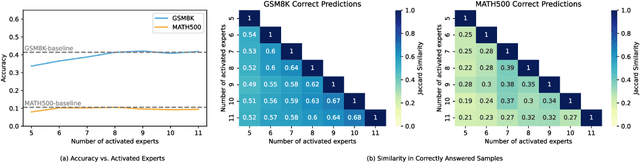
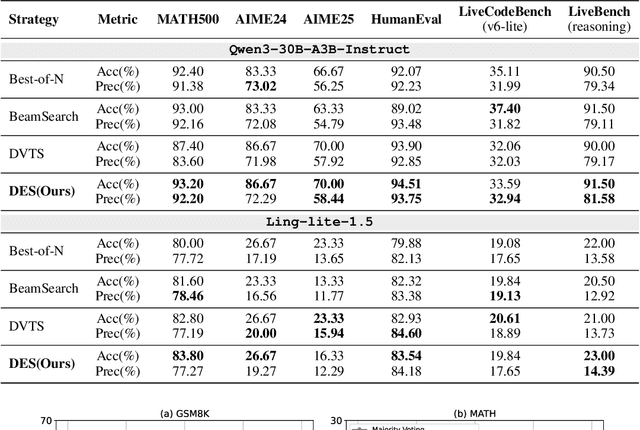
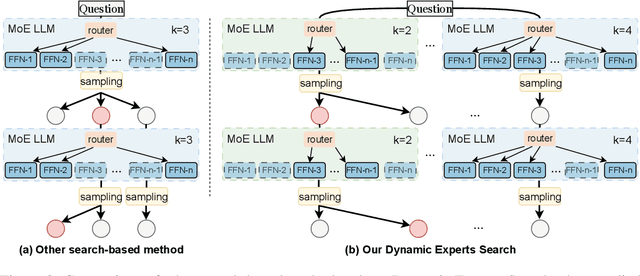
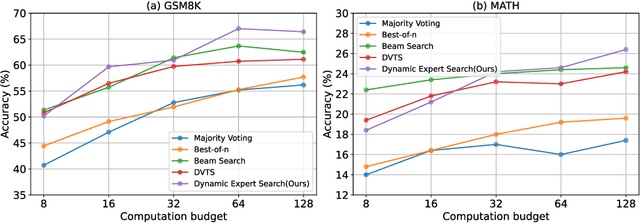
Test-Time Scaling (TTS) enhances the reasoning ability of large language models (LLMs) by allocating additional computation during inference. However, existing approaches primarily rely on output-level sampling while overlooking the role of model architecture. In mainstream Mixture-of-Experts (MoE) LLMs, we observe that varying the number of activated experts yields complementary solution sets with stable accuracy, revealing a new and underexplored source of diversity. Motivated by this observation, we propose Dynamic Experts Search (DES), a TTS strategy that elevates expert activation into a controllable dimension of the search space. DES integrates two key components: (1) Dynamic MoE, which enables direct control of expert counts during inference to generate diverse reasoning trajectories without additional cost; and (2) Expert Configuration Inheritance, which preserves consistent expert counts within a reasoning path while varying them across runs, thereby balancing stability and diversity throughout the search. Extensive experiments across MoE architectures, verifiers and reasoning benchmarks (i.e., math, code and knowledge) demonstrate that DES reliably outperforms TTS baselines, enhancing accuracy and stability without additional cost. These results highlight DES as a practical and scalable form of architecture-aware TTS, illustrating how structural flexibility in modern LLMs can advance reasoning.
From Trial to Triumph: Advancing Long Video Understanding via Visual Context Sample Scaling and Self-reward Alignment
Mar 26, 2025Multi-modal Large language models (MLLMs) show remarkable ability in video understanding. Nevertheless, understanding long videos remains challenging as the models can only process a finite number of frames in a single inference, potentially omitting crucial visual information. To address the challenge, we propose generating multiple predictions through visual context sampling, followed by a scoring mechanism to select the final prediction. Specifically, we devise a bin-wise sampling strategy that enables MLLMs to generate diverse answers based on various combinations of keyframes, thereby enriching the visual context. To determine the final prediction from the sampled answers, we employ a self-reward by linearly combining three scores: (1) a frequency score indicating the prevalence of each option, (2) a marginal confidence score reflecting the inter-intra sample certainty of MLLM predictions, and (3) a reasoning score for different question types, including clue-guided answering for global questions and temporal self-refocusing for local questions. The frequency score ensures robustness through majority correctness, the confidence-aligned score reflects prediction certainty, and the typed-reasoning score addresses cases with sparse key visual information using tailored strategies. Experiments show that this approach covers the correct answer for a high percentage of long video questions, on seven datasets show that our method improves the performance of three MLLMs.
DreamDPO: Aligning Text-to-3D Generation with Human Preferences via Direct Preference Optimization
Feb 05, 2025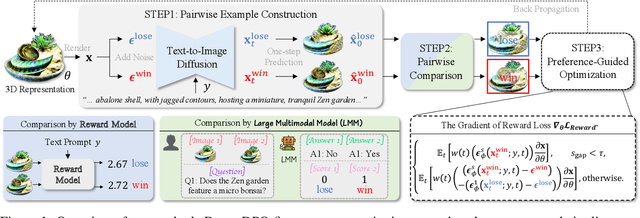
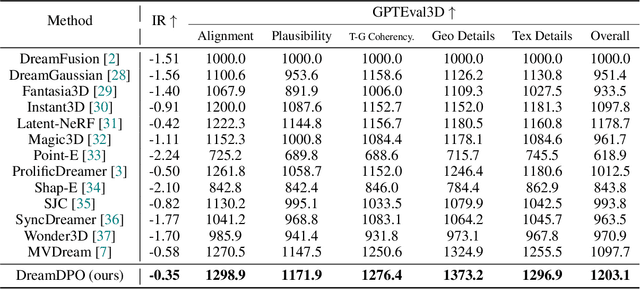
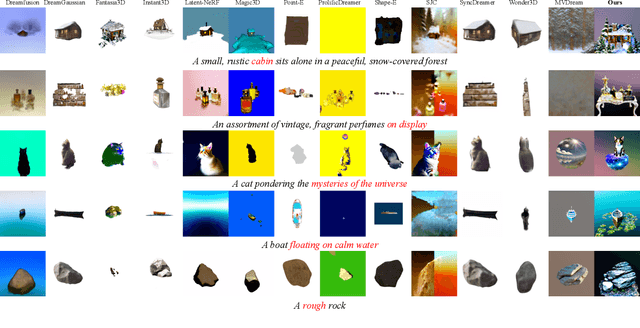
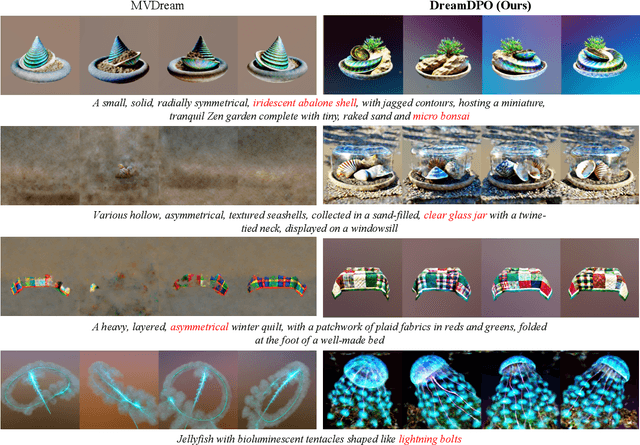
Text-to-3D generation automates 3D content creation from textual descriptions, which offers transformative potential across various fields. However, existing methods often struggle to align generated content with human preferences, limiting their applicability and flexibility. To address these limitations, in this paper, we propose DreamDPO, an optimization-based framework that integrates human preferences into the 3D generation process, through direct preference optimization. Practically, DreamDPO first constructs pairwise examples, then compare their alignment with human preferences using reward or large multimodal models, and lastly optimizes the 3D representation with a preference-driven loss function. By leveraging pairwise comparison to reflect preferences, DreamDPO reduces reliance on precise pointwise quality evaluations while enabling fine-grained controllability through preference-guided optimization. Experiments demonstrate that DreamDPO achieves competitive results, and provides higher-quality and more controllable 3D content compared to existing methods. The code and models will be open-sourced.
TV-Dialogue: Crafting Theme-Aware Video Dialogues with Immersive Interaction
Jan 31, 2025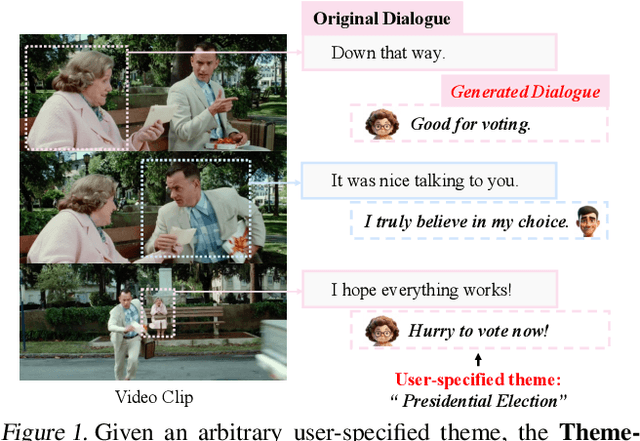
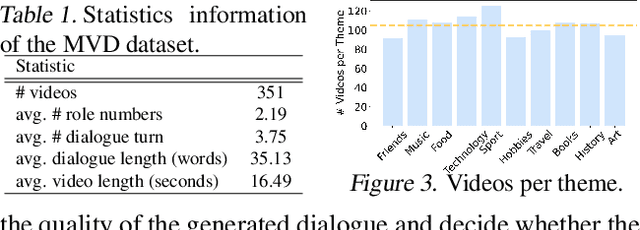
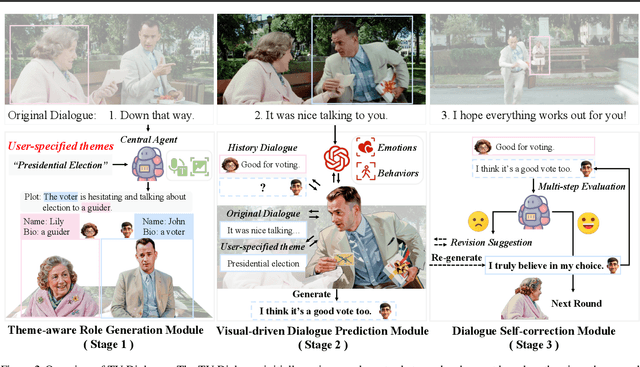
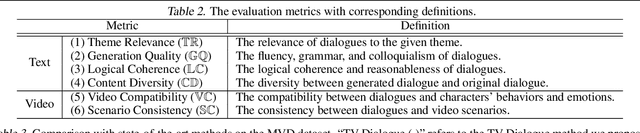
Recent advancements in LLMs have accelerated the development of dialogue generation across text and images, yet video-based dialogue generation remains underexplored and presents unique challenges. In this paper, we introduce Theme-aware Video Dialogue Crafting (TVDC), a novel task aimed at generating new dialogues that align with video content and adhere to user-specified themes. We propose TV-Dialogue, a novel multi-modal agent framework that ensures both theme alignment (i.e., the dialogue revolves around the theme) and visual consistency (i.e., the dialogue matches the emotions and behaviors of characters in the video) by enabling real-time immersive interactions among video characters, thereby accurately understanding the video content and generating new dialogue that aligns with the given themes. To assess the generated dialogues, we present a multi-granularity evaluation benchmark with high accuracy, interpretability and reliability, demonstrating the effectiveness of TV-Dialogue on self-collected dataset over directly using existing LLMs. Extensive experiments reveal that TV-Dialogue can generate dialogues for videos of any length and any theme in a zero-shot manner without training. Our findings underscore the potential of TV-Dialogue for various applications, such as video re-creation, film dubbing and its use in downstream multimodal tasks.
BrainGuard: Privacy-Preserving Multisubject Image Reconstructions from Brain Activities
Jan 24, 2025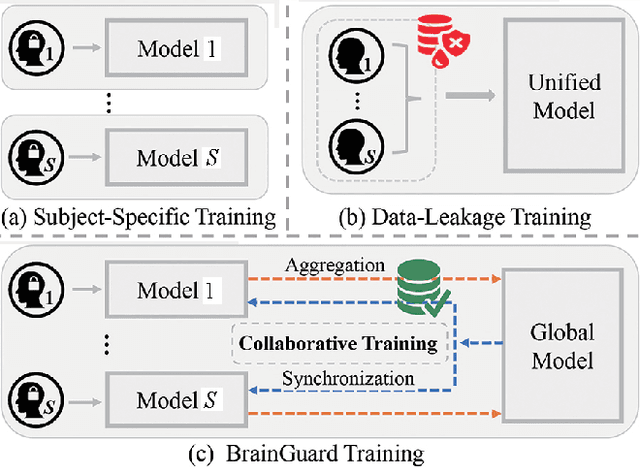
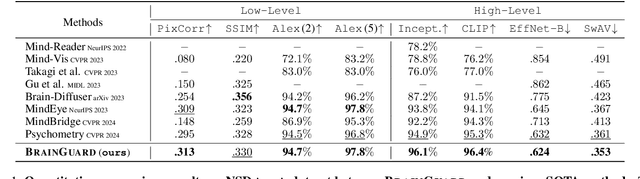
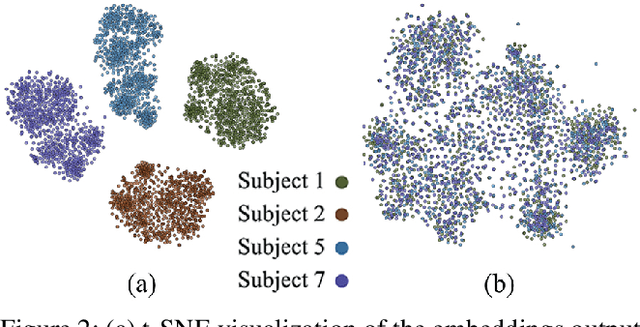

Reconstructing perceived images from human brain activity forms a crucial link between human and machine learning through Brain-Computer Interfaces. Early methods primarily focused on training separate models for each individual to account for individual variability in brain activity, overlooking valuable cross-subject commonalities. Recent advancements have explored multisubject methods, but these approaches face significant challenges, particularly in data privacy and effectively managing individual variability. To overcome these challenges, we introduce BrainGuard, a privacy-preserving collaborative training framework designed to enhance image reconstruction from multisubject fMRI data while safeguarding individual privacy. BrainGuard employs a collaborative global-local architecture where individual models are trained on each subject's local data and operate in conjunction with a shared global model that captures and leverages cross-subject patterns. This architecture eliminates the need to aggregate fMRI data across subjects, thereby ensuring privacy preservation. To tackle the complexity of fMRI data, BrainGuard integrates a hybrid synchronization strategy, enabling individual models to dynamically incorporate parameters from the global model. By establishing a secure and collaborative training environment, BrainGuard not only protects sensitive brain data but also improves the image reconstructions accuracy. Extensive experiments demonstrate that BrainGuard sets a new benchmark in both high-level and low-level metrics, advancing the state-of-the-art in brain decoding through its innovative design.