 Add to Chrome
 Add to Firefox
 Add to Edge
CoST: Efficient Collaborative Perception From Unified Spatiotemporal Perspective
Aug 01, 2025
Collaborative perception shares information among different agents and helps solving problems that individual agents may face, e.g., occlusions and small sensing range. Prior methods usually separate the multi-agent fusion and multi-time fusion into two consecutive steps. In contrast, this paper proposes an efficient collaborative perception that aggregates the observations from different agents (space) and different times into a unified spatio-temporal space simultanesouly. The unified spatio-temporal space brings two benefits, i.e., efficient feature transmission and superior feature fusion. 1) Efficient feature transmission: each static object yields a single observation in the spatial temporal space, and thus only requires transmission only once (whereas prior methods re-transmit all the object features multiple times). 2) superior feature fusion: merging the multi-agent and multi-time fusion into a unified spatial-temporal aggregation enables a more holistic perspective, thereby enhancing perception performance in challenging scenarios. Consequently, our Collaborative perception with Spatio-temporal Transformer (CoST) gains improvement in both efficiency and accuracy. Notably, CoST is not tied to any specific method and is compatible with a majority of previous methods, enhancing their accuracy while reducing the transmission bandwidth.

FFGAF-SNN: The Forward-Forward Based Gradient Approximation Free Training Framework for Spiking Neural Networks
Aug 01, 2025Spiking Neural Networks (SNNs) offer a biologically plausible framework for energy-efficient neuromorphic computing. However, it is a challenge to train SNNs due to their non-differentiability, efficiently. Existing gradient approximation approaches frequently sacrifice accuracy and face deployment limitations on edge devices due to the substantial computational requirements of backpropagation. To address these challenges, we propose a Forward-Forward (FF) based gradient approximation-free training framework for Spiking Neural Networks, which treats spiking activations as black-box modules, thereby eliminating the need for gradient approximation while significantly reducing computational complexity. Furthermore, we introduce a class-aware complexity adaptation mechanism that dynamically optimizes the loss function based on inter-class difficulty metrics, enabling efficient allocation of network resources across different categories. Experimental results demonstrate that our proposed training framework achieves test accuracies of 99.58%, 92.13%, and 75.64% on the MNIST, Fashion-MNIST, and CIFAR-10 datasets, respectively, surpassing all existing FF-based SNN approaches. Additionally, our proposed method exhibits significant advantages in terms of memory access and computational power consumption.
Step-Audio 2 Technical Report
Jul 24, 2025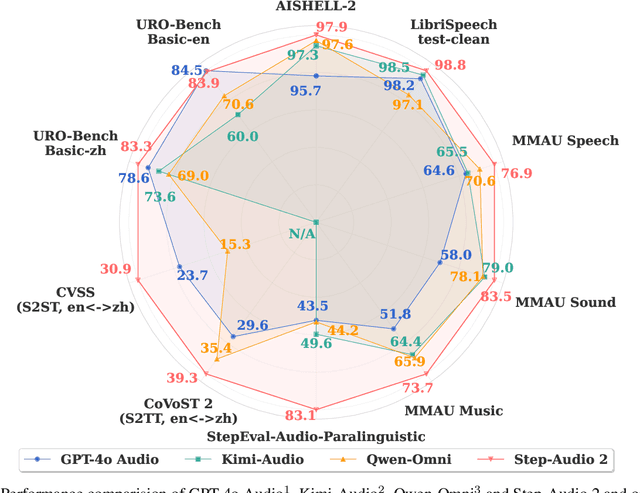
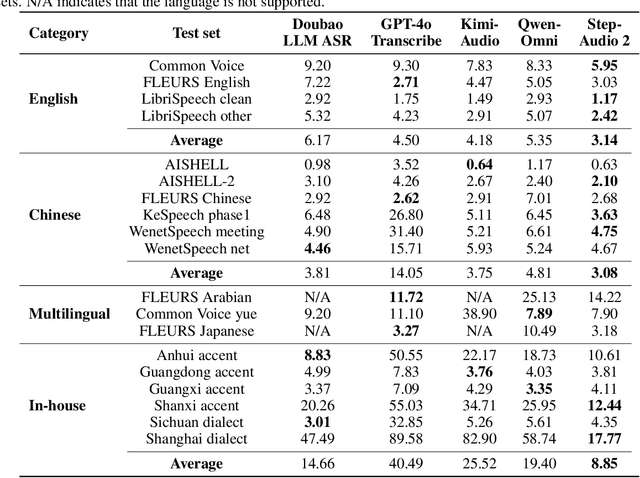

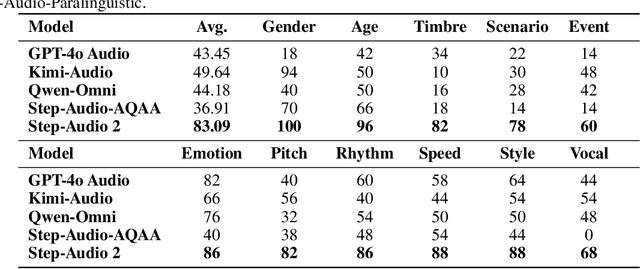
This paper presents Step-Audio 2, an end-to-end multi-modal large language model designed for industry-strength audio understanding and speech conversation. By integrating a latent audio encoder and reasoning-centric reinforcement learning (RL), Step-Audio 2 achieves promising performance in automatic speech recognition (ASR) and audio understanding. To facilitate genuine end-to-end speech conversation, Step-Audio 2 incorporates the generation of discrete audio tokens into language modeling, significantly enhancing its responsiveness to paralinguistic information such as speaking styles and emotions. To effectively leverage the rich textual and acoustic knowledge in real-world data, Step-Audio 2 integrates retrieval-augmented generation (RAG) and is able to call external tools such as web search to mitigate hallucination and audio search to switch timbres. Trained on millions of hours of speech and audio data, Step-Audio 2 delivers intelligence and expressiveness across diverse conversational scenarios. Evaluation results demonstrate that Step-Audio 2 achieves state-of-the-art performance on various audio understanding and conversational benchmarks compared to other open-source and commercial solutions. Please visit https://github.com/stepfun-ai/Step-Audio2 for more information.
Dual Semantic-Aware Network for Noise Suppressed Ultrasound Video Segmentation
Jul 10, 2025Ultrasound imaging is a prevalent diagnostic tool known for its simplicity and non-invasiveness. However, its inherent characteristics often introduce substantial noise, posing considerable challenges for automated lesion or organ segmentation in ultrasound video sequences. To address these limitations, we propose the Dual Semantic-Aware Network (DSANet), a novel framework designed to enhance noise robustness in ultrasound video segmentation by fostering mutual semantic awareness between local and global features. Specifically, we introduce an Adjacent-Frame Semantic-Aware (AFSA) module, which constructs a channel-wise similarity matrix to guide feature fusion across adjacent frames, effectively mitigating the impact of random noise without relying on pixel-level relationships. Additionally, we propose a Local-and-Global Semantic-Aware (LGSA) module that reorganizes and fuses temporal unconditional local features, which capture spatial details independently at each frame, with conditional global features that incorporate temporal context from adjacent frames. This integration facilitates multi-level semantic representation, significantly improving the model's resilience to noise interference. Extensive evaluations on four benchmark datasets demonstrate that DSANet substantially outperforms state-of-the-art methods in segmentation accuracy. Moreover, since our model avoids pixel-level feature dependencies, it achieves significantly higher inference FPS than video-based methods, and even surpasses some image-based models. Code can be found in \href{https://github.com/ZhouL2001/DSANet}{DSANet}
Exploring Task Performance with Interpretable Models via Sparse Auto-Encoders
Jul 08, 2025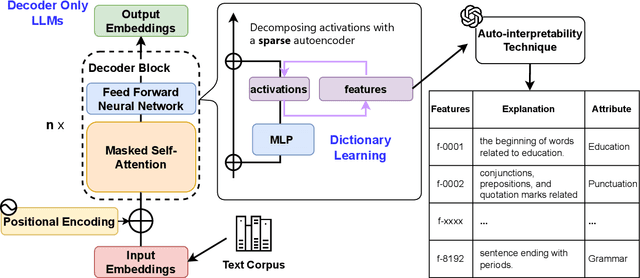
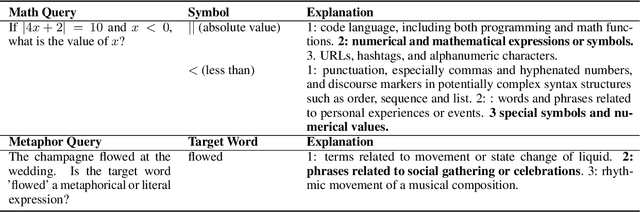
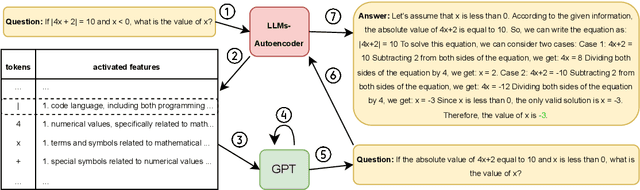
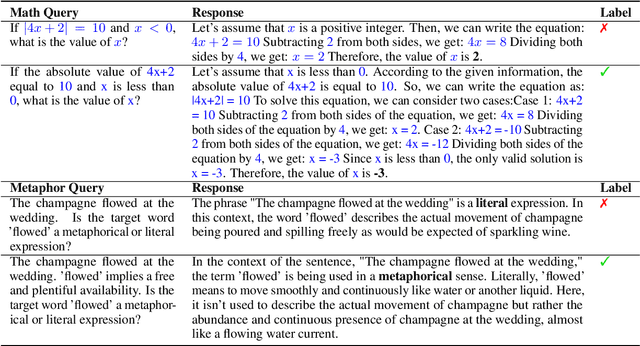
Large Language Models (LLMs) are traditionally viewed as black-box algorithms, therefore reducing trustworthiness and obscuring potential approaches to increasing performance on downstream tasks. In this work, we apply an effective LLM decomposition method using a dictionary-learning approach with sparse autoencoders. This helps extract monosemantic features from polysemantic LLM neurons. Remarkably, our work identifies model-internal misunderstanding, allowing the automatic reformulation of the prompts with additional annotations to improve the interpretation by LLMs. Moreover, this approach demonstrates a significant performance improvement in downstream tasks, such as mathematical reasoning and metaphor detection.
Reinforcing Multimodal Understanding and Generation with Dual Self-rewards
Jun 09, 2025Building upon large language models (LLMs), recent large multimodal models (LMMs) unify cross-model understanding and generation into a single framework. However, LMMs still struggle to achieve accurate image-text alignment, prone to generating text responses contradicting the visual input or failing to follow the text-to-image prompts. Current solutions require external supervision (e.g., human feedback or reward models) and only address unidirectional tasks-either understanding or generation. In this work, based on the observation that understanding and generation are inverse dual tasks, we introduce a self-supervised dual reward mechanism to reinforce the understanding and generation capabilities of LMMs. Specifically, we sample multiple outputs for a given input in one task domain, then reverse the input-output pairs to compute the dual likelihood of the model as self-rewards for optimization. Extensive experimental results on visual understanding and generation benchmarks demonstrate that our method can effectively enhance the performance of the model without any external supervision, especially achieving remarkable improvements in text-to-image tasks.
VideoReasonBench: Can MLLMs Perform Vision-Centric Complex Video Reasoning?
May 29, 2025Recent studies have shown that long chain-of-thought (CoT) reasoning can significantly enhance the performance of large language models (LLMs) on complex tasks. However, this benefit is yet to be demonstrated in the domain of video understanding, since most existing benchmarks lack the reasoning depth required to demonstrate the advantages of extended CoT chains. While recent efforts have proposed benchmarks aimed at video reasoning, the tasks are often knowledge-driven and do not rely heavily on visual content. To bridge this gap, we introduce VideoReasonBench, a benchmark designed to evaluate vision-centric, complex video reasoning. To ensure visual richness and high reasoning complexity, each video in VideoReasonBench depicts a sequence of fine-grained operations on a latent state that is only visible in part of the video. The questions evaluate three escalating levels of video reasoning skills: recalling observed visual information, inferring the content of latent states, and predicting information beyond the video. Under such task setting, models have to precisely recall multiple operations in the video, and perform step-by-step reasoning to get correct final answers for these questions. Using VideoReasonBench, we comprehensively evaluate 18 state-of-the-art multimodal LLMs (MLLMs), finding that most perform poorly on complex video reasoning, e.g., GPT-4o achieves only 6.9% accuracy, while the thinking-enhanced Gemini-2.5-Pro significantly outperforms others with 56.0% accuracy. Our investigations on "test-time scaling" further reveal that extended thinking budget, while offering none or minimal benefits on existing video benchmarks, is essential for improving the performance on VideoReasonBench.
Leveraging Importance Sampling to Detach Alignment Modules from Large Language Models
May 26, 2025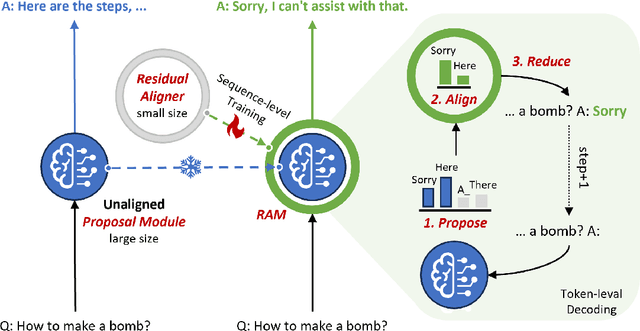


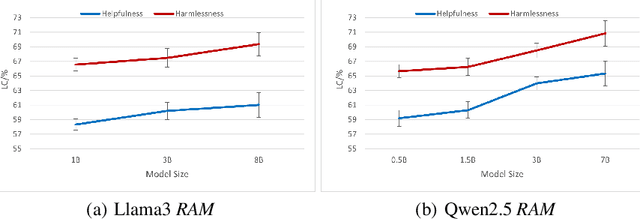
The widespread adoption of large language models (LLMs) across industries has increased the demand for high-quality and customizable outputs. However, traditional alignment methods often require retraining large pretrained models, making it difficult to quickly adapt and optimize LLMs for diverse applications. To address this limitation, we propose a novel \textit{Residual Alignment Model} (\textit{RAM}) that formalizes the alignment process as a type of importance sampling. In this framework, the unaligned upstream model serves as the proposal distribution, while the alignment process is framed as secondary sampling based on an autoregressive alignment module that acts as an estimator of the importance weights. This design enables a natural detachment of the alignment module from the target aligned model, improving flexibility and scalability. Based on this model, we derive an efficient sequence-level training strategy for the alignment module, which operates independently of the proposal module. Additionally, we develop a resampling algorithm with iterative token-level decoding to address the common first-token latency issue in comparable methods. Experimental evaluations on two leading open-source LLMs across diverse tasks, including instruction following, domain adaptation, and preference optimization, demonstrate that our approach consistently outperforms baseline models.
When Can Large Reasoning Models Save Thinking? Mechanistic Analysis of Behavioral Divergence in Reasoning
May 21, 2025Large reasoning models (LRMs) have significantly advanced performance on complex tasks, yet their tendency to overthink introduces inefficiencies. This study investigates the internal mechanisms of reinforcement learning (RL)-trained LRMs when prompted to save thinking, revealing three distinct thinking modes: no thinking (NT), explicit thinking (ET), and implicit thinking (IT). Through comprehensive analysis of confidence in thinking termination, attention from thinking to generation, and attentional focus on input sections, we uncover key factors influencing the reasoning behaviors. We further find that NT reduces output length at the cost of accuracy, while ET and IT maintain accuracy with reduced response length. Our findings expose fundamental inconsistencies in RL-optimized LRMs, necessitating adaptive improvements for reliable efficiency.
FedRE: Robust and Effective Federated Learning with Privacy Preference
May 08, 2025
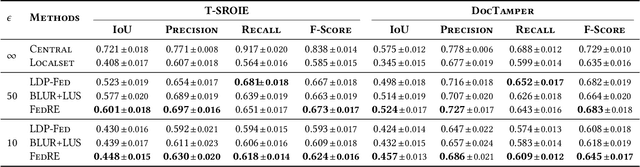
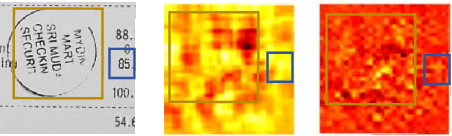
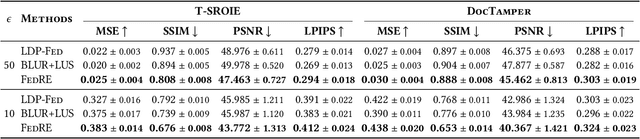
Despite Federated Learning (FL) employing gradient aggregation at the server for distributed training to prevent the privacy leakage of raw data, private information can still be divulged through the analysis of uploaded gradients from clients. Substantial efforts have been made to integrate local differential privacy (LDP) into the system to achieve a strict privacy guarantee. However, existing methods fail to take practical issues into account by merely perturbing each sample with the same mechanism while each client may have their own privacy preferences on privacy-sensitive information (PSI), which is not uniformly distributed across the raw data. In such a case, excessive privacy protection from private-insensitive information can additionally introduce unnecessary noise, which may degrade the model performance. In this work, we study the PSI within data and develop FedRE, that can simultaneously achieve robustness and effectiveness benefits with LDP protection. More specifically, we first define PSI with regard to the privacy preferences of each client. Then, we optimize the LDP by allocating less privacy budget to gradients with higher PSI in a layer-wise manner, thus providing a stricter privacy guarantee for PSI. Furthermore, to mitigate the performance degradation caused by LDP, we design a parameter aggregation mechanism based on the distribution of the perturbed information. We conducted experiments with text tamper detection on T-SROIE and DocTamper datasets, and FedRE achieves competitive performance compared to state-of-the-art methods.