 Add to Chrome
 Add to Firefox
 Add to Edge
Joint Semantic Token Selection and Prompt Optimization for Interpretable Prompt Learning
May 06, 2026
Vision-language models such as CLIP achieve strong visual-textual alignment, but often suffer from overfitting and limited interpretability when adapted through continuous prompt learning. While discrete prompt optimization improves interpretability, it usually depends on large external models, leading to high computational costs and limited scalability. In this paper, we propose Interpretable Prompt Learning (IPL), a hybrid framework that alternates between discrete semantic token selection and continuous prompt optimization. Specifically, IPL formulates semantic token selection as an approximate submodular optimization problem, encouraging tokens that are both human-understandable and semantically diverse. It further adopts an alternating optimization strategy to integrate discrete token selection with continuous prompt tuning, improving interpretability while preserving adaptability to downstream tasks. Our framework is plug-and-play, allowing seamless integration with existing prompt learning methods. Extensive experiments on multiple benchmarks show that IPL consistently improves both interpretability and accuracy across five representative prompt learning methods, providing an effective and scalable extension to existing frameworks.

Distributed Multi-Layer Editing for Rule-Level Knowledge in Large Language Models
Apr 09, 2026Large language models store not only isolated facts but also rules that support reasoning across symbolic expressions, natural language explanations, and concrete instances. Yet most model editing methods are built for fact-level knowledge, assuming that a target edit can be achieved through a localized intervention. This assumption does not hold for rule-level knowledge, where a single rule must remain consistent across multiple interdependent forms. We investigate this problem through a mechanistic study of rule-level knowledge editing. To support this study, we extend the RuleEdit benchmark from 80 to 200 manually verified rules spanning mathematics and physics. Fine-grained causal tracing reveals a form-specific organization of rule knowledge in transformer layers: formulas and descriptions are concentrated in earlier layers, while instances are more associated with middle layers. These results suggest that rule knowledge is not uniformly localized, and therefore cannot be reliably edited by a single-layer or contiguous-block intervention. Based on this insight, we propose Distributed Multi-Layer Editing (DMLE), which applies a shared early-layer update to formulas and descriptions and a separate middle-layer update to instances. While remaining competitive on standard editing metrics, DMLE achieves substantially stronger rule-level editing performance. On average, it improves instance portability and rule understanding by 13.91 and 50.19 percentage points, respectively, over the strongest baseline across GPT-J-6B, Qwen2.5-7B, Qwen2-7B, and LLaMA-3-8B. The code is available at https://github.com/Pepper66/DMLE.
Holistic Optimal Label Selection for Robust Prompt Learning under Partial Labels
Apr 08, 2026Prompt learning has gained significant attention as a parameter-efficient approach for adapting large pre-trained vision-language models to downstream tasks. However, when only partial labels are available, its performance is often limited by label ambiguity and insufficient supervisory information. To address this issue, we propose Holistic Optimal Label Selection (HopS), leveraging the generalization ability of pre-trained feature encoders through two complementary strategies. First, we design a local density-based filter that selects the top frequent labels from the nearest neighbors' candidate sets and uses the softmax scores to identify the most plausible label, capturing structural regularities in the feature space. Second, we introduce a global selection objective based on optimal transport that maps the uniform sampling distribution to the candidate label distributions across a batch. By minimizing the expected transport cost, it can determine the most likely label assignments. These two strategies work together to provide robust label selection from both local and global perspectives. Extensive experiments on eight benchmark datasets show that HopS consistently improves performance under partial supervision and outperforms all baselines. Those results highlight the merit of holistic label selection and offer a practical solution for prompt learning in weakly supervised settings.
UniCom: Unified Multimodal Modeling via Compressed Continuous Semantic Representations
Mar 11, 2026Current unified multimodal models typically rely on discrete visual tokenizers to bridge the modality gap. However, discretization inevitably discards fine-grained semantic information, leading to suboptimal performance in visual understanding tasks. Conversely, directly modeling continuous semantic representations (e.g., CLIP, SigLIP) poses significant challenges in high-dimensional generative modeling, resulting in slow convergence and training instability. To resolve this dilemma, we introduce UniCom, a unified framework that harmonizes multimodal understanding and generation via compressed continuous representation. We empirically demonstrate that reducing channel dimension is significantly more effective than spatial downsampling for both reconstruction and generation. Accordingly, we design an attention-based semantic compressor to distill dense features into a compact unified representation. Furthermore, we validate that the transfusion architecture surpasses query-based designs in convergence and consistency. Experiments demonstrate that UniCom achieves state-of-the-art generation performance among unified models. Notably, by preserving rich semantic priors, it delivers exceptional controllability in image editing and maintains image consistency even without relying on VAE.
Baichuan-Omni-1.5 Technical Report
Jan 26, 2025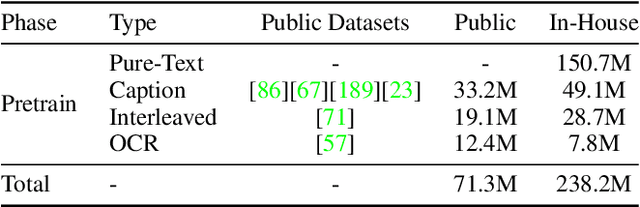
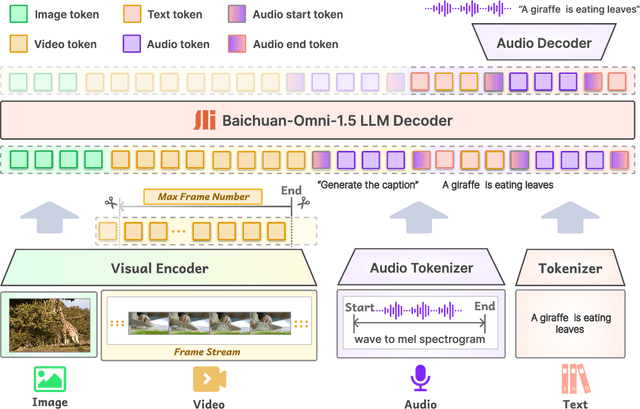
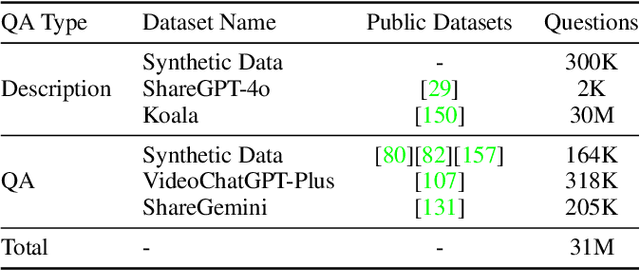
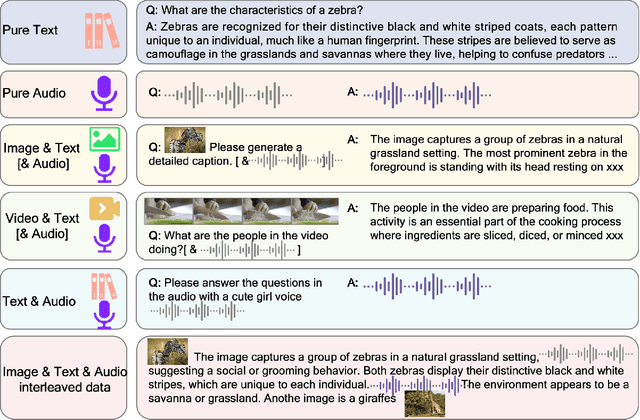
We introduce Baichuan-Omni-1.5, an omni-modal model that not only has omni-modal understanding capabilities but also provides end-to-end audio generation capabilities. To achieve fluent and high-quality interaction across modalities without compromising the capabilities of any modality, we prioritized optimizing three key aspects. First, we establish a comprehensive data cleaning and synthesis pipeline for multimodal data, obtaining about 500B high-quality data (text, audio, and vision). Second, an audio-tokenizer (Baichuan-Audio-Tokenizer) has been designed to capture both semantic and acoustic information from audio, enabling seamless integration and enhanced compatibility with MLLM. Lastly, we designed a multi-stage training strategy that progressively integrates multimodal alignment and multitask fine-tuning, ensuring effective synergy across all modalities. Baichuan-Omni-1.5 leads contemporary models (including GPT4o-mini and MiniCPM-o 2.6) in terms of comprehensive omni-modal capabilities. Notably, it achieves results comparable to leading models such as Qwen2-VL-72B across various multimodal medical benchmarks.
Towards Precise Scaling Laws for Video Diffusion Transformers
Nov 25, 2024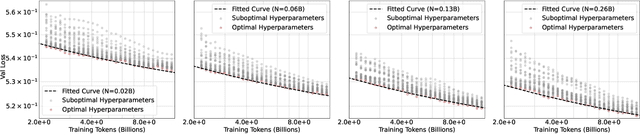


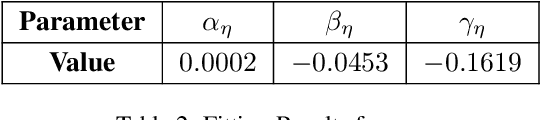
Achieving optimal performance of video diffusion transformers within given data and compute budget is crucial due to their high training costs. This necessitates precisely determining the optimal model size and training hyperparameters before large-scale training. While scaling laws are employed in language models to predict performance, their existence and accurate derivation in visual generation models remain underexplored. In this paper, we systematically analyze scaling laws for video diffusion transformers and confirm their presence. Moreover, we discover that, unlike language models, video diffusion models are more sensitive to learning rate and batch size, two hyperparameters often not precisely modeled. To address this, we propose a new scaling law that predicts optimal hyperparameters for any model size and compute budget. Under these optimal settings, we achieve comparable performance and reduce inference costs by 40.1% compared to conventional scaling methods, within a compute budget of 1e10 TFlops. Furthermore, we establish a more generalized and precise relationship among validation loss, any model size, and compute budget. This enables performance prediction for non-optimal model sizes, which may also be appealed under practical inference cost constraints, achieving a better trade-off.
Beyond Sight: Towards Cognitive Alignment in LVLM via Enriched Visual Knowledge
Nov 25, 2024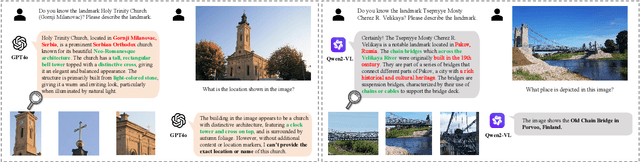
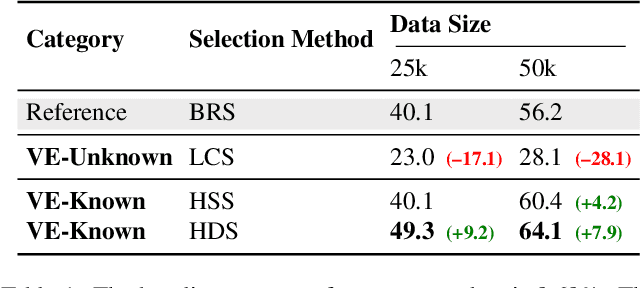
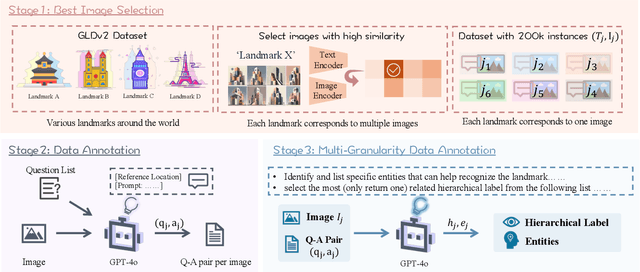
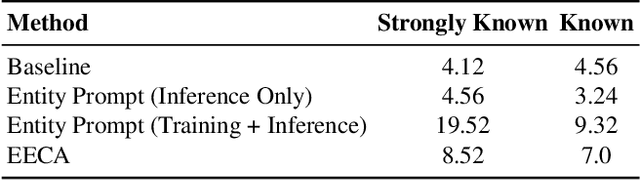
Does seeing always mean knowing? Large Vision-Language Models (LVLMs) integrate separately pre-trained vision and language components, often using CLIP-ViT as vision backbone. However, these models frequently encounter a core issue of "cognitive misalignment" between the vision encoder (VE) and the large language model (LLM). Specifically, the VE's representation of visual information may not fully align with LLM's cognitive framework, leading to a mismatch where visual features exceed the language model's interpretive range. To address this, we investigate how variations in VE representations influence LVLM comprehension, especially when the LLM faces VE-Unknown data-images whose ambiguous visual representations challenge the VE's interpretive precision. Accordingly, we construct a multi-granularity landmark dataset and systematically examine the impact of VE-Known and VE-Unknown data on interpretive abilities. Our results show that VE-Unknown data limits LVLM's capacity for accurate understanding, while VE-Known data, rich in distinctive features, helps reduce cognitive misalignment. Building on these insights, we propose Entity-Enhanced Cognitive Alignment (EECA), a method that employs multi-granularity supervision to generate visually enriched, well-aligned tokens that not only integrate within the LLM's embedding space but also align with the LLM's cognitive framework. This alignment markedly enhances LVLM performance in landmark recognition. Our findings underscore the challenges posed by VE-Unknown data and highlight the essential role of cognitive alignment in advancing multimodal systems.
Baichuan-Omni Technical Report
Oct 11, 2024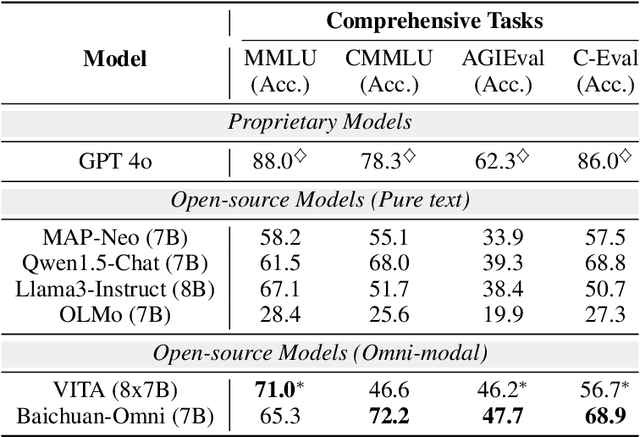

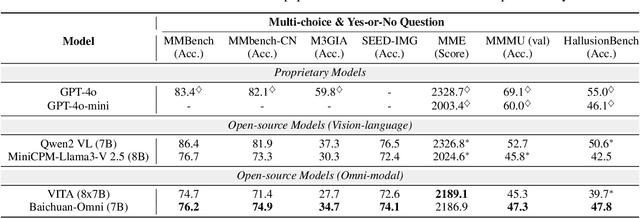

The salient multimodal capabilities and interactive experience of GPT-4o highlight its critical role in practical applications, yet it lacks a high-performing open-source counterpart. In this paper, we introduce Baichuan-Omni, the first open-source 7B Multimodal Large Language Model (MLLM) adept at concurrently processing and analyzing modalities of image, video, audio, and text, while delivering an advanced multimodal interactive experience and strong performance. We propose an effective multimodal training schema starting with 7B model and proceeding through two stages of multimodal alignment and multitask fine-tuning across audio, image, video, and text modal. This approach equips the language model with the ability to handle visual and audio data effectively. Demonstrating strong performance across various omni-modal and multimodal benchmarks, we aim for this contribution to serve as a competitive baseline for the open-source community in advancing multimodal understanding and real-time interaction.
SEA: Supervised Embedding Alignment for Token-Level Visual-Textual Integration in MLLMs
Aug 21, 2024Multimodal Large Language Models (MLLMs) have recently demonstrated remarkable perceptual and reasoning abilities, typically comprising a Vision Encoder, an Adapter, and a Large Language Model (LLM). The adapter serves as the critical bridge between the visual and language components. However, training adapters with image-level supervision often results in significant misalignment, undermining the LLMs' capabilities and limiting the potential of Multimodal LLMs. To address this, we introduce Supervised Embedding Alignment (SEA), a token-level alignment method that leverages vision-language pre-trained models, such as CLIP, to align visual tokens with the LLM's embedding space through contrastive learning. This approach ensures a more coherent integration of visual and language representations, enhancing the performance and interpretability of multimodal LLMs while preserving their inherent capabilities. Extensive experiments show that SEA effectively improves MLLMs, particularly for smaller models, without adding extra data or inference computation. SEA also lays the groundwork for developing more general and adaptable solutions to enhance multimodal systems.