 Add to Chrome
 Add to Firefox
 Add to Edge
Unsupervised Graph Representation Learning with Complementary View Alignment
Jul 27, 2026
Unsupervised graph representation learning aims to derive meaningful node embeddings by capturing both structural and attribute information without relying on labeled data. Existing methods, such as GAEs, have demonstrated effectiveness but typically rely on message-passing mechanisms that assume homophily, leading to performance degradation on heterophilous graphs, where connected nodes exhibit dissimilar features. This homophily bias results in the loss of critical high-frequency components that are essential for identifying heterophilous patterns. To address these challenges, we propose \textsc{AlignGAE}, a novel extension of \textit{MaskGAE} that preserves the full frequency spectrum through complementary view alignment. Our framework introduces a dual-encoder architecture that separately processes structural and attribute information, incorporates node positional encoding to approximate Neighborhood Identity Distribution (NID), and employs dual reconstruction tasks for both edges and node attributes. We further propose theoretically grounded NID alignment strategies that ensure semantic consistency across views while preserving their distinct characteristics. Through comprehensive spectral analysis, we demonstrate that \textsc{AlignGAE} achieves optimal representation properties when the alignment loss converges. Extensive experiments across 12 benchmark datasets validate our approach, showing that \textsc{AlignGAE} outperforms state-of-the-art methods by up to 18.7\% on heterophilous graphs in node classification, while maintaining competitive performance on homophilous graphs. Our results establish a new paradigm for frequency-aware graph representation learning.

When Can You Correct Distribution Drift in Temporal Graph Generation? A Sharpening--Drift Tension and an Impossibility for Observation-Based Correction
Jul 27, 2026Generative models of temporal graphs are trained on one stretch of an evolving network and deployed on the next, and they degrade badly in the gap. We show this degradation is derivable, general, and not fixable from observations. The masked flow-matching loss decomposes exactly, with no independence assumption, into an irreducible entropy plus a divergence whose derivative along the training path is positive precisely for structures rare during training and common at deployment, diverging as their training probability goes to zero. Empirically the trade-off is a power law with exponent $-0.605$ ($R^2=0.9977$), and drift raises the sampler's error floor without changing how many steps reach it: across seven well-powered conditions the drift-period marginal error varies by at most $6\%$ over a $50\times$ range of sampling budgets, while the floor sits $2.2\times$ to $34.3\times$ above the in-period floor. Because the deployment period is observed, correction looks like a matter of measurement. It is not. We prove that any corrector measurable with respect to past observations leaves at least the conditional variance of the statistic it tracks, and that trend extrapolation beats trusting the last observation only when $μ^2>v(1-2ρ)$. Both premises are measurable and both go the wrong way: the drift is trendless and mean-reverting, with a one-step innovation as large as the drift itself. An oracle removes $60\%$ of the error, the best observation-based corrector recovers $5.7\%$ of that, and extrapolation is strictly worse than doing nothing clever.
Towards OOD Generalization in Dynamic Graphs via Causal Invariant Learning
Mar 02, 2026Although dynamic graph neural networks (DyGNNs) have demonstrated promising capabilities, most existing methods ignore out-of-distribution (OOD) shifts that commonly exist in dynamic graphs. Dynamic graph OOD generalization is non-trivial due to the following challenges: 1) Identifying invariant and variant patterns amid complex graph evolution, 2) Capturing the intrinsic evolution rationale from these patterns, and 3) Ensuring model generalization across diverse OOD shifts despite limited data distribution observations. Although several attempts have been made to tackle these challenges, none has successfully addressed all three simultaneously, and they face various limitations in complex OOD scenarios. To solve these issues, we propose a Dynamic graph Causal Invariant Learning (DyCIL) model for OOD generalization via exploiting invariant spatio-temporal patterns from a causal view. Specifically, we first develop a dynamic causal subgraph generator to identify causal dynamic subgraphs explicitly. Next, we design a causal-aware spatio-temporal attention module to extract the intrinsic evolution rationale behind invariant patterns. Finally, we further introduce an adaptive environment generator to capture the underlying dynamics of distributional shifts. Extensive experiments on both real-world and synthetic dynamic graph datasets demonstrate the superiority of our model over state-of-the-art baselines in handling OOD shifts.
Baichuan-M3: Modeling Clinical Inquiry for Reliable Medical Decision-Making
Feb 06, 2026We introduce Baichuan-M3, a medical-enhanced large language model engineered to shift the paradigm from passive question-answering to active, clinical-grade decision support. Addressing the limitations of existing systems in open-ended consultations, Baichuan-M3 utilizes a specialized training pipeline to model the systematic workflow of a physician. Key capabilities include: (i) proactive information acquisition to resolve ambiguity; (ii) long-horizon reasoning that unifies scattered evidence into coherent diagnoses; and (iii) adaptive hallucination suppression to ensure factual reliability. Empirical evaluations demonstrate that Baichuan-M3 achieves state-of-the-art results on HealthBench, the newly introduced HealthBench-Hallu and ScanBench, significantly outperforming GPT-5.2 in clinical inquiry, advisory and safety. The models are publicly available at https://huggingface.co/collections/baichuan-inc/baichuan-m3.
ReSearch: Learning to Reason with Search for LLMs via Reinforcement Learning
Mar 27, 2025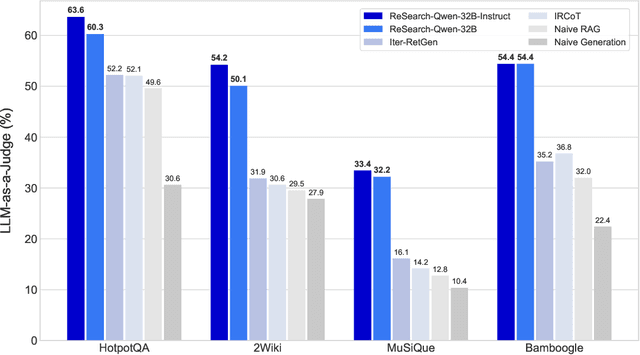
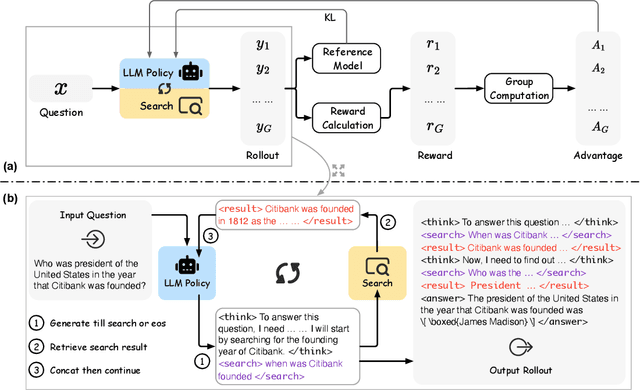
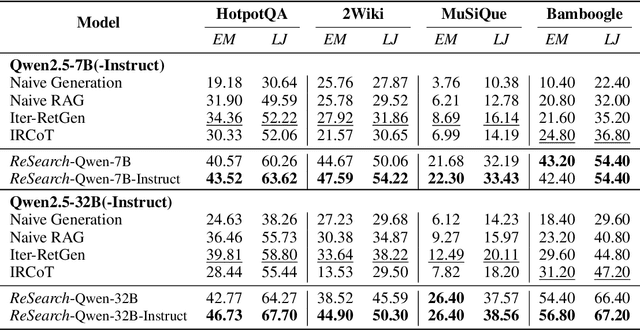
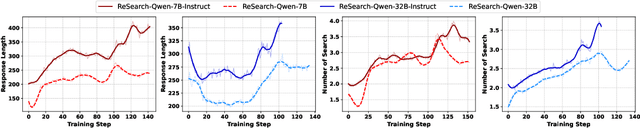
Large Language Models (LLMs) have shown remarkable capabilities in reasoning, exemplified by the success of OpenAI-o1 and DeepSeek-R1. However, integrating reasoning with external search processes remains challenging, especially for complex multi-hop questions requiring multiple retrieval steps. We propose ReSearch, a novel framework that trains LLMs to Reason with Search via reinforcement learning without using any supervised data on reasoning steps. Our approach treats search operations as integral components of the reasoning chain, where when and how to perform searches is guided by text-based thinking, and search results subsequently influence further reasoning. We train ReSearch on Qwen2.5-7B(-Instruct) and Qwen2.5-32B(-Instruct) models and conduct extensive experiments. Despite being trained on only one dataset, our models demonstrate strong generalizability across various benchmarks. Analysis reveals that ReSearch naturally elicits advanced reasoning capabilities such as reflection and self-correction during the reinforcement learning process.
Baichuan-Audio: A Unified Framework for End-to-End Speech Interaction
Feb 24, 2025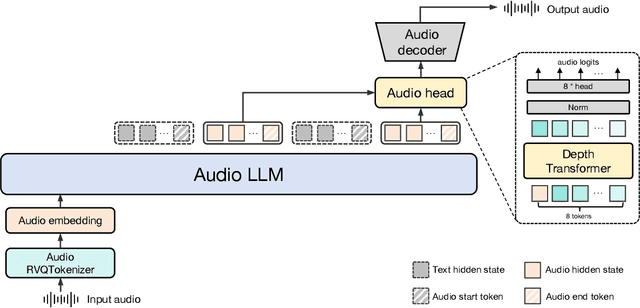
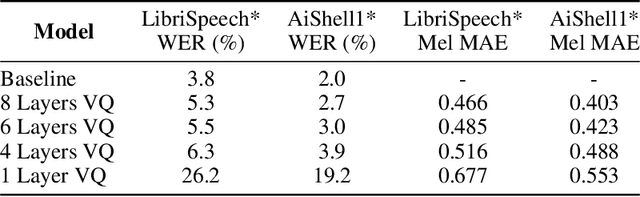
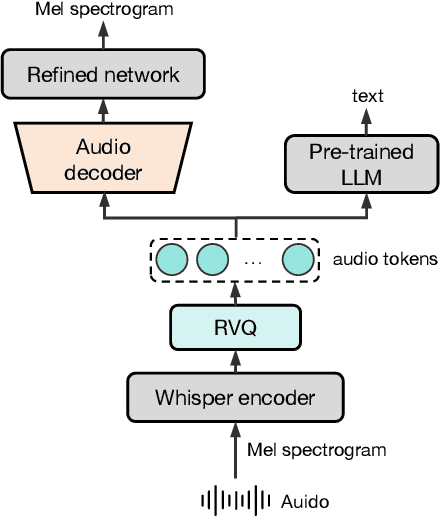
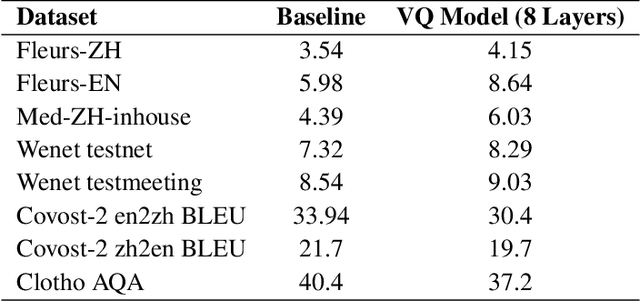
We introduce Baichuan-Audio, an end-to-end audio large language model that seamlessly integrates audio understanding and generation. It features a text-guided aligned speech generation mechanism, enabling real-time speech interaction with both comprehension and generation capabilities. Baichuan-Audio leverages a pre-trained ASR model, followed by multi-codebook discretization of speech at a frame rate of 12.5 Hz. This multi-codebook setup ensures that speech tokens retain both semantic and acoustic information. To further enhance modeling, an independent audio head is employed to process audio tokens, effectively capturing their unique characteristics. To mitigate the loss of intelligence during pre-training and preserve the original capabilities of the LLM, we propose a two-stage pre-training strategy that maintains language understanding while enhancing audio modeling. Following alignment, the model excels in real-time speech-based conversation and exhibits outstanding question-answering capabilities, demonstrating its versatility and efficiency. The proposed model demonstrates superior performance in real-time spoken dialogue and exhibits strong question-answering abilities. Our code, model and training data are available at https://github.com/baichuan-inc/Baichuan-Audio
MM-Verify: Enhancing Multimodal Reasoning with Chain-of-Thought Verification
Feb 19, 2025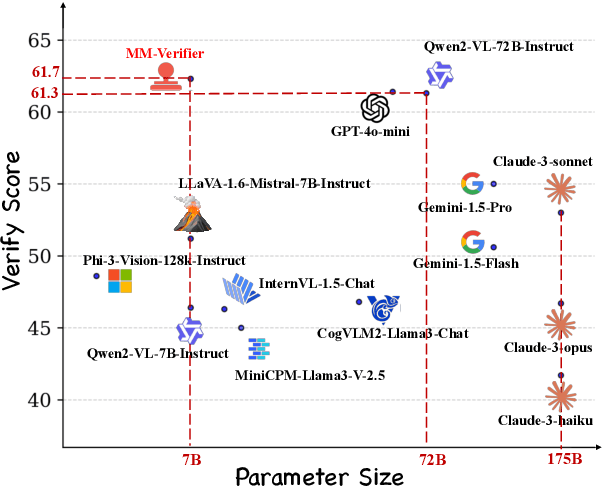
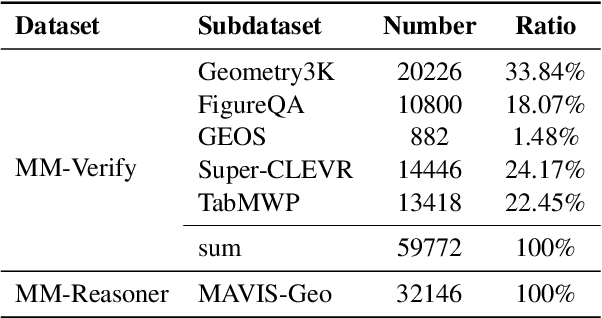
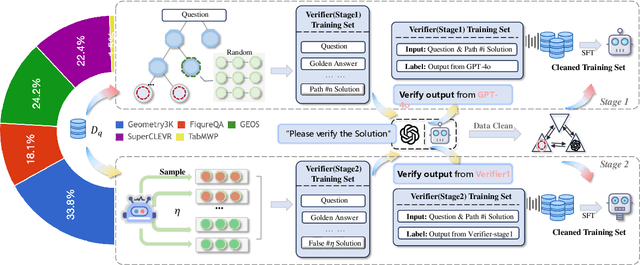
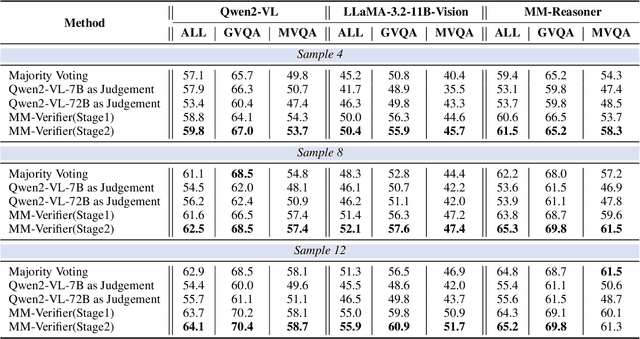
According to the Test-Time Scaling, the integration of External Slow-Thinking with the Verify mechanism has been demonstrated to enhance multi-round reasoning in large language models (LLMs). However, in the multimodal (MM) domain, there is still a lack of a strong MM-Verifier. In this paper, we introduce MM-Verifier and MM-Reasoner to enhance multimodal reasoning through longer inference and more robust verification. First, we propose a two-step MM verification data synthesis method, which combines a simulation-based tree search with verification and uses rejection sampling to generate high-quality Chain-of-Thought (COT) data. This data is then used to fine-tune the verification model, MM-Verifier. Additionally, we present a more efficient method for synthesizing MMCOT data, bridging the gap between text-based and multimodal reasoning. The synthesized data is used to fine-tune MM-Reasoner. Our MM-Verifier outperforms all larger models on the MathCheck, MathVista, and MathVerse benchmarks. Moreover, MM-Reasoner demonstrates strong effectiveness and scalability, with performance improving as data size increases. Finally, our approach achieves strong performance when combining MM-Reasoner and MM-Verifier, reaching an accuracy of 65.3 on MathVista, surpassing GPT-4o (63.8) with 12 rollouts.
Baichuan-Omni-1.5 Technical Report
Jan 26, 2025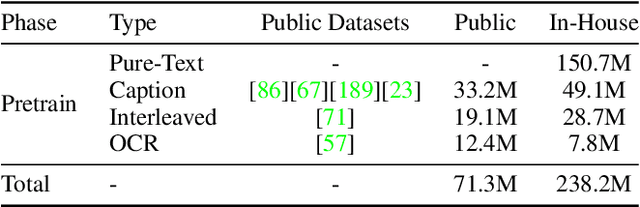
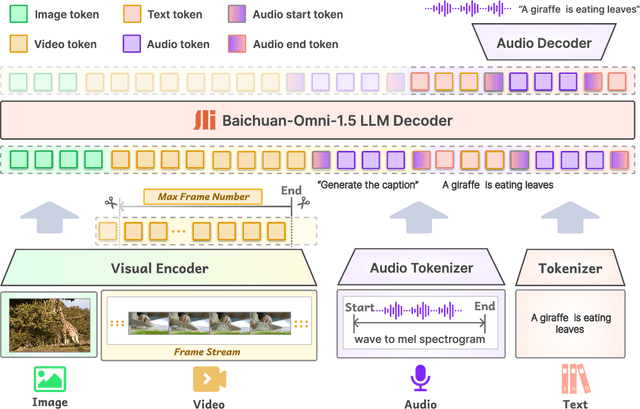
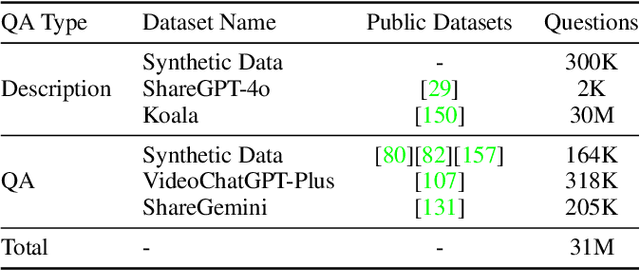
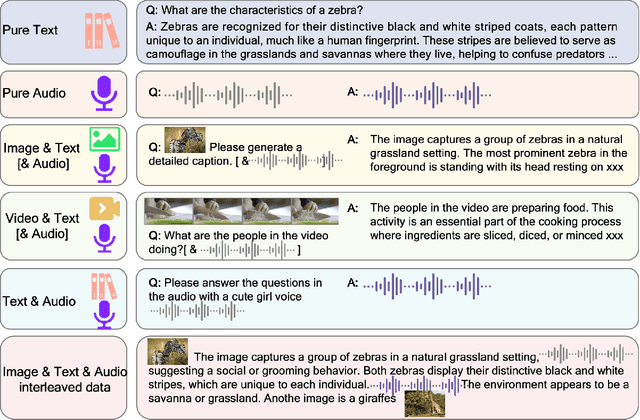
We introduce Baichuan-Omni-1.5, an omni-modal model that not only has omni-modal understanding capabilities but also provides end-to-end audio generation capabilities. To achieve fluent and high-quality interaction across modalities without compromising the capabilities of any modality, we prioritized optimizing three key aspects. First, we establish a comprehensive data cleaning and synthesis pipeline for multimodal data, obtaining about 500B high-quality data (text, audio, and vision). Second, an audio-tokenizer (Baichuan-Audio-Tokenizer) has been designed to capture both semantic and acoustic information from audio, enabling seamless integration and enhanced compatibility with MLLM. Lastly, we designed a multi-stage training strategy that progressively integrates multimodal alignment and multitask fine-tuning, ensuring effective synergy across all modalities. Baichuan-Omni-1.5 leads contemporary models (including GPT4o-mini and MiniCPM-o 2.6) in terms of comprehensive omni-modal capabilities. Notably, it achieves results comparable to leading models such as Qwen2-VL-72B across various multimodal medical benchmarks.
Baichuan Alignment Technical Report
Oct 19, 2024


We introduce Baichuan Alignment, a detailed analysis of the alignment techniques employed in the Baichuan series of models. This represents the industry's first comprehensive account of alignment methodologies, offering valuable insights for advancing AI research. We investigate the critical components that enhance model performance during the alignment process, including optimization methods, data strategies, capability enhancements, and evaluation processes. The process spans three key stages: Prompt Augmentation System (PAS), Supervised Fine-Tuning (SFT), and Preference Alignment. The problems encountered, the solutions applied, and the improvements made are thoroughly recorded. Through comparisons across well-established benchmarks, we highlight the technological advancements enabled by Baichuan Alignment. Baichuan-Instruct is an internal model, while Qwen2-Nova-72B and Llama3-PBM-Nova-70B are instruct versions of the Qwen2-72B and Llama-3-70B base models, optimized through Baichuan Alignment. Baichuan-Instruct demonstrates significant improvements in core capabilities, with user experience gains ranging from 17% to 28%, and performs exceptionally well on specialized benchmarks. In open-source benchmark evaluations, both Qwen2-Nova-72B and Llama3-PBM-Nova-70B consistently outperform their respective official instruct versions across nearly all datasets. This report aims to clarify the key technologies behind the alignment process, fostering a deeper understanding within the community. Llama3-PBM-Nova-70B model is available at https://huggingface.co/PKU-Baichuan-MLSystemLab/Llama3-PBM-Nova-70B.
Facilitating Multi-turn Function Calling for LLMs via Compositional Instruction Tuning
Oct 16, 2024


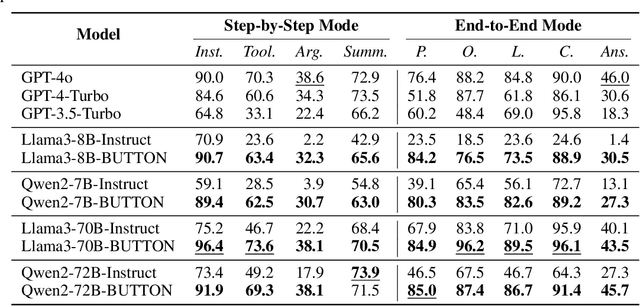
Large Language Models (LLMs) have exhibited significant potential in performing diverse tasks, including the ability to call functions or use external tools to enhance their performance. While current research on function calling by LLMs primarily focuses on single-turn interactions, this paper addresses the overlooked necessity for LLMs to engage in multi-turn function calling--critical for handling compositional, real-world queries that require planning with functions but not only use functions. To facilitate this, we introduce an approach, BUTTON, which generates synthetic compositional instruction tuning data via bottom-up instruction construction and top-down trajectory generation. In the bottom-up phase, we generate simple atomic tasks based on real-world scenarios and build compositional tasks using heuristic strategies based on atomic tasks. Corresponding functions are then developed for these compositional tasks. The top-down phase features a multi-agent environment where interactions among simulated humans, assistants, and tools are utilized to gather multi-turn function calling trajectories. This approach ensures task compositionality and allows for effective function and trajectory generation by examining atomic tasks within compositional tasks. We produce a dataset BUTTONInstruct comprising 8k data points and demonstrate its effectiveness through extensive experiments across various LLMs.