 Add to Chrome
 Add to Firefox
 Add to Edge
Three-Body Scattering for Generative Modeling
Jul 20, 2026
Modern generative models typically rely on an adversarial critic, a prescribed noise-to-data path, or an autoregressive factorization. Instead, we show that a proper distributional energy can induce sample-level motion and provide direct regression supervision for a one-step generator. Three-Body Scattering Modeling (TBSM) for generation turns the energy distance into a constant-size per-projectile interaction: each projectile is attracted toward one real source and repelled from one independently generated source. Conditioned on the projectile and its condition, its expectation equals the $2$-Wasserstein gradient-flow velocity of $\frac12D_E^2(P_θ,Q)$. A batch of $B$ frozen-target events yields $O(B)$ sample-level losses, each using one reference for its condition instead of the minibatch-wide all-pairs field used by methods such as Drifting Models. Tracking this conditional expectation online can reduce field noise. Using scattering in frozen image features, TBSM trains one-step generators on ImageNet-256, achieving FID${}=2.23$ with pixel-space PixelDiT-XL and FID${}=1.63$ with latent-space DiT-XL at NFE${}=1$. We provide a design map relating diffusion-related supervision, Drift-like dynamics, and GAN-like objectives. These results establish tracked scattering as a route to high-dimensional one-step generation. Code: https://github.com/sp12138/TBSM.

LLaDA2.0-Uni: Unifying Multimodal Understanding and Generation with Diffusion Large Language Model
Apr 22, 2026We present LLaDA2.0-Uni, a unified discrete diffusion large language model (dLLM) that supports multimodal understanding and generation within a natively integrated framework. Its architecture combines a fully semantic discrete tokenizer, a MoE-based dLLM backbone, and a diffusion decoder. By discretizing continuous visual inputs via SigLIP-VQ, the model enables block-level masked diffusion for both text and vision inputs within the backbone, while the decoder reconstructs visual tokens into high-fidelity images. Inference efficiency is enhanced beyond parallel decoding through prefix-aware optimizations in the backbone and few-step distillation in the decoder. Supported by carefully curated large-scale data and a tailored multi-stage training pipeline, LLaDA2.0-Uni matches specialized VLMs in multimodal understanding while delivering strong performance in image generation and editing. Its native support for interleaved generation and reasoning establishes a promising and scalable paradigm for next-generation unified foundation models. Codes and models are available at https://github.com/inclusionAI/LLaDA2.0-Uni.
Self-Adversarial One Step Generation via Condition Shifting
Apr 14, 2026The push for efficient text to image synthesis has moved the field toward one step sampling, yet existing methods still face a three way tradeoff among fidelity, inference speed, and training efficiency. Approaches that rely on external discriminators can sharpen one step performance, but they often introduce training instability, high GPU memory overhead, and slow convergence, which complicates scaling and parameter efficient tuning. In contrast, regression based distillation and consistency objectives are easier to optimize, but they typically lose fine details when constrained to a single step. We present APEX, built on a key theoretical insight: adversarial correction signals can be extracted endogenously from a flow model through condition shifting. Using a transformation creates a shifted condition branch whose velocity field serves as an independent estimator of the model's current generation distribution, yielding a gradient that is provably GAN aligned, replacing the sample dependent discriminator terms that cause gradient vanishing. This discriminator free design is architecture preserving, making APEX a plug and play framework compatible with both full parameter and LoRA based tuning. Empirically, our 0.6B model surpasses FLUX-Schnell 12B (20$\times$ more parameters) in one step quality. With LoRA tuning on Qwen-Image 20B, APEX reaches a GenEval score of 0.89 at NFE=1 in 6 hours, surpassing the original 50-step teacher (0.87) and providing a 15.33$\times$ inference speedup. Code is available https://github.com/LINs-lab/APEX.
DeepGen 1.0: A Lightweight Unified Multimodal Model for Advancing Image Generation and Editing
Feb 13, 2026Current unified multimodal models for image generation and editing typically rely on massive parameter scales (e.g., >10B), entailing prohibitive training costs and deployment footprints. In this work, we present DeepGen 1.0, a lightweight 5B unified model that achieves comprehensive capabilities competitive with or surpassing much larger counterparts. To overcome the limitations of compact models in semantic understanding and fine-grained control, we introduce Stacked Channel Bridging (SCB), a deep alignment framework that extracts hierarchical features from multiple VLM layers and fuses them with learnable 'think tokens' to provide the generative backbone with structured, reasoning-rich guidance. We further design a data-centric training strategy spanning three progressive stages: (1) Alignment Pre-training on large-scale image-text pairs and editing triplets to synchronize VLM and DiT representations, (2) Joint Supervised Fine-tuning on a high-quality mixture of generation, editing, and reasoning tasks to foster omni-capabilities, and (3) Reinforcement Learning with MR-GRPO, which leverages a mixture of reward functions and supervision signals, resulting in substantial gains in generation quality and alignment with human preferences, while maintaining stable training progress and avoiding visual artifacts. Despite being trained on only ~50M samples, DeepGen 1.0 achieves leading performance across diverse benchmarks, surpassing the 80B HunyuanImage by 28% on WISE and the 27B Qwen-Image-Edit by 37% on UniREditBench. By open-sourcing our training code, weights, and datasets, we provide an efficient, high-performance alternative to democratize unified multimodal research.
Generative Modeling with Explicit Memory
Dec 11, 2024


Recent studies indicate that the denoising process in deep generative diffusion models implicitly learns and memorizes semantic information from the data distribution. These findings suggest that capturing more complex data distributions requires larger neural networks, leading to a substantial increase in computational demands, which in turn become the primary bottleneck in both training and inference of diffusion models. To this end, we introduce \textbf{G}enerative \textbf{M}odeling with \textbf{E}xplicit \textbf{M}emory (GMem), leveraging an external memory bank in both training and sampling phases of diffusion models. This approach preserves semantic information from data distributions, reducing reliance on neural network capacity for learning and generalizing across diverse datasets. The results are significant: our GMem enhances both training, sampling efficiency, and generation quality. For instance, on ImageNet at $256 \times 256$ resolution, GMem accelerates SiT training by over $46.7\times$, achieving the performance of a SiT model trained for $7M$ steps in fewer than $150K$ steps. Compared to the most efficient existing method, REPA, GMem still offers a $16\times$ speedup, attaining an FID score of 5.75 within $250K$ steps, whereas REPA requires over $4M$ steps. Additionally, our method achieves state-of-the-art generation quality, with an FID score of {3.56} without classifier-free guidance on ImageNet $256\times256$. Our code is available at \url{https://github.com/LINs-lab/GMem}.
Baichuan-Omni Technical Report
Oct 11, 2024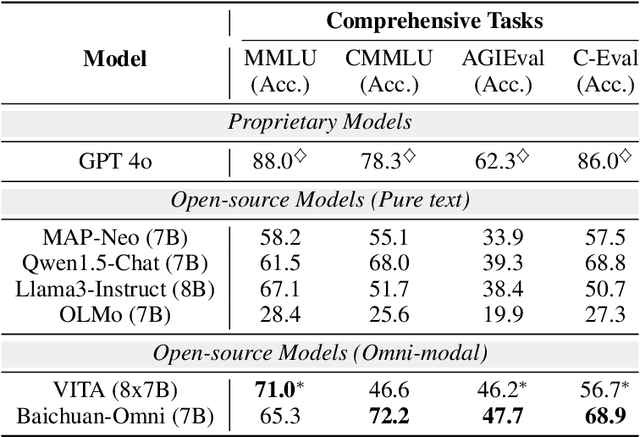

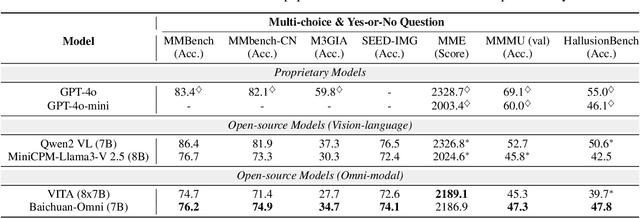

The salient multimodal capabilities and interactive experience of GPT-4o highlight its critical role in practical applications, yet it lacks a high-performing open-source counterpart. In this paper, we introduce Baichuan-Omni, the first open-source 7B Multimodal Large Language Model (MLLM) adept at concurrently processing and analyzing modalities of image, video, audio, and text, while delivering an advanced multimodal interactive experience and strong performance. We propose an effective multimodal training schema starting with 7B model and proceeding through two stages of multimodal alignment and multitask fine-tuning across audio, image, video, and text modal. This approach equips the language model with the ability to handle visual and audio data effectively. Demonstrating strong performance across various omni-modal and multimodal benchmarks, we aim for this contribution to serve as a competitive baseline for the open-source community in advancing multimodal understanding and real-time interaction.
Multimodal Self-Instruct: Synthetic Abstract Image and Visual Reasoning Instruction Using Language Model
Jul 10, 2024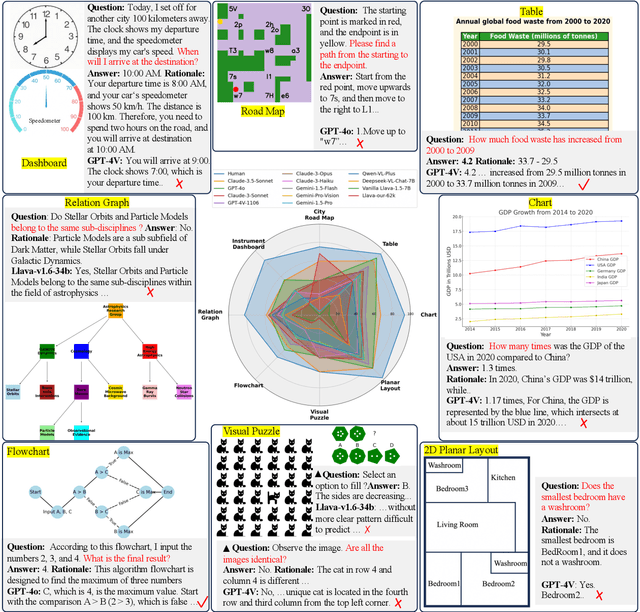
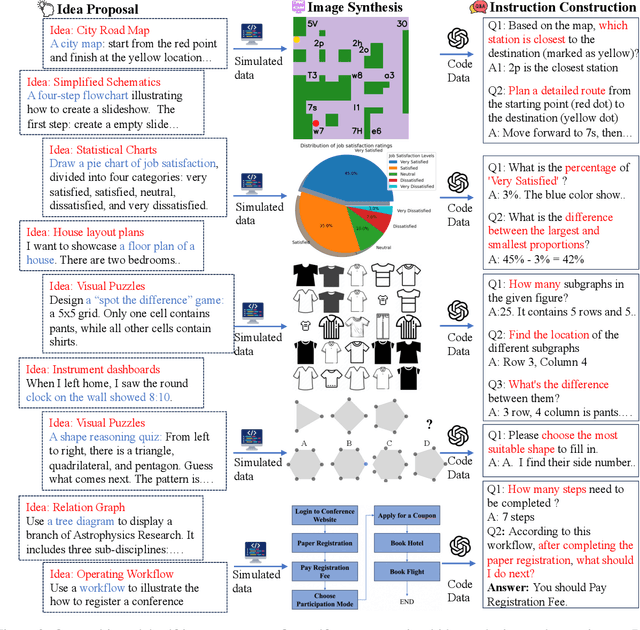
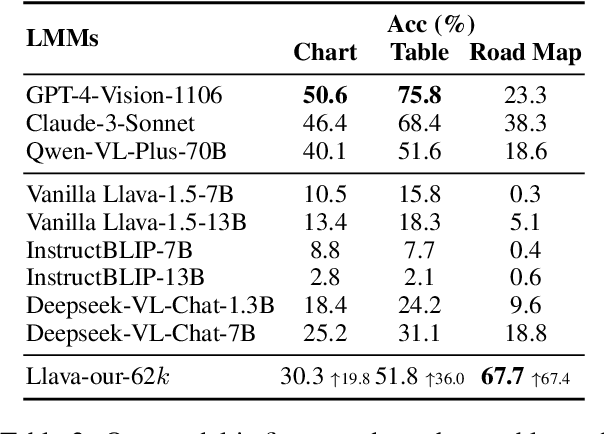
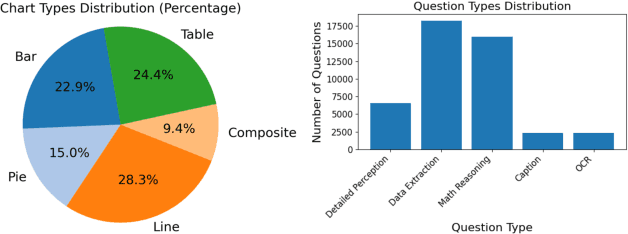
Although most current large multimodal models (LMMs) can already understand photos of natural scenes and portraits, their understanding of abstract images, e.g., charts, maps, or layouts, and visual reasoning capabilities remains quite rudimentary. They often struggle with simple daily tasks, such as reading time from a clock, understanding a flowchart, or planning a route using a road map. In light of this, we design a multi-modal self-instruct, utilizing large language models and their code capabilities to synthesize massive abstract images and visual reasoning instructions across daily scenarios. Our strategy effortlessly creates a multimodal benchmark with 11,193 instructions for eight visual scenarios: charts, tables, simulated maps, dashboards, flowcharts, relation graphs, floor plans, and visual puzzles. \textbf{This benchmark, constructed with simple lines and geometric elements, exposes the shortcomings of most advanced LMMs} like Claude-3.5-Sonnet and GPT-4o in abstract image understanding, spatial relations reasoning, and visual element induction. Besides, to verify the quality of our synthetic data, we fine-tune an LMM using 62,476 synthetic chart, table and road map instructions. The results demonstrate improved chart understanding and map navigation performance, and also demonstrate potential benefits for other visual reasoning tasks. Our code is available at: \url{https://github.com/zwq2018/Multi-modal-Self-instruct}.
Dynamic Mixture of Experts: An Auto-Tuning Approach for Efficient Transformer Models
May 23, 2024The Sparse Mixture of Experts (SMoE) has been widely employed to enhance the efficiency of training and inference for Transformer-based foundational models, yielding promising results. However, the performance of SMoE heavily depends on the choice of hyper-parameters, such as the number of experts and the number of experts to be activated (referred to as top-k), resulting in significant computational overhead due to the extensive model training by searching over various hyper-parameter configurations. As a remedy, we introduce the Dynamic Mixture of Experts (DynMoE) technique. DynMoE incorporates (1) a novel gating method that enables each token to automatically determine the number of experts to activate. (2) An adaptive process automatically adjusts the number of experts during training. Extensive numerical results across Vision, Language, and Vision-Language tasks demonstrate the effectiveness of our approach to achieve competitive performance compared to GMoE for vision and language tasks, and MoE-LLaVA for vision-language tasks, while maintaining efficiency by activating fewer parameters. Our code is available at https://github.com/LINs-lab/DynMoE.