 Add to Chrome
 Add to Firefox
 Add to Edge
Temporal GRPO: Beyond Trajectory-Level Credit in Vision-Language-Action Reinforcement Learning
Aug 13, 2026
Outcome-driven reinforcement learning offers a scalable way to post-train vision-language-action (VLA) policies from sparse task-success feedback. In common GRPO-based VLA post-training, one rollout-level advantage is applied to every action in the trajectory. A rollout that completes several valid stages but fails later can therefore penalize the actions that produced its earlier progress. We call this trajectory-level credit aliasing. Temporal GRPO addresses this problem by constructing detectable task stages, aligning each rollout with stage-specific action intervals, and comparing only rollouts that have entered the same stage. The resulting stage advantages are applied to their corresponding intervals in a single policy update. On RoboTwin 2.0, Temporal GRPO improves task success and sample efficiency, with consistent gains across task horizons. Controlled updates on LIBERO-Long preserve shared prerequisite stages and concentrate improvement at the first stage where rollout outcomes diverge.

BRACE: Taming Sharp Irregularities via Barycentric Rational Forecasting for Fast Diffusion Transformers Inference
Aug 04, 2026Diffusion Transformers (DiTs) have demonstrated exceptional performance in high-fidelity image and video generation. To alleviate their massive computational overhead, temporal feature caching has been proposed to bypass redundant computations. However, existing cache-then-forecast methods driven by derivative-based polynomials often cause severe quality degradation under high acceleration due to unstable long-step predictions. To address this bottleneck, we propose Barycentric Rational Forecasting with Chebyshev Enhancement (BRACE). Motivated by the observation that DiT feature trajectories are globally smooth yet frequently exhibit sharp irregularities and local non-smoothness, BRACE shifts the paradigm from derivative-driven polynomial extrapolation to feature-driven rational forecasting. Specifically, it maintains a local sliding window to cache sparse historical features and leverages adapted Chebyshev weights to formulate a barycentric rational function, directly aggregating these raw features to ensure numerical stability. Extensive experiments demonstrate that BRACE achieves state-of-the-art quality-efficiency trade-offs across various DiT architectures with negligible computational overhead.
Bi-NAS: Towards Effective and Personalized Explanation for Recommender Systems via Bi-Level Neural Architecture Search
Jul 01, 2026Recommender systems are vital in helping users navigate vast amounts of information, offering personalized suggestions and effective explanations for these recommendations. While previous efforts have attempted to provide such explanations, evaluating their effectiveness across various scenarios remains a challenge. Enhancing these explanations is essential for improving user engagement, trust, and decision-making. To facilitate effective explanations within the recommender system, we propose a Bi-level Neural Architecture Search (Bi-NAS) framework to optimize explanations. This approach simultaneously refines cross-attention mechanisms and feature interaction functions by exploring both intra-layer and inter-layer design spaces. Furthermore, we integrate Large Language Models (LLMs) to enhance explanation generation, leveraging zero-shot prompting to produce more effective and personalized justifications. By aligning user feature preferences with item quality scores, our approach ensures that explanations reflect both user intent and item attributes, improving transparency and reasoning depth. Extensive evaluations on four real-world datasets demonstrate that Bi-NAS not only boosts recommendation accuracy but also significantly improves the effectiveness of explanations for recommender systems, providing users with clear and reliable insights into the suggestions they receive.
LMEB: Long-horizon Memory Embedding Benchmark
Mar 19, 2026Memory embeddings are crucial for memory-augmented systems, such as OpenClaw, but their evaluation is underexplored in current text embedding benchmarks, which narrowly focus on traditional passage retrieval and fail to assess models' ability to handle long-horizon memory retrieval tasks involving fragmented, context-dependent, and temporally distant information. To address this, we introduce the Long-horizon Memory Embedding Benchmark (LMEB), a comprehensive framework that evaluates embedding models' capabilities in handling complex, long-horizon memory retrieval tasks. LMEB spans 22 datasets and 193 zero-shot retrieval tasks across 4 memory types: episodic, dialogue, semantic, and procedural, with both AI-generated and human-annotated data. These memory types differ in terms of level of abstraction and temporal dependency, capturing distinct aspects of memory retrieval that reflect the diverse challenges of the real world. We evaluate 15 widely used embedding models, ranging from hundreds of millions to ten billion parameters. The results reveal that (1) LMEB provides a reasonable level of difficulty; (2) Larger models do not always perform better; (3) LMEB and MTEB exhibit orthogonality. This suggests that the field has yet to converge on a universal model capable of excelling across all memory retrieval tasks, and that performance in traditional passage retrieval may not generalize to long-horizon memory retrieval. In summary, by providing a standardized and reproducible evaluation framework, LMEB fills a crucial gap in memory embedding evaluation, driving further advancements in text embedding for handling long-term, context-dependent memory retrieval. LMEB is available at https://github.com/KaLM-Embedding/LMEB.
From Shallow to Deep: Pinning Semantic Intent via Causal GRPO
Mar 03, 2026Large Language Models remain vulnerable to adversarial prefix attacks (e.g., ``Sure, here is'') despite robust standard safety. We diagnose this vulnerability as Shallow Safety Alignment, stemming from a pathology we term semantic representation decay: as the model generates compliant prefixes, its internal malicious intent signal fades. To address this, we propose Two-Stage Causal-GRPO (TSC-GRPO), a framework designed to achieve intent pinning. First, grounded in causal identifiability theory, we train a causal intent probe to disentangle invariant intent from stylistic perturbations. Second, we internalize this causal awareness into the policy via Group Relative Policy Optimization. By employing a cumulative causal penalty within ``fork-in-the-road'' training scenarios, we force the model to learn that accumulating harmful tokens monotonically decreases reward, enabling robust late-stage refusals. Experiments show that TSC-GRPO significantly outperforms baselines in defending against jailbreak attacks while preserving general utility.
Causal Front-Door Adjustment for Robust Jailbreak Attacks on LLMs
Feb 05, 2026Safety alignment mechanisms in Large Language Models (LLMs) often operate as latent internal states, obscuring the model's inherent capabilities. Building on this observation, we model the safety mechanism as an unobserved confounder from a causal perspective. Then, we propose the \textbf{C}ausal \textbf{F}ront-Door \textbf{A}djustment \textbf{A}ttack ({\textbf{CFA}}$^2$) to jailbreak LLM, which is a framework that leverages Pearl's Front-Door Criterion to sever the confounding associations for robust jailbreaking. Specifically, we employ Sparse Autoencoders (SAEs) to physically strip defense-related features, isolating the core task intent. We further reduce computationally expensive marginalization to a deterministic intervention with low inference complexity. Experiments demonstrate that {CFA}$^2$ achieves state-of-the-art attack success rates while offering a mechanistic interpretation of the jailbreaking process.
A Specialized Large Language Model for Clinical Reasoning and Diagnosis in Rare Diseases
Nov 18, 2025Rare diseases affect hundreds of millions worldwide, yet diagnosis often spans years. Convectional pipelines decouple noisy evidence extraction from downstream inferential diagnosis, and general/medical large language models (LLMs) face scarce real world electronic health records (EHRs), stale domain knowledge, and hallucinations. We assemble a large, domain specialized clinical corpus and a clinician validated reasoning set, and develop RareSeek R1 via staged instruction tuning, chain of thought learning, and graph grounded retrieval. Across multicenter EHR narratives and public benchmarks, RareSeek R1 attains state of the art accuracy, robust generalization, and stability under noisy or overlapping phenotypes. Augmented retrieval yields the largest gains when narratives pair with prioritized variants by resolving ambiguity and aligning candidates to mechanisms. Human studies show performance on par with experienced physicians and consistent gains in assistive use. Notably, transparent reasoning highlights decisive non phenotypic evidence (median 23.1%, such as imaging, interventions, functional tests) underpinning many correct diagnoses. This work advances a narrative first, knowledge integrated reasoning paradigm that shortens the diagnostic odyssey and enables auditable, clinically translatable decision support.
LM-mixup: Text Data Augmentation via Language Model based Mixup
Oct 23, 2025Instruction tuning is crucial for aligning Large Language Models (LLMs), yet the quality of instruction-following data varies significantly. While high-quality data is paramount, it is often scarce; conversely, abundant low-quality data is frequently discarded, leading to substantial information loss. Existing data augmentation methods struggle to augment this low-quality data effectively, and the evaluation of such techniques remains poorly defined. To address this, we formally define the task of Instruction Distillation: distilling multiple low-quality and redundant inputs into high-quality and coherent instruction-output pairs. Specifically, we introduce a comprehensive data construction pipeline to create MIXTURE, a 144K-sample dataset pairing low-quality or semantically redundant imperfect instruction clusters with their high-quality distillations. We then introduce LM-Mixup, by first performing supervised fine-tuning on MIXTURE and then optimizing it with reinforcement learning. This process uses three complementary reward signals: quality, semantic alignment, and format compliance, via Group Relative Policy Optimization (GRPO). We demonstrate that LM-Mixup effectively augments imperfect datasets: fine-tuning LLMs on its distilled data, which accounts for only about 3% of the entire dataset, not only surpasses full-dataset training but also competes with state-of-the-art high-quality data selection methods across multiple benchmarks. Our work establishes that low-quality data is a valuable resource when properly distilled and augmented with LM-Mixup, significantly enhancing the efficiency and performance of instruction-tuned LLMs.
KaLM-Embedding-V2: Superior Training Techniques and Data Inspire A Versatile Embedding Model
Jun 26, 2025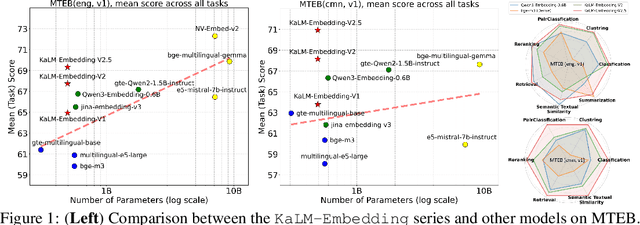
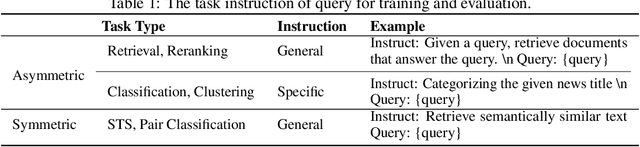

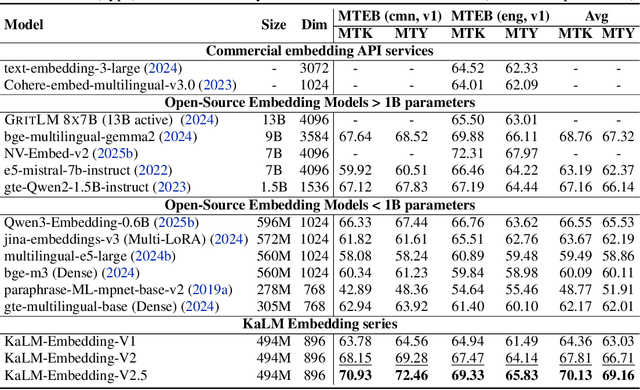
In this paper, we propose KaLM-Embedding-V2, a versatile and compact embedding model, which achieves impressive performance in general-purpose text embedding tasks by leveraging superior training techniques and data. Our key innovations include: (1) To better align the architecture with representation learning, we remove the causal attention mask and adopt a fully bidirectional transformer with simple yet effective mean-pooling to produce fixed-length embeddings; (2) We employ a multi-stage training pipeline: (i) pre-training on large-scale weakly supervised open-source corpora; (ii) fine-tuning on high-quality retrieval and non-retrieval datasets; and (iii) model-soup parameter averaging for robust generalization. Besides, we introduce a focal-style reweighting mechanism that concentrates learning on difficult samples and an online hard-negative mixing strategy to continuously enrich hard negatives without expensive offline mining; (3) We collect over 20 categories of data for pre-training and 100 categories of data for fine-tuning, to boost both the performance and generalization of the embedding model. Extensive evaluations on the Massive Text Embedding Benchmark (MTEB) Chinese and English show that our model significantly outperforms others of comparable size, and competes with 3x, 14x, 18x, and 26x larger embedding models, setting a new standard for a versatile and compact embedding model with less than 1B parameters.
Recognition through Reasoning: Reinforcing Image Geo-localization with Large Vision-Language Models
Jun 17, 2025Previous methods for image geo-localization have typically treated the task as either classification or retrieval, often relying on black-box decisions that lack interpretability. The rise of large vision-language models (LVLMs) has enabled a rethinking of geo-localization as a reasoning-driven task grounded in visual cues. However, two major challenges persist. On the data side, existing reasoning-focused datasets are primarily based on street-view imagery, offering limited scene diversity and constrained viewpoints. On the modeling side, current approaches predominantly rely on supervised fine-tuning, which yields only marginal improvements in reasoning capabilities. To address these challenges, we propose a novel pipeline that constructs a reasoning-oriented geo-localization dataset, MP16-Reason, using diverse social media images. We introduce GLOBE, Group-relative policy optimization for Locatability assessment and Optimized visual-clue reasoning, yielding Bi-objective geo-Enhancement for the VLM in recognition and reasoning. GLOBE incorporates task-specific rewards that jointly enhance locatability assessment, visual clue reasoning, and geolocation accuracy. Both qualitative and quantitative results demonstrate that GLOBE outperforms state-of-the-art open-source LVLMs on geo-localization tasks, particularly in diverse visual scenes, while also generating more insightful and interpretable reasoning trajectories.