 Add to Chrome
 Add to Firefox
 Add to Edge
TFP: Temporally Conditioned Memory-Fusion Policies for Visuomotor Learning
Jul 09, 2026
Vision--Language--Action (VLA) policies such as $π_{0.5}$ and OpenVLA perform well on many manipulation tasks, but they are often reactive: the next action is predicted from the current observation, instruction, and proprioceptive state. This assumption breaks down in stage-dependent manipulation, where visually similar states may require different actions depending on latent task progress and previous interaction outcomes. We argue that such tasks require not only memory, but dynamics-aware belief updates: the policy should preserve task progress during stable or occluded phases and revise its belief near contact, release, or subgoal transitions. We introduce Temporally Conditioned Memory-Fusion Policies (TFP), a lightweight memory-action framework for VLA backbones. TFP maintains an episode-local task-progress belief with Liquid Time-Constant dynamics and injects the updated belief directly into the flow-matching action decoder through adaptive modulation. This lets temporally accumulated context shape the generated action chunk, rather than serving only as passive history context. With a 3.3B-parameter model, TFP improves the average success rate from \(96.9\%\) to \(98.75\%\) on LIBERO and from \(91.4\%\) to \(93.77\%\) on LIBERO-plus. On the memory-focused MIKASA ShellGameTouch diagnostic, TFP achieves success up to \(75.0\%\). Mechanistic analyses show that write-gain changes near manipulation events are about \(6\times\) larger than far non-event phases, and hidden-state interventions show that the belief causally modulates generated action chunks. These results suggest that compact, event-sensitive memory dynamics can improve VLA policies under occlusion, visual perturbation, and stage-dependent task structure.

From Shallow to Deep: Pinning Semantic Intent via Causal GRPO
Mar 03, 2026Large Language Models remain vulnerable to adversarial prefix attacks (e.g., ``Sure, here is'') despite robust standard safety. We diagnose this vulnerability as Shallow Safety Alignment, stemming from a pathology we term semantic representation decay: as the model generates compliant prefixes, its internal malicious intent signal fades. To address this, we propose Two-Stage Causal-GRPO (TSC-GRPO), a framework designed to achieve intent pinning. First, grounded in causal identifiability theory, we train a causal intent probe to disentangle invariant intent from stylistic perturbations. Second, we internalize this causal awareness into the policy via Group Relative Policy Optimization. By employing a cumulative causal penalty within ``fork-in-the-road'' training scenarios, we force the model to learn that accumulating harmful tokens monotonically decreases reward, enabling robust late-stage refusals. Experiments show that TSC-GRPO significantly outperforms baselines in defending against jailbreak attacks while preserving general utility.
Causal Front-Door Adjustment for Robust Jailbreak Attacks on LLMs
Feb 05, 2026Safety alignment mechanisms in Large Language Models (LLMs) often operate as latent internal states, obscuring the model's inherent capabilities. Building on this observation, we model the safety mechanism as an unobserved confounder from a causal perspective. Then, we propose the \textbf{C}ausal \textbf{F}ront-Door \textbf{A}djustment \textbf{A}ttack ({\textbf{CFA}}$^2$) to jailbreak LLM, which is a framework that leverages Pearl's Front-Door Criterion to sever the confounding associations for robust jailbreaking. Specifically, we employ Sparse Autoencoders (SAEs) to physically strip defense-related features, isolating the core task intent. We further reduce computationally expensive marginalization to a deterministic intervention with low inference complexity. Experiments demonstrate that {CFA}$^2$ achieves state-of-the-art attack success rates while offering a mechanistic interpretation of the jailbreaking process.
Robust LiDAR-Camera Calibration with 2D Gaussian Splatting
Apr 01, 2025
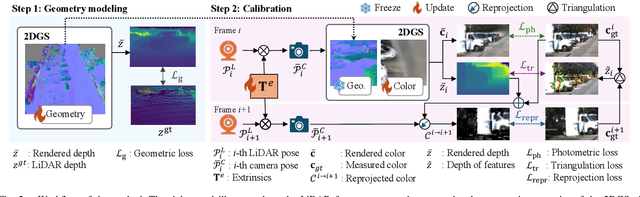


LiDAR-camera systems have become increasingly popular in robotics recently. A critical and initial step in integrating the LiDAR and camera data is the calibration of the LiDAR-camera system. Most existing calibration methods rely on auxiliary target objects, which often involve complex manual operations, whereas targetless methods have yet to achieve practical effectiveness. Recognizing that 2D Gaussian Splatting (2DGS) can reconstruct geometric information from camera image sequences, we propose a calibration method that estimates LiDAR-camera extrinsic parameters using geometric constraints. The proposed method begins by reconstructing colorless 2DGS using LiDAR point clouds. Subsequently, we update the colors of the Gaussian splats by minimizing the photometric loss. The extrinsic parameters are optimized during this process. Additionally, we address the limitations of the photometric loss by incorporating the reprojection and triangulation losses, thereby enhancing the calibration robustness and accuracy.
* Accepted in IEEE Robotics and Automation Letters. Code available at: https://github.com/ShuyiZhou495/RobustCalibration
INF: Implicit Neural Fusion for LiDAR and Camera
Aug 28, 2023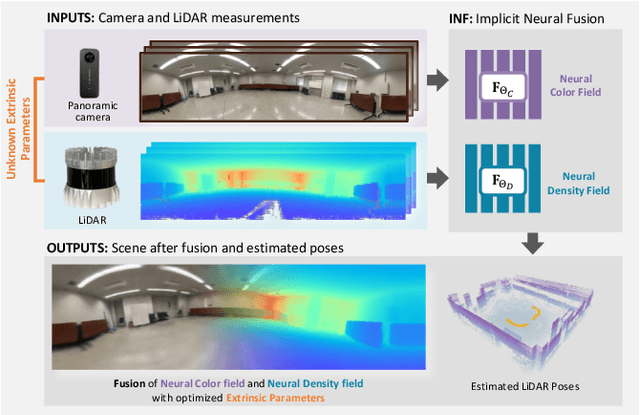
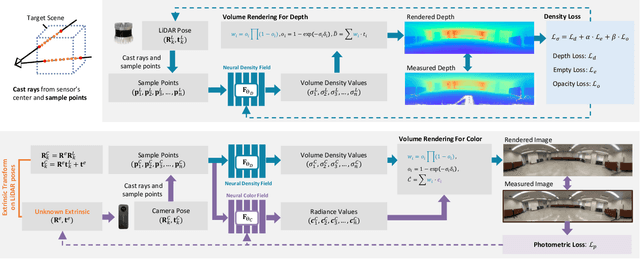
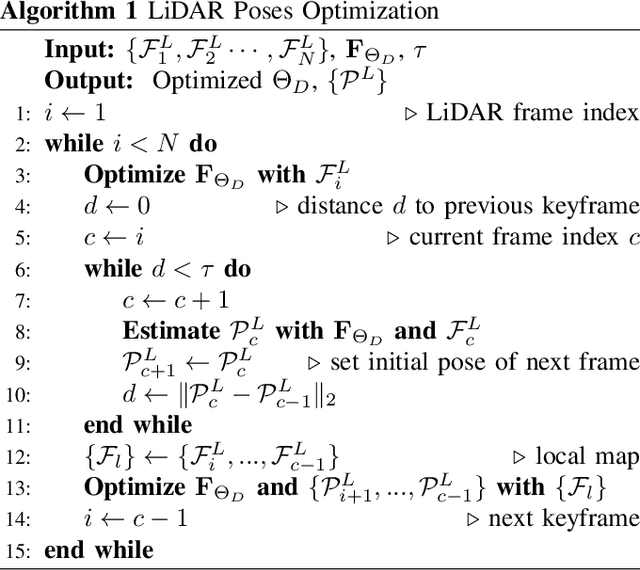
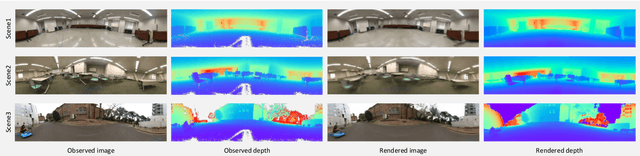
Sensor fusion has become a popular topic in robotics. However, conventional fusion methods encounter many difficulties, such as data representation differences, sensor variations, and extrinsic calibration. For example, the calibration methods used for LiDAR-camera fusion often require manual operation and auxiliary calibration targets. Implicit neural representations (INRs) have been developed for 3D scenes, and the volume density distribution involved in an INR unifies the scene information obtained by different types of sensors. Therefore, we propose implicit neural fusion (INF) for LiDAR and camera. INF first trains a neural density field of the target scene using LiDAR frames. Then, a separate neural color field is trained using camera images and the trained neural density field. Along with the training process, INF both estimates LiDAR poses and optimizes extrinsic parameters. Our experiments demonstrate the high accuracy and stable performance of the proposed method.
AI-GOMS: Large AI-Driven Global Ocean Modeling System
Aug 10, 2023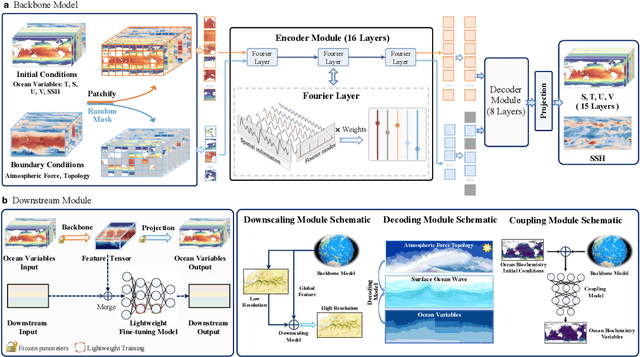
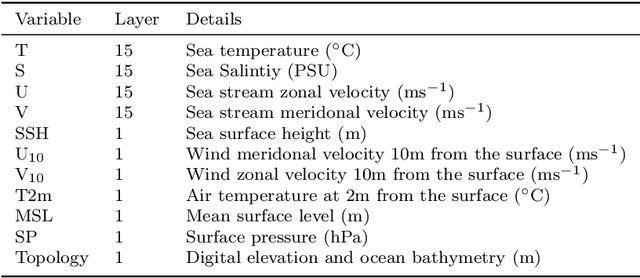
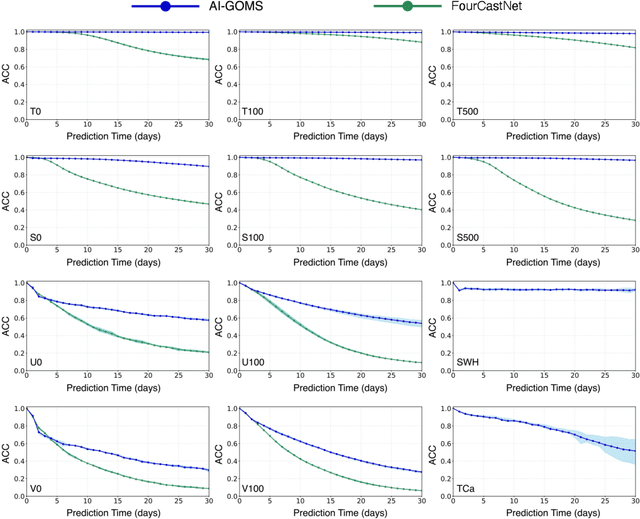
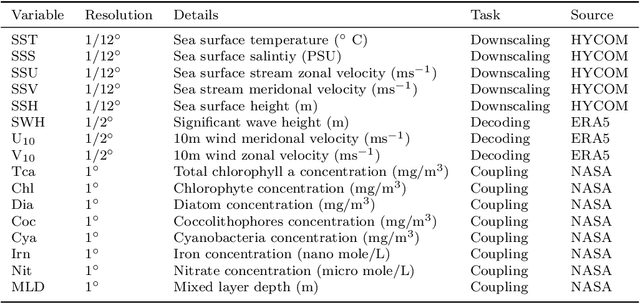
Ocean modeling is a powerful tool for simulating the physical, chemical, and biological processes of the ocean, which is the foundation for marine science research and operational oceanography. Modern numerical ocean modeling mainly consists of governing equations and numerical algorithms. Nonlinear instability, computational expense, low reusability efficiency and high coupling costs have gradually become the main bottlenecks for the further development of numerical ocean modeling. Recently, artificial intelligence-based modeling in scientific computing has shown revolutionary potential for digital twins and scientific simulations, but the bottlenecks of numerical ocean modeling have not been further solved. Here, we present AI-GOMS, a large AI-driven global ocean modeling system, for accurate and efficient global ocean daily prediction. AI-GOMS consists of a backbone model with the Fourier-based Masked Autoencoder structure for basic ocean variable prediction and lightweight fine-tuning models incorporating regional downscaling, wave decoding, and biochemistry coupling modules. AI-GOMS has achieved the best performance in 30 days of prediction for the global ocean basic variables with 15 depth layers at 1/4{\deg} spatial resolution. Beyond the good performance in statistical metrics, AI-GOMS realizes the simulation of mesoscale eddies in the Kuroshio region at 1/12{\deg} spatial resolution and ocean stratification in the tropical Pacific Ocean. AI-GOMS provides a new backbone-downstream paradigm for Earth system modeling, which makes the system transferable, scalable and reusable.