 Add to Chrome
 Add to Firefox
 Add to Edge
Mult-DPO: Multinomial Direct Preference Optimization for Recommender Systems
Jun 08, 2026
Direct preference optimization (DPO) is a simple and effective alignment strategy for large language models (LLMs) based on pairwise preferences. In recommender systems, however, user feedback is rarely pairwise. For a given context, e.g., a user, a session, or a conversation, we typically observe set-wise preferences with multiple positive items, where every positive item should outrank every unobserved or explicitly negative item, with no prescribed order among the positives or the negatives themselves. A natural generalization is to use the Plackett-Luce (PL) reward model, which extends the Bradley-Terry reward model underlying vanilla DPO from pairwise preferences to full rankings of candidates. However, we show that adapting the PL model to set-wise preferences requires marginalizing over all positive orderings, where the resulting expression is combinatorial in complexity. To address this fundamental challenge, we propose Mult-DPO, a novel DPO objective with a tractable multinomial surrogate likelihood over set-wise preference events for the user-preference alignment of LLM-based recommender systems. The multinomial construction is not itself a ranking distribution, but it is defined on the same reward-induced weight space and admits a closed-form DPO-style objective, enabling direct alignment of LLMs with multiple candidates through a classification-style objective. In addition, we prove that the multinomial DPO loss is a tractable upper bound on the marginalized PL DPO loss when optimizing against the set-wise preference data. We further characterize the tightness of this bound in terms of the relative total weight of positives versus negatives, which provides insights into tightening the bound with richer or harder negatives. Finally, we extend Mult-DPO to the alignment of LLMs with multiple preference levels. Code is available at https://github.com/yaochenzhu/Mult_DPO

CausalFlip: A Benchmark for LLM Causal Judgment Beyond Semantic Matching
Feb 23, 2026As large language models (LLMs) witness increasing deployment in complex, high-stakes decision-making scenarios, it becomes imperative to ground their reasoning in causality rather than spurious correlations. However, strong performance on traditional reasoning benchmarks does not guarantee true causal reasoning ability of LLMs, as high accuracy may still arise from memorizing semantic patterns instead of analyzing the underlying true causal structures. To bridge this critical gap, we propose a new causal reasoning benchmark, CausalFlip, designed to encourage the development of new LLM paradigm or training algorithms that ground LLM reasoning in causality rather than semantic correlation. CausalFlip consists of causal judgment questions built over event triples that could form different confounder, chain, and collider relations. Based on this, for each event triple, we construct pairs of semantically similar questions that reuse the same events but yield opposite causal answers, where models that rely heavily on semantic matching are systematically driven toward incorrect predictions. To further probe models' reliance on semantic patterns, we introduce a noisy-prefix evaluation that prepends causally irrelevant text before intermediate causal reasoning steps without altering the underlying causal relations or the logic of the reasoning process. We evaluate LLMs under multiple training paradigms, including answer-only training, explicit Chain-of-Thought (CoT) supervision, and a proposed internalized causal reasoning approach that aims to mitigate explicit reliance on correlation in the reasoning process. Our results show that explicit CoT can still be misled by spurious semantic correlations, where internalizing reasoning steps yields substantially improved causal grounding, suggesting that it is promising to better elicit the latent causal reasoning capabilities of base LLMs.
IAPO: Information-Aware Policy Optimization for Token-Efficient Reasoning
Feb 22, 2026Large language models increasingly rely on long chains of thought to improve accuracy, yet such gains come with substantial inference-time costs. We revisit token-efficient post-training and argue that existing sequence-level reward-shaping methods offer limited control over how reasoning effort is allocated across tokens. To bridge the gap, we propose IAPO, an information-theoretic post-training framework that assigns token-wise advantages based on each token's conditional mutual information (MI) with the final answer. This yields an explicit, principled mechanism for identifying informative reasoning steps and suppressing low-utility exploration. We provide a theoretical analysis showing that our IAPO can induce monotonic reductions in reasoning verbosity without harming correctness. Empirically, IAPO consistently improves reasoning accuracy while reducing reasoning length by up to 36%, outperforming existing token-efficient RL methods across various reasoning datasets. Extensive empirical evaluations demonstrate that information-aware advantage shaping is a powerful and general direction for token-efficient post-training. The code is available at https://github.com/YinhanHe123/IAPO.
Saliency-Aware Multi-Route Thinking: Revisiting Vision-Language Reasoning
Feb 18, 2026Vision-language models (VLMs) aim to reason by jointly leveraging visual and textual modalities. While allocating additional inference-time computation has proven effective for large language models (LLMs), achieving similar scaling in VLMs remains challenging. A key obstacle is that visual inputs are typically provided only once at the start of generation, while textual reasoning (e.g., early visual summaries) is generated autoregressively, causing reasoning to become increasingly text-dominated and allowing early visual grounding errors to accumulate. Moreover, vanilla guidance for visual grounding during inference is often coarse and noisy, making it difficult to steer reasoning over long texts. To address these challenges, we propose \emph{Saliency-Aware Principle} (SAP) selection. SAP operates on high-level reasoning principles rather than token-level trajectories, which enable stable control over discrete generation under noisy feedback while allowing later reasoning steps to re-consult visual evidence when renewed grounding is required. In addition, SAP supports multi-route inference, enabling parallel exploration of diverse reasoning behaviors. SAP is model-agnostic and data-free, requiring no additional training. Empirical results show that SAP achieves competitive performance, especially in reducing object hallucination, under comparable token-generation budgets while yielding more stable reasoning and lower response latency than CoT-style long sequential reasoning.
MolEdit: Knowledge Editing for Multimodal Molecule Language Models
Nov 16, 2025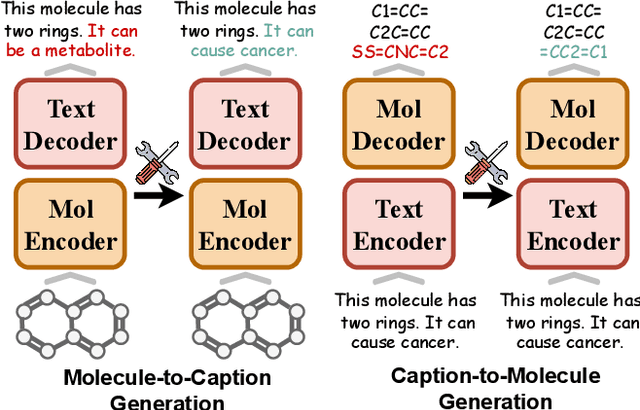
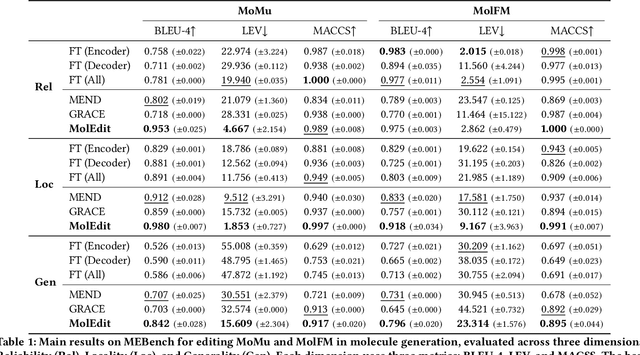
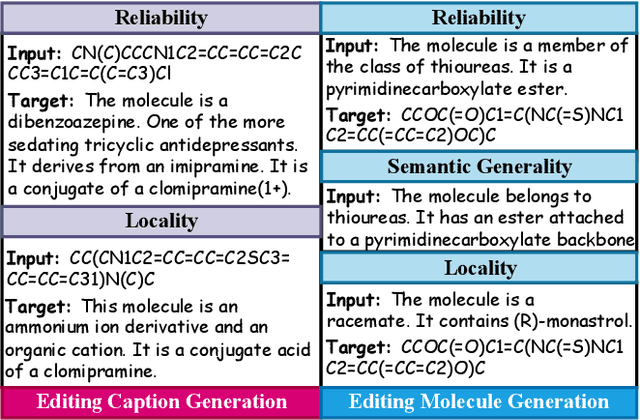
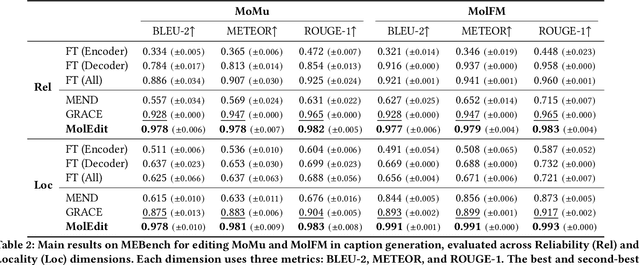
Understanding and continuously refining multimodal molecular knowledge is crucial for advancing biomedicine, chemistry, and materials science. Molecule language models (MoLMs) have become powerful tools in these domains, integrating structural representations (e.g., SMILES strings, molecular graphs) with rich contextual descriptions (e.g., physicochemical properties). However, MoLMs can encode and propagate inaccuracies due to outdated web-mined training corpora or malicious manipulation, jeopardizing downstream discovery pipelines. While knowledge editing has been explored for general-domain AI, its application to MoLMs remains uncharted, presenting unique challenges due to the multifaceted and interdependent nature of molecular knowledge. In this paper, we take the first step toward MoLM editing for two critical tasks: molecule-to-caption generation and caption-to-molecule generation. To address molecule-specific challenges, we propose MolEdit, a powerful framework that enables targeted modifications while preserving unrelated molecular knowledge. MolEdit combines a Multi-Expert Knowledge Adapter that routes edits to specialized experts for different molecular facets with an Expertise-Aware Editing Switcher that activates the adapters only when input closely matches the stored edits across all expertise, minimizing interference with unrelated knowledge. To systematically evaluate editing performance, we introduce MEBench, a comprehensive benchmark assessing multiple dimensions, including Reliability (accuracy of the editing), Locality (preservation of irrelevant knowledge), and Generality (robustness to reformed queries). Across extensive experiments on two popular MoLM backbones, MolEdit delivers up to 18.8% higher Reliability and 12.0% better Locality than baselines while maintaining efficiency. The code is available at: https://github.com/LzyFischer/MolEdit.
Learning from Diverse Reasoning Paths with Routing and Collaboration
Aug 23, 2025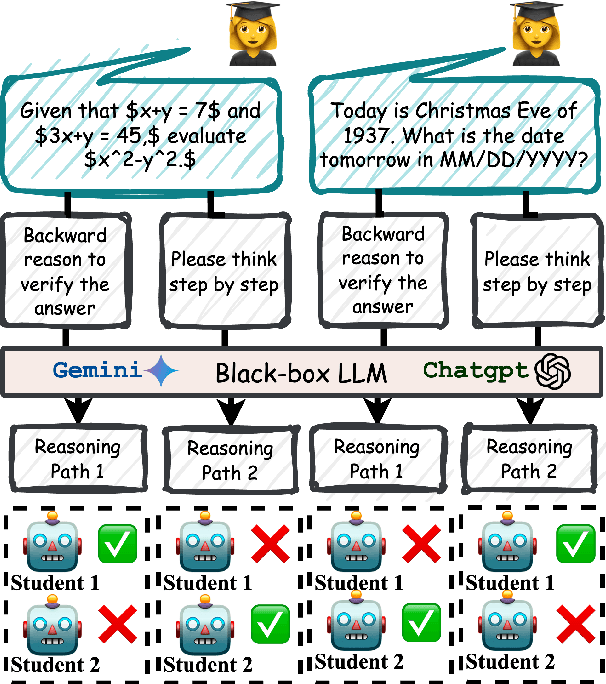
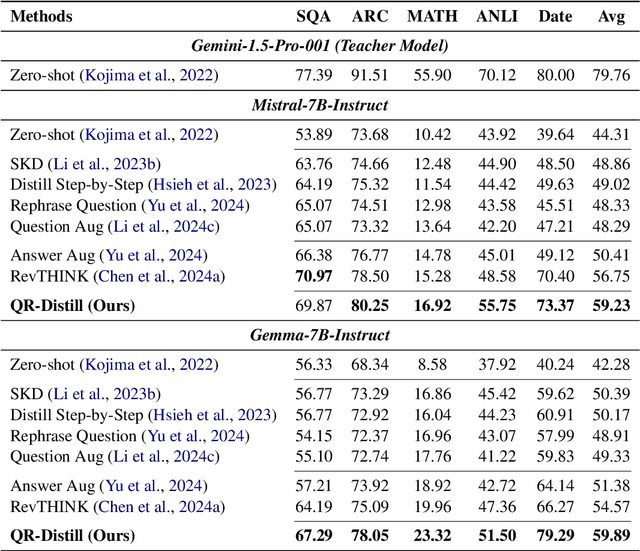
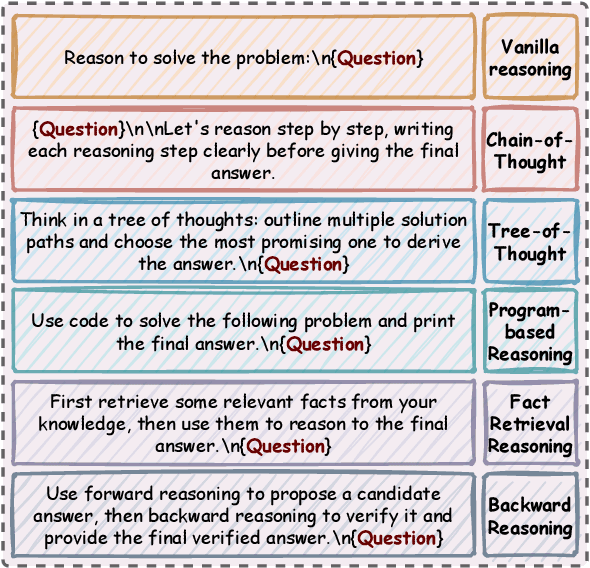
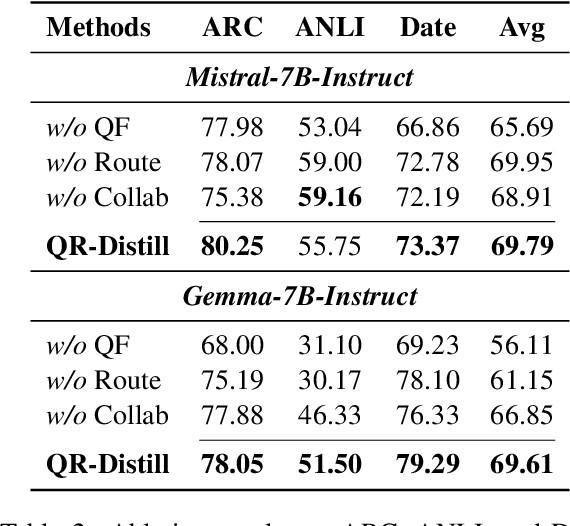
Advances in large language models (LLMs) significantly enhance reasoning capabilities but their deployment is restricted in resource-constrained scenarios. Knowledge distillation addresses this by transferring knowledge from powerful teacher models to compact and transparent students. However, effectively capturing the teacher's comprehensive reasoning is challenging due to conventional token-level supervision's limited scope. Using multiple reasoning paths per query alleviates this problem, but treating each path identically is suboptimal as paths vary widely in quality and suitability across tasks and models. We propose Quality-filtered Routing with Cooperative Distillation (QR-Distill), combining path quality filtering, conditional routing, and cooperative peer teaching. First, quality filtering retains only correct reasoning paths scored by an LLM-based evaluation. Second, conditional routing dynamically assigns paths tailored to each student's current learning state. Finally, cooperative peer teaching enables students to mutually distill diverse insights, addressing knowledge gaps and biases toward specific reasoning styles. Experiments demonstrate QR-Distill's superiority over traditional single- and multi-path distillation methods. Ablation studies further highlight the importance of each component including quality filtering, conditional routing, and peer teaching in effective knowledge transfer. Our code is available at https://github.com/LzyFischer/Distill.
Graph Prompting for Graph Learning Models: Recent Advances and Future Directions
Jun 10, 2025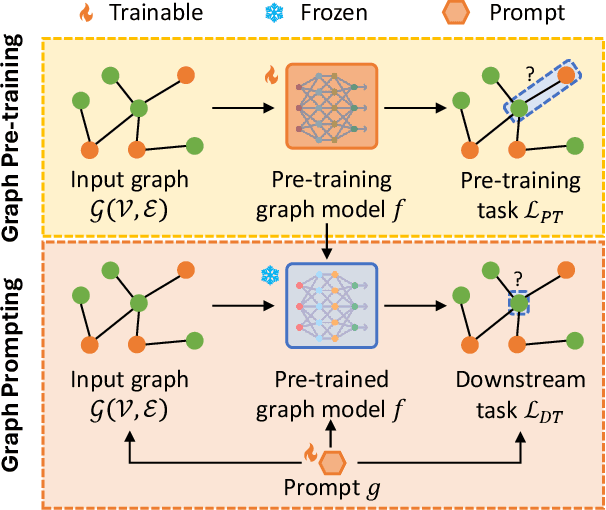
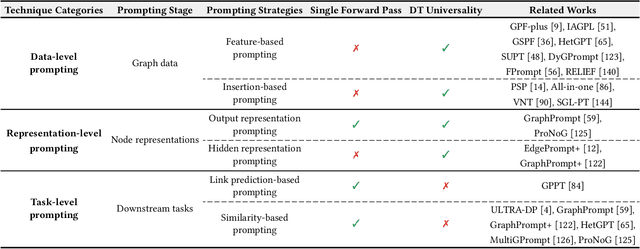
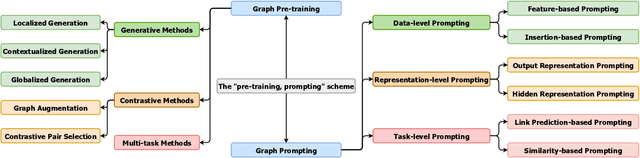
Graph learning models have demonstrated great prowess in learning expressive representations from large-scale graph data in a wide variety of real-world scenarios. As a prevalent strategy for training powerful graph learning models, the "pre-training, adaptation" scheme first pre-trains graph learning models on unlabeled graph data in a self-supervised manner and then adapts them to specific downstream tasks. During the adaptation phase, graph prompting emerges as a promising approach that learns trainable prompts while keeping the pre-trained graph learning models unchanged. In this paper, we present a systematic review of recent advancements in graph prompting. First, we introduce representative graph pre-training methods that serve as the foundation step of graph prompting. Next, we review mainstream techniques in graph prompting and elaborate on how they design learnable prompts for graph prompting. Furthermore, we summarize the real-world applications of graph prompting from different domains. Finally, we discuss several open challenges in existing studies with promising future directions in this field.
Collaborative Retrieval for Large Language Model-based Conversational Recommender Systems
Feb 19, 2025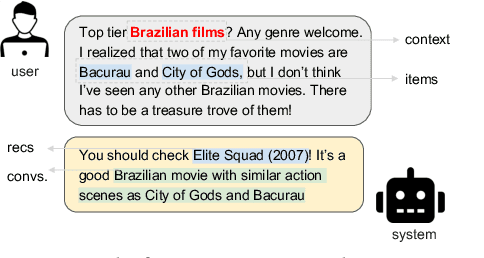
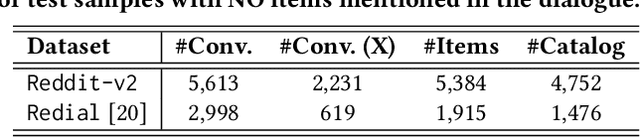
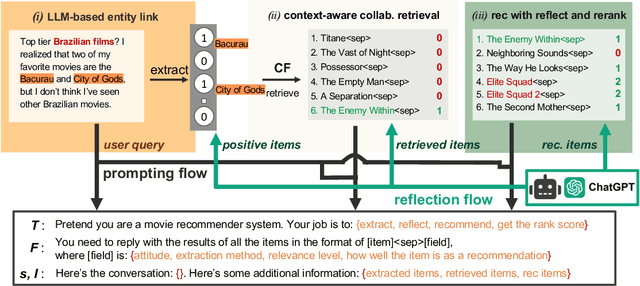
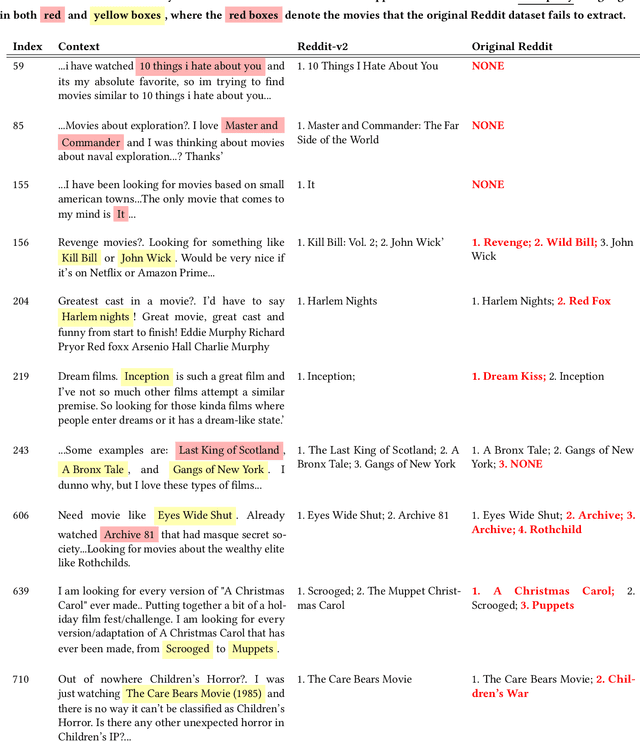
Conversational recommender systems (CRS) aim to provide personalized recommendations via interactive dialogues with users. While large language models (LLMs) enhance CRS with their superior understanding of context-aware user preferences, they typically struggle to leverage behavioral data, which have proven to be important for classical collaborative filtering (CF)-based approaches. For this reason, we propose CRAG, Collaborative Retrieval Augmented Generation for LLM-based CRS. To the best of our knowledge, CRAG is the first approach that combines state-of-the-art LLMs with CF for conversational recommendations. Our experiments on two publicly available movie conversational recommendation datasets, i.e., a refined Reddit dataset (which we name Reddit-v2) as well as the Redial dataset, demonstrate the superior item coverage and recommendation performance of CRAG, compared to several CRS baselines. Moreover, we observe that the improvements are mainly due to better recommendation accuracy on recently released movies. The code and data are available at https://github.com/yaochenzhu/CRAG.
Generative Risk Minimization for Out-of-Distribution Generalization on Graphs
Feb 11, 2025Out-of-distribution (OOD) generalization on graphs aims at dealing with scenarios where the test graph distribution differs from the training graph distributions. Compared to i.i.d. data like images, the OOD generalization problem on graph-structured data remains challenging due to the non-i.i.d. property and complex structural information on graphs. Recently, several works on graph OOD generalization have explored extracting invariant subgraphs that share crucial classification information across different distributions. Nevertheless, such a strategy could be suboptimal for entirely capturing the invariant information, as the extraction of discrete structures could potentially lead to the loss of invariant information or the involvement of spurious information. In this paper, we propose an innovative framework, named Generative Risk Minimization (GRM), designed to generate an invariant subgraph for each input graph to be classified, instead of extraction. To address the challenge of optimization in the absence of optimal invariant subgraphs (i.e., ground truths), we derive a tractable form of the proposed GRM objective by introducing a latent causal variable, and its effectiveness is validated by our theoretical analysis. We further conduct extensive experiments across a variety of real-world graph datasets for both node-level and graph-level OOD generalization, and the results demonstrate the superiority of our framework GRM.
Collaborative Diffusion Model for Recommender System
Jan 31, 2025


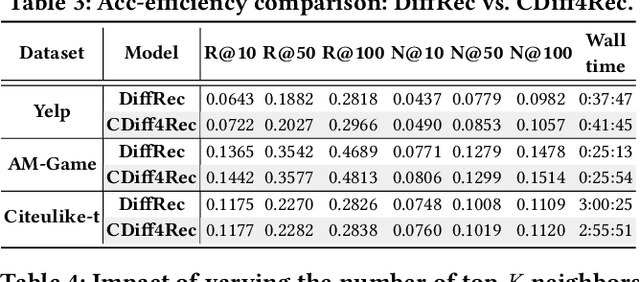
Diffusion-based recommender systems (DR) have gained increasing attention for their advanced generative and denoising capabilities. However, existing DR face two central limitations: (i) a trade-off between enhancing generative capacity via noise injection and retaining the loss of personalized information. (ii) the underutilization of rich item-side information. To address these challenges, we present a Collaborative Diffusion model for Recommender System (CDiff4Rec). Specifically, CDiff4Rec generates pseudo-users from item features and leverages collaborative signals from both real and pseudo personalized neighbors identified through behavioral similarity, thereby effectively reconstructing nuanced user preferences. Experimental results on three public datasets show that CDiff4Rec outperforms competitors by effectively mitigating the loss of personalized information through the integration of item content and collaborative signals.