 Add to Chrome
 Add to Firefox
 Add to Edge
TREK: A Travel Reasoning and Evaluation Kit for LLM Agents in Complex Trip Planning
Jul 29, 2026
Travel planning is a demanding stress test for tool-using LLM agents: a usable itinerary is a single artifact that must be right along many axes at once - every flight, hotel, and attraction must exist and be bookable, the days must be physically traversable, the total must clear a budget, and the plan must serve a traveler whose needs are only partly stated. Existing agent benchmarks reward these properties one at a time and grade the final output with soft or LLM-judged rubrics, which cannot certify that a returned plan is executable and are neither reproducible nor auditable. We introduce TREK (Travel Reasoning and Evaluation Kit), a benchmark for feasible itinerary synthesis: producing a single plan that is jointly constraint-correct, hallucination-free, spatio-temporally executable, budget-valid, and responsive to the traveler's unstated persona needs. TREK comprises 800 multi-constraint tasks - 533 feasible and 267 provably infeasible with typed route/entity/budget causes - over a synthetic, internally consistent knowledge base of 212,530 records across 375 cities and 13 personas, served through a production-style tool sandbox of validated RESTful APIs. Every task is scored by a fully deterministic, rule-based evaluator with no LLM judge and ships a human-verified gold reference that scores a perfect 1.0 under that same evaluator, so the ceiling is demonstrably achievable and every remaining gap is an agent limitation rather than scorer strictness. Evaluating 15 LLM agents across nine constraint dimensions, we find that even the strongest (GPT-5.6) produces a fully-feasible plan on only 46.2% of solvable tasks, with a median of 6.6% and a floor of 0.0%; satisfying travelers' unstated needs emerges as the universal bottleneck, unsolved even at the frontier. We release the dataset, tool sandbox, deterministic evaluator, and agent code as a fully reproducible benchmark.

Reinforcement Learning for Large Language Model Selective Evidence Adoption from Contaminated Retrieval Results
Jul 22, 2026Retrieval-augmented large language models frequently face contexts that interleave useful evidence with misleading statements or instruction-like content. Blanket refusal discards valid evidence, whereas uncritical adoption yields incorrect or unsafe answers. The ability to selectively adopt relevant information while rejecting deceptive or harmful content is therefore critical for reliable deployment in real-world retrieval settings. We introduce SelectBench, a controlled benchmark and training set for selective evidence adoption, and post-train Qwen3.5-4B directly with DAPO using either deterministic rule rewards or a frozen semantic judge. On the corrected 325-example SelectBench-v2 test set, strict success rises from 22.46% for the original checkpoint to 25.54% with DAPO-Rule and 26.46% with DAPO-DeepSeek. Both trained policies reduce forbidden-content adoption and produce shorter, more focused responses, yet prompt-injection following does not improve. The paired gains are modest and fail to survive Holm correction, suggesting that stronger reward shaping or additional training iterations may be needed for more robust gains. DAPO-DeepSeek exhibits no material degradation on MMLU or clean HotpotQA, indicating that the post-training procedure preserves general capabilities. These results demonstrate a directional improvement in selective evidence use, while identifying injection resistance and statistical robustness as important remaining challenges for future work.
Momentum for Reasoning: Dense Intrinsic Signals in Policy Optimization
Jun 07, 2026Reinforcement learning with verifiable rewards (RLVR) has emerged as a powerful paradigm for eliciting long-chain reasoning in large language models. However, existing methods based on Group Relative Policy Optimization (GRPO) rely on a binary outcome reward, which induces two structural failure modes: Zero-Advantage Collapse, in which all rollouts in a group share the same outcome and the gradient vanishes, and Hallucinated Certainty, in which the model becomes increasingly confident on incorrect rollouts late in training. We address both modes by densifying the reward with intrinsic signals computed entirely from the policy's own conditional probabilities, and propose ISPO (Intrinsic Signal Policy Optimization, which combines a sequence-level signal measuring how informative the thinking trajectory is for the final answer, with a token-level directional reward whose hallucinated-certainty hinge penalizes confidently-wrong predictions at critical decision tokens. Across three base models and five mathematical reasoning benchmarks, ISPO consistently outperforms competitive baselines, with the largest gains on the hardest benchmarks where zero-advantage collapse is most frequent, and training-dynamics diagnostics confirm that both failure modes are decreased.
GUI-CIDER: Mid-training GUI Agents via Causal Internalization and Density-aware Exemplar Reselection
May 27, 2026Despite the rapid progress of multimodal large language models in building Graphical User Interface (GUI) agents, their real-world task completion is fundamentally bottlenecked by a lack of world knowledge about GUI operations. Existing solutions typically rely on expensive multi-agent scaffolding or conventional post-training paradigms, such as Supervised Fine-Tuning (SFT) and Reinforcement Learning (RL). However, post-training only allows agents to implicitly absorb world knowledge through action annotations or reward signals, leading to inefficient trajectory memorization rather than genuine comprehension. Therefore, an approach that enables explicit learning of this knowledge is imperative. To this end, we propose GUI-CIDER, a mid-training method that explicitly internalizes GUI world knowledge through Causal Internalization and Density-aware Exemplar Reselection. GUI-CIDER operates in three stages: (1) data synthesis, which distills static planning and dynamic causal knowledge from GUI trajectories into text; (2) exemplar reselection, which filters the corpus by rewarding causal structures and penalizing semantic redundancy; and (3) mid-training, where the refined data is used to embed the acquired knowledge. Extensive experiments on two GUI knowledge benchmarks and three task completion benchmarks demonstrate that GUI-CIDER consistently improves both the agent's understanding of GUI operations and its task success rates.The codes are available at https://github.com/Wuzheng02/GUI-CIDER.
Dynamic Mixture of Latent Memories for Self-Evolving Agents
May 21, 2026Achieving self-evolution in intelligent agents requires the continual accumulation of new knowledge across changing task sequences without forgetting previously acquired abilities. Existing approaches either internalize knowledge by updating model parameters, which induces catastrophic forgetting, or rely on external memory, which fails to genuinely enhance the model's intrinsic capabilities. We propose MoLEM, a generative mixture of latent memory framework based on a dynamic mixture-of-experts (MoE). We treat multiple experts as independent carriers to generate memory. A router selects and weights experts through key-query matching, and the aggregated latent memory is injected into the reasoning process. The base model for reasoning remains entirely frozen, with all experiential knowledge internalized into the additional modules, avoiding catastrophic forgetting. For continual learning, each training stage is paired with a lightweight autoencoder that selects the appropriate routing group at inference, and inputs that match no stage fall back to the pretrained model. Experiments train the framework on continual-learning sequences spanning math, science, and code domains. After training, we evaluate the framework on the corresponding test sets to measure task learning and competence preservation across continual adaptation stages. After the full continual-learning sequence, our method improves the average accuracy by 10.40% over the Vanilla pretrained baseline, while none of the competing methods consistently exceed this baseline across different training orders.
LongCat-Flash-Thinking-2601 Technical Report
Jan 23, 2026We introduce LongCat-Flash-Thinking-2601, a 560-billion-parameter open-source Mixture-of-Experts (MoE) reasoning model with superior agentic reasoning capability. LongCat-Flash-Thinking-2601 achieves state-of-the-art performance among open-source models on a wide range of agentic benchmarks, including agentic search, agentic tool use, and tool-integrated reasoning. Beyond benchmark performance, the model demonstrates strong generalization to complex tool interactions and robust behavior under noisy real-world environments. Its advanced capability stems from a unified training framework that combines domain-parallel expert training with subsequent fusion, together with an end-to-end co-design of data construction, environments, algorithms, and infrastructure spanning from pre-training to post-training. In particular, the model's strong generalization capability in complex tool-use are driven by our in-depth exploration of environment scaling and principled task construction. To optimize long-tailed, skewed generation and multi-turn agentic interactions, and to enable stable training across over 10,000 environments spanning more than 20 domains, we systematically extend our asynchronous reinforcement learning framework, DORA, for stable and efficient large-scale multi-environment training. Furthermore, recognizing that real-world tasks are inherently noisy, we conduct a systematic analysis and decomposition of real-world noise patterns, and design targeted training procedures to explicitly incorporate such imperfections into the training process, resulting in improved robustness for real-world applications. To further enhance performance on complex reasoning tasks, we introduce a Heavy Thinking mode that enables effective test-time scaling by jointly expanding reasoning depth and width through intensive parallel thinking.
DS-ProGen: A Dual-Structure Deep Language Model for Functional Protein Design
May 18, 2025Inverse Protein Folding (IPF) is a critical subtask in the field of protein design, aiming to engineer amino acid sequences capable of folding correctly into a specified three-dimensional (3D) conformation. Although substantial progress has been achieved in recent years, existing methods generally rely on either backbone coordinates or molecular surface features alone, which restricts their ability to fully capture the complex chemical and geometric constraints necessary for precise sequence prediction. To address this limitation, we present DS-ProGen, a dual-structure deep language model for functional protein design, which integrates both backbone geometry and surface-level representations. By incorporating backbone coordinates as well as surface chemical and geometric descriptors into a next-amino-acid prediction paradigm, DS-ProGen is able to generate functionally relevant and structurally stable sequences while satisfying both global and local conformational constraints. On the PRIDE dataset, DS-ProGen attains the current state-of-the-art recovery rate of 61.47%, demonstrating the synergistic advantage of multi-modal structural encoding in protein design. Furthermore, DS-ProGen excels in predicting interactions with a variety of biological partners, including ligands, ions, and RNA, confirming its robust functional retention capabilities.
Developing and Utilizing a Large-Scale Cantonese Dataset for Multi-Tasking in Large Language Models
Mar 05, 2025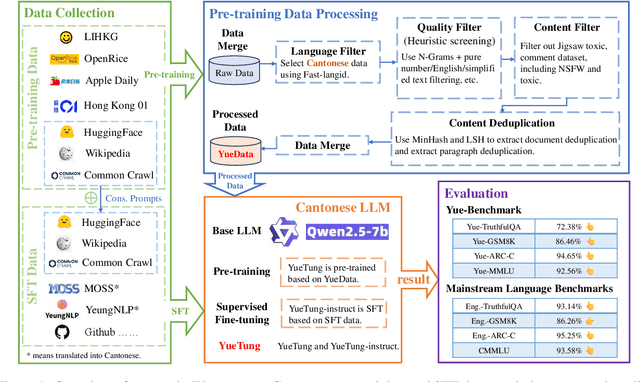
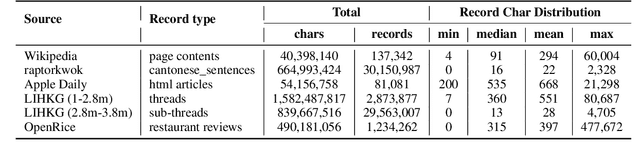
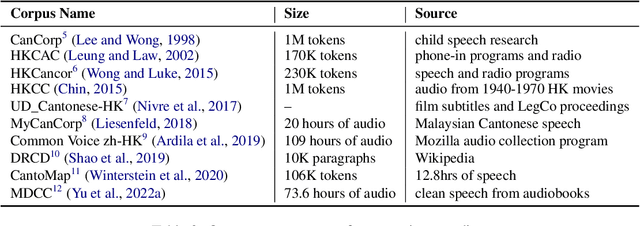
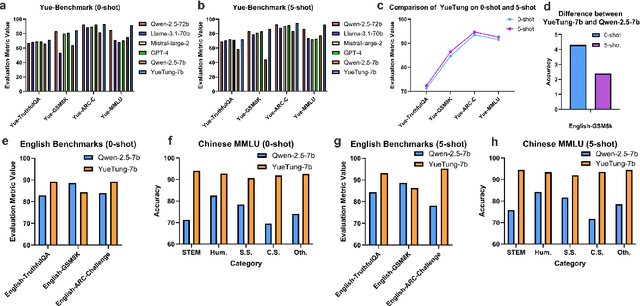
High-quality data resources play a crucial role in learning large language models (LLMs), particularly for low-resource languages like Cantonese. Despite having more than 85 million native speakers, Cantonese is still considered a low-resource language in the field of natural language processing (NLP) due to factors such as the dominance of Mandarin, lack of cohesion within the Cantonese-speaking community, diversity in character encoding and input methods, and the tendency of overseas Cantonese speakers to prefer using English. In addition, rich colloquial vocabulary of Cantonese, English loanwords, and code-switching characteristics add to the complexity of corpus collection and processing. To address these challenges, we collect Cantonese texts from a variety of sources, including open source corpora, Hong Kong-specific forums, Wikipedia, and Common Crawl data. We conduct rigorous data processing through language filtering, quality filtering, content filtering, and de-duplication steps, successfully constructing a high-quality Cantonese corpus of over 2 billion tokens for training large language models. We further refined the model through supervised fine-tuning (SFT) on curated Cantonese tasks, enhancing its ability to handle specific applications. Upon completion of the training, the model achieves state-of-the-art (SOTA) performance on four Cantonese benchmarks. After training on our dataset, the model also exhibits improved performance on other mainstream language tasks.
Advancing Oyster Phenotype Segmentation with Multi-Network Ensemble and Multi-Scale mechanism
Jan 20, 2025Phenotype segmentation is pivotal in analysing visual features of living organisms, enhancing our understanding of their characteristics. In the context of oysters, meat quality assessment is paramount, focusing on shell, meat, gonad, and muscle components. Traditional manual inspection methods are time-consuming and subjective, prompting the adoption of machine vision technology for efficient and objective evaluation. We explore machine vision's capacity for segmenting oyster components, leading to the development of a multi-network ensemble approach with a global-local hierarchical attention mechanism. This approach integrates predictions from diverse models and addresses challenges posed by varying scales, ensuring robust instance segmentation across components. Finally, we provide a comprehensive evaluation of the proposed method's performance using different real-world datasets, highlighting its efficacy and robustness in enhancing oyster phenotype segmentation.
GUIDE: A Global Unified Inference Engine for Deploying Large Language Models in Heterogeneous Environments
Dec 06, 2024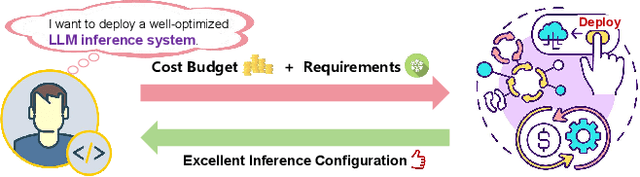
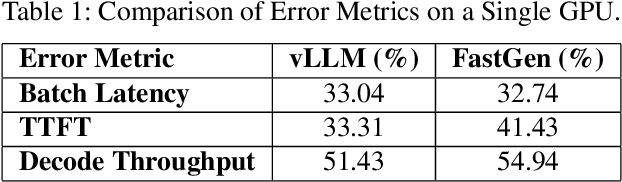
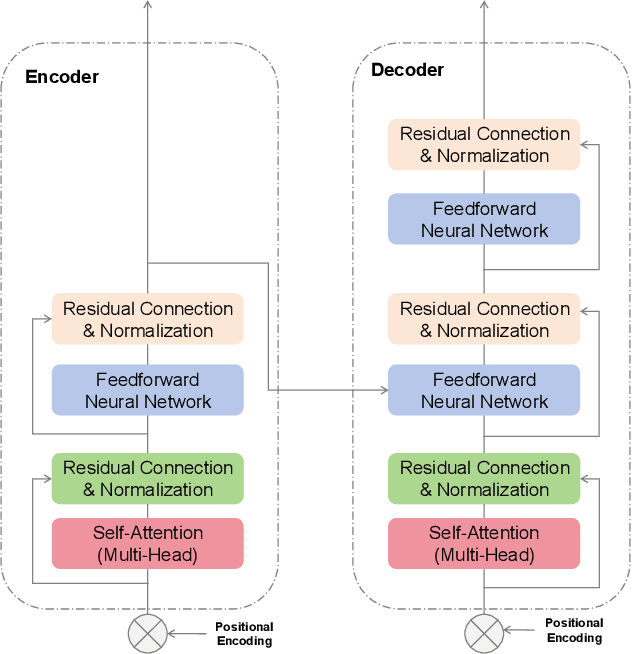
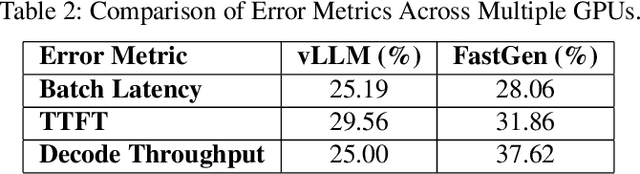
Efficiently deploying large language models (LLMs) in real-world scenarios remains a critical challenge, primarily due to hardware heterogeneity, inference framework limitations, and workload complexities.Efficiently deploying large language models (LLMs) in real-world scenarios remains a critical challenge, primarily due to hardware heterogeneity, inference framework limitations, and workload complexities. These challenges often lead to inefficiencies in memory utilization, latency, and throughput, hindering the effective deployment of LLMs, especially for non-experts. Through extensive experiments, we identify key performance bottlenecks, including sudden drops in memory utilization, latency fluctuations with varying batch sizes, and inefficiencies in multi-GPU configurations. These insights reveal a vast optimization space shaped by the intricate interplay of hardware, frameworks, and workload parameters. This underscores the need for a systematic approach to optimize LLM inference, motivating the design of our framework, GUIDE. GUIDE leverages dynamic modeling and simulation-based optimization to address these issues, achieving prediction errors between 25% and 55% for key metrics such as batch latency, TTFT, and decode throughput. By effectively bridging the gap between theoretical performance and practical deployment, our framework empowers practitioners, particularly non-specialists, to make data-driven decisions and unlock the full potential of LLMs in heterogeneous environments cheaply.