 Add to Chrome
 Add to Firefox
 Add to Edge
Reasoning Error from Known Fact: Step-Level Self-Consistency Group Relative Policy Optimization for LLM
Jul 21, 2026
With the rapid advancement of large language models (LLMs), modern systems not only possess strong foundational capabilities and extensive knowledge, but can also solve complex problems via long, multi-step reasoning. However, as reasoning traces become longer, LLMs may produce a substantial amount of hallucinated content during the reasoning process, which is often difficult to detect. In this work, we conduct a fine-grained analysis of hallucinations arising in LLM reasoning and find that the reasoning traces are particularly prone to Context-Sensitive Factual Hallucinations: cases where the model actually has the relevant knowledge, yet makes factual errors due to contextual interference during reasoning. To address this issue, we propose Step-level Self-Consistency Group Relative Policy Optimization (SSC-GRPO), which assigns step-level rewards to reasoning traces by computing self-consistency scores of individual steps across multiple rollouts. Compared with prior methods, SSC-GRPO achieves state-of-the-art performance on both mathematical reasoning benchmarks and hallucination leaderboards. Our results offer a new perspective for detecting and mitigating hallucinations in the reasoning process of large language models.

Purified OPSD: On-Policy Self-Distillation Without Losing How to Think
Jul 02, 2026On-policy self-distillation (OPSD) has emerged as a promising paradigm for improving LLM reasoning, where a privileged teacher with access to reference solutions provides token-level supervision on the student's own generated trajectories. However, we find that OPSD consistently fails on long chain-of-thought (long-CoT) reasoning models, yielding at best marginal gains while destabilizing the reflective reasoning capability these models depend on. Through a novel decomposition of the teacher's supervision signal, we identify the root cause: the teacher's supervision is dominated by a reference-induced component that drives rote memorization of reference-specific shortcuts, while the question-conditioned, inference-transferable component is ignored or actively opposed. Based on this diagnosis, we propose a two-step solution. First, we construct a reference-only teacher (the same model conditioned on the reference without the question) to isolate the non-transferable component of the supervision signal; the residual after subtracting this component captures the question-conditioned, inference-transferable correction. Second, we use pointwise mutual information (PMI) as the mechanism to transform this residual into a well-formed PMI target distribution that the student can directly distill from, filtering out the reference-induced shortcut. Experiments on four long-CoT models across two datasets demonstrate consistent improvements over both the base model and standard OPSD, while preserving the models' natural epistemic behavior throughout training.
Momentum for Reasoning: Dense Intrinsic Signals in Policy Optimization
Jun 07, 2026Reinforcement learning with verifiable rewards (RLVR) has emerged as a powerful paradigm for eliciting long-chain reasoning in large language models. However, existing methods based on Group Relative Policy Optimization (GRPO) rely on a binary outcome reward, which induces two structural failure modes: Zero-Advantage Collapse, in which all rollouts in a group share the same outcome and the gradient vanishes, and Hallucinated Certainty, in which the model becomes increasingly confident on incorrect rollouts late in training. We address both modes by densifying the reward with intrinsic signals computed entirely from the policy's own conditional probabilities, and propose ISPO (Intrinsic Signal Policy Optimization, which combines a sequence-level signal measuring how informative the thinking trajectory is for the final answer, with a token-level directional reward whose hallucinated-certainty hinge penalizes confidently-wrong predictions at critical decision tokens. Across three base models and five mathematical reasoning benchmarks, ISPO consistently outperforms competitive baselines, with the largest gains on the hardest benchmarks where zero-advantage collapse is most frequent, and training-dynamics diagnostics confirm that both failure modes are decreased.
FLaG: Fine-Grained Latent Grouping for Hallucination Detection
May 29, 2026Hallucinations in large language models (LLMs) arise from heterogeneous failure mechanisms, making reliable detection difficult for any single global uncertainty score. In this work, we formulate hallucination detection as a mechanism-aware evidence aggregation problem, where diverse representation- and token-level signals must be interpreted under multiple latent explanations. We propose FLaG, a lightweight hallucination detection framework that models correctness through a set of latent evidence groups. Each instance is softly associated with multiple groups via an energy-based routing mechanism, and group-conditional reliability signals are combined through a principled log-marginal aggregation. This design enables FLaG to capture heterogeneous hallucination patterns while remaining invariant to decision thresholds and evaluation metrics. The framework operates as a frozen-model head, requires no modification to the underlying language model, and incurs minimal computational overhead. We further provide a theoretical perspective that connects FLaG to optimal evidence aggregation under heterogeneous error mechanisms, showing that the Bayes-optimal test statistic necessarily admits a log-marginal form and that FLaG constitutes a tractable approximation with a controllable error bound. Extensive experiments across multiple benchmarks and LLM backbones demonstrate that FLaG consistently achieves SOTA performance, while exhibiting robust transfer across datasets and models, and remaining effective under limited supervision.
From Parameters to Data: A Task-Parameter-Guided Fine-Tuning Pipeline for Efficient LLM Alignment
May 20, 2026Adapting Large Language Models (LLMs) to specialized domains typically incurs high data and computational overhead. While prior efficiency efforts have largely treated data selection and parameter-efficient fine-tuning as isolated processes, our empirical analysis suggests they may be intrinsically coupled. We posit the Strong Map Hypothesis: a sparse subset of attention heads plays a dominant role in task-specific adaptation, acting as keys that unlock specific data patterns. Building on this observation, we propose From Parameters to Data (P2D), a unified framework that leverages these task-sensitive attention heads as a dual compass for both sample mining and structural pruning. To rigorously quantify the total pipeline cost, we introduce the Alignment Efficiency Ratio (AER) metric for both selection latency and training time. Mechanistically, P2D identifies critical heads via a lightweight proxy and uses them as a functional filter to curate high-affinity data, establishing a synergistic pipeline. Empirically, by updating merely 10% of attention heads on 10% of the data, P2D achieves an 8.3 pp performance gain over strong baselines and delivers a 7.0x end-to-end time speedup. These results validate that precise parameter-data synchronization eliminates redundancy, offering a new paradigm for efficient alignment.
Backtracking When It Strays: Mitigating Dual Exposure Biases in LLM Reasoning Distillation
May 19, 2026Large language models (LLMs) have achieved remarkable success in complex reasoning tasks via long chain-of-thought (CoT), yet their immense computational overhead hinders real-world deployment. LLM reasoning distillation addresses this by transferring reasoning capabilities from formidable teacher models to compact student models. However, existing distillation paradigms face a fundamental dilemma. Typical off-policy distillation strictly utilizes teacher-generated golden trajectories, suffering from an exposure bias due to the mismatch between training distributions and student-generated inference contexts, which leads to error cascades in long CoT reasoning. To address this, on-policy distillation allows students to explore their own trajectories, but we demonstrate that it inherently introduces a reciprocal reversed exposure bias: the teacher model also struggles to provide positive guidance when conditioned on student-generated sub-optimal contexts. To resolve this dual exposure biases problem, we propose Monitoring Trajectories and Backtracking when it strays (MOTAB), a new LLM reasoning distillation pipeline. Specifically, MOTAB dynamically monitors the student's on-policy generation against an adaptive safety boundary. When the generation strays and exceeds this threshold, MOTAB backtracks to the last safe state and leverages teacher intervention to correct the course. This approach inherently tolerates minor student errors to mitigate exposure bias, while preventing sub-optimal contexts to circumvent reversed exposure bias. Extensive experiments on the LIMO-v2 and AceReason datasets demonstrate that MOTAB effectively alleviates the dual exposure biases, yielding a roughly 3% average performance improvement in reasoning tasks.
Supervised Fine-Tuning Needs to Unlock the Potential of Token Priority
Feb 01, 2026The transition from fitting empirical data to achieving true human utility is fundamentally constrained by a granularity mismatch, where fine-grained autoregressive generation is often supervised by coarse or uniform signals. This position paper advocates Token Priority as the essential bridge, formalizing Supervised Fine-Tuning (SFT) not as simple optimization but as a precise distribution reshaping process that aligns raw data with the ideal alignment manifold. We analyze recent breakthroughs through this unified lens, categorizing them into two distinct regimes: Positive Priority for noise filtration and Signed Priority for toxic modes unlearning. We revisit existing progress and limitations, identify key challenges, and suggest directions for future research.
Training-Trajectory-Aware Token Selection
Jan 15, 2026Efficient distillation is a key pathway for converting expensive reasoning capability into deployable efficiency, yet in the frontier regime where the student already has strong reasoning ability, naive continual distillation often yields limited gains or even degradation. We observe a characteristic training phenomenon: even as loss decreases monotonically, all performance metrics can drop sharply at almost the same bottleneck, before gradually recovering. We further uncover a token-level mechanism: confidence bifurcates into steadily increasing Imitation-Anchor Tokens that quickly anchor optimization and other yet-to-learn tokens whose confidence is suppressed until after the bottleneck. And the characteristic that these two types of tokens cannot coexist is the root cause of the failure in continual distillation. To this end, we propose Training-Trajectory-Aware Token Selection (T3S) to reconstruct the training objective at the token level, clearing the optimization path for yet-to-learn tokens. T3 yields consistent gains in both AR and dLLM settings: with only hundreds of examples, Qwen3-8B surpasses DeepSeek-R1 on competitive reasoning benchmarks, Qwen3-32B approaches Qwen3-235B, and T3-trained LLaDA-2.0-Mini exceeds its AR baseline, achieving state-of-the-art performance among all of 16B-scale no-think models.
Merge-of-Thought Distillation
Sep 10, 2025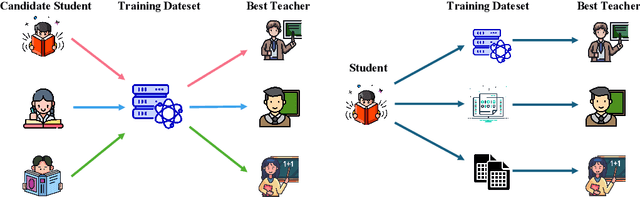
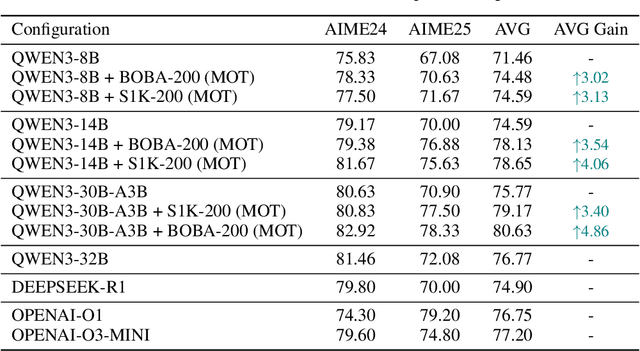
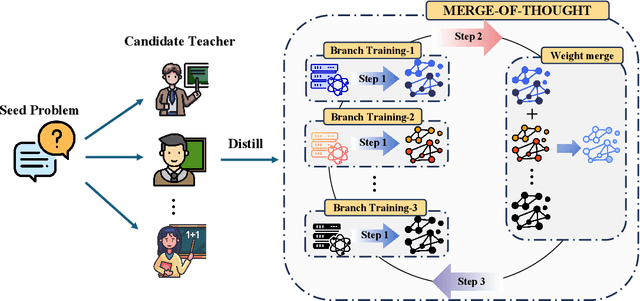
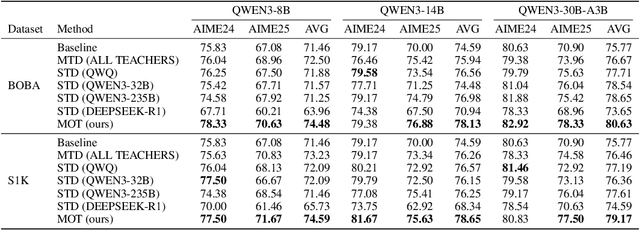
Efficient reasoning distillation for long chain-of-thought (CoT) models is increasingly constrained by the assumption of a single oracle teacher, despite practical availability of multiple candidate teachers and growing CoT corpora. We revisit teacher selection and observe that different students have different "best teachers," and even for the same student the best teacher can vary across datasets. Therefore, to unify multiple teachers' reasoning abilities into student with overcoming conflicts among various teachers' supervision, we propose Merge-of-Thought Distillation (MoT), a lightweight framework that alternates between teacher-specific supervised fine-tuning branches and weight-space merging of the resulting student variants. On competition math benchmarks, using only about 200 high-quality CoT samples, applying MoT to a Qwen3-14B student surpasses strong models including DEEPSEEK-R1, QWEN3-30B-A3B, QWEN3-32B, and OPENAI-O1, demonstrating substantial gains. Besides, MoT consistently outperforms the best single-teacher distillation and the naive multi-teacher union, raises the performance ceiling while mitigating overfitting, and shows robustness to distribution-shifted and peer-level teachers. Moreover, MoT reduces catastrophic forgetting, improves general reasoning beyond mathematics and even cultivates a better teacher, indicating that consensus-filtered reasoning features transfer broadly. These results position MoT as a simple, scalable route to efficiently distilling long CoT capabilities from diverse teachers into compact students.