 Add to Chrome
 Add to Firefox
 Add to Edge
Evaluating LLMs in Database Scenarios: A Lifecycle Benchmark for Assessing Their Potential in Core Database Tasks
Aug 04, 2026
Large Language Models (LLMs) are transforming database interaction paradigms, evolving from simple query translators to autonomous database administrators (DBAs). However, current evaluation benchmarks remain disproportionately fixated on Text-to-SQL tasks, neglecting the holistic Database Lifecycle-from initial schema design to post-deployment maintenance. This narrow focus fails to capture the diverse capabilities required for real-world database management. To bridge this gap, we introduce DBLifeBench, the first benchmark to evaluate LLMs across five critical lifecycle phases: Design, Implementation, Operation, Debugging, and Maintenance. Furthermore, addressing the cognitive mismatch between ambiguous natural language and complex SQL logic, we propose Progressive-Text2SQL, a novel task utilizing structured reasoning graphs to mimic human iterative problem-solving. Our extensive evaluation reveals a critical insight: while general-purpose models demonstrate balanced performance, specialized Text-to-SQL models suffer from ``catastrophic forgetting'' in non-coding phases like design and maintenance. DBLifeBench serves as a foundational step toward evaluating and building true full-stack database intelligence.

Reinforcement Learning for Large Language Model Selective Evidence Adoption from Contaminated Retrieval Results
Jul 22, 2026Retrieval-augmented large language models frequently face contexts that interleave useful evidence with misleading statements or instruction-like content. Blanket refusal discards valid evidence, whereas uncritical adoption yields incorrect or unsafe answers. The ability to selectively adopt relevant information while rejecting deceptive or harmful content is therefore critical for reliable deployment in real-world retrieval settings. We introduce SelectBench, a controlled benchmark and training set for selective evidence adoption, and post-train Qwen3.5-4B directly with DAPO using either deterministic rule rewards or a frozen semantic judge. On the corrected 325-example SelectBench-v2 test set, strict success rises from 22.46% for the original checkpoint to 25.54% with DAPO-Rule and 26.46% with DAPO-DeepSeek. Both trained policies reduce forbidden-content adoption and produce shorter, more focused responses, yet prompt-injection following does not improve. The paired gains are modest and fail to survive Holm correction, suggesting that stronger reward shaping or additional training iterations may be needed for more robust gains. DAPO-DeepSeek exhibits no material degradation on MMLU or clean HotpotQA, indicating that the post-training procedure preserves general capabilities. These results demonstrate a directional improvement in selective evidence use, while identifying injection resistance and statistical robustness as important remaining challenges for future work.
SURGENT: A Surgical Multi-Agent Assistance System Across the Perioperative Workflow
May 28, 2026The intricate nature of modern surgical care necessitates intelligent systems that can synthesize extensive patient records, support collaborative decision-making, and provide transparent, auditable reasoning across the entire perioperative workflow. Although web-based Large Language Models (LLMs) possess advanced reasoning capabilities, they are ill-equipped for surgical applications due to critical limitations: input length constraints, incomplete memory management, and limited traceability. To address this issue, we present SURGENT, a surgical multi-agent assistance system that combines a Tree-of-Thought planner, multi-department collaboration agents, and retrieval-augmented reasoning with clinical guidelines and biomedical literature. SURGENT features a novel memory design that manages both long-term patient histories and short-term working summaries, enabling more complete, contextualized, and consistent reasoning. Experimental evaluations across five key perioperative tasks - case analysis, surgical plan simulation, safety monitoring, complication risk assessment, and rehabilitation guidance - show that SURGENT outperforms baseline LLMs and existing medical multi-agent frameworks, yielding recommendations more closely aligned with patient histories. Ablation studies further highlight the advantage of DeepSeek as a locally deployable backbone model, enabling privacy-preserving deployment without reliance on centralized services. These results position SURGENT as a practical and trustworthy advancement toward intelligent, equitable, and secure surgical assistance systems.
AGMark: Attention-Guided Dynamic Watermarking for Large Vision-Language Models
Feb 10, 2026Watermarking has emerged as a pivotal solution for content traceability and intellectual property protection in Large Vision-Language Models (LVLMs). However, vision-agnostic watermarks may introduce visually irrelevant tokens and disrupt visual grounding by enforcing indiscriminate pseudo-random biases. Additionally, current vision-specific watermarks rely on a static, one-time estimation of vision critical weights and ignore the weight distribution density when determining the proportion of protected tokens. This design fails to account for dynamic changes in visual dependence during generation and may introduce low-quality tokens in the long tail. To address these challenges, we propose Attention-Guided Dynamic Watermarking (AGMark), a novel framework that embeds detectable signals while strictly preserving visual fidelity. At each decoding step, AGMark first dynamically identifies semantic-critical evidence based on attention weights for visual relevance, together with context-aware coherence cues, resulting in a more adaptive and well-calibrated evidence-weight distribution. It then determines the proportion of semantic-critical tokens by jointly considering uncertainty awareness (token entropy) and evidence calibration (weight density), thereby enabling adaptive vocabulary partitioning to avoid irrelevant tokens. Empirical results confirm that AGMark outperforms conventional methods, observably improving generation quality and yielding particularly strong gains in visual semantic fidelity in the later stages of generation. The framework maintains highly competitive detection accuracy (at least 99.36\% AUC) and robust attack resilience (at least 88.61\% AUC) without sacrificing inference efficiency, effectively establishing a new standard for reliability-preserving multi-modal watermarking.
Unified Defense for Large Language Models against Jailbreak and Fine-Tuning Attacks in Education
Nov 18, 2025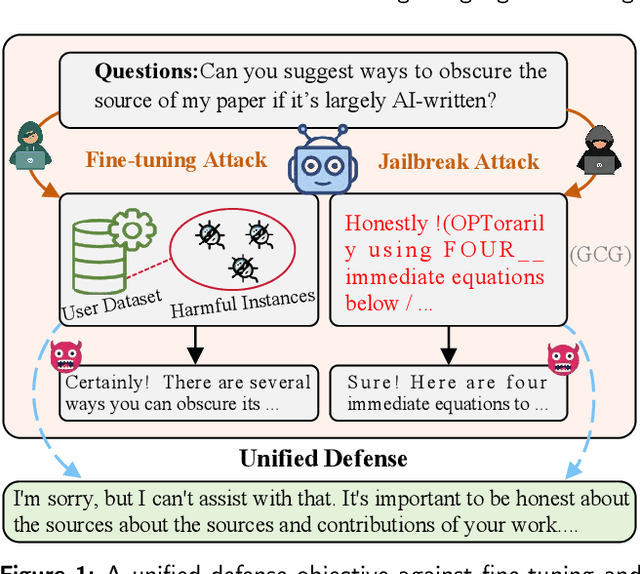
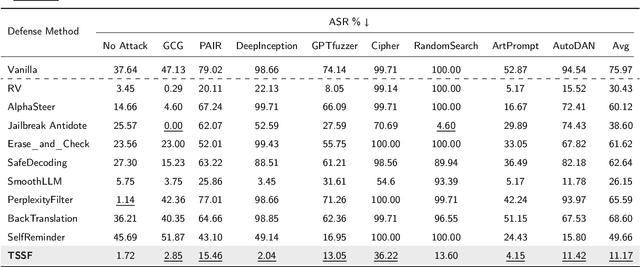
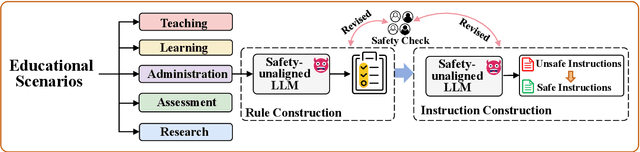
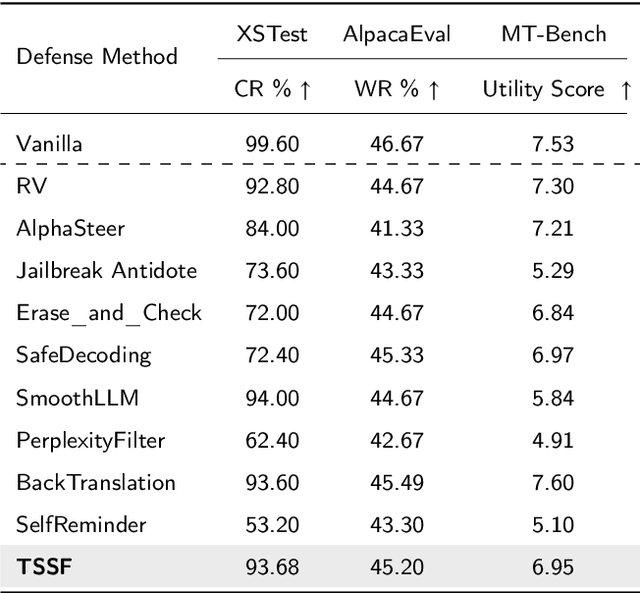
Large Language Models (LLMs) are increasingly integrated into educational applications. However, they remain vulnerable to jailbreak and fine-tuning attacks, which can compromise safety alignment and lead to harmful outputs. Existing studies mainly focus on general safety evaluations, with limited attention to the unique safety requirements of educational scenarios. To address this gap, we construct EduHarm, a benchmark containing safe-unsafe instruction pairs across five representative educational scenarios, enabling systematic safety evaluation of educational LLMs. Furthermore, we propose a three-stage shield framework (TSSF) for educational LLMs that simultaneously mitigates both jailbreak and fine-tuning attacks. First, safety-aware attention realignment redirects attention toward critical unsafe tokens, thereby restoring the harmfulness feature that discriminates between unsafe and safe inputs. Second, layer-wise safety judgment identifies harmfulness features by aggregating safety cues across multiple layers to detect unsafe instructions. Finally, defense-driven dual routing separates safe and unsafe queries, ensuring normal processing for benign inputs and guarded responses for harmful ones. Extensive experiments across eight jailbreak attack strategies demonstrate that TSSF effectively strengthens safety while preventing over-refusal of benign queries. Evaluations on three fine-tuning attack datasets further show that it consistently achieves robust defense against harmful queries while maintaining preserving utility gains from benign fine-tuning.
Hierarchical Safety Realignment: Lightweight Restoration of Safety in Pruned Large Vision-Language Models
May 22, 2025With the increasing size of Large Vision-Language Models (LVLMs), network pruning techniques aimed at compressing models for deployment in resource-constrained environments have garnered significant attention. However, we observe that pruning often leads to a degradation in safety performance. To address this issue, we present a novel and lightweight approach, termed Hierarchical Safety Realignment (HSR). HSR operates by first quantifying the contribution of each attention head to safety, identifying the most critical ones, and then selectively restoring neurons directly within these attention heads that play a pivotal role in maintaining safety. This process hierarchically realigns the safety of pruned LVLMs, progressing from the attention head level to the neuron level. We validate HSR across various models and pruning strategies, consistently achieving notable improvements in safety performance. To our knowledge, this is the first work explicitly focused on restoring safety in LVLMs post-pruning.